

Fentaw Teshome Asnakew and Aklog Birara Tamirate
Abstract
From the ethnic elite coalition takeover of the Ethiopian state in 1991; and especially since Prime Minister Abiy Ahmed Ali assumed power in 2018, the Amhara people have been targeted for multipronged dispossession, displacement, marginalization, unparalleled subjugation, dehumanization and total elimination this time by the state itself. The collateral damage to all Ethiopians is substantial with far reaching consequences.
These systematic, violent, cruel, savage and recurring state and government led assaults on Amhara since 2020 meet the UN definition of genocide.
We would like to draw your attention to the ten stages of genocide identified by Genocide Watch and used globally in measuring it. The Amhara case meets all indicators. It is total war with no end in sight. Amhara faces the prospect of extinction.
. https://www.genocidewatch.com/tenstages
Assaults on innocent Amhara civilians as well as destructions of economic and social infrastructure have increased dramatically following the Emergency Declaration by the Abiy regime in August 2023. These state-led killings, deliberate rapes, wholesale arrests, large scale displacements, and destructions compound recurrent state and non-state assaults in Addis Ababa, Wollega, Gurafarda, Bale, May Kadra, and Benishangul-Gumuz. The centre of the assault is today the Amhara region, where most Amhara live and work.
The Amhara “problem” is Ethiopia’s core governance challenge. Abiy Ahmed and his diehard ethnonationalist team deny the policies and programs they currently pursue Favor one tribe over the rest. This deepens and broadens human insecurity and poverty.
The Economist provides a series of insightful and balanced commentaries concerning the trouble Ethiopia faces under Abiy Ahmed. In its latest on May 25, 2026, its analysis under the title “Abiy Ahmed dreams of remaking Ethiopia in his image” is factual and compelling. It debunks the Abiy rhetoric Ethiopia is enjoying unprecedented growth and development.
“Manufacturing, which made strides under Mr Abiy’s predecessors, is in the doldrums; its share of GDP has fallen by a third since he took office. It does not help that Mr Abiy frequently touts statistics that leave experts scratching their heads. “I don’t even look at them anymore—they’re just so made up,” says a weary Western aid official. The government recently told donors it no longer needs their help in responding to humanitarian crises, but official figures believe that claim. The World Bank reckons the share of the population living on $3 a day or less hit 43% last year, up from 33% a decade ago. The UN’s World Food Programme says some 7m people are in urgent need of food aid. Hundreds of thousands of young Ethiopians, seeing little prospect for the future, leave each year”
The political side is bleaker. It is this side that will inevitably undo Abiy and his party.
” Yet the biggest threat to Mr Abiy’s economic vision is his political one. The prime minister says he is uniting Ethiopians. In practice, that has meant centralising power. Large parts of the state apparatus and state-run economy are under his thumb. This includes, for instance, the sovereign wealth fund established in 2021, and, more recently, a security “task force” charged with overseeing the upcoming election. Subsidies from the federal government to Ethiopia’s states were a collective 60% of the national budget in 2018. By 2026 they had shrunk to just 20%.
Mr Abiy has also been accused of favouring the Oromo, his own ethnic group and the country’s largest. The heads of the army, air force and federal police are all Oromo. So is the mayor of Addis Ababa. Economic power seems to be shifting their way. One prominent Oromo opposition figure concedes that the government has been focused on uplifting Oromos more than other groups.”
Abiy Ahmed’s public policy of recreating “Ethiopia in his image” is premised on a zeros-sum game, I win and you lose. The losers in the process are more than 70 percent of Ethiopians, especially the 43 percent unable to eat a single meal a day.
The authors subscribe to the conclusion by the Economist.” Increasingly, Ethiopians of all stripes—not just the Tigrayans who waged war against the federal government between 2020 and 2022—resent Mr Abiy for amassing too much power. In Amhara, the second biggest region, an insurgency launched against the federal government in 2023 is escalating.
Before Mr Abiy took power Ethiopia was an autocratic but largely stable country. Today large swathes of it are beyond the government’s control and off limits to investors, both local and foreign; one reason for the disappointing FDI figure.
Earlier analysis by the Economist “Abiy Ahmed is throttling free expression in Ethiopia” and “The prime minister’s re-election is certain, Ethiopia’s future less so” foretell the environment under which Abiy Ahmed Ali plans to prolong his rule for years to come.
This leads us to our research findings and conclusions.
Research findings and feedback from a cross section of people within and outside Ethiopia establish credible evidence that Amhara face an existential threat. The only way out from this threat is for all Amhara and those who share the danger to mobilize, organize and overhaul the ethnic federal system; and replace it with a citizenship-based Constitution and federal system.
Sadly, Amhara “elite” is the most fragmented of them all. There is no single advocacy team. Theres is no credible media outlet. Theres is no umbrella organization to mobilize financial and material resources in support of the struggle for justice. There are not many Amhara who participate in protests except well organized and motivated Amhara in the UK and Australia.
The plus side is that young Amhara within the country is more aware of the danger and are fighting back.
The Amhara Fano freedom movement began as a peaceful civic resistance calling for justice, the rule of law, equitable treatment, human protection and democracy. Continued government repression, persecutions, killings, arrests of thousands of Amhara and total closure of civil, political and spiritual space compelled Amhara Fano to revert to armed struggle. The struggle is one of sheer survival. For this reason, this is a democratic movement that will serve the interests of all Ethiopians.
Objective:
This study seeks to analyse the underlying causes and socio-economic consequences of the ongoing state led war against Amhara; to document the scale and nature of human rights violations; and to advocate for international recognition and intervention to halt atrocities against the Amhara population.
An additional objective is to urge the fragmented Amhara political, social and cultural elite to mobilize, organize, coalesce and operate in support of the struggle for justice.
Participants and Setting:
This research is based on surveys in selected rural districts of the Amhara Region (Merawi, Kobo, Dabat, and Gaynt) and the Bale Zone of Oromia Region. Participants include affected community members, local leaders, youth, women’s groups, teachers, and religious figures.
Methodology:
A qualitative research design is employed, utilizing eight focus group discussions (FGDs), twenty key informant interviews (KIIs), field observations over fifteen days, and discourse and case study analyses. Data is thematically analysed using triangulation to ensure validity and reliability of the findings.
Results:
Findings indicate that approximately 90 percent of frontline combatants originate from impoverished rural households, underscoring the war’s close link to structural poverty. The Amhara region is among the poorest in Ethiopia,
The conflict has resulted in the deaths of thousands of civilians, including women, children, teachers, priests, and healthcare professionals. A total of 2,666 women killed or subjected to sexual violence, 194 female students and children abducted or murdered. Infrastructure destruction and disruption of agricultural activities have led to severe livelihood losses, with famine conditions prevailing due to the government’s denial of access to humanitarian aid.
Statistical analysis based on qualitative frequency counts reveals that 93 percent of respondents cite famine and loss of income as their most critical challenges, while 88 percent identify human rights abuses and displacement as the most immediate threats.
These famine-like conditions and degradation of human rights are, by all accounts, planned, deliberate, intentional and state led.
Conclusions:
The war and famine in the Amhara region impact marginalized rural populations, particularly women and children disproportionately exacerbating poverty and undermining progress toward the UN mandated Sustainable Development Goals (SDGs).
This is deliberate intended to inflict pain and suffering and diminish Amhara potential.
In its latest assessment of education in Ethiopia dated February24, 2026, the World Bank reports “Good quality learning environments are essential to attract and keep children in school, as well as to deliver proper learning outcomes. In terms of infrastructure, only a third of primary and middle schools have a functional water supply and access to a source of electricity, with significant variations between regions. It is estimated that recent and ongoing conflicts notably in the Amhara region have destroyed or damaged 6,000 schools (i.e. 15 percent of all schools). As per the national education policy, pre-primary and primary classrooms are to be housed within the same premises. With the demand for increased enrolment in pre-primary education, the existing school infrastructure and capacity are stretched to provide adequate space for accommodating pre-primary classes. There is a demand for expanding the number of additional pre-primary classrooms and water, sanitation and hygiene facilities, and upgrading some of the existing ones, mostly in the regions with poor infrastructure and a high pre-primary age population, resulting in enrolment rates below the national average.”
Amhara youth suffer most from this deficiency in Ethiopian social public policy. The Centre for International Policy Studies concludes in 2026 “The Targeting of schools and educators in the Amhara region shows a pattern of targeted human atrocity” typically associated with Genocide. Four thousand six hundred schools were damaged or destroyed by Abiy Ahme’s Army. This affects four million five hundred thousand Amhara youth. This is more than four times the population of next-door Djibouti.
In his critique of the TPLF initiated the Constitution on the subject on May 15, 2026. Dr. Gregory Stanton, founder and president of Genocide Watch informs the international community that the “Abiy government has committed genocides against Amhara, Tigrayans and others.” He warns “If Prime Minister Abiy Ahmed’s government writes a new constitution, Abiy’s reputation as a violent tyrant among Amhara and Tigrayan will mean the new constitution be regarded as illegitimate as the 1995 Constitution” and ethnic genocide will persist and may get even worse.
We urge change of the ethnicity and language-based constitution. This change must, however, involve all Ethiopian stakeholders. It must be consultative, participatory and independent of interference from the current OPDO dominated Prosperity Party machine. It must involve independent international observers.
We therefore recommend immediate international intervention as imperative. It will at least halt the violence and genocide. It will ensure humanitarian access and protect civilian lives.
Such action will respond to the voices of affected communities. These affected voices are crying for the restoration of peace and stability. They wish to rebuild their lives and livelihoods without fear of their own government,
It is only then that the prospect of sustainable rural development in the Amhara region will have a better prospect for success.
We urge you to read the entire paper below.
Keywords: Amhara, war, rural development, youth, famine, humanitarian crisis, human rights
- Introduction
War impacts development directly and indirectly, potentially leaving lasting damage to human and social development and outweighing direct benefits. An alternative approach to analyzing these issues could focus on different aspects of the conflict and its relationship with development including (a) the drivers of conflict; (b) conflict process; and/or (c) reconstruction, as vitally important (World Bank, 2018). Apart from security issues, war-torn societies and countries face immense challenges in rebuilding damaged critical infrastructure(Mitoulis et al., 2023). War affects Ukraine’s production and thus global food security (Deininger et al., 2023).
This case study is relevant to Ethiopia. The war causes severe disruptions to the national food system, making the issue of resilience and persistence of different agricultural models critical to domestic food security (Mamonova, 2023).
War and its relationship with rural development is exceedingly important (World Bank, 2018). War increases the amount of financial and related resources required for reconstruction (Jonathan D. Moyer David Bohl Taylor Hanna 2019).
The war in the North in Ethiopia (2021/2022) followed by the continuing war against Amhara since 2023 caused immense destruction that will take decades and tens of billions of dollars of investment capital.
Research findings in multiple clustered regions show that conflict and war cause forty five to forty seven percent of agricultural abandonment each related to war (Buchner et al., 2022). These war-torn countries and regions suffered hugely from cropland loss and inevitable food shortages. These shortages cause starvation, death and human light.
Geographical characteristics, conflicts and wars make quick monitoring of the spatiotemporal attributes and adverse impacts of agricultural cropland status extremely hard to conduct fieldwork. The review highlights a paucity of evidence for effective treatment options for children and adolescents affected by war from LMICs in the Middle East(Lim et al., 2022). Nevertheless, the results reveal the serious negative influence of war on agricultural management and development (Ma et al., 2022)
Reasons for the Research:
The war that took place in the Amhara Regional State of Ethiopia from 2020 to 2025 remains critically underreported and understudied. Its scope and complexity, particularly the severe loss of life and destruction in rural areas, is not documented or communicated to the international community. The ongoing state-sponsored ethnic cleansing, atrocities and genocidal actions committed against the Amhara people demand urgent scholarly attention by Ethiopian and international experts.
This research aims to shed light on these realities, calling for humanitarian intervention and urging world leaders to speak out against the ongoing genocide. Countless individuals have been displaced, killed, raped, and deprived of their livelihoods, underscoring the urgent need for comprehensive investigation and global awareness. The UN system must respond before thousands and thousands more Amhara perish.
We draw your attention to the below urgent call to the international community.
Our research findings and interviews with a cross section of people within and outside Ethiopia confirm drone strikes and killings, mass arrests, rapes, displacements and weaponization of starvation tools to reduce the size of the Amhara population. This is deliberate and systemic. It will not stop unless the Ethiopian people rise in unison and unless the international community pays immediate attention.
Ethiopia’s ethnic federal system has evolved into one where political power, resource allocation including budget and investment is based not on merit and fairness but ethnic affiliation. Under Abiy Ahmed and his OPDO elite dominated Prosperity Party, state institutions including federal defense and security forces are ethnic elite dominated. The result is widespread state-led violence, slaughter of civilians including children and women with impunity.
This is a well-designed and executed program to disenfranchise and marginalize Amhara for good.
Addressing the basic needs of the poor
The immediate needs of most Ethiopians like food, healthcare, education, shelter, safe drinking water, transportation, information and communication technologies are beyond reach.; and beyond the willingness and capacity of the current government of Ethiopia.
The ongoing war in the Middle East has exacerbated the problem. Skyrocketing oil prices and shortage of fertilizer supplies compound the problem. Ethiopia’s domestic governance problem makes it impossible for most to survive let alone thrive. This is especially true for Amhara. Because it is targeted by the government in power for elimination.
The devastating impacts of the war have created numerous complex challenges that remain insufficiently explored and or addressed. This is especially the case in terms of economic and socio-psychological damage that is ignored, at minimum not adequately reported to or acknowledged by the international community. The international community appears to be either influenced by government propaganda or is indifferent to the conflict. UN officials visit Addis Ababa that showcases glitz amidst incredible poverty. Ethiopia’s multidimensional poverty affects more than seventy percent of the population. Abject poverty has climbed to forty three percent under Abiy Ahmed. The most affected population is Amhara.
Ethiopia faces a food crisis. According to the Bureau of Agriculture (Agriculture, 2022), more than 40 million people in the Amhara region have been directly affected by the war. They face starvation.
This study aims to examine the underlying causes and socio-economic consequences of the ongoing conflict, document continuing human rights violations, and calls for global attention concerning atrocities committed against the Amhara people. The research is conducted in selected rural districts of the Amhara region (Merawi, Kobo, Dabat, and Gaynt) as well as in the Bale Zone of the Oromia region.
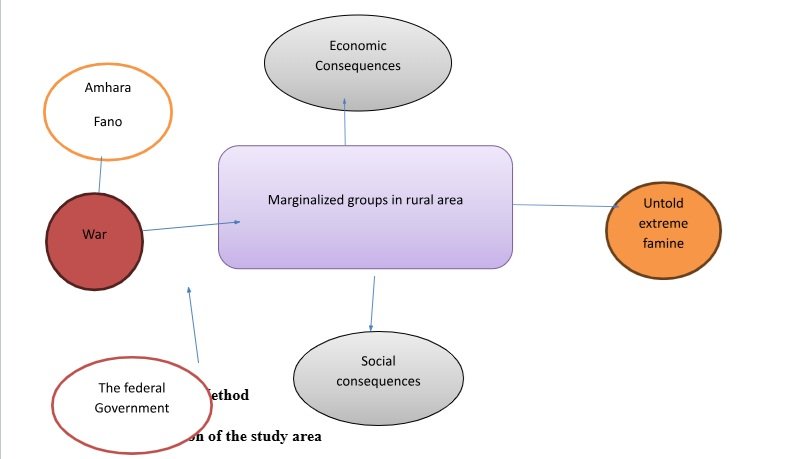
Figer 1. Conceptual framework of the study
2. Research Method
2.1. Description of the study area
This study is conducted in the Amhara Regional State, located in Northern Ethiopia. The Amhara region is one of the largest regions in the country. Historically, the Amhara people have played a vital role in the development of Ethiopian civilization and the formation of the Ethiopian state since ancient times. Sadly, Amhara is accused of oppression, subjugation and land annexation rather than liberation and modernization of Ethiopia.
We would like to underscore historical facts. The well-known social scientist, human rights activist and constitutional law expert Gregoy Stanton of Human Rights Watch confirms the following:
- “Ethiopia is the birthplace of humanity.
- It is in Ethiopia the oldest ancestor of homo sapiens dating back 4.2 million years ago was discovered.
- From 100 AD, the Kingdom of Aksum established a unified civilization that lasted 900 years. This places Ethiopia among the top ancient civilizations like China, Persia and the rest.
- After Armenia (301 AD), Ethiopia was the world’s second Christian Kingdom (324 AD).
- The Ethiopian Orthodox Tewahedo Church (EOTC) became the official state religion
The EOTC is spiritual, cultural. Linguistic and learning backbone of the Amhara population. Degrading and attacking it amounts to degrading Amhara history and identity.
In this connection, we wish to point out despite this huge contribution to the civilization of Ethiopia; the Aby regime is determined to marginalize and ultimately eliminate the Ethiopian Orthodox Tewahedo Church (EOTC).
- Islam was introduced to Ethiopia during first Hijira in 615 AD.
- The Solomonic Dynasty from which kings and emperors came was ruled by Amhara since the collapse of the Aksumite kingdom, in 960 AD.
- Emperor Menelik II reestablished the Ethiopian Empire and expanded it from 1866 to 1889.
- Ethiopia has been divided among or between eighty ethnic groups. The 1995 Constitution cemented this division, making ethnic conflict, war, secession inevitable and equitable and sustainable development untenable.
- In 2023, Abiy sent troops to the Amhara region to dissolve Amhara Fano forces. The death toll of this state-led war is in the tens of thousands, with at least 100, 000 displaced.”
The war continues.
Geographically, the Amhara region is bordered by Sudan and Eritrea to the northwest, the Tigray Regional State to the north, the Afar region to the east and southeast, and the Oromia and Benishangul-Gumuz regions to the west and southwest. The Amhara region is among the richest in Ethiopia in terms of natural, cultural and human capital resources. At the same time, it is among the most neglected and poorest. The Abiy regime is determined to impoverish the region further.
2.2. Research Design
The study employed a qualitative research design complemented by a cross-case analysis and a review of relevant literature. A mixed-methods approach is utilized, with qualitative data serving as the primary source and supported by secondary data from review articles and reports on the impacts of war. A comprehensive desk (theoretical) review was conducted to provide contextual understanding and strengthen the qualitative findings.
2.3. Methods of Data Collection
Open-ended questionnaires prepared and pre-tested to ensure reliability and clarity. Approximately 20 key informant interviews were conducted with elderly individuals, women, and youth. These groups were purposefully selected due to their credibility within the community, per tradition, elderly people and women are often regarded as honest and reliable sources of information. This helps reduce bias. Youth participants are included because they are among the most affected groups—many directly harmed by the war, either through forced recruitment, violence, or human rights abuses, including killings and sexual violence.
In addition, we gathered qualitative data through eight focus group discussions (FGDs), engaging a total of 80 participants representing different sections of society.
2.4. Data Sources
The study utilizes both primary and secondary data sources. Secondary data is collected from published reports and journals, including international sources such as USAID, UNDP, the World Bank, Insecurity Insight, Amnesty International, Human Rights Watch, and OCHA. Unpublished materials, including media reports, local documents, and field notes also reviewed.
Primary data is obtained from key informant interviews and focus group discussions conducted in selected districts of the Amhara region, namely Merawi, Kobo, Dabat, and Gaynt.
The lead researcher conducted direct field observations in conflict-affected areas, including Chena, Gashena, Merawi, Gaynt, Guna Begemdir, Dawint, and the Gojjam front, over a period of 100 days. These firsthand experiences provide invaluable insights into the realities of the war. The observations reveal severe human suffering—young women and freedom fighters killed, wounded; people displaced, women and girls subjected to rape, children forced to beg, and both livestock and the environment devastated. The extent of the destruction is beyond human imagination—heartbreaking, inhumane, and deeply traumatizing.
Imagine it is the government of Ethiopia led by Abiy Ahmed Ali that commits these war crimes, crimes against humanity and crimes of genocide in the twenty first century.
Against this, we are appalled by the lack of international attention and scrutiny.
3. Results of the study
Consequences of War on Livelihoods and Human Well-being
Millions of children stopped attending school. Food prices soared. Poor families struggle to feed their children. The displaced live in overcrowded and unsanitary conditions, making life unbearable. The consequences of the ongoing war are severe and widespread, affecting agricultural production, education, migration, infrastructure, investment, morbidity, mortality, productivity, and trade. The future for the affected community is bleak.
In the Sagibigie, Abergele, Wollo, and Janamora areas of the Amhara region, more than 12.1 million children suffer from hunger and malnutrition (BOA Report, 2024). According to group discussants, “many people are dying either directly from gunfire or silently from hidden famine. Particularly children.” People are reportedly dying for lack of a single piece of bread.
A Case Study: Gender-Based Violence and Psychological Trauma
The first tragic case reported in the Gaynt area involves a child whose parents were killed by government-aligned militants. The child remained with the bodies for an entire day, trying to feed and sleep on the chest of the deceased mother (Field Visit, 2023).
The second case from Kobo town in North Wollo involves a woman, referred here as K, who was shot four times after resisting an attempted rape (Key Informant, 2024). This rape involves a member of the invading Army deployed by Abiy Ahmed.
The third case refers to a 21-year-old university student, identified as Z, and a mother of an eight-month-old baby girl from Boza. She reported her predicament to Amnesty International:
“Two militants came to my home and demanded food. I told them I had none. They raped me. Later, they brought potatoes and ordered me to cook for them. Then they said, ‘What do you prefer that we put your baby in boiling water or that we rape you?’ I was terrified they would hurt my baby. I still have nightmares about it. Afterward, they destroyed my notebooks and study materials and threatened to shoot me and my mother-in-law.”
(Amnesty International, 2021)
The fourth case refers to a female student from Chena informed Amnesty International:
“I was at home with my mother and grandmother when two-armed men arrived around 11 a.m. One wore military clothes, the other civilian. They spoke a mix of Tigrinya and Amharic, saying: ‘Our families were raped, now it’s our turn to rape you.’ One of them raped me in the courtyard while the other raped my mother inside. My mother is now very sick, depressed, and desperate.”
(Field Observation, 2022.
This is a revengeful rape by members of TPLF armed forces.
The fifth case study is an aggregate.
Large scale massacre and displacement of Amhara Christians is a standard phenomenon especially under Abiy Ahmed. “In the Bale area of the Oromia region, a brutal attack claimed the lives of 300 Christian Amhara civilians. Among the victims was a mother who died while shielding her five-year-old son. The child survived, though his leg was severely injured in the explosion. Found hours later clinging to his mother’s body and crying for help, he was eventually taken to a hospital. Unfortunately, due to the severity of his injuries, part of his leg became necrotic and was amputated in October 2025”
“According to key informant interviews, the primary victims of the war are rural residents — particularly women and children, who continue to bear the greatest humanitarian, physical, and psychological burdens of the conflict.”
The sixth refers to the totality. If we assess killings, maiming, mass arrests, displacements and rape separately we do not grasp the full picture of the plight of the Amhara. The full picture is massive and multifaceted. Equally important is, for example, economic life like food. You die if you do not eat food.
“Crop production has declined by more than 40 percent across all major crops due to the lack of agricultural inputs. The government appears to be diverting its resources in support of the ongoing war while neglecting the agricultural sector.
According to group discussants, starvation and famine is used as a weapon to weaken the Amhara population. The main reason is this. Rural communities are perceived to be the economic and logistical backbone of the Fano resistance movement. Further, humanitarian activities have been severely disrupted by the ongoing conflict, and a considerable number of aid workers have reportedly been killed.”
4.. Theoretical Review
4 (1) The trend of War in the World
The UK is a key factor in the global defense industry in terms of arms sales to the Middle East and the Middle East and North Africa. These regions are beset with decades long regional conflicts, wars and foreign interventions such as Iraq, Yemen, and Libya (Can, 2023) and now Iran and the GCC.
Conflict remains the key driver of food insecurity. Close to 100 million people experienced acute hunger across 23 countries affected by conflict and insecurity in 2020. Protracted conflict is the main cause of six of the ten worst food crises. In 2020, 56-armed conflicts were active around the world, the highest number recorded since the end of the Second World War. Fatalities caused by organized violence increased dramatically for the first time in six years (WFP, 2020).
The world today is more conflict prone than ever before. The UN system is no longer functional.
Political conflicts continue harming civilian populations hard, particularly the most vulnerable like children, the elderly and people with disabilities. Women and girls face increased risk of sexual abuse from continued conflict. Government attacks against humanitarian workers and assets continue: 117 humanitarian workers killed in 2020, 108 working in their own country. More than 1 percent of the world’s population is now displaced. 42 percent are children (OCHA, 2022).
The ongoing war in Sudan illustrates the lasting legacy of colonialism constructed by imperial powers to divide and rule. Following his capture and consolidation of the Ethiopian state and government in 2018, the Abiy regime follows and implements the same ethnic elite supremacy doctrine and policy as the TPLF. In 2019, Abiy Ahmed dismantled EPRDF and replaced it with the OPDO-dominated Prosperity Party. This party is less representative than the party it replaced. It has total control of all institutions in the country. Ethiopia today is a one party state. Abiy Ahmed wants to continue with this same state through an election in which his party plans to compete against itself.
We believe the outcome is predictable: Abiy Ahmed’s party wins and Ethiopia’s troubles intensify. Ethiopia’s leaders refuse to learn from their own mistakes and from the mistakes of previous leaders and other nations.
A Sudan-like scenario is possible.
4.2. Sudan war
The British colonial rulers used existing ethnic, regional and racial differences to divide the population, a practice that survives to this day. Militia activism deepened divisions among rebel supporters and caused two civil wars between the government in Khartoum and southern regions. This has so far claimed 1.5 million lives. Additionally, the ongoing conflict in the western region of Darfur claimed more than 200,000 people and the displacement of two million people (Kohnert, 2023)
4.3. Niger
Sitting in the heart of West Africa – a region long plagued by political instability and constant threat of terrorism is the Republic of the Niger. This country finds itself grappling with another military coup. The key players in this unfolding drama include domestic military forces and the invisible hands of international powers(Zambakari, 2023).
In West Africa Violent conflict, vestiges of colonial rule, vested external interests, and a lack of strong national institutions are among the major obstacles(Olaniyan, 2023).
Why is the Niger case relevant for Ethiopia?
The Niger country case informs us that rain fed agriculture is more sensitive to civil conflict and droughts. These vulnerabilities affect food production. Less production causes increases in the cost of food. Less food supply causes food insecurity. No food causes deaths.
Water scarcity is equally concerning. Herders who need grazing land to avoid livestock losses compete for scarce water. This leads to conflict. Countries with a low human development index (HDI) are particularly vulnerable to double exposure to natural disasters and armed conflict(Scheffran, Link, & Schilling, 2019).
Ethiopia’s Human Development Index is among the lowest. It ranks 180th out of 193 countries (2025).
So, the world community must ask why the Abiy regime perpetrates war against its own people? Doesn’t its policy keep Ethiopia poor?
Why does the international community accept glitz amid abject poverty and human suffering?
4.4. YEMEN WAR UNLAWFUL ATTACKS:
The Yemeni conflict is often described as the century’s worst man-made humanitarian disaster. It has caused an unprecedented crisis. It left millions of people suffering from famine, disease, and violence. The conflict that devolved into full scale civil war is exacerbated by the involvement of various international stakeholders, each with their own competing geopolitical interest (Bano, 2023). This conflict contributes hugely to the War on Terror and is destabilizing countries and stimulates migration(Kalush & Lambert, 2023).
Similarly, Ethiopia suffers from foreign interference with the United Arab Emirates playing a prominent role supplying destructive weapons like drones to the Abiy regime.
4.5. War between Russia and Ukraine 2022 to date
This war has global implications. It affects Africa too. Total exports of wheat from Ukraine declined by half compared to the pre-war period. Agricultural land and uncollected crops decreased by half. The entire agricultural economy is affected by hostilities. It is impossible to purchase feed and provide veterinary services to farm animals. As a result animals die(Rexhepi, Berisha, & Xhaferi, 2023) and carbon dioxide emissions hamper international healthcare efforts. The ongoing war threatens the global environment by releasing ammunition emissions into the environment leading to healthcare hazards. The research analyzed the worldwide environmental effects(Imran, Khan, Jambari, Musah, & Zaman, 2023).
Conditions in the Amhara, Afar, Somali, Tigray regions show similar strains. Drought-like conditions affect 28 million people across East Africa causing hunger.
While the Ukraine-Russia crisis receives international attention; there is a real danger that the international community is not responding adequately to the escalating hunger crisis in East Africa.
Ethiopia, Kenya, Somalia, South Sudan and beyond are experiencing full-scale catastrophe(OXFAM, 2022) that require urgent response. Humanitarian aid is at the lowest level this century. The EBOLA outbreak and potential spread may make the situation far worse.
Ukraine exports huge amounts of wheat to many nations across the globe including Africa. Decline in exports affects 49 million people in East Africa (Oxfam report, 2022). This aggravates other factors.
Africa is a huge continent with immense resources including farmland. In the long term, African farmers must be encouraged to produce enough food. This can only happen if there are peace and stability in all countries.
Hunger is a form of terrorism that causes psychological pain.
Stress, and post-traumatic stress symptoms that include female gender, self-rating health status, past psychiatric history, and avoidance coping (Chudzicka-Czupała et al., 2023) are threats. Those who face and experience conflict and wars are especially vulnerable.
4.6. History of war in Ethiopia
4.5.1 The internal War in Ethiopia (2020-2023)
For ethnic elites war is a way of life. Ethiopia suffers from recurring wars. After taking power in 1991 TPLF annexed Wolkait, Tegede, Telemt and Raya formally, ethnically cleansing the indigenous Amhara population, populating it with Tigrayans, imposing a new culture including language and incorporating this land mass into Tigray (Niggli, 1986).
TPLF’s strategic objective is to deny indigenous Amhara not only lands; but also, identity. The same is true for Abiy’s OPDOPP. More so.
TPLF and its successor, the OPDO PP, have, for all practical purposes, transformed all aspects of Amhara life and degraded it. They do this by parading misleading and manmade narratives, accusing and denigrating Amhara, accusing it as an oppressor and colonizer, expressing ethnic superiority bordering on racism, undermining, insulting and diminishing Amhara and destroying its institutions, icons, cultures, faith and language.
Both parties apply destructive tools like sterilization and castration, mass murder and incarceration with the sole intent of reducing Amhara into a minority. This is a major component of Amhara genocide. In the process, authorities and their agents slaughter children and the disabled, rape girls and women in front of their loved ones. The intent has an additional benefit; shame and cause psychological pain.
The level of cruelty against Amhara is beyond description. Authorities deny those they do not kill or wound or expel their sources of livelihood. For example, cattle and chickens are slaughtered, granaries and homes burned and economic and social infrastructure like schools, clinics and hospitals destroyed.
This too is part of Amhara marginalization. OPDOPP utilizes different tools like starvation, massive displacement, mass arrest, mass expulsion, rape and other methods to degrade, debase and decapitalize Amhara.
Eyewitnesses inform us that girls and women are often impregnated by Abiy Amed’s military invaders and occupiers. Those born are then forced to abandon their mother tongue and learn the language of the father; in the case of TPLF Tigrigna and in the case of OPDOPP Afan Oromo.
Abiy Ahmed’s strategic objective is to expand land annexation and establish Oromumma in place of Ethiopia.
This expansionism and colonia-type of aggression is not limited to the Amhara region. The evidence is that Abiy Ahmed’s armed forces have carried out military aggression against all regions except Tigray. The most recent case is the Amhara like war in the Sidama region. This too is part of Oromo expansionism.
We quote Dr. Stanton again. “Abiy Ahmed is ethnically Oromo” and operates as a zealot Oromo ethno-nationalist. The Economist confirms this thesis. In the event Abiy Ahmed chooses to change the Constitution, he is most likely to affirm ethnic hegemony of the Oromo ethnic elite. His mental model thus far is antithetical to representative democracy that requires political pluralism and diversity.
Today, Abiy Ahmed’s OPDO PP is trying to campaign throughout the Amhara and Oromia regions uncontested. Two docile and self-serving parties affiliated with the governing party are granted a tiny proportion of seats and campaign as if things are normal. More than 80 percent of the Amhara region is liberated from the Aboy regime. Oromia is equally conflict ridden and unsafe.
It is most likely that the Abiy regime will hold elections in locations where it has military dominance. In the light of this, it is not hard to imagine if it declares a win with a few votes.
The international community must reject such an election carried out under duress and amid a civil war in most of Ethiopia.
5. Discussions of the findings
War and its consequences on rural development are huge, with multigenerational impact.
The estimated damage of agricultural yield in the Amhara region alone is more than 14 million Quintals. This shortfall deprives the Amhara regional market food availability and accessibility in the Amhara region (Muhyie, Yayeh, Kidanie, Metekia, & Tilahun, 2025)
“According to discussants in the office of agriculture Amhara region more than 40 percent of yield reduction occurred for the last 5 years affecting major crops like teff and maize (on Average 2025 “.
The direct destruction caused by war and government restrictions concerning economic activities has a direct marked impact on the lives of the people of Ethiopia. Ethiopia’s GDP growth is estimated to have decreased by 2.31 percent to 6.06 percent (Insecurity Insight, 2021). This is huge.
Modeling work by the United Nations Economic Commission for Africa (UNECA) suggests that, in the best-case scenario, Ethiopia’s growth is reduced by 1.2 percent, in the mid-case scenario by 2.4 percent, and in the worst-case scenario by 4.5 percent (UNECA, 2021). The inflation rate in Ethiopia reached 42.9 percent in April (CSA 2022).
Ask who can afford to buy essentials?
War contracts Ethiopia’s economy big time. Ethiopia’s tragedy is that its leaders deny the depth and breadth of multidimensional poverty.
The data above shows Ethiopia’s economy has contracted or shrunk. Authorities including Aby Ahmed deny reality, arguing instead Ethiopia is undergoing a renaissance unprecedented in its long history. This is unbelievable.
Take the farming population. The supply of fertilizer has either decreased substantially or stopped in the Amhara region.
The lag in Ethiopia’s development index graphically shows huge gaps in meeting basic needs like drinking water, nutrition, literacy, access to public services) political freedom, and human security in the war ravaged Amhara region (Amhara regional state Bureau of economic development 2022).
Our study confirms conflict and food insecurity are closely related. Direct violent deaths are concentrated, affecting especially adult men and youths, who constitute the fighting forces. These deaths imply long-term impact on rural development. The reason is this. There will be a shortage of productive or working age social capital. Further, breakdown of the health system in the Amhara region means an increase in the mortality rate (Iqbal, 2010).
Our research shows that decrease in productive human capital affects productivity in the agricultural sector in rural areas.
The case of internally displaced persons (IDPs) is least understood by the international community as well as by Ethiopians elites. It is not just a number. It is human capital. We have a different take and cite the following set of facts.
- Displaced people lose access to their food entitlements.
- People in conflict zones are cut-off from market links and humanitarian aid.
- Displaced people lose their employment and income because of fighting.
- Informal taxation adds to economic decline. Those with guns tax.
- In the Amhara region only 40 percent of the crop planted is harvested.
- More than 12 million people in the Amhara region are forcibly removed from their livelihood and farmers in War affected areas of the country are unable to produce (FFS, 2022).
- The situation is worrying in other parts of the country.
- An estimated 16.8 million people face crisis levels of acute food insecurity in Ethiopia (Un 2021).
- Armed conflicts cause food insecurity and starvation directly.
This occurs through disruption and destruction of food systems, reduction of farming populations, destruction of infrastructure, reducing resilience, and increasing vulnerabilities, disruptions in accessing the market, increasing food price or making goods and services unavailable altogether (Weldegiargis et al., 2023).
It forces early migration of wildlife and livestock animals and causes the destruction of crops and infrastructure in the region (FAO 2022). This is consequential.
- A total of more than 17 million people are highly affected by food insecurity in the region.
- In the war against Amhara, the loss emanating from the agricultural sector alone entails trillions of Birrs in incomes and material resources. This loss affects sustainable development goals.
- The reason for this huge loss is constant drone and military strikes exceeding 370 to date.
- These bombings target wild animals, livestock, sheep, goats, chickens, donkeys, dogs, birds, plants, farms, homes, granaries, churches, monasteries and innocent civilians (KI, 2022) and triangulated by practical observation.
Gaph1: Incidence of participation of rural youth in war 2024

Amhara massacred in Ethiopia is either equivalued or exceeds genocide occurrences in the world.
Novel cognitive and non-cognitive indicators and using monthly and municipality-level variation in the timing and severity of massacres in Colombia from 1999 to 2007, I show that children exposed to terrorist attacks (Duque, 2017)
Conclusions
1/The war against Amhara is catastrophic: the loss of countless human lives is beyond comprehension; as is the social and economic infrastructure.
2/ The war has traumatized and despaired tens of millions forcing hundreds of thousands of civilians to flee abandoning the sources of their livelihoods.
3/ The social fabric of Ethiopian society in general and Amhara in particular is torn apart.
3/ The economy is ruined and the natural environment severely damaged.
4/Amhara rural communities—already among the poorest in the world, are devastated.
5/ Ethiopia’s GDP has declined under Abiy Ahmed.
6/ In the Amhara region alone, more than 30 million people are directly impacted by constant state led bombardment using tanks, mortars, drones and military aircraft.
7/ The prospect of famine looms.
8/ The most affected by war in Ethiopia are the poorest segments of society.
8/ The education and health sectors are in ruins.
This affects youth and their education and health services especially those who need medical care. This alone implies long term consequences. The four and half million Amhara children who lack education face a grim future.
9/ Seen in totality, recurrent war means destruction of human capital.
10/ Ethiopia’s rural economy (the bulk) is in a dire situation.
Farmers are unable to produce crops. Millions of women and children face immense hardship: lack of access to health services and relentless and heartless targeted persecution by government forces.
The indirect effects of the war— widespread rape, famine, and the depletion of human resources—compound human suffering by their own government. This is criminal and must be adjudicated in the long term.
11/ Rural areas endure far greater harm than urban centres. Rural dwellers have been uprooted from their livelihoods, and large-scale massacres have occurred. Abiy Ahmed’s defence forces have slaughtered children, women and religious leaders, bombarded and erased entire neighbourhoods.
Recommendations for action
Ethiopians, especially Amhara, outraged by Abiy Ahmed’s state led crisis must initiate a comprehensive and context-sensitive rural development model to rebuild the war-ravaged countryside where most people live and work.
Ethiopians in the Diaspora, especially Amhara must consider establishing a Fund for Rehabilitation, Reconstruction and Restoration (FRRR), identify priority areas like education, health, modern smallholder farming, small and medium size enterprises and fund them.
Ethiopians in the Diaspora, especially Amhara have an obligation to design, finance and help implement rural industrialization including better housing, safe drinking water, sanitation and indigenous manufacturing using local inputs and targeting the consumer needs of the people.
Ethiopians in the Diaspora, especially Amhara, have an obligation to help strengthen local institutional capacity by training, mentoring and empowering girls, women, youth, farmers and local entrepreneurs. This option is intended to foster resilience.
Ps. You can send comments and feedback to: Aklog Birara —abt.semegn@gmail.com
Or Fentaw Teshome —email fentawta@gmail.com
Reference and citations
Agriculture, A. r. B. o. (2022). Rehabilitation plan for war Affected Areas the
Region. Unpublished report.
Bano, M. (2023). YEMEN-A FRAGILE STATE AND OVERRIDING INTERNATIONAL STAKES. Middle East Technical University,
Buchner, J., Butsic, V., Yin, H., Kuemmerle, T., Baumann, M., Zazanashvili, N., . . . Radeloff, V. C. (2022). Localized versus wide-ranging effects of the post-Soviet wars in the Caucasus on agricultural abandonment. Global Environmental Change, 76, 102580.
Can, M. (2023). The UK’s Arms Sales to the Middle East: Current Trends and Lessons for the Future. In The Arms Race in the Middle East: Contemporary Security Dynamics (pp. 329-340): Springer.
Chudzicka-Czupała, A., Hapon, N., Chiang, S.-K., Żywiołek-Szeja, M., Karamushka, L., Lee, C. T., . . . Ho, R. (2023). Depression, anxiety and post-traumatic stress during the 2022 Russo-Ukrainian war, a comparison between populations in Poland, Ukraine, and Taiwan. Scientific Reports, 13(1), 3602.
Deininger, K., Ali, D. A., Kussul, N., Shelestov, A., Lemoine, G., & Yailimova, H. (2023). Quantifying war-induced crop losses in Ukraine in near real time to strengthen local and global food security. Food Policy, 115, 102418.
Duque, V. (2017). Early-life conditions and child development: Evidence from a violent conflict. SSM-population health, 3, 121-131.
Imran, M., Khan, S., Jambari, H., Musah, M. B., & Zaman, K. (2023). War psychology: The global carbon emissions impact of the Ukraine-Russia conflict. Frontiers in Environmental Science, 11, 1065301.
Iqbal, Z. (2010). War and the Health of Nations: Stanford University Press.
Kalush, R., & Lambert, L. A. (2023). Violence, Political Instabilities and Large-Scale Migrations in the MENA Region: Libyan, Syrian, and Yemeni Cases in Regional Perspective. In The Post-American Middle East: How the World Changed Where the War on Terror Failed (pp. 145-175): Springer.
Kohnert, D. (2023). On the impact of the 2023 Sudanese war on Africa and beyond. Available at SSRN 4473724.
Lim, I. C. Z., Tam, W. W., Chudzicka-Czupała, A., McIntyre, R. S., Teopiz, K. M., Ho, R. C., & Ho, C. S. (2022). Prevalence of depression, anxiety and post-traumatic stress in war-and conflict-afflicted areas: A meta-analysis. Frontiers in psychiatry, 13, 978703.
Ma, Y., Lyu, D., Sun, K., Li, S., Zhu, B., Zhao, R., . . . Song, K. (2022). Spatiotemporal Analysis and War Impact Assessment of Agricultural Land in Ukraine Using RS and GIS Technology. Land, 11(10), 1810.
Mamonova, N. (2023). Food sovereignty and solidarity initiatives in rural Ukraine during the war. The Journal of Peasant Studies, 50(1), 47-66.
Mitoulis, S.-A., Argyroudis, S., Panteli, M., Fuggini, C., Valkaniotis, S., Hynes, W., & Linkov, I. (2023). Conflict-resilience framework for critical infrastructure peacebuilding. Sustainable Cities and Society, 91, 104405.
Muhyie, J. H., Yayeh, D., Kidanie, S. A., Metekia, W. A., & Tilahun, T. (2025). Synthesizing the impact of armed conflicts on food security, livelihoods and social dynamics in Amhara region, Ethiopia. BMC nutrition, 11(1), 29.
Niggli, P. (1986). Ethiopia, deportations and forced-labour camps. Ethiopia, deportations and forced-labour camps.
OCHA. (2022). Global Humanitarian Overview. Report.
Olaniyan, A. O. (2023). International Relations in West Africa. In Oxford Research Encyclopedia of International Studies.
OXFAM. (2022). As many as 28 million people across East Africa at risk of extreme hunger if rains fail again. Report.
Rexhepi, B. R., Berisha, B. I., & Xhaferi, B. S. (2023). Analysis of the impact of the war on the economic state of agriculture in Ukraine. Economic Affairs, 68, 839-844.
Scheffran, J., Link, P. M., & Schilling, J. (2019). Climate and conflict in Africa. In Oxford Research Encyclopedia of Climate Science.
Weldegiargis, A. W., Abebe, H. T., Abraha, H. E., Abrha, M. M., Tesfay, T. B., Belay, R. E., . . . Mulugeta, A. (2023). Armed conflict and household food insecurity: evidence from war-torn Tigray, Ethiopia. Conflict and Health, 17(1), 22.
WFP. (2020). Global report on Food Crisis.
Zambakari, C. (2023). Military Coup in Niger: The Legacies of Colonialism and the US War on Terror in West Africa. THE ZAMBAKARI ADVISORY| AFRICA REPORT(14).
Editor’s Note : Views in the article do not necessarily reflect the views of borkena.com
__
Join our Telegram Channel : t.me/borkena
Like borkena on Facebook
To submit Press Release, send submission to info@borkena.com
Add your business to Ethiopian Business Listing / Ethiopian Business Directory
Join the conversation. Follow us on X (Formerly Twitter) @zborkenato get the latest Ethiopian News updates regularly.
To Support Borkena : https://borkena.com/subscribe-borkena/ – one time support or small monthly options available. Inquire information about it : info@borkena.com
አያ ጅቦ – ሳታመካኝ – ብላኝ!
1). Abiy’s Ethiopia | Amara Farm Mechanization | Amara Industrialization: Abiy helped Amaras prosper [industry, food security, etc.]. Yet, the Egypt-Eritrea Proxy Amara Fanno [Misnomer] has been wreaking havoc [disrupting development, closing schools, etc.]:
i). Amara Food Security & Self-Sufficiency: → [ youtu.be/_ejBczkTHlA?t=300 ]
ii). ‘Amara Fanno’ Destroyed Businesses: → [ youtu.be/xvv-gCotkVo ]
iii). ‘Amara Fanno’ Burned-Down Amara Exports: → [ youtu.be/nHgFZYel-ck?t=15 ]
iv). ‘Amara Fanno’ Killed Teachers in front of Students: → [ youtu.be/_kicLjxC3HQ ]
2). Democratic Election [DE] | Domestic Terrorism [DT] | Domestic Terrorists [DTs]: Ethiopia’s last election was held under on-site election scrutiny by AU/UN/EU/US/etc.
i). ALL 86 Ethiopian Ethnics elected their respective Ethnic Leaders in their respective Ethnic Zones →Amaras elected theirs just like all others! No opposition filed complaint! Abiy’s Party won! Abiy became PM!
ii). DE results should be respected by ALL CITIZENS! Insurrection against elected governments is DT. Abetting DT is DT, too! So, NO MERCY for DTs & their Abettors!
3). Mutualistic Co-Existence vs. Parasitic Co-Existence: Amaras have benefited the most from Ethiopia ever since the Feudal Monarchy Serfdom Era [FMSE]. Amaras have served as FMSE’s ተላላኪ አሽከር እና ጉዳይ አስፈፃሚ all over Ethiopia. They live(d) in towns & benefited from all 86 Ethnics [Jobs, Education, Health Care, etc.]. That’s how Amaras made most of the entrants/graduates of schools/universities all over Ethiopia and hold office jobs, too.
4). Usual ‘Amara Intelligentsia’ Empty Rhetoric: In 2019, over 15 million Amaras were living in Oromo Zone [OZ] alone → [ youtu.be/IXBVqbOe9uY?t=2320 ]. So, more Amaras live in OZ than in Amara Zone [AZ]. Isn’t it intriguing when more live in OZ?
Compare: I met no Oromo during many Gojjam-Gonder sojourns. I have never heard of Oromos inviting Amaras to OZ or preventing Amaras from leaving OZ. Go & See how Ethiopians are UNWELCOME in Gojjam-Gonder, but how Whites & Arabs are Idolized!