
By Staff Writer
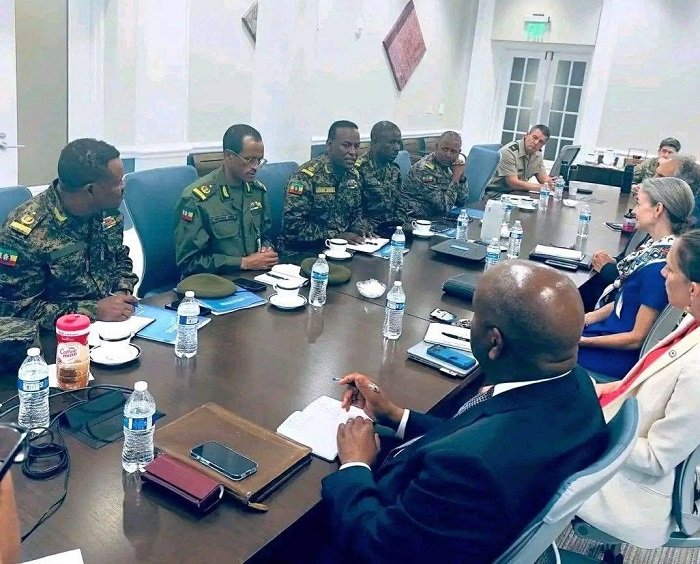
NAIROBI, Kenya — A high-level Ethiopian military delegation, led by Major General Teshome Gemechu, traveled to the United States and held bilateral consultations with officials from the U.S. Department of Defense. The discussions resulted in an agreement to establish “comprehensive defense and security strategic cooperation,” expand institutional defense collaboration, and strengthen strategic coordination.
The agreement, formalized as a “Structured Bilateral Dialogue” (BSD) framework, aims to advance several key objectives:
- Safeguarding mutual interests: Protecting the national interests of both countries and ensuring mutual benefit.
- Strengthening mutual trust: Rebuilding and enhancing trust between the two nations following a period of diplomatic friction.
- Ensuring regional stability: Enhancing joint efforts to guarantee lasting peace and stability in the Horn of Africa.
The agreement centers on three comprehensive pillars:
- Defense and Security Cooperation: Deepening joint security engagements, including intelligence-sharing, military training, and operational trust to restore high-level military collaboration.
- Economic Prosperity and Investment: Expanding bilateral trade flows and direct commercial engagement, shifting the dynamic away from aid dependency toward enterprise.
- Regional Peace and Stability: Aligning diplomatic strategies across the Horn of Africa and the Red Sea corridor.
The U.S. Department of Defense participated directly in these talks, reflecting a growing American perception of Ethiopia as a key regional anchor state. The agreement marks a decisive shift from reactive crisis management to a mature, forward-looking strategic alliance. A high-level U.S. Department of Commerce delegation has already visited Ethiopia to explore joint ventures in emerging sectors like artificial intelligence and tech start-up acceleration.
This recent agreement builds on a broader bilateral dialogue framework signed in May 2026, which also covered cooperation on the Grand Ethiopian Renaissance Dam (GERD) and the war in Sudan. Both capitals have committed to implementing the agreed frameworks quickly and transitioning the defense relationship into a stronger strategic partnership.
__
Join our Telegram Channel: t.me/borkena
Like borkena on Facebook
Join the conversation. Follow us on X (formerly Twitter) @zborkena to get the latest Ethiopian news updates regularly. Subscribe to the YouTube channel. To share information or for submission, email info@borkena.com
America Should Stand With Ethiopia—Not With Any One Government
Why U.S. engagement in the Horn must strengthen legitimate institutions, not only short-term stability
The United States has understandable reasons for strengthening its relationship with Ethiopia.
Ethiopia remains one of the most consequential states in the Horn of Africa. Its population, geography, military capacity, economic potential, diplomatic weight, proximity to the Red Sea, and role in the conflicts surrounding Sudan and Somalia make sustained American engagement not only understandable but necessary.
There is nothing inherently troubling about such cooperation.
The more difficult question is what kind of stability that cooperation is intended to preserve.
The Government Is Not the Country
Foreign policy necessarily operates through governments.
Washington cannot conduct diplomacy with an abstraction called “the Ethiopian people.” It must negotiate with the government exercising state authority.
But that practical necessity should never become a conceptual mistake.
The government of Ethiopia and Ethiopia itself are not the same thing.
Governments change. Leaders leave office. Political coalitions rise and fall.
The country remains.
A durable American relationship with Ethiopia must therefore be capable of surviving changes in leadership, political alignment, and governing ideology.
That requires Washington to distinguish between cooperation with the government currently administering the state and political identification with that government’s continued hold on power.
The United States should maintain diplomatic, economic, and security engagement with Addis Ababa.
But its ultimate investment should be in Ethiopian institutions strong and legitimate enough to survive whoever governs them.
Nor Should Washington Simply Choose the Opposition
The opposite mistake would be equally dangerous.
Ethiopia currently contains multiple political and armed centers of opposition. But they do not constitute a single coherent democratic alternative.
Political alliances remain fluid. Groups that share opposition to the government may still differ profoundly in history, objectives, ideology, territorial claims, and visions of Ethiopia’s future.
Therefore, Washington should not treat Ethiopian politics as a contest in which it must determine which coalition is most likely to prevail and then place its bet accordingly.
That would merely substitute one form of short-term calculation for another.
The deeper question is:
Why have Ethiopia’s institutions become unable to contain profound political disagreements without significant portions of society repeatedly turning toward armed confrontation?
That is the institutional problem deserving attention.
Authority Is Not Legitimacy
A government may possess an army, bureaucracy, international recognition, taxation authority, diplomatic relations, and administrative control.
Those things establish authority.
They do not automatically establish legitimacy.
Likewise, an opposition movement may possess substantial popular sympathy, military capability, territorial influence, or historical grievances.
Those things do not automatically make that movement legitimate either.
Legitimacy asks a different question:
Do citizens believe that political authority is exercised through institutions sufficiently fair, accountable, predictable, inclusive, and lawful to deserve their continued acceptance?
That question cannot be answered merely by identifying who controls the capital or who possesses the strongest armed force.
And this is where American policy requires particular caution.
When Strategic Stability Masks Political Fragility
From Washington’s perspective, Ethiopia may understandably appear indispensable to regional stability.
But there are two different kinds of stability.
Strategic stability emphasizes continuity, security cooperation, predictable state behavior, territorial order, commercial relationships, and regional balance.
Legitimate stability depends upon institutional trust, civic inclusion, accountability, peaceful political competition, reconciliation, and citizens’ belief that common institutions belong to them.
A country can possess the first while losing the second.
That is the danger.
If external assistance strengthens the government’s security capacity while political trust, accountability, reconciliation, and civic legitimacy continue to deteriorate, the result may be stronger state machinery resting upon weaker political foundations.
Such an arrangement may preserve order temporarily.
It may also deepen resentment and make future conflict more destructive.
Stability imposed without legitimacy eventually becomes fragility.
Good Intentions Are Not Enough
None of this requires assuming malicious intentions on the part of the United States.
Washington may genuinely believe that closer defense cooperation, economic engagement, and diplomatic coordination will help prevent Ethiopia and the wider Horn from descending into greater instability.
Those are legitimate objectives.
But international relations must ultimately be judged not only by intentions but by consequences.
Military assistance intended to strengthen security can become politically controversial if citizens believe it enables repression.
Diplomatic recognition intended to encourage stability can be interpreted as international endorsement of domestic political arrangements.
Economic cooperation intended to promote prosperity can lose legitimacy if citizens perceive that benefits are concentrated while institutional grievances remain unresolved.
This is precisely why foreign partners need to distinguish supporting the Ethiopian state from appearing to endorse every action of the Ethiopian government.
Ethiopia’s Internal Crisis Is Also a Regional Question
The stakes extend far beyond Ethiopia’s borders.
The Horn of Africa is already confronting interconnected conflicts and rivalries involving Sudan, Somalia, Eritrea, Red Sea security, cross-border armed movements, displacement, trade corridors, and competing international interests.
Under such conditions, a bilateral policy designed only around the immediate relationship between Washington and Addis Ababa can generate consequences far beyond that relationship.
An intervention intended to strengthen one center of stability can alter calculations among neighboring governments, armed movements, and domestic political actors.
The correct conclusion is not that the United States should withdraw.
It is that American engagement should become more institutionally sophisticated.
What Should America Support?
The United States does not need to choose a favored Ethiopian faction.
It can choose principles.
It can support civilian protection, accountable public institutions, constitutional political competition, meaningful national dialogue and reconciliation, professional and politically neutral security institutions, equality of citizenship, and peaceful participation.
And it can use its diplomatic relationships with government and non-governmental actors alike to reinforce one fundamental principle:
No major Ethiopian community should conclude that armed struggle is the only reliable means through which it can protect its interests or participate in the country’s political future.
These standards should apply equally.
Government abuses should not be excused because the government is a strategic partner.
Opposition abuses should not be excused because the opposition challenges an unpopular government.
That is what genuine neutrality requires.
A Partnership Built to Outlive Governments
The United States should remain deeply engaged with Ethiopia.
But the objective should be larger than maintaining productive relations with today’s leadership.
Washington should seek a relationship with Ethiopia capable of surviving tomorrow’s leadership as well.
That means investing politically in institutions rather than personalities, legitimate processes rather than preferred outcomes, and peaceful political competition rather than calculations about which faction appears strongest at a particular moment.
The ultimate American interest is not the survival of one Ethiopian government.
Nor should it be the victory of one opposition coalition.
It is an Ethiopia whose political institutions are sufficiently legitimate that changes of government do not threaten the survival of the state itself.
That is where strategic stability and legitimate stability finally meet.
The United States should not ask merely:
Who can work with us today?
It should also ask:
What political order will still be capable of holding Ethiopia together when today’s leaders are gone?
America should therefore neither choose Ethiopia’s government nor choose its opponents.
It should support the conditions under which Ethiopians can resolve that political contest without destroying their country.
That is not neutrality born of indifference.
It is partnership grounded in a genuine concern for Ethiopia’s long-term future.
— Fikeru Zewdie
Author of Ethiopia’s Crisis of Legitimacy: How Nations Preserve Their Future Through Legitimate Governance
This is the best story about the old country this year. Good Ole USA has been pouring billions in financial and material assistance to the old country for decades. During the great famine of the mid 1980’s that was created by Mengistu, EPLF, TPLF and other groups, thousands were dying daily until USA came in with its life saving food and medical aid that brought the famine to an abrupt end. This military cooperation is just the ice on the cake. More such great news, please!!!
How about a couple of the F15’s, F16’s and Patriot missiles? That would be a big ice on the cake. Right on USA, right on!!!!