
Part I
Amsal Woreta
Part I: Unpacking Ethiopia’s “Reset Syndrome”
Since the overthrow of Emperor Haile Selassie in 1974, Ethiopia has undergone three major political breaks—from the Derg to the EPRDF, and most recently, the post-2018 order. Each transition was hailed as a decisive break with the past, promising peace, democracy, and development. Yet, each has instead reproduced familiar patterns of crisis, conflict, and mass human rights violations.
This Part II of our analysis introduces the concept of Ethiopia’s “reset syndrome”: a vicious, half-century-long cycle where every new regime attempts to Refound the state from above while preserving the deeper, self-defeating logic of zero-sum politics, militarized state-building, and impunity.
We argue that Ethiopia’s problem is not merely a question of who rules, but of how power is conceived, distributed, and constrained. This installment will establish this argument by:
- Diagnosing the Cycle: Providing a concise historical overview of the three post-imperial regimes and detailing how the Red Terror, authoritarian ethnic federalism, and the Tigray War entrenched a pattern of cyclical violence.
- Defining the Drivers: Proposing an analytical framework that identifies the core structural and cultural factors that make each political settlement fragile and reversible—from extra-constitutional transitions to the instrumentalization of identity.
In Part III, we will move from diagnosis to prescription, exploring the critical lessons Ethiopia’s elites should have learned and proposing a detailed roadmap for the next transition: a shift from regime replacement to a citizenship-anchored constitutional transformation.
Executive Summary
Since the overthrow of Emperor Haile Selassie in 1974, Ethiopia has experienced successive regime changes—from the Derg (1974–1991) to the EPRDF (1991–2018) and the post-2018 order under Prime Minister Abiy Ahmed—each accompanied by crisis, conflict, and mass human rights violations. The Derg’s Red Terror, EPRDF’s authoritarian ethnic federalism, and the recent war in Tigray and other regional conflicts have entrenched a pattern of cyclical violence rather than delivering the promised peace, democracy, or development. Drawing on historical scholarship and political analysis, this paper argues that Ethiopia suffers from a “reset syndrome” in which each regime attempts to Refound the state from above, while preserving the deeper logic of zero-sum politics, militarized state-building, instrumentalized identities, and impunity.
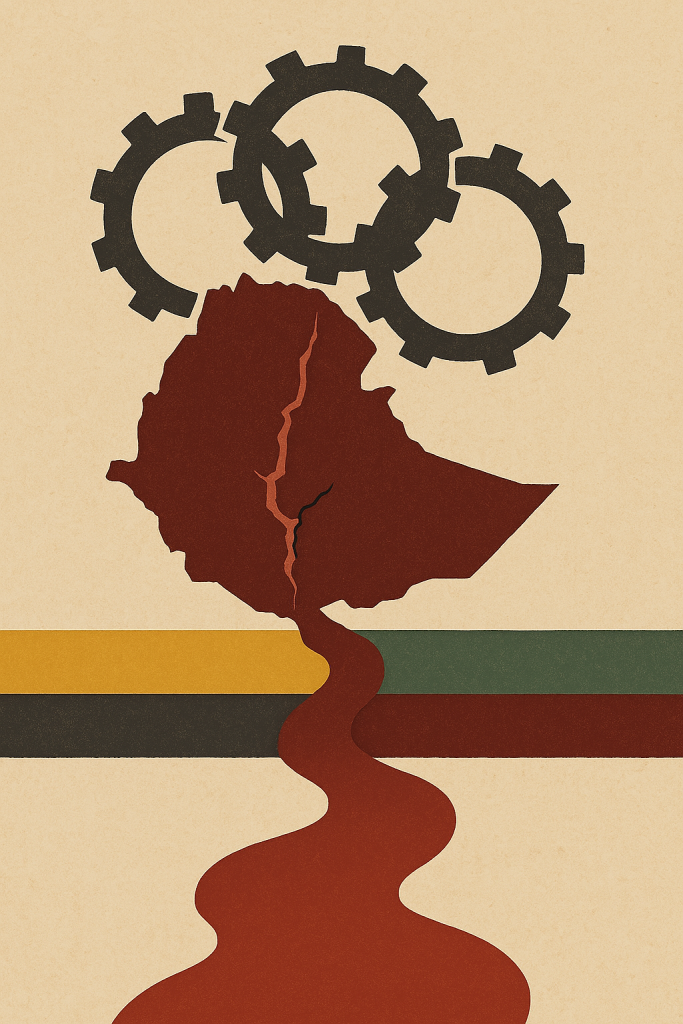
- The Cracking Map of Ethiopia: Represents the fragmentation, crises, and threat to state integrity mentioned throughout the paper.
- The Gears (Cogs) of Power: Symbolizes the cycles of regimes, the continuous mechanical operation of “zero-sum politics,” and “constitutional engineering” driven by elites.
- The River of Red: Represents mass violence, blood, and atrocities that accompany every regime change (Red Terror, Tigray War, regional conflicts).
The paper proceeds in four steps. First, it provides a concise historical overview of the three post-imperial regimes and their patterns of violence. Second, it reviews the relevant analysis on Ethiopian state formation, ethnic federalism, and transitional justice. Third, it proposes an analytical framework for understanding the vicious cycle of regime change and betrayal, identifying structural and cultural drivers. Finally, it asks what Ethiopian powerholders should have learned after fifty years—and proposes a set of principles and steps for the next transition: a shift from regime replacement to a negotiated, citizenship-anchored constitutional transformation; from ethnic dominance to balanced federalism; from impunity to truth and targeted accountability; and from personalized rule to strong institutions.
1. Introduction
The 1974 overthrow of Emperor Haile Selassie marked the end of Ethiopia’s imperial order and the beginning of an unresolved struggle over the nature of the state, citizenship, and political community. What followed was not a linear transition to democracy, but a sequence of regimes—military socialist, revolutionary democratic, and post-authoritarian reformist—that each claimed to correct the failures of its predecessor while reproducing new forms of violence and exclusion. This paper addresses two interrelated questions: 1. Why has Ethiopia experienced a vicious cycle of crisis, polarization, and mass atrocities with almost every regime change since 1974? 2. What should those in power have learned from this history, and what must the next change look like if the country is to exit the cycle rather than repeat it?
The argument advanced here is that Ethiopia’s problem is not only who rules, but how power is conceived, distributed, and constrained. Regime changes have tended to be extra-constitutional and winner-take-all. Successive elites have relied on security apparatuses and ideological mobilization to consolidate power, instrumentalizing class, ethnicity, or religion, while avoiding comprehensive accountability for past atrocities. The result is a fragile state in which each “new beginning” is built atop unresolved grievances and competing memories of injustice.
Methodologically, the paper is based on a synthetic reading of historical works on modern Ethiopia, analyses of ethnic federalism, recent literature on political culture and cyclical conflict, as well as studies of transitional justice, combined with normative institutional analysis oriented toward policy design. It does not offer new primary data but rather reinterprets existing scholarship through the lens of “reset syndrome” and asks what this implies for future constitutional and political reform.
2. Historical Trajectories of Regime Change and Violence
2.1 The Derg (1974–1991): Revolutionary Terror and Militarized State-Building
The Derg, a committee of junior officers, seized power in 1974 amid protests over famine, inequality, and authoritarian imperial rule. The revolution was driven by a coalition of students, workers, and military actors seeking land reform and social justice. However, the Derg’s rule soon degenerated into extreme repression. Between 1976 and 1978, the Red Terror was launched as an urban counter-insurgency campaign against rival leftist forces. Human rights reports describe systematic killings, torture, disappearances, and mass arrests; the death toll is estimated in the tens of thousands to hundreds of thousands. The Derg also fought prolonged wars in Eritrea, Tigray, and other regions, deepening militarization and centralization. Mengistu Haile Mariam and other top officials were eventually tried after 1991, but the trials did not evolve into a broader process of truth-telling or reconciliation.
2.2 EPRDF (1991–2018): Ethnic Federalism and Authoritarian Developmentalism
In 1991, the Ethiopian People’s Revolutionary Democratic Front (EPRDF)—a coalition of ethnically based insurgent movements led by the Tigray People’s Liberation Front—overthrew the Derg. The new rulers promised multi-party democracy, recognition of nations and nationalities, and a break with centralizing imperial and military traditions. The 1995 Constitution established a federal system based on “nations, nationalities, and peoples,” granting regional states significant formal autonomy and even the right to secession. Scholars have described Ethiopia as a dominant-party federation in which a de jure federal system coexisted with de facto centralization within the EPRDF and its allied ethnic parties. Ethnic federalism recognized previously suppressed identities and enabled use of local languages in administration and education, but it also institutionalized ethnicity as the main axis of political mobilization. Citizens were encouraged to seek protection and resources primarily through ethnic parties. New conflicts emerged over borders, identity, and power-sharing, especially in mixed areas and peripheral regions. Elections were tightly managed; 2005’s competitive polls were followed by a clampdown that left hundreds of dead and thousands imprisoned. While the EPRDF delivered infrastructure and economic growth, the combination of ethnic federalism and authoritarian control produced deep ambivalence. For many, the system neither resolved historical national questions nor created genuine equal citizenship; rather, it entrenched competing ethnic nationalisms within a rigid party-state.
2.3 Post-2018: Abiy Ahmed’s Reform, Fragmentation, and Renewed War
In 2018, internal EPRDF divisions and mass protests in Oromia and Amhara culminated in the rise of Abiy Ahmed as prime minister. Initially, the transition appeared transformative: political prisoners were released, exiled opposition groups returned, civic space opened somewhat, and a peace agreement with Eritrea ended the formal state of war and earned Abiy the Nobel Peace Prize. Yet the reform moment quickly gave way to fragmentation and renewed violence. Tensions between the federal government and the TPLF escalated over the pace and direction of change and over control of security institutions. In November 2020, war broke out between federal and allied forces and Tigrayan forces. The conflict involved large-scale atrocities and systematic sexual violence, with death toll estimates ranging into the hundreds of thousands. Despite the Pretoria ceasefire in 2022, implementation has been uneven, and Ethiopia remains beset by conflict in multiple regions, including Amhara and Oromia. Reports of massacres forced displacement, and communal violence have continued, reflecting a broader crisis of legitimacy and state authority rather than a single, contained war. Across three regimes, different ideological projects—socialist revolution, ethnic federalism, and “modemed” reform—have all failed to establish a stable, inclusive political order. Instead, each has added its own chapter to a long history of state-linked mass violence.
3. Understanding the Vicious Cycle
This section reviews four strands of analysis relevant to Ethiopia’s reset syndrome: political culture and state formation; ethnic federalism; transitional justice; and the post-2018 transition and Tigray war.
3.1 Political Culture, State Formation, and Cyclical Conflict
Historical studies of modern Ethiopia emphasize long-term patterns of centralization, regional resistance, and elite competition that predate 1974. These works highlight the tension between a center-building project and multi-ethnic peripheries, where attempts to consolidate authority have often been violent and contested. More recent scholarship explicitly frames Ethiopia’s contemporary predicament as one of political culture and cyclical conflict. Such work argues that many explanations overly focus on ethnicity, while neglecting deep-seated patterns of elite behavior, zero-sum competition, and instrumental use of identity. These analyses resonate with studies of competing ethnic nationalisms and the state’s struggle to democratize in a context of militarized politics.
3.2 Ethnic Federalism: Promise, Paradox, and Conflict
The analysis on ethnic federalism in Ethiopia is extensive and often critical. Scholars show that while the 1995 Constitution formally meets criteria for a federal system, the centralized party structure constrained genuine regional autonomy. Ethnic federalism recognized previously suppressed identities and enabled local linguistic and cultural expression, but it also institutionalized ethnicity as the dominant frame of politics. Citizens increasingly relied on ethnic parties to access resources and protection, and conflicts over borders, identity, and power sharing became more common. Other analysts underline the paradox that ethnic federalism was designed to resolve the national question but has, in practice, heightened the politicization of ethnic identity and produced both intra- and inter-regional conflicts. Newer empirical work shows that exposure to violent conflict can increase support for ethnic federalism among populations who view it as a protective shield against a distrusted central state, even as elite-level debates question the system’s viability.
3.3 Transitional Justice and the Red Terror Trials
The primary experiment in transitional justice in post-1974 Ethiopia was the Red Terror trials conducted after the fall of the Derg. A Special Prosecutor’s Office was created to investigate atrocities, and mass prosecutions of former officials followed. Scholars note that while the trials were significant in holding some perpetrators accountable and establishing a judicial record, they were limited in scope and inclusiveness. They focused on a relatively narrow period and one regime, did not incorporate broad public participation or restorative mechanisms, and were closely tied to the successor regime’s own state-building project. As a result, Ethiopia has never had a comprehensive truth-telling process encompassing abuses across regimes, nor a sustained national conversation about memory, responsibility, and forgiveness. This absence is crucial for understanding the persistence of competing victimhood narratives and unresolved grievances that resurface in each conflict.
3.4 The Abiy Transition and the Tigray War
Policy analyses initially framed Abiy Ahmed’s accession as an opening for democratization but warned of potential backlash and fragmentation if reforms were not institutionalized and inclusive. After 2020, the focus shifted toward documenting the Tigray war and its regional consequences. Investigative reports highlight the scale of violence, including sexual atrocities and mass displacement, and the fragility of the post-Pretoria peace. This emerging body of work underscores the continuity of patterns identified under previous regimes: reliance on militarized solutions, suppression or co-optation of dissent, and the limited reach of formal peace agreements when underlying political settlements remain contested.
4. Analytical Framework: Ethiopia’s Vicious Cycle of Reset Syndrome
Synthesizing the historical and scholarly evidence, Ethiopia’s post-1974 trajectory can be conceptualized as a reset syndrome: repeated attempts by new elites to Refound the state, while leaving intact or repurposing the underlying logic of rule.
4.1 Zero-Sum Political Competition and Extra-Constitutional Transitions
In all three regime changes—1974, 1991, and 2018—decisive shifts in power occurred primarily through extra-constitutional means: military coups, insurgent victories, or intra-party upheavals accelerated by street protests, rather than through institutionalized electoral alternation. The absence of credible rules for peaceful alternation of power has fostered a political culture in which losing power appears existentially threatening, opposition actors see armed struggle or revolutionary rupture as the only path to change, and incumbents view concessions as dangerous signs of weakness rather than prerequisites for stability.
4.2 Militarized State Building and Impunity
The Derg inherited and intensified a tradition of military centrality. EPRDF was itself a coalition of guerrilla movements that maintained strong security institutions after 1991. Post-2018, Abiy’s government has relied both on inherited security structures and new alliances with regional forces and foreign armies. Across regimes, impunity for security-force abuses has been widespread. Limited accountability for Red Terror perpetrators, weak responses to violent repression of protests and opposition, and stalled mechanisms for investigating atrocities in the Tigray war and other recent conflicts all signal that violence is a viable political instrument, encouraging future abuses and discouraging trust in institutions.
4.3 Instrumentalization of Identity
Each regime has mobilized identity in distinct but analogous ways. The Derg framed opponents as class enemies, legitimizing their elimination. EPRDF institutionalized ethnicity as the primary basis of federal units and political parties, fueling both empowerment and competition. Under Abiy, both pan-Ethiopian and ethno-nationalist narratives have been used by different actors to stigmatize rivals, with social media amplifying hate speech against multiple communities at different moments. Instrumentalization of identity turns political disagreements into existential struggles, making compromise difficult and civilian targeting thinkable.
4.4 Constitutional Engineering without Deep Consent
Major constitutional restructurings—the Derg’s socialist proclamations, the 1995 ethnic federal constitution, and current reform initiatives—have been driven by relatively narrow elite coalitions and have not emerged from broadly inclusive, binding deliberative processes. Consequently, each settlement is seen by opponents as partisan and reversible. Instead of becoming stable rules of the game, constitutions function as instruments of the ruling coalition.
4.5 Structural Inequalities and Peripheral Marginalization
Beyond politics and identity, socio-economic inequalities and center–periphery divides persist. Peripheral regions, pastoralist communities, and urban poor remain disproportionately exposed to displacement, land grabs, and under-investment, while being mobilized as fighters or proxies in broader struggles. When these material grievances are filtered through ethnic narratives, they fuel cycles of rebellion and repression.
5. Lessons Those in Power Should Have Learned Since 1974
Given fifty years of costly failures, several lessons are now inescapable for Ethiopian elites.
5.1 Violence as a Political Instrument is Self-Defeating
The Derg’s Red Terror did not secure the revolution; it delegitimized it, contributed to state collapse, and left deep social scars. EPRDF’s reliance on selective repression undermined its own developmental achievements, fueling the protests that ended its dominance. The Tigray war and other recent conflicts have not pacified Ethiopia; they have fragmented it and invited regional destabilization. Every supposedly “necessary” massacre becomes tomorrow’s recruitment poster for insurgency.
5.2 No Group Can Rule Ethiopia Alone
Historical and contemporary analyses converge on a simple fact: Ethiopia’s demographic, regional, and religious diversity makes permanent hegemony by any single group—party, ethnicity, or region—both unjust and unstable. Attempts by successive regimes to monopolize power have resulted in growing resistance, insurgencies, and eventual crises of legitimacy.
5.3 Ethnic Recognition Requires a Civic Core
Ethnic federalism responded to real demands for recognition and autonomy. But despite a strong civic conception of equal citizenship and robust safeguards for minorities everywhere, it has produced hardened boundaries and escalation of identity-based claims. Uncertainty and vulnerability for those living outside their designated home region, and a politics in which cross-ethnic, issue-based coalitions struggle to emerge, demonstrate the need to integrate recognition into a broader framework of citizenship-anchored rights and responsibilities.
5.4 Partial Transitional Justice is Not Enough
The Red Terror trials were a pioneering effort but limited in scope and inclusive; they did not establish a national model of dealing with a violent past that could be extended to later abuses. Without broader truth-telling and accountability—including for atrocities committed under EPRDF and during the Tigray war—Ethiopia remains trapped in impunity cycles. Survivors carry unresolved trauma; perpetrators or their allies remain influential; and each new conflict is framed through competing historical grievances.
5.5 Personality-Driven Reform Without Institutionalization Will Fail
The pattern from Mengistu to Meles to Abiy shows that charismatic or strong leaders can temporarily centralize authority and drive rapid change, but without building independent courts, parliaments, media, and security institutions, their projects either ossify into authoritarianism or disintegrate in crisis. Institutional design and enforcement—not personal virtue—must be at the heart of any durable settlement.
6. Toward a Different Kind of Transition: Principles and Steps
If another transition is approaching, the key question is how to make it qualitatively different from 1974, 1991, or 2018. The following principles and steps are proposed as a roadmap.
6.1 Immediate Priorities: Ending Mass Violence and Creating Space
First, all armed actors must commit to protecting civilians, religious sites, and critical infrastructure. International and regional organizations can support monitoring mechanisms to verify compliance. Second, the detention of non-violent political opponents and journalists should end, enabling genuine debate. Restrictions on peaceful assembly and independent media should be lifted, subject only to narrowly tailored limitations. Third, humanitarian access in war-affected regions must be ensured irrespective of political alignments, under neutral oversight.
6.2 Inclusive and Binding National Dialogue
A meaningful national dialogue must differ from past conferences that were either elite-driven or lacked implementation mechanisms. It should be inclusive, with representation of major political parties, regional governments, civil society, religious and traditional authorities, women and youth movements, and, where feasible, representatives of armed groups willing to negotiate. The dialogue needs a clear legal mandate to formulate proposals on constitutional reform, security arrangements, and transitional justice, with agreed paths to implementation. Independent facilitation, possibly with African or international technical support, can help build trust among parties.
6.3 Constitutional Reform: From Ethnic Federalism Alone to Citizenship-Anchored Federalism
Based on dialogue outcomes, a constitutional convention could develop amendments or a new basic law that affirms equal citizenship through a robust bill of rights and retains federalism while diversifying the criteria for regional units. Regions may still reflect cultural-linguistic communities but should also consider historical, geographic, and economic logics, with flexible mechanisms for internal re-organization. Independent constitutional courts, human rights commissions, and boundary or intergovernmental commissions with clear mandates and safeguards against capture should be established.
6.4 Security-Sector Reform and Demobilization
Breaking the cycle of militarized politics requires civilian oversight of security forces, with transparent chains of command and budgetary scrutiny. Vetting of units implicated in serious abuses, coupled with training in humanitarian and human rights law, is essential. Disarmament, demobilization, and reintegration programs for non-state armed groups must be paired with economic reintegration pathways to reduce incentives for renewed conflict.
6.5 Comprehensive Transitional Justice
A national transitional justice framework should establish a truth commission with a broad temporal mandate and powers to take testimony from victims, perpetrators, and witnesses across regions and regimes. This should be complemented by targeted prosecutions of those most responsible for grave crimes and by reparations and memorialization for victims, including symbolic recognition, counseling, and material support.
6.6 Socio-Economic Inclusion and Local Governance
Political reform must be accompanied by policies that address everyday grievances. Equitable fiscal federalism requires transparent, formula-based transfers linked to population, need, and performance to reduce perceptions of favoritism. Strengthening local councils and courts to manage disputes and service delivery, with safeguards for minorities, and prioritizing employment, land security, and basic services in conflict-affected and marginalized regions are essential to underpin any political settlement.
6.7 Civic Education and Cultural Change
Over time, Ethiopia must cultivate a political culture in which adversaries are seen as legitimate competitors, not mortal enemies, and multiple identities—ethnic, religious, national, and local—are accepted as complementary. This requires educational reforms, responsible media, and leadership from religious and traditional authorities to promote messages of shared dignity and responsibility, and to condemn violence against civilians without qualifications.
7. Conclusion
Since 1974, Ethiopia has undergone three major regime changes—each heralded as a decisive break with the past. Yet each has reproduced familiar patterns of crisis, betrayal, and mass suffering. The Derg’s socialist revolution collapsed under the weight of terror and war; EPRDF’s ethnic federal developmentalism combined recognition with repression and seeded new conflicts; Abiy’s reformist turn opened space briefly before plunging the country into another devastating war. The evidence shows that these outcomes are not accidental but rooted in structural and cultural factors: zero-sum politics, militarized state-building, instrumentalized identities, partial transitional justice, and constitutional engineering without deep consent. For those in power—and those seeking power—the central lesson is stark: there will be no sustainable victory for any camp unless Ethiopia itself survives as a political community in which all citizens can live with basic security, dignity, and voice. The next transition, whenever and however it comes, must therefore be more than another reset. It must be a constitutional and moral transformation that replaces the logic of domination with the logic of shared rules, shared responsibility, and shared memory. Whether Ethiopia continues to bleed with every change of government—or finally breaks the cycle—will depend on the willingness of current and future elites to act not only as leaders of factions or peoples, but as stewards of a fragile and plural republic.
Editor’s Note : Views in the article do not necessarily reflect the views of borkena.com
__
Support Borkena : https://borkena.com/subscribe-borkena/
Join our Telegram Channel : t.me/borkena
Like borkena on Facebook
Borkena Ethiopian News Youtube Channel
To submit Press Release, send submission to info@borkena.com
Add your business to Ethiopian Business Listing / Ethiopian Business Directory
Join the conversation. Follow us on X (Formerly Twitter) @zborkena to get the latest Ethiopian News updates regularly.