

Girma Berhanu (Professor)
Introduction
For most of my professional life, I have been engaged in academia, with a focus on justice and equality—particularly in the fields of disability studies and cognitive anthropology, including intellectual abilities.
During the TPLF regime, I authored a paper exposing ethnic discrimination in Ethiopia, specifically in terms of the blatantly unequal distribution of academic scholarships. Shortly afterwards, I published another article that addressed an utterly taboo subject: the practice of male rape, or “sodomy,” in Ethiopian prisons. Both of these articles were empirical studies which were published in peer-reviewed journals. Unsurprisingly, both of these articles provoked significant backlash. Government supporters could have responded with reasoned critique, but instead resorted to insults and attempts at character assassination –my first brush with the pernicious effects of ‘cancel culture’. Following the change of government, instead of witnessing an improvement, the overall situation deteriorated. Those hoping for a new dawn were met with an exponential increase in ethnic apartheid, gross human rights violations, and systemic injustices. Undeterred, I continued reporting and writing on these issues for the past seven years. However, the response became increasingly hostile. The current regime, along with its ethnically affiliated organizations, appears unwilling to tolerate dissent.
In my efforts to help stop the ongoing genocide in Amhara region and the collective punishment of its population, I have interacted with a broad range of activists, intellectuals, and former politicians, especially those from the Amhara ethnic group. What I encountered, however, was troubling: pervasive conflict, fragmentation, self-sabotage, and a lack of sustainable, unified action.
I addressed this issue in a reflective article, where I analyzed the political activism landscape through the lens of social, emotional, behavioral, and cognitive maturity—particularly within the Amhara struggle for democracy, freedom, and equality. Although many factors contribute to the polarization and fragmentation within this movement, I focused on emotional instability as a key dimension undermining cohesion and effectiveness[1]. The ultimate goal of my reflection was to foster unity and healing by encouraging self-awareness and maturity among advocacy groups and within the broader Amhara community.
In this specific article, I argue that many of the barriers to achieving peace, harmony, and a cohesive national struggle in Ethiopia stem from collective trauma. This unaddressed trauma continues to shape not only our personal identities but also our political behavior, often to our own detriment. Acknowledging and addressing this trauma is essential if we are to move toward meaningful change.
I was encouraged to write this reflective essay by a number of recent experiences and influences. One of the most significant was my recent involvement with the research network Trauma-Informed Approaches to Conflict and Crisis in Education,[2] which expanded my intellectual horizon and deepened my understanding of trauma in conflict-affected societies.
Additionally, I had a moving and insightful conversation with a London-based journalist and philanthropist who expressed a genuine concern for Ethiopia’s collective trauma. Around the same time, I engaged in a long and thought-provoking discussion with an Ethiopian heart surgeon based in Sweden, focusing on the experience of highly educated women in Ethiopia. We explored how, despite their achievements, women are often reduced to their gender—treated “as just women”—regardless of their expertise. In Ethiopia, to be both attractive and highly educated as a woman often comes with a daily psychological burden. The pervasive tendency among men to not take these women seriously is itself a form of trauma that is routinely normalized.
Further deepening my reflections, I read a timely and relevant article titled Conflict, Trauma, and Coping: The Experiences of Internally Displaced People in Northern Ethiopia. The study highlighted the severe mental health consequences of conflict and forced displacement experienced by participants, and it emphasized the urgent need for mental health interventions in Ethiopia’s conflict-torn regions. It called for efforts focused on enhancing social capital, leveraging spirituality, and promoting communal culture to foster resilience and mitigate the effects of trauma among internally displaced persons (IDPs)[3].
One of the motivations behind initiating this writing was the recurring patterns of unpredictability, emotional volatility, and the lack of long-term sustainability I have observed in diaspora-led projects. It is possible that the fragmentation, pervasive anger, and erosion of trust and communal bonds are rooted in the collective trauma historically endured by the community. The cracks—of anger, of mistrust, of broken connection—may trace back to a deeper wound, a shared trauma etched into our collective memory.
Together, these experiences have shaped my understanding of how collective trauma manifests across different dimensions of Ethiopian society—gender, displacement, conflict—and how urgently we must address it through both scholarly and community-based approaches.
Collective Trauma: Unseen scars and the struggle for identity
While individual trauma has been extensively studied, collective trauma remains a relatively new area of research. Although collective traumas may appear to emerge “out of the blue,” many are rooted in unresolved crises of the past. The term collective trauma refers to the psychological responses to a traumatic event that impact an entire society. It encompasses more than just the historical record or the recollection of a tragic event experienced by a group—it signifies a deeply embedded memory within the collective consciousness of that group. Like all forms of memory, collective trauma is not a static reproduction of events but an evolving reconstruction through which a society attempts to make sense of its past.
This is precisely what the Amhara people have been experiencing for over 50 years. The trauma they endured, particularly during the infamous revolution, lives on in the collective memory of the group. Unlike individual memory, collective memory persists beyond the lives of direct survivors. It is carried forward by members of the group who may be temporally and geographically distant from the original events. Among the Amhara, the effects of this inherited trauma can be seen in the current generation, both within Ethiopia and across the diaspora. These generations, who did not witness the trauma firsthand, often remember and reconstruct these events differently from the original survivors. Over time, this reconstruction may take various forms and meanings, reshaping the narrative from one generation to the next[4].
Such a memory dynamic can give rise to what psychoanalyst Vamık Volkan (1997)[5] terms a chosen trauma, a phenomenon in which a group symbolically links a collective calamity suffered by its ancestors with its current identity and sense of ontological security. As Gilad Hirschberger (2018) explains, collective trauma is a cataclysmic event that shatters the basic fabric of society. Beyond the devastating loss of life, it represents a profound crisis of meaning. Hirschberger outlines a process that begins with the trauma itself, evolves into collective memory, and ultimately culminates in a new system of meaning that redefines group identity and shapes the direction of the group’s future.
Collective trauma refers to a devastating event in a group’s history that has enduring psychological, social, and political consequences—affecting both victim and perpetrator groups long after the event itself has ended. As Yehuda and colleagues (2002)[6] observed, much of the early psychological literature on collective trauma focused primarily on its health-related and psychopathological impacts. However, recent scholarship has expanded this focus to explore the broader social and political dimensions of trauma[7], particularly in relation to collective perpetration and victimization. This emerging body of work has produced important insights. For instance, research has shown that collective victim beliefs can serve to justify and legitimize contemporary political violence. It has also explored how the experience of collective victimhood may be linked to material gains and competition over those gains (Noor et al., 2012). Within the Ethiopian context, nationalist discourses—particularly among some Tigrayan and Oromo political actors—often frame their group histories through the lens of collective victimhood. In some cases, these narratives have been used to justify hostility or violence against the Amhara people, positioning them as historical perpetrators and thereby reinforcing cycles of interethnic tension and grievance.
Recent literature increasingly recognizes collective trauma as a genuine and impactful experience with lasting consequences for subsequent generations—an effect clearly observable in the case of the Amhara people. Given that one of the central aims of intergroup relations research is to understand and promote conflict resolution and reconciliation, the long-term effects of collective trauma are often evaluated through this lens. In this context, historical victimization is typically viewed as both a psychological burden and a barrier to peacebuilding, often serving as a distorting filter in intergroup dynamics (Schori-Eyal et al., 2017). Abrutyn (2024) argues that the memory of victimization has both adaptive and maladaptive dimensions. While such memories can lead to distrust of adversaries and reluctance to compromise—reactions that may hinder reconciliation—these responses can also serve a protective function, safeguarding the group from disingenuous peace overtures or potential exploitation. This duality is evident among many Amharas today, who express deep suspicion toward the intentions of certain Oromo and Tigrayan political actors. Although the enduring memory of trauma—such as that experienced by the Amhara—can contribute to a paralyzing, hyper-vigilant mindset, it can also foster post-traumatic growth. In this more constructive form, trauma becomes a source of meaning that underscores the group’s resilience and its capacity for recovery and transformation in the aftermath of historical calamity. These outcomes are especially relevant today, as new generations—both descendants of victims and perpetrators—grapple with the need to make sense of the past. In doing so, they seek not only to interpret historical events but also to craft narratives that guide present behavior and inform a collective vision for the future (Hirschberger, 2018)[8].
The Legacy of Collective Trauma: Political and Social Implications for the Amhara People in Ethiopia
For several decades, I have observed the trauma endured by the Amhara people—wounds that remain largely invisible yet deeply embedded in the collective psyche. Though the data are often unsystematic, the anecdotal evidence is robust: a consistent and profound impact on mental health and emotional well-being is clear among many people I know.
My own experience is marked by personal loss and painful memory. My grandmother lost two of her cousins—Aklilu Habtewold and Akalework Habtewold—both high-ranking government officials who were executed without trial, along with sixty others, during the early days of the Derg regime. I remember vividly that she was not allowed to mourn them publicly or receive visitors who came to grieve with her. The regime was so brutal that it denied families even the basic human right to bury their loved ones or grieve according to cultural and religious tradition.
The infamous Red Terror campaign launched by the Derg in the late 1970s claimed the lives of countless young people. I, too, was caught in its grip. As a young boy, I was imprisoned in one of the Kebele detention centers in downtown Addis Ababa. I was tortured repeatedly using the parrot’s perch (Wofelala)—a tool (see below) designed specifically for inflicting pain. Despite the severe beatings, I managed to remain silent. Three of my friends, however, could not withstand the torture. Under duress, they confessed to things they had not done, falsely admitting involvement in activities they were never a part of. All three were executed.
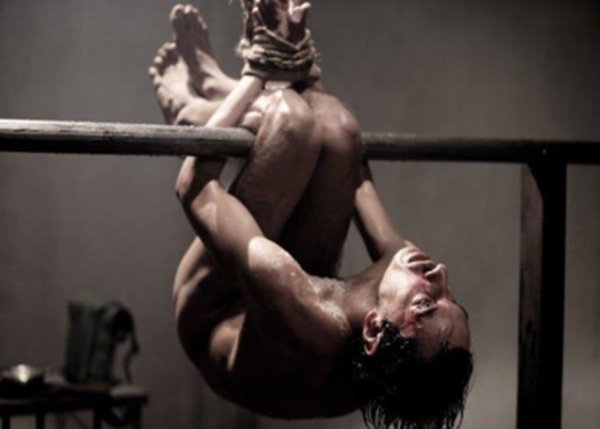
Fig 1. A widely used name for this kind of setup is “the parrot’s perch”—in Portuguese, pau de arara. It’s a notorious torture position in which the victim’s wrists and ankles are bound to a pole or bar, forcing their body into an inverted, contorted suspension that inflicts intense pain.
I survived, not because I was innocent—none of us were guilty—but because I happened to be the youngest among the detainees. According to a former security official who knew my father, I was considered too young to be executed.
Echoes of the Red Terror: I remember losing 27 acquaintances—friends, classmates, neighbors—during the horrific Red Terror campaign of the late 1970s. Their faces, names, and voices have never left me. It was a time of fear so deep that even our silence could betray us. No one was truly safe.
Among the countless families torn apart, I still think most often of our neighbor, a kind and humble man whose life was shattered when five of his sons were taken and executed. Only one son, the sixth, survived—and that, by some miracle I still cannot explain.
The massacre was orchestrated by a man known in whispers and curses as Solomon the Fascist. His name struck terror in our hearts. He wasn’t just a man—he was a symbol of cruelty, of the merciless brutality that defined that era. His hands were stained with the blood of the innocent.
The surviving son—his eyes once full of life—became a quiet man, haunted by what he had seen. He carried a terrible burden: the memory of his brothers’ last moments, and the horror that unfolded near Gefersa, just outside Addis Ababa. I often wonder how he endured it all. How does one live with so much loss and yet keep moving forward?
He lived in Higher 15, Kebele 23. I don’t know if he is still alive. I wish, deeply, that he had written his story down—his account of those dark days. It is a story that deserves to be remembered, not just for the sake of history, but for justice, for healing, for truth. In those woods near Gefersa, tens of others were executed—young men and women, many of them barely out of school. Their stories, like his, are vanishing with time.
We must not let silence bury them!
This experience alone could fill a book. But what remains with me even more strongly, after four decades, is a growing realization: many of those who were executed shared a common identity—they were of Amhara origin. At the time, no one spoke in terms of ethnicity. We saw ourselves as Ethiopians. But looking back, the ethnic undertones and selective persecution become harder to ignore.
The Sociological Dimensions of Collective Trauma: The Amhara Experience in Contemporary Ethiopia
The sociological form of trauma experienced by the Amhara people has intensified over recent decades. Under the TPLF-led regime (1991–2018), the propagation of Tigrean superiority contributed significantly to the marginalization of the Amhara. This was followed, and in some ways worsened, by the administration that came to power in 2018, which has been characterized by Oromo-centric nationalist rhetoric that further deepens Amhara exclusion. These political regimes have perpetuated trauma through what can best be described as the collectivization and enculturation of social pain—a process in which evolved negative affective responses to separation, rejection, exclusion, and isolation from cherished social objects (such as status, recognition, and historical continuity) become ingrained in a group identity.
This process transforms individual experiences of pain into collective social trauma, and further, into cultural identity. For the Amhara people, trauma is not merely historical—it is lived. The group is subjected to persistent threats that undermine their ability to form and maintain meaningful attachments to social institutions that generate purpose and imbue identity with confidence.
This cultural trauma is rooted in exclusion from access to privilege, status, and power, while simultaneously being linked to an identity that is saturated with historical pain. It manifests in various forms of isolation—residential, marital, occupational, educational, and beyond—and in the rejection experienced through prejudiced expectations regarding competence, performance, and reward. In the worst cases, this trauma manifests as stigmatization, severely diminishing economic opportunities, weakening social networks, and curtailing personal agency (Link & Phelan, 2013).
As Desalegne Birara (2025) argues, the targeted killings, mass incarcerations, and displacement of Amhara civilians in regions such as Oromia, Benishangul-Gumuz, and Southern and Southwestern Ethiopia are not merely physical acts of violence. They constitute symbolic violence—intended to erase the Amhara people’s historical identity and delegitimize their role in the Ethiopian nation-state. This dynamic aligns with Michel Foucault’s theory of biopolitical control, wherein the state exercises power over life itself by regulating who lives, who dies, and under what conditions (Foucault, 1978). The violence against the Amhara, then, represents not only ethnic cleansing but also an attempt to reconfigure Ethiopia’s political and historical narrative by silencing one of its foundational peoples. The Amhara genocide, which began covertly in the 1970s and escalated dramatically after 2018, must be analyzed in relation to the historical construction of the Amhara identity as being associated with Ethiopian state power. The demonization of Amharas as an “oppressor class”, as shown in the works of Workneh (2023) and Mihiret (2025), has evolved into an entrenched discursive practice. Through a Foucauldian lens, one can argue that this narrative functions to justify and normalize the disenfranchisement and systemic targeting of the Amhara population. By portraying the Amhara as oppressors, the state establishes a power imbalance that legitimizes violence, exclusion, and dispossession. This narrative has rationalized ethnic cleansing and militarized repression in regions such as Welkait and Metekel, where civilians are deliberately targeted and their identity erased through massacres and forced displacement (Birara, 2025, p. 18)[9].
Collective Trauma in Amhara Politics: A Necropolitical Perspective
Collective trauma in Amhara politics is a powerful and ongoing force that shapes political attitudes, group identity, and interethnic relations in Ethiopia. The Amhara people—one of the country’s largest ethnic groups—have endured a series of historical and contemporary experiences that have contributed to a pervasive sense of collective victimization. These experiences involve deeply shared emotional and psychological wounds, stemming from systemic violence, oppression, and exclusion. Importantly, these traumas are perceived not merely as isolated events, but as targeted assaults on the Amhara group identity—rooted in their language, religion, cultural history, and ancestral connection to key geographic regions of Ethiopia.
A compelling theoretical lens through which to understand this dynamic is necropolitics, as conceptualized by Achille Mbembe (2019)[10]. He writes: “The ultimate expression of sovereignty resides in the power and capacity to dictate who may live and who must die… to define who matters and who does not, who is disposable and who is not.” Necropolitics, then, reveals how governments assign unequal value to human life and structure policies that create zones of abandonment, exclusion, and disposability. This framework is evident in the treatment of Amharas, and other marginalized groups, under contemporary Ethiopian governance. A stark example is the Addis Ababa City Corridor Project, which has led to the forced removal of Amhara residents from parts of the city under the guise of development. These individuals have been displaced from neighbourhoods they historically occupied and relocated to the peripheries, often receiving only nominal compensation for their demolished homes. This practice effectively marginalizes non-Oromo residents, particularly Amharas, reducing them to rootless citizens—stripped of their historical and spatial belonging. Under the logic of necropolitics, proximity to dominant ethnic power structures determines the perceived value of life. The closer one is to these centres of power, the more one’s life is protected and valued. Conversely, the further one is from ethnic-based privilege, the more precarious one’s existence becomes. The Amhara experience is thus not just a case of economic or political marginalization, but a deeper existential crisis marked by the systematic devaluation of life and identity.
Major sources of the Collective Trauma Among the Amhara, and Pathways Toward Healing and Resolution
It is important to note that during the 2020 conflict—widely referred to as the Tigray War—an estimated one million Amharas perished, marking one of the most devastating chapters in the community’s history. This loss is widely perceived as the systemic outcome of a coordinated effort by the federal regime in collusion with the Tigray People’s Liberation Front (TPLF) to annihilate the Amhara population.
Currently, the Amhara region is under siege. The area faces relentless drone strikes, aerial bombings, and widespread dehumanization. The federal crackdown on Fano in 2023–2024 further deepened the collective trauma and sense of betrayal felt by the Amhara people, as countless civilians were caught in the crossfire. What is widely seen as an invasion of the region by the Abiy Ahmed regime has resulted in the deaths of hundreds of thousands.
The humanitarian situation is dire. Schools have been shut down; farms and industries are non-functional; health facilities are barely operational. Current estimates suggest that over 5 million students are out of school, and the number of internally displaced persons is in the millions. The region’s infrastructure is in ruins, and basic services have collapsed. According to some reports, Fano now controls approximately 85% of the region, reflecting both the scale of state withdrawal and the degree of local resistance.
Despite the scale of this catastrophe, it has received scant attention in international media. The ethnic cleansing, pogroms, and mass incarceration of Amhara journalists and politicians—which have continued for decades—have similarly failed to generate global outrage. One might justifiably say, “The Amhara: The Forgotten People of Ethiopia.”
The roots of this crisis can be traced to the establishment of the EPRDF/TPLF-led federal system, which institutionalized ethnic divisions under the guise of ethnic federalism. This system redefined Amhara identity as merely one ethnic category among many, leading to widespread perceptions that Amharas were being politically and geographically contained within the Amhara region. The loss of territories historically associated with Amhara identity—such as Welkait and Raya—became powerful symbols of dispossession. Furthermore, the propagation of the “Neftegna” narrative, which labelled the Amhara as historical oppressors, led to widespread vilification, despite the fact that many Amharas had themselves suffered under previous regimes.
Over time, a deep perception has emerged among Amhara communities that the federal government has consistently failed to protect them, fuelling resentment and mistrust. These developments have given rise to a militarized resistance identity.
The emergence of Fano, an Amhara youth militia, is a direct response to this long-standing sense of abandonment and insecurity. For many young Amharas, joining Fano represents both a protective measure and a symbol of dignity and defiance. With over a million youth reportedly participating in the resistance, the psychological and political ramifications are profound. This is not simply a movement; it is a manifestation of trauma-driven identity politics.
The collective trauma suffered by the Amhara people has contributed to a growing sense of suspicion and hostility toward other ethnic groups, especially Tigrayans and Oromos. These sentiments are not merely byproducts of propaganda or ethnic rivalry—they are grounded in lived experiences of systemic violence, exclusion, and displacement.
In the absence of formal acknowledgment and justice for the suffering endured by Amharas, many within the community view national peace initiatives as one-sided and illegitimate. As such, reconciliation efforts are often met with skepticism, interpreted not as genuine moves toward justice, but as strategies to maintain an ethnic hierarchy that continues to marginalize the Amhara.
The Road Forward: Healing Ethiopia Through Empathy, Justice, and Inclusive Transformation
The road forward for Ethiopia is easier to articulate than to implement. It is, in truth, a complex and demanding path—one that requires enormous sacrifice, courage, and a national reckoning. Ethiopia’s ongoing political instability cannot be fully understood without acknowledging the deep collective trauma carried silently by its communities, particularly the Amhara. Healing in this context is not merely psychological—it is political, social, and structural. It demands leadership, empathy, and above all, truth.
We can outline the path rhetorically, though each step is challenging in practice:
- National acknowledgment of Amhara suffering
- Equitable protection of all citizens, regardless of ethnicity
- Inclusive national dialogue
- Resolution of disputed territories
- Mechanisms for accountability and justice
- Support for cultural resilience, mental health, and civic engagement
Amhara political consciousness today is shaped by a complex fusion of historical pride, modern marginalization, and collective trauma. This trauma is not incidental—it is the result of decades of structural violence, political exclusion, and recent conflicts. Healing this wounded identity requires more than rhetorical gestures. It calls for a dismantling of ethnonationalist narratives, genuine political inclusion, and transparent accountability for violence and injustice.
Without sincere efforts to understand and address this trauma, Ethiopia risks perpetuating a cycle of mistrust, resentment, and violence. A peaceful and just future requires empathy, truth, and a transformative approach to politics rooted in human dignity.
A friend of mine, a medical doctor living in Sweden, recently shared an unpublished article he wrote—a powerful reflection on how Ethiopia has descended into its current crisis. In our discussion, he summarized his core message with a poignant question:
“Is there a path forward?”
His answer was both hopeful and sobering: Ethiopia has already transformed, irreversibly. The challenge now is not to resist change, but to build a new ethical and social framework suited to this transformed reality. A sustainable future must strike a balance between modern progress and the restoration of integrity, unity, and ethical leadership. The danger is not simply external conflict, but the risk of complete moral decay within society.
He concluded with a powerful reflection that resonates deeply:
“Only through conscious effort—at the individual, communal, and national levels—can Ethiopia regain a sense of purpose and direction. To create a better society, transformation must begin within myself, by recognizing my own share in the wrong actions and values I have followed, instead of always pointing to others.”
And so, we are left with a final, haunting question that demands our collective attention:
We brought our country to this abyss—can we repair it?
[1] https://borkena.com/2025/02/12/ethiopia-political-activism-and-emotional-labilities-the-case-of-amhara-struggle-for-survival-in-ethiopia-and-its-diaspora/
[2] https://weraonline.org/international-research-networks-irns/
[3] Mamed, G. E., Tefera, G. M., Bitew, M., Ngondwe, P., & Wolde, A. D. Conflict, trauma, and coping: The experiences of internally displaced people in northern Ethiopia. Journal of Traumatic Stress.
[4] Licata, L., and Mercy, A. (2015). “Collective memory, social psychology,” in International Encyclopedia of the Social & Behavioral Sciences, Vol. 4, 2nd Edn, ed. J. D. Wright (Oxford: Elsevier), 194–199. doi: 10.1016/B978-0-08-097086- 8.24046-4
[5] Volkan, V. (ed.) (1997). “Chosen trauma: unresolved mourning,” in Bloodlines: From Ethnic Pride to Ethnic Terrorism, (New York, NY: Farrar, Straus, & Giroux), 36–49
[6] Yehuda, R., Halligan, S. L., and Bierer, L. M. (2002). Cortisol levels in adult offspring of Holocaust survivors: relation to PTSD symptom severity in the parent and child. Psychoneuroendocrinology 27, 171–180. doi: 10.1016/S0306- 4530(01)00043-9
[7] Abrutyn, S. (2024). The roots of social trauma: Collective, cultural pain and its consequences. Society and Mental Health, 14(3), 240-256.
[8] Hirschberger, G. (2018). Collective trauma and the social construction of meaning. Frontiers in psychology, 9, 1441.
[9] Birara, D. (2025). From Defeating Colonialism to Facing Genocide: Historical Precedents and Prospects of the Amhara Existential Struggle in Ethiopia. Journal of Amhara Studies, 1(1), 1-28.
[10] Mbembe, Achille. 2019. Necropolitics. Theory in Forms. Durham, NC: Duke University Press.
Editor’s Note : Views in the article do not necessarily reflect the views of borkena.com
__
Subscribe : https://borkena.com/subscribe-borkena/
Join our Telegram Channel : t.me/borkena
Like borkena on Facebook
Add your business to Ethiopian Business Listing / Ethiopian Business Directory Business Listing Toronto
Join the conversation. Follow us on X (Formerly Twitter) @zborkena to get the latest Ethiopian News updates regularly. Subscribe to YouTube channel To share information or for submission, send e-mail to info@borkena.com
Without reducing all what has been expressed in this article, it is a tragedy to continue to relive the past trauma (collective or not is another issue) and reinforcing to not forgetting it all, being taken as ‘wisdom’ is an active trauma of the dead (old) trauma.
We all carry scars from our past experiences, but to continue to glorify & worshiping is not going to serving us to progress and grow and expand our earthly experiences.. that is what ‘life’ is experience with scars of joy & sadness the deference between them is where on the ‘scale’ of measurement, like ‘hot’ & ‘cold’.
It is a shame reliving ‘trauma’ as an “Anniversary’ is celebrated worldwide, some of them are glorified and are declared as holiday, like the ‘holocaust’ of WWII, 80 years ago, yet there is an active ‘holocaust’ going on right now in GAZA and no one is lifting a finger to stop it.
Imagine if the day today began with all that happened last year, last month, last week, even just yesterday, it wouldn’t be a brand-new-day on its own merit as the sun comes out to start the day. The majority of the day will be rehashing all that has happened and everyone will be exhausted to start anew.
The good thing is ‘days’ do not have ‘memory’, and each one starts as brand NEW day; with all its possibilities. .
We humans ‘beings’ unlike all the other creatures (plant and animal) we share this planet with, are blessed with both memory & imagination, instead of using these gifts according to their unique purpose and application, we tend to suffer them as a curse instead of the gift they are.
Memory is meant to serve us so that we do not repeat past mistakes, or where to look for something… Imagination is to help us project our ideas into the future, and to apply our energy in the direction of the imagined endeavor.
Instead we end up suffering our memory (dead data) what happened 10,20 years ago we suffer today & repeatedly, and our imagination as to what is going to happen to us tomorrow, next year, 20 years from now… it is insanity, people are not suffering LIFE, they are suffering their past experiences, and their own imagination of the future that is not going to happen at all.
We add to that ‘identity’ the core of the article, each one of us have multiple those identities that are societal, ethnic, & natural (gender) attributes, and individually assigned based of sport, profession, interests based in the tens or hundreds… and identity by its nature needs defending and we go out of our ways even when it is illogical 7 silly to do so. It is a serious business until you step out of it consciously and extract yourself from this madness; because it is false.
As I mentioned earlier we are a ‘human being’ in FORM but ENERGY in ESSENCE.
‘Creation’ as a whole is a display of FORMS, starting from the Universe itself to the tiniest single cell, & microscopic virus or organism. And within all forms exist ENERGY, meaning the SAME ENERGY is appearing in multitudes of FORMS; meaning what is in a virus or blade of GRASS ( in a smallest quantity) is also in the
human FORM (in a larger and concentrated quantity), in an elephants, a whale etc.
No ‘Form’ exists without Energy in it.
The piece of rock is as alive as you and me, but is vibrating at very slow speed beyond measure…so we assume it is dead or life-less (Energy-less)
The ‘Energy’ itself then exists outside of ‘creation’, in fact ‘creation’ came out of the Energy, therefore we could call it the source of ‘creation’ or the Creator itself. Everything & everyone you see, touch, test, smell, hear has in it the same Energy is in Your body ( you call yourself).
Therefore, you are Energy experiencing LIFE on Earth in a ‘human form’, YOU ARE NOT HUMAN, but the Energy within the human form.Your ‘LIFE’ everything about you is happening inside your body, not outside! What is happening outside is the ‘COLLECTIVE REACTION’ , which you can sit and observe without any action but fully engaged as an observer…with minimal effect from it ( because effects are created within you, by you).
So,STOP identifying with what you are NOT; including all of the other FALSE IDENTITIES you carry around AND ARE WILLING TO DIE for at a drop of hat… And all these unnecessary SUFFERINGS WILL MELT AWAY like a MORNING DEW.
Old DATA is only good to use it to build a better tomorrow, not to suffer its memory!
A ship /boat that dropped an anchor goes in circle (‘ouroboros’) to nowhere, as the wind changes direction, only when it pulls its anchor will sale FREE, to be able to navigate the sea beyond skillfully, or crash into a light house or a cliff, run a ground.
Here is a discussion that sprinkles some of that truth…with Clif High
Link = youtube.com/watch?v=Rdb2e5uNyLI
2)
“At first there was nothing (not-a-thing) ”
“The Unseen World in of Kybalion – Mental Planes, Vibration, Polarity & Universal Mind”
Link = youtube.com/watch?v=Rdb2e5uNyLI
Be well.
Correction:
Sorry for the duplicate link posted by error…
Here is the correct link for the “discussion’ with Clif High
Link = dailymotion.com/video/x3a1bcx
Be well.
When looking for the above link I run into this one and it speaks of the same things ‘old memory’ and how not to let them control us…
It turns out it is Astrological view of the day’s energy!
The old saying, when one is ready for learning, the ‘teacher’ appears out of nowhere.
Link = youtube.com/shorts/k-5kERKBjcw
Be well
“We’ve Entered the Age of Aquarius — What They DIDN’T Tell You”
Link = youtube.com/watch?v=cHuFLwWzlnQ
Moving from era ‘belief’ to the era of ‘knowing’ !
Be well.
I find Prof Girma’s article candis and enlightening.
Sir, you raised many good points: all philosophical in nature. Philosophy, indeed, can be soothing and articulate, but for every discourse, every witty argument, an opposing perspective can be just as coherent and legitimate. The conclusion, then, is confusing: if both left and right are equally valid, does any of it actually mean anything? If all perspectives are true, then none are, and we are left with humbug. So, philosophy has very little use in the topic of pain- trauma. We can philosophize all we want about consciousness, but it won’t wipe a tear. It might indeed give you perspective as to how to deal with it, how to feel about it and cope with it.
Now, to your points:
1. Remembering trauma prolongs suffering.
Yes and No. We ARE our memories.
Yes, if you mean remembering trauma should not be to inflict another trauma and start a vicious circle. Yet, as Kahneman noted, the remembering self and the experiencing self are distinct. Remembering the Holocaust is nothing like living through it. Remembering the Red Terror, or talking about it today, is far from the Wefie-lala torture we experienced then and since: now even in a legalized form, according to the latest decree by the Ethiopian parliament.
And no – forgetting, or even minimizing, the Holocaust, Red Terror, Woyanie Sodomy, OLF/OLA killings, is a crime in itself, just as ignoring or downplaying the genocide currently being committed by Zionists in Gaza is a moral failure. Or, the OLA savagery against the Amhara today.
In fact, I would argue the opposite of your conclusion: play the Holocaust films again, and again – but this time show the real-life images of Gaza, the Amhara genocide by savages. Let memory serve truth (As Prof Girma is trying to portray in his valuable article).
2. Memory and imagination are misused.
Agreed—they can be misused. But that does not mean they are inherently harmful. In fact, the coming AI revolution may challenge us precisely in this area. Memory and imagination, properly used, allow us to heal wounds, correct delusions, and help resist leaders driven by hallucination. The problem is not their use—but their misuse.
3. Trauma as identity.
You’re right; identity is fluid, shaped by time, experience, and definition. But collective trauma and identity are intertwined. Trauma can build identity, especially for communities like the Armenians or, more recently, the Amhara.
You use Buddhist ideas, but when out of context, they can obscure this reality. Identity has its place—particularly when it helps communities articulate suffering and seek justice.
4. Humans as a form of energy.
Yes, in a cosmic or metaphysical sense, we are stardust, vibrations, particles and waves… or whatever. But what of it? While true in the abstract, this truth doesn’t offer much guidance for the daily dilemmas of living. Physics doesn’t replace ethics- instead, it begs ethics for its translation.
5. Life happens within, not outside.
Maybe. But boundaries are porous. The self is in constant dialogue with the world. What’s inside is shaped by what’s outside, and vice versa. It’s not separation, but interplay.
6. Letting go is liberation.
Indeed, the Stoics and Buddhists teach this, but not as a casual aphorism. Detachment is not indifference. It’s a disciplined posture toward life—accepting impermanence without passivity. It’s a deep well, not a surface quote.
7. Creation arises from energy.
Yes, if we’re speaking in terms of physics, mass and energy are interchangeable. But if you mean this as a spiritual insight, then we must ask: to what end? It’s poetic, perhaps, but abstract. How does it help us live?
8. Anchored minds cannot move forward.
If by this you mean fixed mindsets, yes. But narrating the past isn’t necessarily anchoring. In African thought, the concept of Sankofa teaches that wisdom lies in looking back while standing firmly in the present, looking forward. “It is not wrong to go back for that which you have forgotten”. Reflection is not regression.
Basically we are in agreement 99.9% except some nuances here and there and I think that is because I touched on it when I said the same ‘Energy’ is manifested in various ‘Forms’ from a blade of grass to a human-being, but have not gone further, to clarify what mean by it better.
By saying “As I mentioned earlier we are a ‘human being’ in FORM but ENERGY in ESSENCE.”
(a) The human-being in ‘Form’ is to pointing to our ‘body’.
(b) The ‘Energy in Essence’ is pointing to the “Sprite’ ( we are told since childhood, exits the body and “goes to heaven” at the time of death (of the ‘body’).
Now, to simply put it, we are talking about two entities, the ‘body’ (‘creation’) and the ‘spirit’ ( energy or ‘the creator’ itself (as an entity) or ‘consciousness’ in a broader sense.
So, be it the ‘Human-being’, a worm, a blade of grass, a rock, the universe as a whole, we are talking about ‘creation’ and the ‘creator’ in one ‘Form’ or another.
Our ‘body’ we identify as ‘me’ is basically the ‘food we have eaten since birth, at birth our infant body is the food ‘ our mothers have eaten for the 9 months since inception, and the conception itself ( sperm and egg) have their bases in food.
So, what we eat /gather can be ours, but cannot be us. ( we are NOT the body).
In the same way, the ‘silo DATA’ we collected since birth from family, friends, teachers, professional training/specializations also can be ours ( where we draw our unique-individual-‘perspectives’ from) but cannot be us.
There are only 2 kinds of suffering, ‘physical’ (food based) & mental (data-based, as well as neurological (which is food-based). so, trauma, entirety, stress (taking on more than we can (prepared to) handle) all the various forms are all physical & psychological.
Just like ‘Fire’ does NOT share the burning experienced by what is consumed… Energy / Spirit / the creator / Consciousness does not share what the creation as a whole experiences.
Meaning you and me (as the energy in all ‘forms’) being consciousness itself, we do not share the scars of trauma the body experiences.
Another simplistic analogy can be, the pan vs the food cooked in the pan,both are on the hot stove top but only one gets cooked.or worse get burned.
So, the less we identify with our-body and its limitations, and the more we identify with our TRUE nature as consciousness itself (that we are), suffering and trauma are non-existent; (as ‘flame’ for a fire.) Instead the ‘intelligence’ that created ‘creation’ becomes accessible to you, or your connection to it becomes ‘active’ ( which is functionally ‘dormant’ due to our identification with the limitation of the ‘body’… science calls the dormant- ‘connectors’ “Junk-DNA”. The difference between ‘ Christ’ and the rest of humanity is, his ‘junk DNA’ was fully activated, meaning he had access to the creator ‘intelligence’ that created the universe..
That is why he said ” … You also can do the works I have been doing, and they (some) will do even greater things than these,” )
Wrong ‘identity’ not only lets us kill each other ( the term ‘other’ itself is FICTION, THERE IS NO ONE ELSE HERE.)
The other way to look at it is, only you know what goes on inside your body, no one even comes close to guessing what is in your mind, how you feel, what you think about or not at all. There is only you here (there) in your world, vice versa mine!.
Our ‘perspective’ is limited by our data-silo, which is different from person to person that is why we say ‘all perspectives are true’ to the individual, that is why people argue on a subject matter because not only the differences data-silo each hold but the Data-‘indexing’ in each person’s subconscious mind diferes time to time ( just like the Google-search ‘results are changing regularly based on the ‘indexing diferencial in time…) As your words-use are indexed based on your repeat-use of them… sparsely used words/names/places get pushed out of the indexing and you at times have difficulty accessing them in your conversations…
In the same way as a ‘creator’ what we dwell on such as ‘trauma’ becomes kept in the indexing and the chances of encountering them or their vibration-much becomes evident in our experiences….because the brain thinks you like them and keep searching and presenting their equivalent.. (like google search).
Life experiences in general are the combined result of the collection of our choices, therefore (as a creator) it is wise to be careful & choosy!
“5. Life happens within, not outside.
Maybe….”
Try to pinch you, one centimeter or even one mm away from your skin, nothing happens.. even when you touch/pinch you only feel the sensation of a touch not the toucher, or the touched (the outside).
All your 5 senses are directed towards the ‘outside’ simply because they are ‘survival’ mechanisms to protect the ‘world /universe within).
Close your eyes, there is no ‘outside’, everything that ever happened to you, 9love/hate/hunger/anger/hot/cold/happiness/sadness/trauma … ) all happened ‘inside’ some assisted/triggered by events /actions from outside… But when you are asleep, not only the ‘outside’ you ‘the inside’ disappear altogether; worse when ‘dead’ neither exist.
All Gone! (the universe itself, all the ‘important identities’ GONE ) .
“8. Anchored minds cannot move forward.
If by this you mean fixed mindsets, yes.”
Meaning identification with the body ( ምድራዊ ) attachment with the Earth (what is (happening) on it ) becomes STRONG (karmic connection) delays liberation’ from 3D (graduation to higher “Dimensions’) until the over identification is softened to easily cut the chain and move on FORWARD ( 4D,…12D). ( Comparable to “B” grades and above vs ‘D” grades and below = repeat the class; in the schooling systems )
This all in regards to ‘the gymnastics’ in the mind, but in Time-scale as far as consciousness (you, that is in slumber ‘inside’ with no care in the world) is concerned all is well; when the universe (creation-experiment) is complete and physicality NO-MORE, none of all these matters one bit.
The collected DATA is the ‘take-away’ that prompted CREATION to happen in the first place.
The Question that started CREATION was ” What else can Consciousness be, besides ‘ECSTASY’?”
‘ECSTASY’ being 100% , before the experiment, and the data after the experiment all the ‘trauma’ and sufferings collected would end up being 0.000000000…..0001% , combined, so nothing ever changes as far as consciousness is concerned and it remains ECSTASY 9.99999999….9999%
Again, it is like anything else, some ideas are not for everyone as interpretations, choices, and tastes vary…
Sorry, for any errors, in assumptions, and excessive repetitions, I may have gone on all over the place as my thoughts take the best of me…I was just typing away here on this page … not sure if they do spell checks here…
Hope I did a better explanation this time…
Anyways, nice chatting with you!
Be well.
“The Forbidden Book That Reveals EXACTLY How to Manipulate & Bend ‘Energy’..”
Link = youtube.com/watch?v=ZIIYk2HoWrU
Think ‘Red car”, all you are going to see all day long is a lot of ‘red cars’ more than any other day…
Everything (in creation) is ‘energy’ vibration, so is ‘trauma’ or any thing else…
You ‘manifest’ that which you think about the most, as a creator…
Be well
“This Video Finds You When You’re READY — Thoth’s Godlike PSYCHIC Power Secret Revealed”
Link = youtube.com/watch?v=eXy6OQTcGO8
Be well.
“The Forbidden Method Used by Hermetics to ENABLE the Pineal Gland ”
Link = youtube.com/watch?v=AZk8Y_S6OkEv
Be well.
After creating Adam, God asked his disciples where to place the ‘key to the kingdom’ , one suggested at the bottom of the sea, another on the top of a mountain, on the Moon, on the furthest planet… for each they agreed he will find it soon enough… and the last one said put it inside him where will not even think there is anything valuable… And it was done!.
“Thoth’s FORBIDDEN TECHNIQUE to activate your INNER VISION and see beyond the hidden”
Link = youtube.com/watch?v=GMmw2aEB_0o
Be well.
“THE MOST POWERFUL WISDOM OF THOTH: A law to MANIFEST ANYTHING! ”
Link = youtube.com/watch?v=q9_48zvXGJg
Be well.