
Sponsored Content
By Kevin A.
Guest Post
Ethiopia is a country where ancient history and pristine nature exist almost unchanged, creating the feeling of a journey into the past. Here tourists can see the rock-hewn churches of Lalibela, harsh landscapes, ancient cities, and high-altitude plateaus that still preserve the traditional way of life.
Traveling in Ethiopia requires some preparation, especially when it comes to communication and internet access on the road, as infrastructure outside major cities may be limited. Many travelers address this issue in advance with digital solutions such as eSIM Plus, which allows them to stay connected and use navigation without having to buy local SIM cards.
This article contains nine of the most interesting places in Ethiopia that are worth visiting to see the country in all its diversity — from ancient religious centers to unique natural landscapes.
Top Attractions in Ethiopia: 9 Places You Must Visit
1. Lalibela
Lalibela is one of the most iconic places in Ethiopia, known for its monolithic churches carved into the rock in the 12th–13th centuries. These temples are not just architectural monuments, but active shrines, where pilgrims come to this day. The most famous among them is the St. George’s Church in the shape of a cross, hidden in the depths of a rocky massif.
Visiting Lalibela is a real journey through time. There is almost no sense of modernity here: barefoot priests, ancient rituals, the smell of incense and chants creates the impression that you are in the biblical era. For a complete immersion, it is worth visiting during religious holidays, when thousands of believers gather at the temples.
2. Danakil Depression
The Danakil Depression is one of the most extreme places on the planet. Temperatures here can rise above +45 °C, and the surface is covered with acidic lakes, salt formations, and a volcanic landscape. The most famous place in the region is the Dallol geothermal field, where colors, and shapes seem unreal.
Despite the harsh conditions, travelers, and researchers regularly travel to the area. The landscapes of Danakil are like shots from another planet, and many compare them to Venus or Mars. It is best to travel with experienced guides, as the region is difficult to access and requires special training.
3. Gondar
Gondar is the former capital of the Ethiopian Empire and one of the most picturesque cities in the country. There is a complex of castles and palaces, known as the Royal Enclosure (Fasil Ghebbi), included in the UNESCO list. The architecture combines Ethiopian, Portuguese and Arabic elements, making the ensemble unique.
In addition to the castles, in Gondar it is worth visiting the Debre Berhan Selassie Monastery, famous for its frescoes with images of angels. The city is well suited for those who want to combine history, culture, and a relaxed atmosphere — there are many cozy hotels and cafes with views of ancient buildings.
4. Simien Mountains
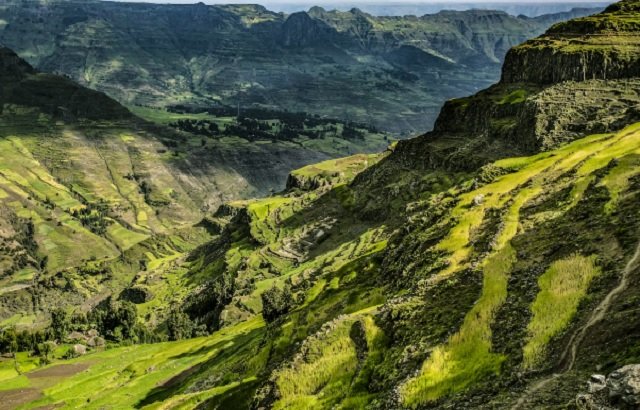
The Simien Mountains are one of the best trekking destinations in Africa. This national park is a UNESCO World Heritage Site and offers impressive landscapes: deep canyons, jagged peaks, rare plants, and unique fauna. Here you can find geladas (herbivorous monkeys with red spots on their chests), the Ethiopian wolf and the woodcock.
Routes through the park range from light walks to multi-day camping trips. The views from the plateaus and mountain passes are breathtaking, especially at sunrise or sunset. For trekking, you can hire local guides and porters, as well as rent a mule to carry things.
5. Lake Tana
Lake Tana is the largest lake in Ethiopia and the source of the Blue Nile. Its shores and islands are decorated with ancient monasteries, some of which were founded in the 14th century. They are reached by boat, and inside you can see icons, ancient manuscripts and wall paintings.
The most famous monastery is Ura Kidane Mehret, located on the Zege Peninsula. Tourists come here not only for the architecture and religious heritage, but also for the peaceful atmosphere of the lake, the opportunity to watch birds, go boating, or have a picnic on the shore.
6. Aksum
Aksum is one of the oldest cities in Ethiopia and the center of the legendary Aksumite kingdom. This is an archaeological wonder, where there are giant obelisks, ruins of palaces, and underground tombs. The most famous obelisk is a 24-meter granite stele, a symbol of ancient power.
Aksum is considered a sacred place for many Ethiopians. According to legend, it is here that the Ark of the Covenant is kept — in the chapel next to the St. Mary of Zion Church. Although entry into this chapel is strictly prohibited, the presence of the shrine is felt in the atmosphere of the city.
7. Omo Valley
The Omo Valley is a real open-air ethnographic museum. Dozens of tribes live here, each of which preserves its own traditions, language, rituals, and style of dress. The most famous are the Mursi, Hamer, Karo, and Dasanech tribes.
A trip to the Omo Valley is not just a journey, but a cultural immersion. Visiting villages, participating in rituals, observing everyday life and crafts provide a unique understanding of the diversity of human culture.
8. Arba Minch
The city of Arba Minch is located between two lakes — Chamo and Abaya — and is the gateway to the Nechisar National Park. This is a great place to observe crocodiles, hippos, pelicans, and other birds. The park offers safaris both by land and by water.
Especially impressive is the so-called “Crocodile House” on Lake Chamo, where you can see huge reptiles up close. It is also worth climbing the plateau, which offers a stunning view of the “Bridge of God” — a narrow strip of land between two lakes.
9. Erta Ale
Erta Ale is one of the few volcanoes in the world with a constantly active lava lake. The path to the crater requires climbing on foot and tolerance for heat and dust.
The nighttime sight of lava pulsating in the crater is memorable for a lifetime. This is one of those places where nature demonstrates its primeval power. The trip must be carefully planned and must be accompanied by experienced guides.
Conclusion
Traveling through Ethiopia leaves you with the feeling that in a single trip you have experienced several different worlds at once — from ancient stone temples and imperial cities to almost untouched natural landscapes and traditional settlements.
The more time you spend here, the stronger the feeling that Ethiopia is not just a tourist destination, but a place with a very deep and vibrant history that cannot be superficially understood.
Disclaimer: This article is a sponsored post. The inclusion of links to third-party services does not constitute an endorsement by Borkena. All content is provided for informational purposes as part of a paid arrangement.
Dear Sir,
Thank you for this beautiful itinerary.
Could you tell me what kind of transportation can We use to go to these wonderful places? I prefer to see also on the way the splendid panoramic view of the Landscape only by vehicle. Thank you.
How safe is Ethiopia currently to travel by car to the designated travel destinations? My friends tell me that,due to an active war going on to the Amhars, and Tigray, Oromia etc….regions, this itinerary may be difficult to accomplish it. Is it true? Thank you.