
By Serawit Adane
Under normal circumstances, the military is one of the core institutions of a country. It serves as the last line of defense for a nation’s sovereignty. A country with a strong, powerful, steady, and stable military institution is one that can stand firm in times of trouble and withstand fierce attacks from external forces.
World history offers numerous examples of strong empires: the great Alexander, Napoleon, the cannon-equipped British might, and, not least, the most powerful military force of the last 100 years—the American military institution, which protects the interests of global hegemony. Only this week we saw a military wonder, the U.S. military operation to capture Nicolás Maduro. In the early hours of January 3, 2026, the United States launched a large-scale, highly coordinated military raid-style mission called Operation Absolute Resolve to capture Venezuelan President Nicolás Maduro and his wife in Caracas. Over 150 U.S. aircraft (fighters, bombers, drones, and support planes) and special forces helicopters departed from multiple bases, suppressed Venezuelan air defenses, and flew low into Venezuelan airspace under cover of darkness. Delta Force and other special operations troops then rapidly assaulted Maduro’s fortified residence, overwhelmed his guards and seized him and his wife—reportedly within minutes—before flying them out to U.S. custody. That is a full military dominance and strength. Period. Does this follow international law? Hmmm, when you are the world, top military might, you have the privilege of doing whatever you want.
Ethiopia, too, has managed to build and sustain strong military institutions, both during the Derg era and under the TPLF-led government. In both periods, Ethiopia’s armed forces played roles that extended beyond the country’s borders, contributing to regional and international security efforts. The historic victory at Adwa remains a powerful testament to Ethiopia’s long-standing ability to organize and strengthen its defense system in the face of adversity and external pressure. While historians can offer detailed and nuanced accounts of these developments, this discussion will focus primarily on the structure, role, and significance of Ethiopia’s current military institution.
The Misplaced Role of the Military Institution
To begin with, Abiy Ahmed claims that he has reformed the military institution. During the Tigray war, he stated that he was building (and perhaps by now has built) a modern military force unlike anything Ethiopia has seen in the past hundred years. He also claims to be working on strengthening the Air Force to improve its capacity far beyond its forty-year history. Yes, we can see a massive headquarters building and other infrastructure. However, any critical thinker might ask: what has truly transpired since these reforms? Based on reports and what has been observed so far: (i) The military has been heavily involved in command posts over the past six years—first in Welega, then Tigray, and now in Amhara and Benishangul. (ii) The military has neglected its primary duty of protecting the country’s borders: in the northwest with Sudan, in the southwest with South Sudan, in parts of northern Ethiopia bordering Eritrea, and in the south along the Somalia and Kenya borders.(iii) There has been a noticeable decline in Ethiopia’s engagement as a UN peacekeeping force, despite its previous strong reputation. In short, the military is primarily responsible for safeguarding national sovereignty and territorial integrity. Its core functions include: defense against external threats – protecting the country from foreign aggression and invasions; maintaining internal security – assisting in stabilizing internal conflicts when necessary, under constitutional limits; disaster response and humanitarian aid – providing support during natural disasters and emergencies; and peacekeeping and international cooperation – participating in global peacekeeping missions and alliances. Looking at the facts on the ground over the past six years, the role of the military in the country has been grossly misplaced.
Consequences of the Misguided Role of the Military Institution: Suffering soldiers
The consequences of these activities are evident to anyone who carefully tracks and compiles statistics on conflicts and wars. How many young soldiers have died in clashes with OLA in Oromia, during the two-year war in Tigray, and in the ongoing three-year guerrilla-style fighting in the Amhara region? How many have been wounded? How many have been captured? Is the government transparent with the public about these figures?
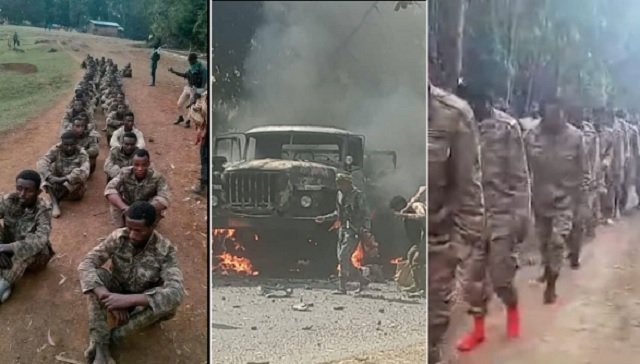
During the Tigray war alone, tens of thousands of soldiers were killed. Some estimates suggest more than 300,000 deaths, while TPLF forces reportedly lost over 600,000 young fighters. What about the continuous conflicts across Oromia since the day Abiy came to power? What about the nearly three-year-long conflict with Fano forces? How many young lives have been lost? How many have been wounded or left broken in the mountains of the Amhara region? Videos and images shared over the past three years offer glimpses of the dead, wounded, and captured. Who truly cares about these young lives being destroyed nonstop for the past six years?
This week, on one of the war fronts in the Amhara region, hundreds of soldiers were captured in a single day. Among them, a young Oromo soldier from the Harar area was heard saying that the military is drafted and that no one has the energy or will to fight. He revealed that he is a 9th-grade student who was forcibly taken into the army. We have heard that Abiy has almost lost most of the army, and now he is sending soldiers from Oromia, among the million recruits prepared by Obbo Shimelis even before the Tigray war, as part of the national army. These precious lives are being destroyed every day in unfamiliar fields and terrains. Meanwhile, the cadres, those few in power, and their paid media propagandists will claim that such narratives are anti-government, anti-military sentiment, or even label critics as ‘Banda’ or ‘bada’—defectors. But who is the real defector? Who is selfish and merciless toward their countrymen? Who is blind and self-serving here? Can they truly sleep peacefully at night with a clear conscience, or only with substances and extra drinks?
Abiy has stated on national TV and social media several times that it is easy to recruit, or even forcibly seize, a million youth every year and send them to war. He seems to believe that Ethiopia’s population of 130 million is excessive and can be exploited for such meaningless massacres as long as his power is preserved. How can these generals count the dead and wounded and still sleep peacefully at night? How can they be so corrupt and criminal that they are willing to undermine the institution to such a level? Why are they not thinking about the precious lives of all those young people they forcibly take and send to endless destruction?
What could be the root cause of this moral decay?
Why have they decided to send the army to kill the poor and disadvantaged in the country? Against whom are they really fighting, the people of Ethiopia? Have they all been bought with money and other incentives to destroy the nation and its people? As the saying goes, “The love of money is the root of all evil.” Is it the UAE or other foreign forces that hold their souls captive, ensuring Ethiopia and Ethiopians remain weakened in the Horn of Africa for decades to come? The strength of any military lies in its morality. The patriotic nature of a military institution is founded on moral integrity. How low is the morale of this institution today? Forget the corrupt generals who have been bought with money, land, property, who come on national TV shows, and social media, to propagate empty propaganda. Listen to the soldiers, the thousands captured by Fano. You will hear their agony, the meaninglessness of their mission, their lack of motivation, and their confusion about why they are fighting their own people, acting like a terrorist force in villages and mountains far from the capital city, areas the Western media have deliberately underreported or ignored. Sometimes it feels as though not only the UAE controls Abiy and his circle, but Western forces are also complicit, ensuring the country suffers endlessly. It should not be just about keeping one man in office; there should be a bigger picture. This man’s soul appears to be bought by others, serving only their interests. That may be the only explanation for why they allow him to kill millions without accountability.
A call for the people of Ethiopia
The agony of our country’s youth must be heard. Ethiopia, please save your youth—they are your future. Respect their lives. Stop this madness of recruiting young people every three months and sending them to destruction. Why have the people of Addis Ababa become so indifferent that they do not want to know the reality in most parts of the country? How can a nation survive if the next generation is continually being sent to annihilation? Ethiopia’s population of 130 million is not that large, it is not like India or China. It is not even half the population of Indonesia and only about half that of Nigeria. Why are these leaders fixated on reducing the population? If a proper government and administration were in place, all these youth could build the nation’s economy. Furthermore, the dignity of the country’s military institution must be restored. A country is strong and safe when these two pillars, its youth and its military, are empowered and supported by its people. It is time to ask hard questions.
Editor’s Note : Views in the article do not necessarily reflect the views of borkena.com
__
Support Borkena : https://borkena.com/subscribe-borkena/
Join our Telegram Channel : t.me/borkena
Like borkena on Facebook
Borkena Ethiopian News Youtube Channel
To submit Press Release, send submission to info@borkena.com
Add your business to Ethiopian Business Listing / Ethiopian Business Directory
Join the conversation. Follow us on X (Formerly Twitter) @zborkena to get the latest Ethiopian News updates regularly.