
The Abiy government faces an increasingly difficult political and military environment. Tigray forces have seized Mekelle’s Alula Aba Nega Airport, and Ethiopian Airlines has suspended flights to Mekelle, Axum, and Shire. In recent weeks, Fano forces have been capturing senior Ethiopian military officers in greater numbers and with greater frequency than before. Together, these developments point to a serious deterioration in the government’s security position.
A growing number of government officials are also relocating their families to Western capitals. In a recent speech, Field Marshal Birhanu Jula revealed that his wife and children are out of the country (video). His revelation came on the heels of new restrictions on exit visas for government officials and their family members.
The economic picture is just as troubling. Social media is filled with accounts from university valedictorians and gold medalists who say they remain unemployed two or three years after graduating. The government’s official economic data have lost credibility. In 2025, the World Bank has declined to assign Ethiopia an income classification. In 2026, The UN-FAO and UN-WFP excluded Ethiopia from their global food-crisis report because its data did not meet their standards. This is the politically correct way of saying the government’s economic data is fake.
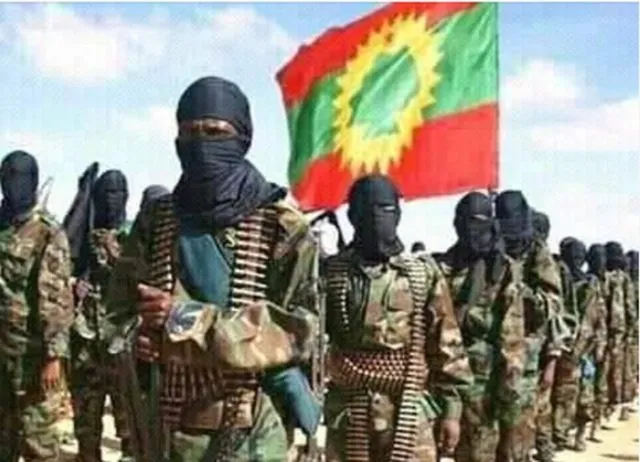
Against this backdrop, it is worth examining the shifting balance of power between the government and the opposition alliance, and in particular the position of the Oromo Liberation Army (OLA).
Pushed into a corner, Abiy Ahmed is relinquishing the center of Ethiopia’s ethno-nationalist–pan-Ethiopianist spectrum. His government is moving toward Oromo-nationalist positions, most visibly on the status of Addis Ababa and the federal role of Afaan Oromo. That shift may buy Abiy temporary relief from hardline Oromo pressure, but it also opens space for the OLA to reposition itself.
In a recent interview with Kush Media, Habtamu asked the OLA spokesperson Jiregna Gudeta:
“Oromo people are asking why the OLA joined the Amhara–Tigray alliance at this particular time, when the PP government is working toward making Addis Ababa the capital of Oromia and Afaan Oromo a working language of the federal government?”
Jiregna responded that the OLA would remain in the alliance despite heavy pressure from the extremist Oromo camp.
Whatever the OLA’s ultimate objective, this is a consequential choice, and it can be read in two ways: (1) as a leverage play or (2) as a transformation play.
A Leverage Play
If the OLA’s immediate goal is to extract maximum concessions from the Prosperity Party, remaining in the coalition gives it significant tactical leverage. It signals to Abiy that symbolic or cultural concessions will not satisfy its political demands. Political restructuring, power-sharing, control of the Oromia regional administration, and the distribution of federal power all remain on the table. Simply put, the OLA can bargain from a position in which accepting whatever the government offers is not its only alternative.
A Transformation Play
The fact that Abiy is caught between a rock and a hard place gives the OLA the upper hand. On the one hand, Abiy is embracing hardline Oromo positions; on the other, his government keeps delaying any attempt to implement them. For example, the National Dialogue Commission was supposed to present its report on or before September 20. After the alliance gained traction, however, the report appears to have been delayed.
Even extremist figures such as Jawar Mohammed are openly advising the government to shelve controversial decisions on Addis Ababa and on making Afaan Oromo an official language. Under such circumstances, why should the OLA vie for the extremist position? Doing so would only consign it to irrelevance.
If the OLA’s longer-term goal is to become a principal actor in a post-Abiy political order, remaining in a broad, multi-ethnic alliance serves an even larger purpose.
A significant portion of the Oromo public is exhausted by conflict and increasingly focused on peace, security, jobs, and economic stability. By resisting pressure to leave the alliance, the OLA distinguishes itself from those demanding maximalist Oromo positions at any cost.
This is where the equation becomes especially interesting: the OLA may be moving into the political middle just as Abiy moves out of it.
Why the OLA Has Reason to Stay in the Alliance
The OLA may be the weaker military partner relative to Fano and the TPLF, but its Oromo constituency gives it considerable political weight. Its participation also gives the alliance a national character, making it harder to dismiss the coalition as an Amhara–Tigray project. When the alliance negotiates its own internal arrangements, that constituency will give the OLA leverage well beyond its battlefield strength.
Second, the National Dialogue has exposed how deep Ethiopia’s disagreements run. The Commission was designed to identify issues requiring national consensus, yet its scheduled September 20 presentation has been postponed. Whatever its eventual outcome, the process underscores a basic reality: no single ethnic constituency can impose its preferred constitutional order on the rest of the country. That reality rewards actors who can build coalitions across ethnic lines.
Third, Oromo society is not politically monolithic. There is no single Oromo position on Addis Ababa, federal power, language policy, territorial questions, or the future constitutional order. Many Oromos have legitimate grievances, but that does not mean they want an endless cycle of ethnic confrontation. This creates an opening for the OLA.
The Abiy Dilemma
As noted above, Abiy is caught in a bind. He has accommodated enough of the hardline Oromo agenda to unsettle the political center, but not enough to satisfy the hardliners, who continue to press him publicly on Addis Ababa’s status and the federal role of Afaan Oromo. He risks losing the middle without winning the flank.
That raises an obvious question for the OLA: why compete for hardline space that is already crowded and that the governing party itself is now contesting? Doing so would only erode the OLA’s distinctiveness.
Its greater opportunity lies elsewhere: defending Oromo interests while presenting itself as a participant in a broader Ethiopian settlement. That would let the OLA compete for the middle ground rather than fight for the most extreme position on either end of the spectrum.
The Political Irony
The irony is striking. An armed Oromo movement may be positioning itself as the more pragmatic political actor just as the governing party loses its claim to the middle.
The strategy carries risk. Sustained hardline pressure could split the OLA’s own ranks, and its insurgent record will not be quickly forgotten. But if the OLA can hold its alliance together while resisting narrow ethnic positioning, it could gradually transform its political identity from an insurgent organization into a consequential political interlocutor.
That would not automatically make the OLA legitimate in the eyes of all Ethiopians or international stakeholders. But it could substantially change how it is perceived and the bargaining power it brings to any future transition.
The central question, then, is no longer simply whether the OLA can win militarily. It is whether the OLA can convert its military alliance into political leverage, and then convert that leverage into a credible claim on Ethiopia’s political middle.
If it succeeds, the political upper hand may come not from controlling the most territory or fielding the largest army, but from occupying the political space everyone else has abandoned.
Fano’s and the TPLF’s Role in Shaping the Political Dynamic
The OLA’s political leverage cannot be understood in isolation from the two other major forces in the alliance: Fano and the TPLF. Together, the three create a tripod of power that spans Ethiopia’s major demographic and political blocs. This tripartite arrangement gives the alliance unprecedented national weight and prevents the government from easily framing the resistance as a localized or single-ethnic uprising.
However, this dynamic also introduces inherent tensions. Fano and the TPLF harbor unresolved disputes over administration, borders, and constitutional arrangements. For a deeper look at this dynamic, read my article “The Promises and Pitfalls of Ethiopia’s Anti-Abiy Alliance.”
Editor’s Note: Views in the article do not necessarily reflect the views of borkena.com
__
Join our Telegram Channel: t.me/borkena
Like borkena on Facebook
To submit a press release, send the submission to info@borkena.com
Add your business to Ethiopian Business Listing / Ethiopian Business Directory
Join the conversation. Follow us on X (formerly Twitter) @zborkena to get the latest Ethiopian news updates regularly.