
The man born to destroy the life of millions, What a cursed life?
By Alula Yinager
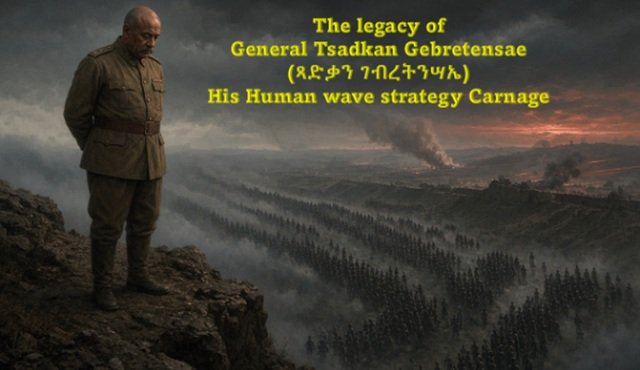
General Tsadikan is known for his military strategy called the “human wave” tactic. This involves using masses of soldiers to engage the opposing force head-on, regardless of the opponent’s weapons, the geography of the battlefield, the relative military strength of the two sides, or the potential cost in human lives. Even when his fierce enemies have built strong, fortified trenches and other defensive positions, Tsadikan continues to use the human-wave tactic, sacrificing the lives of thousands or even tens of thousands of young people in a single war. Let us examine three pieces of evidence supporting this claim.
1. The Evidence from the Ethiopia–Eritrea War, 1998–2000
The Ethiopia–Eritrea War provides some of the clearest historical evidence for examining the question of mass-casualty offensive warfare. The conflict began in 1998 and was fought principally around Badme, Tsorona-Zalambessa, and Bure. Human Rights Watch documented repeated cycles of major offensives, withdrawals, and renewed attacks. In February 1999, Ethiopia broke through Eritrean defenses around Badme, while Eritrean forces subsequently inflicted heavy casualties on Ethiopian troops around Tsorona. The conflict escalated again in May 2000, when Ethiopia launched a major offensive deep into Eritrean territory. Human Rights Watch reported that Ethiopian authorities appeared prepared to accept very large numbers of casualties in order to dislodge Eritrean forces, including reports of human-wave attacks.
In conversations with people who participated in the war, one fighter recalled being in a fortified trench and watching large numbers of Ethiopian soldiers advance toward what he described as their slaughter. He remembered that the soldiers kept coming until the defenders became exhausted from shooting and killing so many of them. He described the battlefield as being flooded with soldiers being sent into what appeared to be a massacre. The broader casualty figures are also disputed. One Eritrean government publication gives Ethiopian losses between 70,000 and 130,000 soldiers and Eritrean losses at approximately 19,000, while other historical estimates differ. The official Ethiopian data accounts that the person alleged to have been behind this strategy was General Tsadikan, who is said to have sacrificed more than 70,000 Ethiopian soldiers during the war. Following the conflict, he lost his position, reportedly because of the enormous number of lives lost under his command.
2. During the Tigray War with the Federal Government, November 2020–November 2024
During the Tigray War, there were three major rounds of fighting over a period of roughly two years. The first began when the Northern Command was attacked by TPLF forces. The federal government galvanized support from inside and outside of the country and faced TPLF forces. This led to the capture of Mekelle and other parts of Tigray by the combined forces of the Ethiopian federal government and its allies. The second round began about eight months later. During Operation Alula Aba Nega, TDF forces drove the Ethiopian military out of Tigray, inflicting a major military and political humiliation on the federal forces. General Tsadkan returned to the center of the military effort once again. As widely reported, Tigrayan forces launched a major offensive in June 2021, retaking Mekelle and large parts of Tigray. Reports identify General Tsadkan as a senior commander of the Tigrayan forces during this phase. The third round of the conflict followed. TDF forces, under Tsadkan and other commanders, sent hundreds of thousands of fighters into the Amhara region during the second and third rounds of the war, using the HUMAN WAVE tactic again. They captured and advanced through numerous towns, eventually reaching areas around Debre Sina, within relatively close proximity to Addis Ababa, before withdrawing back toward Tigray.
During both the advance and the subsequent withdrawal, many thousands of TDF fighters reportedly lost their lives. The forces repeatedly relied on large-scale frontal assaults to advance toward Addis Ababa. General Tsadkan was again at the center of this military campaign. During this period, Tigray reportedly lost approximately 650,000 people, while casualties on the government side have been estimated at around 350,000 soldiers. Together, these figures would represent close to one million lives lost in the conflict in the country. The government also used UAE drones to strike TDF forces when they were advancing in large formations. Given the enormous scale of the casualties, an important question is: What military strategy contributed to such a devastating loss of life? One explanation put forward is the use of large-scale frontal assaults, or “human-wave” tactics, which critics attribute to General Tsadkan’s military strategy. His role in directing these operations therefore remains central to this argument.
3. The Current Ethiopian Military Movement Toward Mekelle and beyond
The present situation gives this historical question renewed importance. But the setup is totally different. The formation of seven coalition forces against Abiy Ahmed Ali’s forces, who is again backed by countries such as the UAE, has fundamentally changed the situation. Abiy Ahmed Ali hijacked the Pretoria Agreement by literally hijacking the three people who were representing Tigray: Tsadkan, Getachew Reda, and Tadesse Werede. These were the people in Pretoria, Captown, and elsewhere negotiating their lucrative lives with the genocider Abiy Ahmed Ali, in the words of Getachew Reda himself. Abiy Ahmed Ali always takes pictures and videos with these people as if he is respecting the peace treaty, while he is preparing and cooking another war to humiliate the Tigray forces and the Tigray people again. This time, he managed to get a few of these people to stand with him, one of them is General Tsadikan, the Human wave strategy expert. Abiy Ahemed Ali has literally bought him. But against Abiy Ahmed Ali, seven coalition forces, Fano, TDF, OLA, and four other forces, have united to throw him out of 4-Kilo. As of 29 September 2026, fighting has again escalated across northern Ethiopia. The TPLF and federal government have accused each other of initiating the latest escalation, and fighting has spread across Tigray, Amhara and Afar. But the Allied forces against Abiy Ahmed Ali are winning it on many fronts.
Abiy Ahemd Ali is terrified. He has turned to General Tsadkan’s advice. He has discussed and planned with him for months, intending to use the cursed and evil wisdom of General Tsadkan. Tsadkan pledged his signature war strategy: the human wave. Abiy has no problem gathering young soldiers from the streets, mostly from the southern nations and ethnic groups. Abiy Ahmed Ali, the number one 21st century terrorist on the planet, has said himself that he can train one million youths easily within a few months in a country of 130 million people. Yes, he can do that in a country where most of the population is young and poor. Now, two human-life destroyers have joined forces. One provides the human resources and the money, controlling the bank and tank; the other plans the carnage. As reported elsewhere, General Tsadkan is leading Abiy Ahmed Ali’s war, and they have placed more than 250,000 forces at Kobo, and they are marching along the highway toward Mekele. The human wave is now marching along a road supported by huge military infrastructure. Along this route are cities such as Alamata, Maychew, and Mehoni before reaching Mekele. Abiy Ahmed Ali’s propaganda machine is working day and night, claiming that they are celebrating the capture of these places. But what is happening along the way? They do not say it.
What is going on? The Awash River dies as it travels, a consequence of the mobile war strategy!
The TDF forces, together with allied forces, are using a strategy to cut off the forces and slowly eliminate them. This war strategy can be compared to how the Awash River slowly loses its flow without joining the ocean like the Nile River does. The river dies out after traveling roughly 1,200 kilometers (750 miles) northeast from the Ethiopian highlands, eventually emptying into a series of terminal salt lakes. This mobile strategy has been used by Fano forces for the past three years. Abiy Ahmed Ali’s forces have been humiliated over the past three years with this strategy.
Now, the TDF is creating a salt-lake type of situation for Abiy Ahmed Ali and General Tsadkan’s human wave, which is simply traveling along the road to Mekele. It is just like a river, like the Awash, traveling along a particular path. The longer the river travels through salty land, the weaker the river becomes until it eventually dies out. Dr. Debretsion said, “We fight the enemy at the right place and the right time.” He added that it is a mobile war. For Abiy Ahmed Ali, his childish dream is to go to Mekele and take pictures again, like in 2020, and, if he can, he wants to go to Asab as well. The longer he travels, the better it is for the coalition forces, since from Addis Ababa to Mekele and beyond, Abiy and his generals have no support everywhere. The people are against them. It is just a matter of time. There is war from the outskirts of Addis Ababa to Mekele. Right now in every part of the path Abiy Ahmed Ali force traveling is a carnage war destroying this senseless human wave. Even Addis Ababa is bombarded with drones that the Abiy Ahmed Ali military system has no idea.
The result of General Tsadkan’s human-wave strategy will be a disaster for young people, something we have seen in our lifetime again and again. Maybe another million lives now? This is just because one so-called general is asked again and again by ruthless people. What kind of life is this? What kind of purpose is there in living this way? To be an instrument to wipe out tens of thousands, or hundreds of thousands, or millions in your lifetime. This is a cursed life. History will judge this man. He will be remembered as a person who was able to destroy the lives of millions during his lifetime. For him, joining another genocider, Abiy Ahmed Ali, is another unfortunate circumstance for Ethiopians.
Editor’s Note: Views in the article do not necessarily reflect the views of borkena.com
__
Join our Telegram Channel: t.me/borkena
Like borkena on Facebook
To submit a press release, send the submission to info@borkena.com
Add your business to Ethiopian Business Listing / Ethiopian Business Directory
Join the conversation. Follow us on X (formerly Twitter) @zborkena to get the latest Ethiopian news updates regularly.