
By Fikeru Zewdie
What happens when the global system becomes more capable of managing fragility than resolving it?
Across the world, governments, institutions, and international partners increasingly confront a difficult challenge: how to preserve stability in environments experiencing deep political, social, and institutional strain.
In many cases, the immediate priority is understandable. Prevent collapse. Reduce violence. Maintain economic continuity. Preserve basic governance functions. Support humanitarian access. Avoid regional instability.
Yet an important question often remains unanswered:
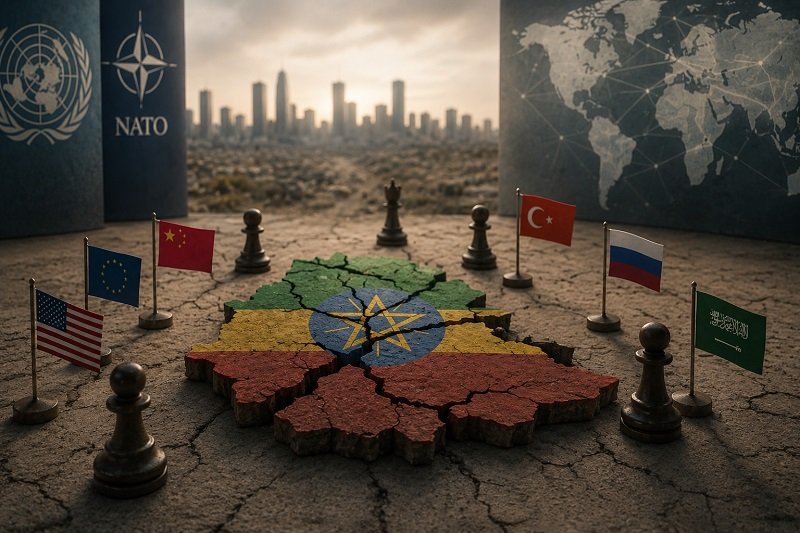
What happens when stabilization becomes the destination rather than the bridge? This paper introduces a framework I describe as The International Normalization of Fragility.
The concept refers to a growing tendency—both domestically and internationally—to manage institutional fragility rather than structurally resolve it. Systems continue functioning. Governments remain operational. Elections may proceed. Diplomatic relationships endure. Economic partnerships continue.
Yet beneath this appearance of continuity, deeper questions often remain unresolved:
● public trust,
● institutional legitimacy,
● civic cohesion,
● accountability,
● and the relationship between citizens and the institutions that govern them. The result is a condition in which fragility does not disappear. It adapts.
Governance Without Legitimacy
Legitimacy is not the same as authority. Authority is the ability to govern. Legitimacy is the public acceptance of that authority as fair, justified, and worthy of trust.
A government may continue functioning administratively while public confidence weakens. Institutions may remain present while their credibility becomes increasingly contested. Elections may occur while citizens question whether meaningful change remains possible.
This creates a condition that can be described as governance without legitimacy. The danger is not immediate collapse.
The danger is gradual erosion.
Trust declines slowly. Participation weakens. Institutions lose credibility. Citizens increasingly adapt to conditions they no longer fully believe in. Over time, instability becomes normalized.
Stabilized, Not Reconstructed
A stable government is not always the same thing as a stable society.
Administrative continuity, diplomatic recognition, economic assistance, and security cooperation can help preserve order. In many circumstances, these measures are necessary. However, stabilization alone cannot reconstruct legitimacy.
Legitimacy emerges when citizens believe institutions operate fairly, apply rules consistently, protect rights equally, and provide meaningful avenues for participation and accountability.
Without these foundations, fragility may remain managed without ever being resolved. The result is not reconstruction.
It is stabilization without renewal.
Reconstruction Before Erosion Becomes Irreversible The central concern of this framework is not revolution.
It is reconstruction before erosion becomes irreversible.
The challenge facing fragile societies is not merely preserving institutions. It is restoring confidence in them.
Long-term stability depends upon:
● credible institutions,
● equal protection under law,
● accountability,
● civic trust,
● reconciliation,
● and meaningful public participation.
It must support institutions citizens can believe in, protections they experience equally, and reconciliation communities recognize as credible.
Conclusion
This framework is not limited to any single country.
It raises a broader international question:
What happens when the global system becomes more capable of managing fragility than resolving it?
The answer may determine not only the future of individual states, but the future of legitimacy itself.
The central concern is not revolution.
It is reconstruction before erosion becomes irreversible.
Adapted from the forthcoming book:
The International Normalization of Fragility: Ethiopia’s Crisis of Legitimacy and Institutional Fragmentation
__
Editor’s Note : Views in the article do not necessarily reflect the views of borkena.com
__
Join our Telegram Channel : t.me/borkena
Like borkena on Facebook
To submit Press Release, send submission to info@borkena.com
Add your business to Ethiopian Business Listing / Ethiopian Business Directory
Join the conversation. Follow us on X (Formerly Twitter) @zborkenato get the latest Ethiopian News updates regularly.
To Support Borkena : https://borkena.com/subscribe-borkena/ – one time support or small monthly options available. Inquire information about it : info@borkena.com