
A sociological and political analysis of power collapse, religious division, and the path towards reconstruction in Ethiopia
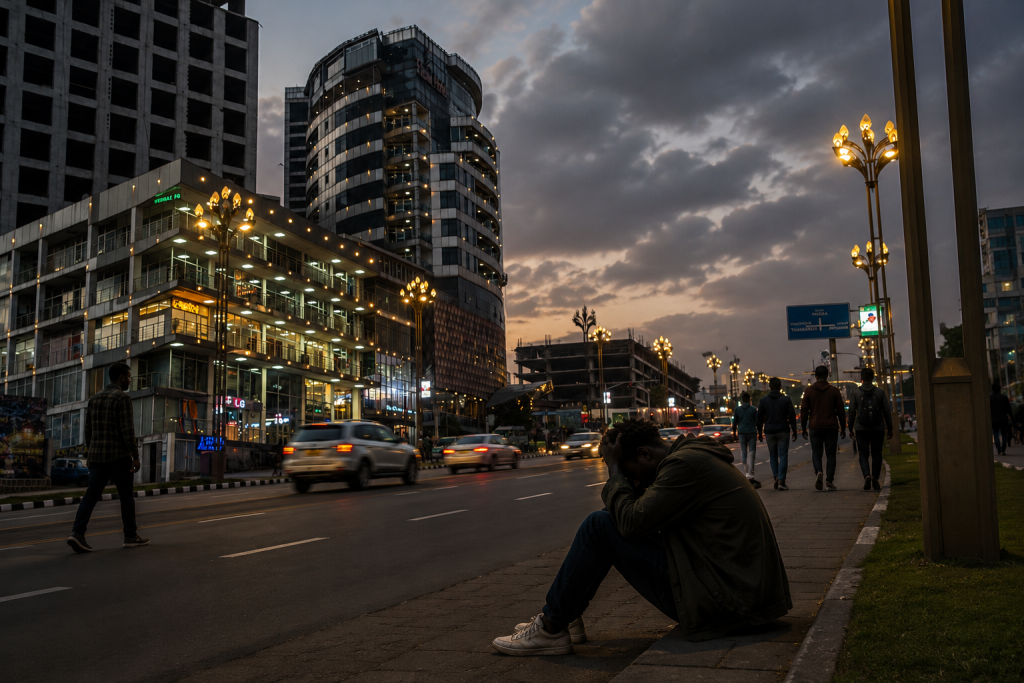
By Berhutesfa
Denmark
It can be argued that modern society is gradually losing its inherent humanity, its social cohesion and the ability to cultivate a good life for its citizens. To understand this development, one can borrow a concept from biology, namely the process of decay and decomposition. In nature, decay refers to the inevitable decomposition of organic matter, whether plants or living organisms, which lose their vital vitality and begin to disintegrate. This biological process serves as an accurate picture of the social erosion we are witnessing today. Change is a basic condition for all living things, but when an element is isolated from its source, decay begins. Just as a fruit that falls from the tree first loses its freshness, then rots and smells, and finally becomes toxic and unhealthy for its surroundings, so too can a society erode when its supporting pillars fail.
This process of degradation is clearly reflected in the age of social media. A healthy and stable society is supported by common manifestations, solid values and mutual credibility. These social norms are fertile and morally grounded, and they form the very foundation of the rule of law and democracy, which makes a peaceful and harmonious life of society possible. When these norms erode, however, a state of instability and discord arises, which raises the urgent petition: How can we rebuild and unite a fragmented community? Part of the answer and inspiration is to be found in historical and philosophical currents, including the idea of the equal and democratic citizenship, which historically has served as a guideline for the development of society.
Neither a community nor the institutions that are supposed to serve it are static or unchangeable entities. A community is a dynamic organism that is constantly changing, growing and shaped by the political currents and regimes in power. This design should ideally be in accordance with constitutional principles, as seen for example in the American constitutional tradition. The political dimension of this decay draws threads back to classic democratic dilemmas. When the institutions that were originally created to protect freedom instead begin to polarize the population, democratic legitimacy is weakened. From a historical perspective, we see that democracies rarely collapse overnight through military coups; Rather, they erode from within, as the written and unwritten norms are gradually set aside for short-term political gain.
When political actors begin to regard the opposition as an existential threat instead of a legitimate counterpart, society is locked into a paralyzing crisis and political chaos. If the current regime undermines society’s democratic rules of the game and terrorizes public debate, a destructive circle is created in which citizens’ rights and freedoms are curtailed. This creates a paradoxical political climate of mutual mistrust, in which democratic actors end up fearing each other and the very system they are supposed to protect. If the government fails in its core task – protecting citizens’ freedoms – it poses a direct threat to the country’s internal stability and its external alliances.
This decay must be understood as a gradual process in which society slowly harms itself. It is a sign of a deep crisis of civilisation, in which society is crumbling from within, as social insecurity and mutual mistrust between citizens grow. A well-functioning social order requires a unifying force. This power is created through a living, social vision that ensures that no citizen is elevated above the community and that justice is done under the law. When this vision fails, it is replaced by a scapegoat culture, where the faults of one are projected onto the other, and where legal equality is undermined.
Ethiopia as an empirical example of state collapse and totalitarian anomie
When the theoretical framework of societal erosion is to be demonstrated in reality, the current situation in Ethiopia constitutes a shocking and topical case study of total Dys’s functionality, lawlessness and anarchy. Ethiopia has been plunged into a devastating nationwide civil war, whose roots can be traced directly back to the country’s own constitution. Through the system of ethnic federalism, the state has been divided into regions based on ethnicity. This has created a destructive institutionalization of an “us against them” dichotomy, in which the various states no longer cooperate, but instead compete and wage war against each other.
This structural division has been further exacerbated by the extreme centralisation of power in the hands of Prime Minister Abiy Ahmed. The regime has developed in a distinctly totalitarian direction, where the prime minister has effectively risen above the law. The traditional parliamentary chain of control, which ensures the separation of powers between the legislative, executive and judicial powers, has been completely abolished. Control is monopolized in the hands of a single leader, which has reduced state institutions to mere tools for personal and political agendas. The current government has lost the ability to treat the country’s citizens with equality and justice, and the central power has effectively lost control of the territory. The government’s authority today does not really extend much further than the borders of the capital Addis Ababa. This power vacuum has left the rest of the country in a violent anarchy, with the ethnic states fighting each other, with disastrous humanitarian consequences.
Alongside the political and military collapse, the country’s economy has completely collapsed. Inflation is rising uncontrollably, and all-encompassing poverty is now affecting the majority of the population, which
has effectively dissolved the economic livelihood. In this environment of absolute anomie, crime has exploded. Lawlessness has materialized in an organized kidnapping industry; Civilian buses traveling between states are now hijacked almost daily by armed groups demanding ransoms of millions of local currency (Birr). The population lives under constant conditions of terror, where the state can no longer guarantee the most basic physical security.
The Dissolution of the Social Glue: Religious Division and the Prosperity Gospel
Historically, religion has served as a crucial social glue in Ethiopia, managing to bind the population together across deep ethnic divides. However, this stabilizing factor has also broken down. Religious institutions and religious communities, which used to form bridges between the groups, have been drawn into the conflict and are now fighting each other internally.
This sectarian division is exacerbated by the fact that certain religious currents are granted special privileges under the current regime. Prime Minister Abiy Ahmed is closely associated with the theological movement Prosperity Gospel . This theology, which preaches that material wealth and political success are direct signs of divine blessing, has in effect been elevated to a semi-official state ideology through the ruling Prosperity Party. By legitimizing inequality and portraying the position of those in power as cosmically justified, a deep chasm is created between the elite and the suffering population. This favouritism towards specific religious networks undermines the principle of religious neutrality, erodes mutual trust and reinforces feelings of alienation and injustice among the over-forgotten populations.
This Ethiopian example also exposes a glaring moral failure in the global social order. Although Western countries and international organizations are fully aware of the horrors that are unfolding – including systematic genocide, widespread sexual abuse, constant kidnappings and an all-out civil war – concrete action is not being taken. The geopolitical reluctance to intervene testifies to a global passivity, where strategic and economic interests are given priority over the protection of fundamental human rights. The international indifference to the suffering of the Ethiopian people cements the image of a global community that, like the local one, has lost its moral compass needle.
Sociological Deconstruction: Foucault and Durkheim in an Anarchic Context
When we analyze why the modern individual may feel a certain fascination with or powerlessness in the face of a society in moral disintegration, we must turn to sociology. Today, fear has become a central focal point for social organization, demarcation and shifts in the balance of power. Sociological theories can help us deconstruct and understand this process. Society’s solidarity can be eroded to such an extent that social harmony is replaced by the cynical logic of the power game. Under totalitarian regimes or in dysfunctional states, we see how this dynamic extends all the way into the control of the human body and consciousness, drawing clear threads to Michel Foucault’s theories of biopower, discipline, and the subtle structures of power.
Foucault argues that modern power is no longer only exercised through visible, physical violence from a sovereign ruler, but has become diffuse and internalized in the individual. Power works through institutions – such as the education system, the healthcare system and the digital infrastructures – that subtly shape our behaviour, body and consciousness. In a context of authoritarian control and religious manipulation (as through the Gospel of Prosperity), ideological structures are used to discipline the population and stifle the opposition. This constant oppression creates a deep, existential fear of survival. Paradoxically, this surveillance and control does not lead to stronger communities, but rather to an isolation of the individual. When solidarity is replaced by constant competition and mistrust, the moral basis for the common good disappears.
Structural options for the reconstruction of the rule of law
Reversing this trend and resolving the deep Dys functionality in a state like Ethiopia requires a series of fundamental, long-term and structural transformations. The problem cannot be solved with superficial political compromises; This requires a total reconstruction of the institutional architecture of society:
1. Restoring the separation of powers and the rule of law: The precondition for any stabilization is the dissolution of the totalitarian concentration of power. The executive, legislative, and judicial branches must be constitutionally separated, so that no individual—including the prime minister—is above the law. Independent courts and anti-corruption bodies must be established to hold those in power accountable and protect citizens’ fundamental freedoms from state abuse.
2. Constitutional reform and a break with ethnic federalism: The current constitutional structure, which divides the country into warring ethnic enclaves, must be reformed. There is a need to move towards a geographical or democratic federalism that values the common, equal citizenship over ethnic affiliation. This will weaken the “us against them” dichotomy and reduce the incentive for the regional states to wage war among themselves.
3. National dialogue, inclusion and truth reconciliation: A comprehensive, neutral and internationally monitored national dialogue process should be initiated. This process must include all ethnic and political groupings in order to create a new social contract. Following the example of other post-conflict states (e.g. South Africa), a Truth and Reconciliation Commission must be established to process the severe trauma of genocide and civil war.
4. Separation of church and state and secular mediation: In order to restore religion’s role as a civil glue, the state must completely refrain from privileging certain denominations or ideologies such as the Prosperity Gospel. Absolute freedom of religion and secular equality before the law must be guaranteed. Independent, interfaith councils must be established to mediate internal religious conflicts and rebuild interfaith social ties.
5. International engagement and humanitarian intervention: The international community and the Western powers must break their passivity. Targeted diplomatic and economic pressure must be exerted on the regime through sanctions against those responsible for war crimes. At the same time, coordinated international action is required to stabilize the economy, curb inflation and provide direct humanitarian aid outside corrupt state channels.
This kind of social erosion, as it plays out in the Western world in the form of moral fragmentation, and ultimately in Ethiopia as raw anarchy and totalitarian collapse, finds its ultimate theoretical framework in Émile Durkheim’s sociological theory of anomie. The concept of anomie explains precisely how the total rupture of society’s moral, legal and social regulation leads to the alienation of the individual, the dissolution of social ties and ultimately to a complete and fatal dissolution of society. Only through a radical institutional and moral reconstruction can anarchy be overcome and replaced by a just social order.
Editor’s Note : Views in the article do not necessarily reflect the views of borkena.com
__
Join our Telegram Channel : t.me/borkena
Like borkena on Facebook
To submit Press Release, send submission to info@borkena.com
Add your business to Ethiopian Business Listing / Ethiopian Business Directory
Join the conversation. Follow us on X (Formerly Twitter) @zborkenato get the latest Ethiopian News updates regularly.
To Support Borkena : https://borkena.com/subscribe-borkena/ – one time support or small monthly options available. Inquire information about it : info@borkena.com