 and its allies strategic Military Alliance, Could Bring Down Abiy Ahmed...Read.)
Nama Nekemto
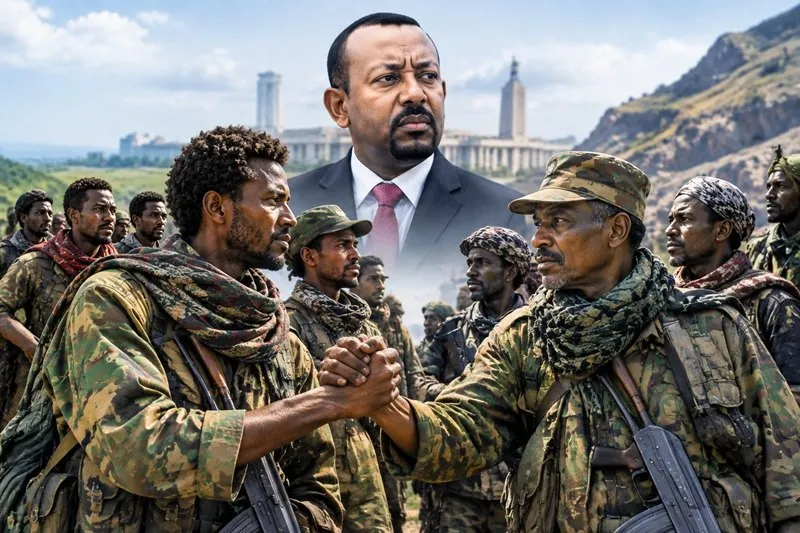
The unfolding political landscape in Ethiopia appears poised for a profound transformation, driven by recent developments concerning the Amhara Fano National Movement (AFNM), Tigray People’s Liberation Front (TPLF), Oromo Liberation Front (OLA) and other alliances. These emerging dynamics suggest a critical juncture that could precipitate a substantial and perhaps irreversible shift in national governance and regional stability. The current administration’s strategy regarding armed opposition has seemingly triggered a significant recalibration of both domestic and international allegiances.
Entities traditionally considered supportive of the central government, including Eritrea, Sudan, and Somalia, are now reportedly exhibiting signs of heightened tension or pursuing divergent interests, rather than maintaining cooperative engagement with Prime Minister Abiy Ahmed’s leadership. This evolving geopolitical configuration has undeniably drawn the administration into a multifaceted array of challenges, spanning both military and diplomatic spheres.
Attempts to initiate dialogue with the TPLF, reportedly facilitated by international diplomatic missions approximately two weeks prior and continuity, have unfortunately failed to yield constructive outcomes. Multiple drone attacks in the Tigray region rather than ameliorating tensions, have further compounded an already precarious situation, seemingly deepening existing divisions.
The perceived lack of progress in these crucial negotiations, coupled with the noticeable deterioration in relationships with key regional countries, casts serious doubt on the government’s strategic foresight and its capacity for effective crisis management.
Observers note a distinct focus by the current leadership on projecting an image of unyielding strength, which appears to overshadow the actual possession of tangible resources or the coordinated support essential for successfully navigating complex political resolutions.
This intricate strategic predicament raises considerable apprehension that any further intensification of military engagements could severely destabilize the nation’s already fragile peace, thereby diminishing prospects for achieving a sustainable and lasting resolution to ongoing conflicts and obscuring any pathways towards long-term national reconciliation.
A Nation In The Brink Of Collapse!
Over the past eight years, there has been a palpable erosion of the widespread public support to the government initially garnered for the nation’s strategic objectives. In addition to numerous internal civil conflicts, recent intelligence reports have reportedly indicated instances of foreign military incursions into national territory, particularly in regions such as Benshangul Gumuz bordering Sudan. This alleged development notably diverges from previously established official narratives concerning national security.
Furthermore, significant ethical and procedural concerns are being voiced regarding military conscription practices. Persistent reports highlight the coercive enlistment of predominantly Oromo youth, a situation that is said to contribute to an alarming increase in desertions from the front lines and a rise in individuals seeking refuge or emigration to avoid compulsory service.
These disturbing accounts coincide with directives for accelerated recruitment efforts, which are reportedly escalating public anxieties about a perceived disregard for human welfare amidst continuous hostilities.
Across diverse segments of the population, from bustling urban centers to remote rural communities, citizens are reportedly enduring severe socio-economic hardships, widely attributed to the prevailing governmental policies of solving problems with brutal war.
This pervasive discontent appears to be cultivating a growing consensus among a broad spectrum of the populace regarding the urgent imperative for unified and determined action to instigate fundamental changes in the nation’s leadership and its overarching strategic trajectory.
Amhara Fano National Movement (AFNM) strategic and tactical objectives for forming alliances
AFNM’s foundational purpose is unequivocally rooted in advocating for the freedom and well-being of the Amhara community. It functions as a grassroots movement, organically established by the people it represents, and dedicated exclusively to their collective aspirations.
AFNM maintains complete autonomy in formulating its strategic alliances and military collaborations. The crucial decisions regarding the nature and partners of such engagements are exclusively determined through its internal processes, uninfluenced by external actors or entities.
While AFNM actively monitors and values the diverse perspectives offered by activists and journalists, it is imperative to distinguish between consideration and direct policy implementation. The organization’s internal decision-making processes, while receptive to external input, are not bound to adopt every suggestion. Consequently, any disappointment concerning the non-incorporation of specific individual ideas would be misplaced, given the structured nature of its strategic formulation.
The strategic and tactical directives guiding AFNM’s endeavors are determined through a robust, democratic deliberative process involving its membership and leadership. These crucial decisions are systematically underpinned by thorough research and comprehensive analysis, ensuring a well-informed and data-driven approach to its objectives.
Conclusion
Recent developments in the Ethiopian political landscape indicate the consolidation of various opposition factions, including those with military capabilities, into a unified alliance against the dictatorial regime.
Drawing upon historical precedents and geopolitical analyses, the emergence of a cohesive opposition, particularly one encompassing diverse capabilities, can often serve as a critical juncture, potentially ushering in periods of heightened political fluidity and challenging established governance structures.
While precise forecasts remain speculative, the formation of such a comprehensive alliance is widely believed as a new and influential factor in the evolving political dynamics, warranting close monitoring of its impact on the country’s leadership trajectory.
Editor’s Note: Views in the article do not necessarily reflect the views of borkena.com
__
Join our Telegram Channel: t.me/borkena
Like borkena on Facebook
To submit a press release, send the submission to info@borkena.com
Add your business to Ethiopian Business Listing / Ethiopian Business Directory
Join the conversation. Follow us on X (formerly Twitter) @zborkena to get the latest Ethiopian news updates regularly.
Dream on, lazy boy.
The alliance will legitimize the Tigray military operation in Ethiopia to remove Abiy Ahmed from power. This is an internal developement and together with the current US administration which has no interest in saving Abiy Ahmed, Tigray faces no Diplomatic pressure. The forces of Abiy Ahmed are in disarray and the Tigray military operation in Ethiopia can conclude soon.
You Tigrayans are weak. You are being bombed by drones daily and again today and yesterday. The only thing Tigrayans are good at is talk and nothing else. Keep being bombed by drones its a good thing.
Opdo Derg 2.0 is panicking
You Tigrayans are weak being bombed daily by drones. Another November 2021 will happen again and more Drones will just bomb you
I can’t stop laughing,
Why people say or write whatever they want to say regardless of if it make sense or not?
”Ethiopian political landscape indicate the consolidation of various opposition factions, including those with military capabilities, into a unified alliance against the dictatorial regime”
How did you come up with that? How do you compare 3 cats vs 1 Huge lion? did you wrote this with empty stomach? did someone forced you to lie? I am trying to understand what makes you dream such unachievable dream?