
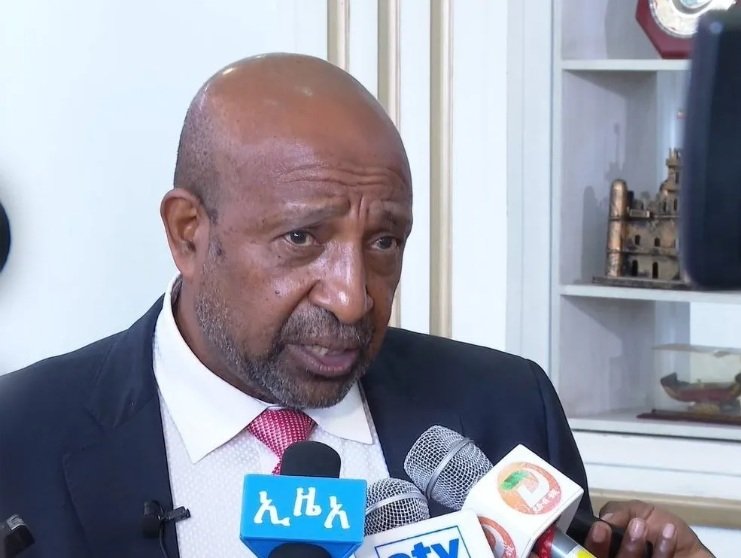
By: Habte H.
Birhanu Nega is a name that resonates deeply within the political landscape of Ethiopia. For many, he symbolized the hope of a democratic future, a beacon of liberal ideals and a vocal critic of Ethiopia’s authoritarian past. In the early 2000s, his political activism, particularly during the 2005 elections, positioned him as a leading figure in the opposition, fiercely advocating for democratic principles and rule of law. His captivating speeches, intellect, and ability to engage in political debates won him admiration both domestically and internationally. For many Ethiopians, Birhanu Nega was the person they trusted the most when it came to fighting for democracy and political reform.
Yet, despite the overwhelming optimism surrounding his leadership, Birhanu Nega’s transformation in the last few years has been surprising – and for some, even disappointing. From being a staunch advocate of democracy and human rights, he is now a member of the dictator’s cabinet in the Prosperity Party (PP), a coalition criticized for its ethnonationalist approach to governance. His current role as Minister of Education in this government raises a crucial question: How did a leader once synonymous with democratic ideals become an active participant in an ethnonationalist regime? I will explore this issue, prompted by a suggestion from a reader who asked me to address Birhanu’s shift after my recent post on Daniel Kibret.
A Calculated Shift – The Decision to Join the Government
Birhanu Nega’s political transformation can largely be attributed to his pragmatic and calculated nature. Known for his analytical approach, Birhanu spent years studying Ethiopian politics. Over time, he likely recognized the limitations of opposition movements in effecting systemic change. His early work with the opposition party Kinijit (CUD) focused on championing democratic governance, but as the years passed, his views shifted towards a more practical approach.
Joining the Prosperity Party (PP) cabinet and the party itself (do not believe he is a member of the PP his denials, though he is serving the values and principles) – was likely driven by a belief that working within the system would offer a more effective means of enacting change. In Birhanu’s eyes, perhaps influencing policy from the inside seemed more viable than remaining an outside critic. Ethiopian politics is notoriously challenging for opposition figures, particularly those who lack access to state power. By aligning himself with the ruling coalition, Birhanu might have seen this as his last opportunity to leave a tangible mark on Ethiopia’s future.
This decision represented a shift from his earlier ideals toward a more pragmatic approach. Birhanu, who once prioritized democratic values, appears to have accepted that Ethiopia’s political climate demands a more adaptable mindset. His belief that serving the people from within the government might be more impactful than attempting change from the outside aligns with this transformation.
However, this shift has come at a significant cost. Birhanu’s decision to join the PP cabinet highlights a generational shift in Ethiopian politics – one based more on pragmatism and materialism than the faith and principles that once defined him. In the context of Christian teachings, true change is not simply the result of human effort but of alignment with God’s will. Birhanu’s move may, therefore, represent not just a political shift but a spiritual one. It could have been an opportunity for him to return to the values that once guided him, seeking divine support rather than relying solely on worldly concerns.
The Role of Age and Timing
Age also plays a significant role in Birhanu’s decision. At 60 years old, Birhanu may feel that time is running out for him to achieve his political goals. The opportunity for opposition leaders to have a significant impact in Ethiopia, with its turbulent political history and power struggles, is limited. With the rise of the PP under Abiy Ahmed’s leadership, Birhanu may have seen this as his last chance to be part of a transformative political change in Ethiopia.
For many politicians of his generation, there is an undeniable sense of urgency. Unlike the younger generation, who can afford to wait for an ideal political environment, leaders from Birhanu’s era often feel the pressure to leave a legacy before it is too late. Ethiopia’s political history has shown that opposition leaders often do not last long in the face of powerful state apparatus. The fear of becoming politically irrelevant might have pushed Birhanu toward aligning himself with the ruling party, regardless of the compromises it entailed.
While his age and the fear of irrelevance are understandable, it would have been more admirable if Birhanu, along with others from his generation, had chosen to stick to his principles, even at the cost of power. The world may view his shift as necessary for survival, but for those who admired his earlier struggle, it feels like a surrender. Birhanu might have been remembered better as a martyr for democracy, standing by his values, rather than as a servant of a government that contradicts everything he once stood for.
Disillusionment and a Shift in Values
A critical factor in Birhanu’s transformation is the disillusionment he likely experienced. Ethiopia’s history, particularly its long struggle for democracy, has been marred by setbacks. After years of political upheaval, fraudulent elections, and authoritarian rule, it is understandable that some leaders – including Birhanu – might lose faith in the possibility of a truly democratic system.
Birhanu has expressed frustration with Ethiopia’s political system, and it is plausible that he grew weary of the continuous struggle for an idealized democratic form that seemed elusive. His disappointment with the lack of democratic progress may have led him to accept that meaningful change could only come through working with those in power – even if it meant compromising some of his values.
The rise of ethnic federalism and the associated challenges also likely played a significant role in his shift. Ethiopia’s transition from a Marxist-Leninist regime to a federal democracy in the 1990s created a complex political environment that many, including Birhanu, struggled to navigate. The dominance of ethnonationalist policies under the PP, which has exacerbated ethnic tensions, may have made Birhanu feel that the only way to affect stability was to work within this framework – or risk being irrelevant in a political system that seemed unyielding.
A Loss of Reputation and Moral Authority
Despite his pragmatic approach, Birhanu Nega’s current position has come at a significant cost to his reputation. Once regarded as a symbol of hope for Ethiopian democracy, Birhanu’s shift to the PP is viewed by many as a betrayal. His credibility as a democratic leader has been severely damaged. As Minister of Education in a government criticized for its ethnonationalist policies, Birhanu has limited power to influence the changes that matter most to the ideals he once championed.
His role as Minister of Education, while important, appears to be largely symbolic in a government that lacks the democratic foundation Birhanu once supported. With limited control over broader political and economic forces, his position in the current government is more token than substantive.
Conclusion: Pragmatism or Betrayal?
Birhanu Nega’s political journey raises difficult questions about leadership, loyalty, and ideals. While his decision to join the PP cabinet may be seen as pragmatic, it has clearly cost him his reputation as a democratic leader. Whether this was a calculated move to serve the people, or a betrayal of his core values depends on one’s perspective. Regardless, Birhanu’s transformation serves as a stark reminder of the difficult choices political leaders must make when faced with the tension between idealism and the harsh realities of governance.
In the end, Birhanu Nega’s journey highlights the painful truth that, in a country like Ethiopia, democratic ideals can only carry a leader so far. Sometimes, to effect change, one must adapt to – and even become complicit with – the existing power structures. For better or worse, Birhanu has chosen survival over principle.
Editor’s Note : Views in the article do not necessarily reflect the views of borkena.com
__
Subscribe: https://borkena.com/subscribe-borkena/
Join our Telegram Channel : t.me/borkena
Like borkena on Facebook
Add your business to Ethiopian Business Listing / Ethiopian Business Directory
Join the conversation. Follow us on X (Formerly Twitter) @zborkena to get the latest Ethiopian News updates regularly. Subscribe to YouTube channel To share information or for submission, send e-mail to info@borkena.com
But, all the same, he is an acrobatic opportunist who eventually was given by the public the historic name MEISON. And don’t forget that he is an inherently business-minded capitalist with a lot of investments of his own and family. No wonder “Prosperity” attracted his hidden ego. And this incites one to re-ponder his earlier political activities. Well, … a long journey from EPRP to MEISON… interesting!
First: Berhanu Nega has never been MEISON.
Second: the wealth of his family has NOTHING with his political career. He would have been the wealthiest if he chose to build on the wealth of his families.
Third: either PP must have stolen election votes or really the Ethiopian people did not vote him. I was disappointed that he was not elected even in the Woreda he grew up.
Ethiopians must take the responsibility for voting 99% for PP! It’s really hard to believe this number!!!
I am sure PP must have stolen election votes. At that time EZEMA accepted the election results not because it believed in it, but to avoid escalation and the trap associated with that.
Ofcourse I am disappointed by Berhanu‘s conformity to PP. At least I expected a sharp voice. On the other hand: the PM would fire him overnight.
So may be he’s trying to serve genuinely his country. This would be measurable.
Rather I am more disappointed by the party EZEMA for not standing up for the people and its principles.
Who said he was MEISON? It is the name given to his and “his party’s” role as current BANDA. Aren’t they? Have you ever followed Girma Seifu’s tv footages? So, you see, what I mean by MEISON?
I understand. Thanks.
Thanks for your understanding.
The statement “At 60 years old, Birhanu may feel that time is running out for him to achieve his political goals” is dark and reflective of your vision rather than Birhanu’s. People do achieve their goals at different ages and under a variety of conditions. Things could happen so that those already in the system could take advantage. Btw, Berhanu’s age is recorded as 66, 67, or 68. Certainly not 60. Whether Birhanu (Berhanu) miscalculated or is a sellout is his business. So we remember, Abiy got “elected” because of Ethiopians’ growing contempt for Tplf. Had people known who Abiy was, Berhanu could have garnered a lot more votes. Abiy is aware of this and won’t allow elections to take place on the excuse of a state of emergency. I am not a supporter of Berhanu. My take is that he does not want to repeat his grand mistake of not taking parliamentary seats Kinijit had won in 1997 (and he, Mayor of Addis). We just have to wait and see.
Your analysis is clear and fair. However, one thing that I can never accuse Berhanu of is opportunism. This man has dedicated almost his entire life, from the time he joined the EPRP in the seventies to this day. He could have made a different political decision in the past, but what he did was never done for some advantage but to be more effective. Living to serve your country is better than dying in the hands of repressive governments. Perhaps a Navalny would have been more effective in exile than dying in prison at the behest of a cruel dictator. My only regret for Berhanu is that he has not been given enough power to deliver for the Ethiopian people. I wonder if Abiy chose him to appease the opposition or because he wanted real reform in the education sector. At this juncture, I hope he brings effective change to Ethiopia even if he never ascends to a higher power.
“For many Ethiopians, Birhanu Nega was the person they trusted the most when it came to fighting for democracy and political reform.”
Fighting for democracy and ‘shaping a democratic future’ are two different things… One limits you as an actor from afar, the other gives you a chance to shape it from within, the analysis seems to suggest the former is principled and honorable, but in a long & roundabout way admits the limitation of such approach.
Based on the integrity & maturity of the man described herein, he made a conscious decision to be a player from within instead, in the understanding that there are more opportunities to do well, as well as demonstrate the vision he holds for his nation and its people as whole in practice, in the process who knows, he might end up persuading the powers (the ‘villains’ (ours)) he gets to work with.
Transformation is natural, (principled) stagnation (death) is not, that is how nature works, and mimicking natural laws never fails (Spring is here).
“Wisdom comes from experience. Experience is often a result of lack of wisdom.”
“If you are looking at life as a possibility, you will see possibilities everywhere. If you are looking at life as a problem, you will see problems everywhere.”
Happy Spring!
(This one is unlike any other in the past… enjoy!)
Be well.
The analyis looked over Brihanu’s deep resentment against Amharas and Tigres . His true face revealed when he released his view as a headline in G7 home page, stating that Obama became the first black president in USA so no more Northern people in Ethiopian politics should be leaders. Imagine, in liberal democracy, Obama provided unwaivering support to make Biden a president as it was not about race but about shared policy and ideology .Birhanu was a short-sighted and a hater. Once, I heared him saying his wish was to eradicate TPLF and its Ideology and walk freely in addis and drink cofee in tomoca. we did not know his intension and dark plans. Of course, I dropped G7 from my head and erased it from my heart the day I read the above mentioned Headline in G7 homepage. I do not know how many Ethiopians remember that headline of G7?
Questions for the author Habte H.
You accuse Berhanu of betraying Amhara interests by serving under Abiy, but wasn’t his removal of ethnic quotas in teacher hiring a direct blow to Oromo nationalist dominance in education? Why ignore this win? If Berhanu resigned today, wouldn’t PP replace him with an Oromo making Amhara cultural erasure worse? Is principled resignation worth that risk?
Berhanu’s Kinijit allies (e.g., Andualem Arage) are jailed, while he’s in government. But if all Amhara leaders refuse power, doesn’t that leave the community voiceless in Addis? Fano militants call Berhanu a ‘traitor,’ yet they themselves reject negotiations with PP. If both armed struggle and government participation are ‘sellouts,’ what’s your third path?
When Amhara elites like Gedu Andargachew joined EPRDF, you called it ‘infiltration.’ Now you condemn Berhanu for not ‘changing PP from within.’ Isn’t this a double standard?
Should Amhara leaders all become martyrs, or is survival necessary to fight another day? Berhanu’s critics say he ‘abandoned’ ethnic federalism opposition. But wasn’t the old unitary state also oppressive to Amhara peasants? What system do you actually want?
You blame Berhanu for PP’s Amhara massacres, but has any Amhara in PP (e.g., Agegnehu Teshager) stopped the killings? Isn’t the problem Abiy’s dictatorship, not one minister?
Berhanu reintroduced Amharic as a federal working language in schools. PP hardliners want to erase Amhara history from textbooks but Minister Berhanu expanded Emperor Tewodros and Menelik coverage. Isn’t he fighting cultural war that he doesn’t hail from?
Amhara teachers say Berhanu’s merit-based hiring freed them from Oromo nationalist quotas. Why are people like Habte T and supporters supporters silent on this tangible gain?
It is reported that some Fano warlords demand Amhara autonomy but take orders from Eritrea’s Isaias. Isn’t Berhanu’s ‘collaboration’ with PP less treasonous than that?
Nonsense!!
Nonsense!!