
Yonas Biru, PhD
In several articles, I have argued that contemporary political invocations of Gadaa, Oromummaa, and Irreechaa are politically motivated and futile projects aimed at establishing a pan-Oromia hegemony. Subsequent developments have vindicated my argument on all three counts.
For an in-depth analysis, read my November 2025 article titled “Oromummaa’s Adulteration of Waaqeffanna, Gadaa, and Irreechaa Is Tearing the Oromo Fabric Apart.” The article predicted the collapse of Oromummaa under the weight of fabricated culture and fictitious claims to indigenous democracy.
In this article my focus is on Oromia’s six new regions and how they represent the proverbial last nail on the coffin of Oromummaa. The brilliance of Asafa Jalata’s Oromummaa doctrine lay in its ambition: to forge a single Oromo culture, identity, and nationalism out of a vast and varied people. In his work, Gadaa is the foundation of that project and Irreechaa its most visible cultural expression. Jalata presented both as the shared inheritance of a Greater Oromia.
It was an ingenious construct while it lasted. It did not last because the unified culture he curated was never organic to the society he sought to build. Across much of Oromo land, Gadaa and Irreechaa have shallow roots. As pan-Oromo institutions, they are political inventions grafted onto a people far more diverse than the doctrine allowed.
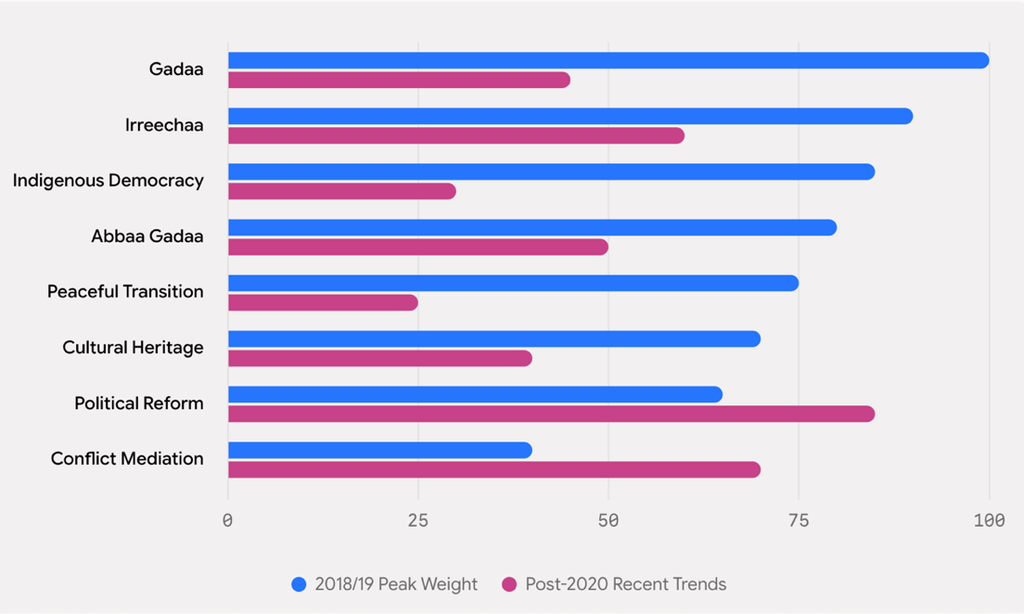
The chart below compares how prominently key terms featured in Oromo political discourse at their 2018/19 peak with their weight in the years since 2020. In 2018/19, all we heard about was Gadaa, Irreechaa, and Indigenous Democracy. By 2025/26, people were paying little attention to these political fictions, while talk of political reform and conflict mediation had grown. Even the high priests of Gadaa no longer peddle it as a political panacea. Readers can get a similar result using word clouds.
We were told Oromo indigenous democracy would lead to peaceful transition. The fictional indigenous democracy proved a dud. The only chatter that grew was the need for political reform and conflict mediation to undo the damage done by Gadaa as a tool of indigenous democracy.
The Abiy Doctrine: Dividing Oromia
Oromia’s new six-cluster arrangement now threatens to finish what the doctrine’s own weaknesses began. By drawing administrative lines around Oromia’s internal divisions, it gives those divisions institutional form. The six clusters are East (Hararghe), Southeast (Arsi and Bale), South (Guji and Borana), West (Wollega), Southwest (Jimma, Ilu Ababor, and Buno Bedele), and Central (Shewa).
The danger is that the restructuring will convert existing political and identity differences into institutionalized competition among geographically defined power centers. The leadership appointments already hint at how these lines may be read.
Four of the six cluster leaders appear, by name and public profile, to come from Muslim backgrounds, and they have been assigned to predominantly Muslim areas. Wollega, by contrast, is predominantly Protestant, while Shewa has a substantial Orthodox Christian population and a distinct political history.
And because the cluster vice presidents answer to the regional parliament rather than to the regional president, autonomy is built into the design. For all practical purposes, these are autonomous regions, and the logical next step is for each to become a full region in its own right. Shewa and Wollega will find it more plausible to form an alliance with the Amhara tribal land. In fact, that is manifested in OLA’s alignment with Fano and TPLF.
The Politics Behind the Map
The restructuring also comes amid visible friction at the top. Two months ago, I wrote on Facebook: “Shimelis and Abiy are taking different sides on the Addis Ababa issue. That is why Jawar and Tsegaye ኩርኩር are supporting Shimelis. Abichu will strike back. የሚሰማ ጆሮ ያለው ይስማ እያላት ነው ሽሜን።” [The Amharic line translates roughly as: “He is telling Shime, ‘Let whoever has ears to hear’”]
Within a week, Abiy threatened to launch an anti-corruption investigation, warning that “we do not know where it will land.” I wrote at the time that this was a warning siren meant to silence Shimelis. Seen in that light, a map that disperses power away from the regional president’s office is hard to read as a purely administrative reform.
Three Land Mines
First, resentment is already festering in Wollega and Shewa. Many in Wollega feel excluded from the national political apparatus. In Shewa, political activists have complained that their land is being handed to Muslim Oromos from Arsi and Bale. When administrative boundaries roughly track religious ones, grievances like these can harden into entrenched conflict.
Second, the new map creates a new political geography. In place of one Oromo political center, there are now six centers of administrative and political power. The logic is predictable: regional power creates regional constituencies, constituencies compete for resources and appointments, competition breeds perceptions of exclusion, and exclusion strengthens regional identity.
In a polity where identity politics is the governing principle, each cluster will develop its own constituency, patronage network, security apparatus, and sense of identity. Tribalism is not cured by multiplication. Every new center of power eventually asks why someone else has more.
Third, the clusters map onto the conflict itself. Wollega and Shewa are the heartland of the OLA insurgency, while the predominantly Muslim areas are broadly seen as pro-Abiy. Ahmedin Jebel has posted a string of Facebook messages praising Abiy’s “economic miracle” and branding the opposition alliance as warmongers. His praise follows Sheikh Ibrahim Tufa’s elevation of Abiy to near-sainthood, a notch below the Prophet Muhammad.
The Religious Fault Line Oromummaa Cannot Simply Wish Away
Oromummaa was built on Gadaa and Irreechaa, institutions that predate both Islam and Christianity among the Oromo. But millions of Oromos today are Muslim and millions are Christian, and many experience the religious symbolism of Irreechaa very differently from how the doctrine presents it. Cultural nationalism anchored in pre-Islamic and pre-Christian institutions was always going to struggle to win equal devotion from Oromo Muslims and Christians without asking them to subordinate their faith to a cultural framework.
The doctrine could paper over that fault line as long as Oromia had a single political center. The six-cluster map removes the paper. When administrative boundaries, political loyalties, and religious majorities begin to line up, the religious question stops being an abstract debate about identity and becomes a practical question about who holds power, and where.
What Is at Stake
Wollega has historically been one of the most important centers of Oromo political and intellectual life. Shewa has followed a different but equally consequential trajectory, shaped above all by its relationship with Addis Ababa. If substantial constituencies in these two areas conclude that the new arrangement places them outside the inner circle of power, a reform presented as administrative efficiency could end up intensifying the very regional grievances Oromummaa was meant to transcend, and burying the doctrine for good.
If Oromummaa is truly a national project, it must embrace Oromos who are Muslim and Christian, Shewan and Wollegan, eastern and western, without requiring any of them to become less of themselves in order to become more Oromo. Instead, Oromummaa insists on being the defining Oromo identity, above faith and region. The hoopla around Gadaa has already died down. Irreechaa will be the next casualty.
Rest in Peace Gadaa! Rest in Peace Oromummaa! Rest in Peace Irreechaa!
Editor’s Note: Views in the article do not necessarily reflect the views of borkena.com
__
Join our Telegram Channel: t.me/borkena
Like borkena on Facebook
To submit a press release, send the submission to info@borkena.com
Add your business to Ethiopian Business Listing / Ethiopian Business Directory
Join the conversation. Follow us on X (formerly Twitter) @zborkena to get the latest Ethiopian news updates regularly.
It looks there is a bitter sibling rivalry between Brother Yonas and Oromummaa. Didn’t the brother once told us ChatGPT has buried Oromummaa 6 feet under? In doing so it means it has also buried Amharummaa, Tigreummaa, and 80 other ummas 6 feet under. Some things just refuse to die and have 9 lives. Here is the link:
https://borkena.com/oromummaa-krog-and-chatgpt-bury-political-oromummaa-six-feet-under/
Keep writing Brother.
Make that:
Didn’t the brother once tell us ChatGPT has buried Oromummaa 6 feet under?
We must celebrate the new regional division of the administration for greater national unity. This sub regional administration zone must ti extend to Tigray and Amhara artificial tribal land . As history inform us Ethiopia was ruled and its administration was based in ” Aweraga ” regional entities. It is a weapon to downgrade the artificial ethnic nationalism among Oromo, Tigray,Amhara ethnic entrepreneurs at last. I congratulate the Abey government for this decision eventhough his administration suffers with chronic corruption and subjugation of civil rights