
By ETHDefenders
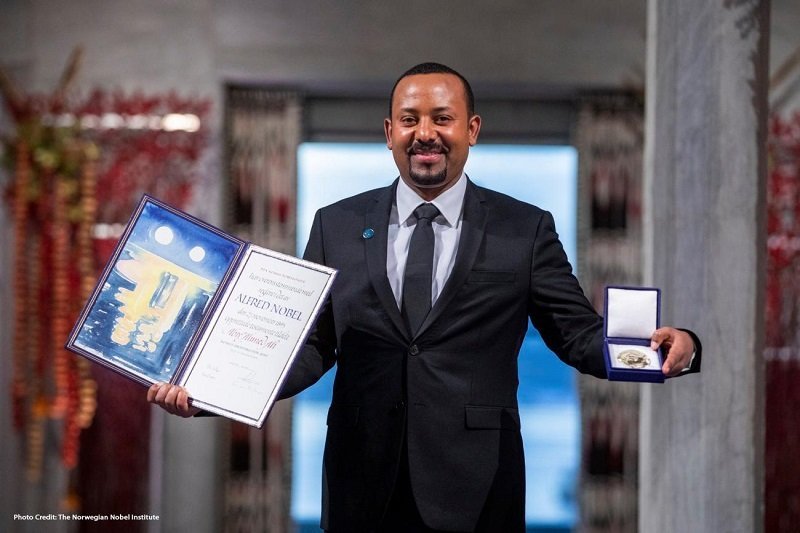
The awarding of the Nobel Peace Prize to Ethiopian Prime Minister Abiy Ahmed Ali in 2019 was hailed as a triumph of hope over history. The Nobel Committee celebrated Abiy as a reformer who ended decades of hostility with Eritrea and promised democratic transformation at home. Yet today, that decision stands in stark contrast to the lived reality of millions of Ethiopians, who have experienced war, repression, displacement, hunger, and fear under his rule.
This contradiction is not merely ironic. It is tragic—and deeply instructive.
The Nobel Peace Prize and the Illusion of Reform
The Nobel Peace Prize recognized Abiy Ahmed for specific actions at a specific moment: the Eritrea peace agreement and an initial political opening that included releasing prisoners and welcoming exiled opposition groups. But the prize was awarded based on promise, not proof. It assumed continuity—an assumption that has since collapsed.
Rather than deepening democratic institutions, Abiy increasingly centralized power around himself, weakened independent checks, and replaced pluralistic politics with securitized rule. The language of reform gave way to the logic of force.
The Nobel Peace Prize was never revoked because it cannot be. But its continued existence alongside mass violence exposes the limits of symbolic international recognition when it is disconnected from long-term accountability.
War Against the State’s Own Population
Since 2020, Ethiopia has been ravaged by multiple overlapping wars. Entire regions have been devastated. Tens of millions have required humanitarian assistance, while millions have been displaced internally. Reports from the United Nations, humanitarian agencies, and independent journalists describe widespread atrocities committed during these conflicts, including airstrikes on civilian areas, mass killings, sexual violence, starvation as a weapon of war, and the destruction of infrastructure essential to survival.
The Ethiopian state has deployed drones and air force capabilities against its own population. Critics argue that these wars were not unavoidable acts of self-defense but political choices—decisions made to preserve power at the cost of human life.
By any serious measure, a country whose government wages war against its own citizens on such a scale cannot credibly be described as at peace.
Repression, Fear, and the Silencing of Truth
As war expanded, freedom contracted. Ethiopia has experienced one of the sharpest declines in press freedom in Africa. Journalists have been arrested, media outlets shut down, and reporting criminalized under expansive emergency and anti-terror laws. Political opponents, activists, and ordinary citizens have been imprisoned, harassed, or disappeared.
Numerous reports accuse the government of tolerating—or directly enabling—illegal detentions, kidnappings, and extrajudicial killings carried out by security forces and allied groups. Among those accused by critics is a shadowy and feared structure referred to by victims as “Koree Nageenyaa”, described as an informal but powerful instrument of intimidation, abduction, and violence.
Whether formally institutionalized or not, the result is the same: a climate of terror that suppresses dissent and fractures society.
Ethnic Power and the Politics of Supremacy
One of the most explosive accusations surrounding Abiy Ahmed’s rule concerns ethnic power. Abiy, who comes from the Oromo nation, is accused by many Ethiopians of abandoning federal equality and instead promoting Oromo political supremacy.
According to critics, large parts of the country have been forced to live in fear and anxiety as ethnic identity has become a matter of survival. In Oromia, reports allege that displaying the Ethiopian national flag or singing the national anthem has been restricted or punished. Non-Oromo communities have reportedly faced killings, forced displacement, and systematic intimidation. Entire populations have been driven from their homes.
At the same time, development, infrastructure, and political privilege are widely perceived to have been concentrated disproportionately in Oromia, reinforcing the belief that state power has been ethnically captured rather than nationally shared.
This represents not unity but domination—not reform but ethnicized authoritarianism.
Dispossession, Prestige, and Moral Bankruptcy
In Addis Ababa alone, hundreds of thousands of residents have reportedly been dispossessed in the name of redevelopment, often with inadequate compensation or consultation. These evictions have occurred while the government has invested billions of dollars in monumental projects, including an enormous palace complex that critics view as a symbol of personal power rather than public service.
This contrast—between architectural grandeur and mass hunger, between elite spectacle and widespread suffering—has become emblematic of Abiy Ahmed’s rule. While millions face food insecurity and basic survival is uncertain, the state projects an image of strength and glory disconnected from the realities of its people.
Why the Nobel Prize Remains—and Why That Matters
The Nobel Peace Prize will not be taken away. Not because the suffering is unreal, but because the prize was never designed to enforce morality or justice. It judges moments, not trajectories. It rewards gestures, not outcomes.
But this does not absolve Abiy Ahmed. Nor does it validate his actions.
Instead, his case stands as one of the starkest warnings of modern politics: a leader can speak the language of peace while governing through war; can win international praise while destroying his own country; can be celebrated abroad while feared at home.
Conclusion: Peace Cannot Be Declared While a Nation Bleeds
History will not remember Abiy Ahmed for the medal he received in Oslo. It will remember him for what Ethiopia became under his rule.
Peace is not a ceremony. It is not a prize. It is not a speech. Peace is measured in lives protected, freedoms preserved, and nations held together by justice rather than fear.
By that measure, the tragedy of Ethiopia today is not only a national disaster—it is an indictment of the belief that peace can be personalized, celebrated prematurely, and detached from accountability.
The Nobel Peace Prize remains.
But peace, for millions of Ethiopians, does not.
Editor’s Note : Views in the article do not necessarily reflect the views of borkena.com
__
Support Borkena : https://borkena.com/subscribe-borkena/
Join our Telegram Channel : t.me/borkena
Like borkena on Facebook
Borkena Ethiopian News Youtube Channel
To submit Press Release, send submission to info@borkena.com
Add your business to Ethiopian Business Listing / Ethiopian Business Directory
Join the conversation. Follow us on X (Formerly Twitter) @zborkena to get the latest Ethiopian News updates regularly.
Unless a constitutional change is made, the collapse of Ethiopia is inevitable. The Oromo juggernaut Abiy Ahmed cannot keep Amharas under subjugation forever. No trickery can stop the Amhara struggle for survival. The Amharas knows that, Abiy Ahmed’s propaganda about Eritrea’s port and Egyptian politics is a deceptive strategy to thwart Amhara’s struggle for survival. Amharas will never accept the Oromo superiority. In their struggle for survival, the Amharas must create alliance with Eritrea, Egypt and Sudan. The other deceptive tool that Abiy Ahmed is using to thwart Amhara’s struggle for survival is Ethiopia’s National Dialogue Commission. Always remember, the whole EPRDF – PP thing is an echo chamber.
Ethiopia’s National Dialogue Commission is a hoax. ENDC is another tool that Abiy Ahmed is using to extend the life of the EPRDF – PP ethnocentric political system. The EPRDF – PP ethnocentric political system is at its peak and must be replaced with a new system, or it will regress and cause destruction. Abiy’s delusional grandeur is already causing the death of millions of Amharas. What can solve Ethiopia’s problem is a new constitution. The regime of Abiy Ahmed must be replaced with a transitional government. The primary mission of the transitional government is to prepare a new constitution for Ethiopia. Ethiopia needs a federal system similar to that of the USA. The transitional government must request economic and military assistance from the USA. If agreed, the USA need to send American troops as advisors to assist the transitional government. The existing Police force must continue its duties during and after the transitional government. Ethiopia’s National Defense Forces must be replaced. Bloodshed cannot buy loyalty. Power through Ethnic allegiance, and governance through intimidation and terror must come to an end.
– In the new constitution, Ethiopia must be governed by the principles of human rights.
– The new constitution must guarantee justice, human rights, civil rights, and private ownership of land.
– In the new constitution, Ethiopia needs to be restructured and modeled after the USA federal system.
– In the new constitution, member states to the new Ethiopian federation must use Amharic and their local language equally without any discrimination and limitations as working languages of their state.
– In the new constitution, Ethnic based political organizations must be prohibited by law.
– In the new constitution, Oromo and Tigrian politicians must be prohibited by law from participating in any separatist activities globally.
– The new constitution must guarantee private ownership of land.
– …
My Telegram Link is MGAZ9.