
By: Getahun Tsegaye
Staff Reporter
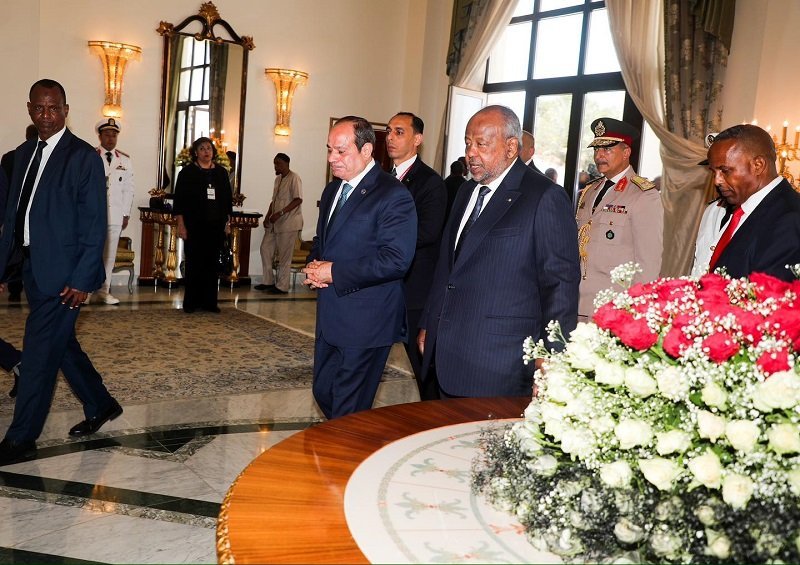
Addis Ababa, Ethiopia – President Abdel Fattah El Sisi’s recent visit to Djibouti and his extensive discussions with President Ismail Omar Guelleh underscore a concerted effort by Red Sea coastal states to solidify their unified stance amidst increasing regional tensions. As reported by Egypt Today, this meeting gains significant weight against Ethiopia’s growing and vocal ambition for direct access to the Red Sea, a development that has sparked geopolitical concerns across the Horn of Africa.
Egypt Today highlighted that the two presidents “categorically rejected any actions that threaten the safety and freedom of navigation in the Red Sea,” emphasizing that “the primary responsibility for governing and securing this key maritime trade route rests solely with the Red Sea and Gulf of Aden littoral states.” This statement firmly reiterates Egypt’s long-standing position that only nations bordering the Red Sea should dictate the region’s maritime security framework – a principle Cairo views as non-negotiable.
Ethiopia, landlocked since Eritrea’s independence in 1993, has increasingly framed access to the sea as a critical national interest detrimental to its existence. Prime Minister Abiy Ahmed has publicly argued that Ethiopia’s large population, economic potential, and historical connections justify a reconsideration of its landlocked status, stating that sea access is not merely a privilege but a “natural right.” While Addis Ababa has not explicitly threatened military action, such rhetoric carries the potential to destabilize the region, given its delicate geopolitical landscape.
According to Egypt Today, the discussions between Egypt and Djibouti encompassed a broad spectrum of cooperation, ranging from defense and counterterrorism to water resources and education, illustrating a deep strategic alliance. Their agreement to contribute troops to the new African Union Support and Stabilization Mission in Somalia (AMISOM) further demonstrates a shared commitment to containing insecurity that could potentially impact Red Sea maritime security.
In this context, a university professor specializing in hydropolitics, speaking anonymously to Borkena, suggested that “Egypt’s diplomatic push can be seen as part of a broader counterweight strategy against Ethiopia’s regional ambitions.” The expert elaborated, “It’s not just about port access—this is about power projection, influence in the Horn, and controlling the future of regional trade and security.” The symbolism of Egypt and Djibouti, both Red Sea littoral states, reaffirming their joint position while Ethiopia seeks maritime access sends a clear and strategic message: decisions regarding this crucial waterway will not be dictated by landlocked states or actors perceived as attempting to reshape the existing order.
Conversely, some analysts propose that Ethiopia’s renewed pursuit of sea access may serve purposes beyond purely strategic or economic ones. Observers speculate that the government’s maritime aspirations could be, at least in part, a calculated diversion from escalating domestic unrest, particularly the protracted conflict in the Amhara region, which has persisted for over two years with no clear end in sight.
A political analyst and lecturer at Addis Ababa University told Borkena that the maritime narrative might serve a dual purpose. “While Ethiopia’s desire for sea access is grounded in legitimate long-term strategic needs, its sudden prominence in the national discourse cannot be separated from the current internal instability,” he explained. “It is a convenient tool to rally nationalist sentiment and redirect attention away from internal divisions and the government’s struggles to contain the Amhara insurgency.”
The analyst further noted the timing, stating, “This is not the first time governments have turned to foreign policy narratives to consolidate internal control. By positioning Ethiopia as being unfairly landlocked and portraying its neighbors as gatekeepers to its economic future, the administration is mobilizing patriotic emotions in a way that can mute domestic criticism—at least temporarily.”
The Horn of Africa remains deeply unstable, with ongoing conflict in Sudan, political tensions within Ethiopia, and Somalia’s persistent challenges underscoring the urgency of regional cooperation. The security of the Red Sea, a vital global maritime corridor, is increasingly intertwined with the internal dynamics of these fragile states. Consequently, Egypt’s efforts to spearhead regional discussions on Red Sea governance may also be an attempt to preempt external interference, whether from neighboring landlocked states or global powers.
As the situation continues to unfold, Ethiopia’s pursuit of sea access could test not only its bilateral relationships with Eritrea and Djibouti but also the evolving security consensus among Red Sea nations. For Egypt and its allies, the priority remains clear: to uphold the integrity of the existing maritime order and prevent unilateral actions that could trigger broader conflict.
__
Subscribe : https://borkena.com/subscribe-borkena/
Join our Telegram Channel : t.me/borkena
Like borkena on Facebook
Add your business to Ethiopian Business Listing / Ethiopian Business Directory Business Listing Toronto
Join the conversation. Follow us on X (Formerly Twitter) @zborkena to get the latest Ethiopian News updates regularly. Subscribe to YouTube channel To share information or for submission, send e-mail to info@borkena.com
Egypt, Egypt, Egypt! Never ceases to amaze me. Yesterday was Eritrea and Somalia. Now it is Djibouti’s turn for the spell of el-Sisi’s charm. You can’t call it lucky charm. I don’t really call it anything. A desperate move or what? The GERD dam, for all intents and purposes is almost finished. It has been running on most of its cylinders like a well-oiled engine for more than a year now. Thousands of homes in Djibouti are bright light all night long after a power line has reached the territory more than 3 years ago. The water piped from the Adi Gala(Hadhi-Gale) aquifer has been quenching the thirst of Djiboutians for years now. Ethiopia had produced and educated the very capable of Djiboutians running its affairs from its start in 1977. Then, you are pressed to ask Egypt as a Djiboutian the cardinal question: What have you done for me lately? Nothing but rhetoric. Poor Egypt. It tried to summon Eritrea and Brother Isu turned out to be a tough cookie for Sisi’s halawa ravaged teeth. It ain’t 1959 or 1972 and Idris Adem and Saleh Sabbe were long gone. Menendez and his wife are unceremoniously sentenced to be locked up for 11 plus years. On Somalia side, it turned out to be a critical piece of the puzzle gone or missing for el-Sisi. Every effort to exclude Ethiopia out of the peace keeping force fell flat on its face. Brother Hassan Sheikh Mohamud goes like ‘Is that Sisi out of his mind?’
Hey Janet! Hit it for Djibouti’s sake: ‘What have you done for me lately?’ Nothing!!!!
Hey el-Sisi! Who you gonna go for next? Singapore? Iceland? I got a live one and that will do it for you. How about Easter Island? Wait a minute, that ain’t gonna work cuz that island is Chilean territory. How about Tasmania? That ain’t gonna fly either. I gave up!!!!
Once our local idiots settle and all our resources organized accordingly, I think Ethiopia should preemptively strike Egypt and change the dynamics. We have been playing defense for so long. I am sure we will get that chance at some point. Truth prevails.
Some backward activist in Ethiopia believes that it is very unfair to think like this due to larger military equipment’s Egypt is holds, but they never talked about if a war happens Ethiopia will have the upper hand due to so many reasons…
The reality is that Ethiopia is well capable of doing this. They must learn to back the f**k of from Ethiopia. Trust me, it can be done… it’s just our local idiots who are wasting our resources for now….
If I had to guess, these must be the words of Teddy Fikre. That would explain the stupidity, although most Ethiopians are dumb enough to believe this as well. You think Ethiopia can beat Egypt? Then you really know nothing.
Egypt is very advanced compared to Ethiopia, in almost every way. Egyptians I meet are highly trained and highly educated. They have a good position in this world. Egyptians are mentally stronger and have a better understanding about religion. Meanwhile, most Ethiopians don’t even know who they really are.
Isn’t it high time that Ethiopia taught any lesson to Egypt & Egypt’s Proxy Dogs [EPD]? They have been bleeding & destabilizing Ethiopia. Why shouldn’t Ethiopia do the same?
1). Egypt in Ethiopia: Ethiopia expelled Egyptian spy [management Radisson Blue Addis (RBA)]. Later, RBA took over Wzo/Wzt Tiliksew’s Bahir-Dar Hotel [gave her Range Rover].
2). Egypt: America donates ≥$4 billion to Egypt [Bread Subsidy] every January. America also gives billions more in military aid. Top that up with various aid from IMF, WB, etc.
3). Egypt’s Economy: Nile-dependent enormous commercial farms, Suez Canal & Oil Export [Red Sea & Mediterranean Sea dependent], Egypt Air, Tourism, …
4). Egypt’s Strength: America-subsidized Defense, over-funded spy agency, West’s Pro-Egypt financial institutions, EPD that can’t survive without Egypt’s ምፅዋት እና ፍርፋሪ
5). Djibouti: Survives on land lease to ≥8 countries, port fees from Ethiopia, and aid from Arab League. Ethiopia sends Djibouti fresh fruits/vegetables/Khat, free potable water…
6). EPLF [Eritrea]: Ethiopia should (i). Take back Aseb Region [annexed by ‘EPLF’ 1991]; (ii). Deport EPLF’s spies; (iii). Use Tekezze for bottled water, irrigation, etc. (iv). Get its money/assets frozen by EPLF; (v). Freeze/Close any EPLF-related account/business/etc.