
By Staff Reporter
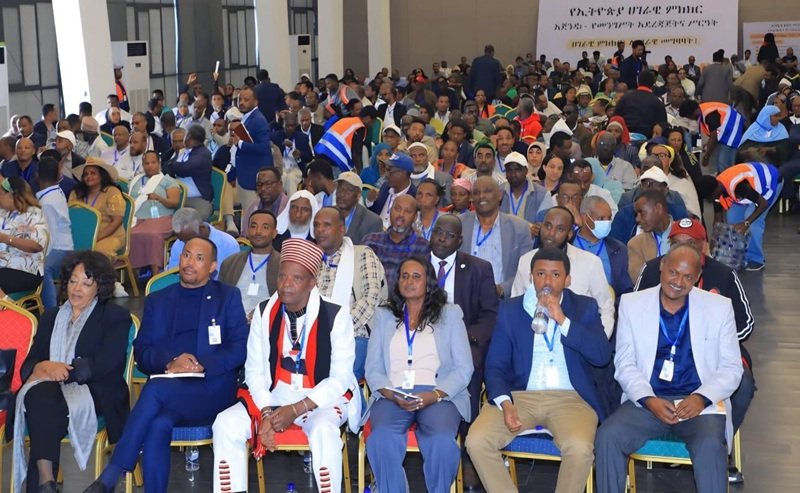
(Nairobi, Kenya) — High-stakes political friction, unresolved ideological divisions, and heightened state security surveillance are casting a shadow over the National Dialogue Commission‘s consultation process as it transitions into its decision-making phase in Addis Ababa, according to a news report by local outlet Wazema Radio.
Sources close to the deliberations informed Wazema that participants expressed strong objections during working group discussions regarding the administration of the capital, explicitly warning: “Addis Ababa is a federal city, and we will not pass a decision that benefits one region exclusively.”
Delegates halted proceedings prior to a vote to allow extended deliberation after warning that forcing an immediate vote could spark “uncontrollable situations.” Participants also raised serious concerns over credential verification procedures and alleged political pressure aimed at swaying outcomes.
Wazema reported a significant ideological rift among members of the ruling Prosperity Party regarding the legal status of Addis Ababa. Heated debates inside meeting halls have reportedly threatened internal party cohesion, leading some delegates to accuse senior party leaders of attempting to orchestrate member positions over clear points of disagreement.
Mediation efforts have achieved partial progress. Sources confirmed that negotiators set aside a controversial proposal—”Let Addis Ababa be part of Oromia”—in favor of negotiating a framework that ensures “shared benefit.” However, significant tension remains across meeting halls despite ongoing pressure to reach a consensus.
During discussions on the governance model—a sub-agenda under the State Structure and Form framework—a proposal to introduce a “parliamentary system led by a president” gained strong traction among participants, Wazema reported. While an alternative presidential system was also submitted, the president-led parliamentary model garnered far broader support.
Under the proposed structure, parliament would appoint a president to a six-year term, capped at a maximum of two terms. This framework would align national elections to a six-year cycle. Prime Minister Abiy Ahmed previously stated that the Prosperity Party had registered an agenda with the National Dialogue Commission to legally determine leadership term limits.
Wazema confirmed that the National Intelligence and Security Service (NISS) has intensified monitoring over working groups handling sensitive topics, particularly those deliberating on federal cities, nation-building, and state structure.
NISS agents maintain an active presence at entrance and exit points of meeting halls, conducting strict identity checks on delegates. Security officials justified the heightened surveillance by claiming that unauthorized participants assigned to other agendas were entering restricted group meeting rooms.
Multiple political parties have formally submitted complaints to the commission regarding procedural gaps, according to sources cited by Wazema. Following the transition to the third phase of the consultation process, three complaining parties notified the commission that they may isolate themselves from further participation if procedural flaws are not corrected.
In addition, several parties representing ethnic recognition, administrative structure, and regional status claims expressed dissatisfaction after the commission aggregated their specific demands into a generic summary stating that “administrative and identity questions deserve a response.”
The chairman of one political party confirmed to Wazema that his party is preparing a joint complaint with like-minded organizations. He warned that if the commission fails to provide a substantive response, his party will issue a formal public statement and withdraw from the dialogue process entirely.
As the dialogue enters its third, decision-making stage, two key institutional structures are poised to begin work:
- The Consensus Task Force: Composed of mediating elders and scholars tasked with forging agreements on unresolved issues where consensus failed at the working group level.
- The Regional Representatives Assembly: A decision-making body whose membership was recently expanded from 211 to 336 delegates.
The commission elected members of the Regional Representatives Assembly on July 31, 2026. In a briefing delivered on August 5, 2026, the commission informed delegates that it will soon outline the precise mandate and operational responsibilities for assembly members as they prepare to convene.
__
Join our Telegram Channel: t.me/borkena
Like borkena on Facebook
Join the conversation. Follow us on X (formerly Twitter) @zborkena to get the latest Ethiopian news updates regularly. Subscribe to the YouTube channel. To share information or for submission, email info@borkena.com