
By Caleb Ta (Dr.)
Abstract
This article examines the deteriorating conditions of medical professionals in Ethiopia, highlighting their economic struggles, systemic neglect, and the broader implications for national healthcare. Amidst increasing political unrest and violent military interventions, Ethiopian doctors and health workers find themselves abandoned by a regime that prioritizes military spending and propaganda over public health. The paper explores how authoritarian governance under Prime Minister Abiy Ahmed has led to widespread disillusionment, brain drain, and humanitarian crises, particularly in regions like Amhara and Tigray. Supported by first-hand narratives, media reports, and economic data, the article argues for urgent structural reforms and international attention to the plight of Ethiopian healthcare professionals.
The Iceberg of Ethiopia’s Healthcare Crisis
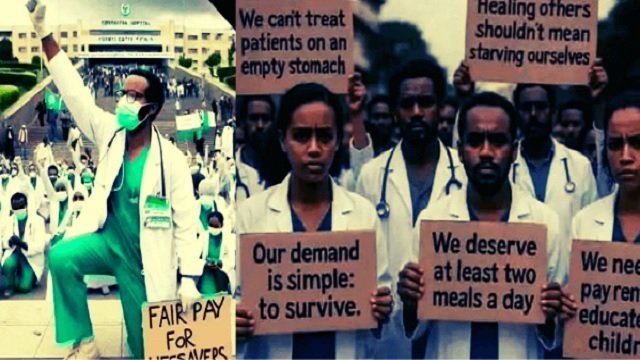
“We are not asking for luxury — just to live with dignity while serving the public,” echoed medical protestors across hospital courtyards and medical schools nationwide. This statement captures what lies above the surface: a profession pushed to the edge.
The Visible Tip: A Cry for Dignity
At the surface, the public sees doctors and nurses protesting, demanding fair wages, safer working conditions, and basic respect. These are not pleas for privilege, but urgent calls to preserve their ability to care for others without becoming casualties themselves.
Beneath the Surface: A Suppressed Reality
Below this visible unrest lies a hidden crisis. Ethiopia’s healthcare workers face severe underpayment, chronic burnout, and even military violence. In war-affected regions, some have been detained, bombed, or silenced. As the military budget expands and elite lifestyles flourish, frontline medical staff are vilified for asking to survive.
The Deep Core: Eroded Trust and National Collapse
At its foundation, the crisis threatens more than healthcare. It represents a collapse of public trust and national integrity. When those who heal the nation are abandoned, when hospitals are bombed, and when caregivers are forced into exile, the moral compass of society begins to break. Without urgent reform, Ethiopia risks losing not only its doctors—but its conscience.
Introduction
Healthcare professionals are the backbone of any society’s health infrastructure. In Ethiopia, however, they have become casualties of a political regime that appears indifferent to their welfare and the broader implications for national health. Prime Minister Abiy Ahmed’s Prosperity Party has come under fire for systemic disregard for doctors, nurses, and medical staff, especially in conflict-affected regions such as Amhara. Once revered professions are now associated with economic hardship, insecurity, and psychological trauma.
Current State of Medical Professionals in Ethiopia
Ethiopian doctors, especially those in conflict zones, are facing extreme challenges including:
- Drone strikes on ambulances and hospitals, reportedly killing medical professionals such as Dr. Andualem Dagna in Bahir Dar (Amnesty International, 2023).
- Lack of salaries and workplace destruction, with many professionals reporting monthly salaries as low as 4,700 birr (~$85 USD), which fails to cover even basic living expenses (The Reporter Ethiopia, 2024).
- Government neglect, where instead of engaging in constructive dialogue, leadership responds to professional concerns with militarized force or dismissive rhetoric (BBC News, 2024).
The Prime Minister’s comment, “The government will not solve the poverty and problems of a country by distributing individual salaries,” illustrates a governance style marked by neoliberal austerity and authoritarian disdain for essential workers (Abiy, 2024, as cited in The New York Times, 2024).
Economic Crisis and Brain Drain
Over the past five years, Ethiopia has faced soaring inflation and currency devaluation, eroding the purchasing power of all civil servants, especially medical staff (World Bank, 2023). Many healthcare workers have migrated abroad in search of better wages and living conditions, contributing to a “brain drain” that further debilitates an already fragile healthcare system (International Organization for Migration, 2023).
According to surveys by the Ethiopian Medical Association, over 60% of medical students express intentions to leave the country post-graduation. This mass exodus weakens the public health infrastructure and places millions at risk, particularly in rural and war-torn regions (EMA, 2022).
Militarization vs Healthcare: A Stark Budgetary Misalignment
The Ethiopian government’s allocation of national resources under the leadership of the Prosperity Party, led by Prime Minister Abiy Ahmed, underscores a profound disconnect between military spending and investment in public health infrastructure. While hospitals across the country suffer from equipment shortages, drug stockouts, understaffing, and outdated medical facilities, the state’s military budget continues to swell at an alarming rate.
According to the African Development Bank (2023), the Ethiopian Ministry of Defense received approximately 20% of the national budget, a figure that significantly exceeds the combined funding for the Ministries of Health and Education. This disproportionate allocation comes at a time when Ethiopia ranks among the lowest in sub-Saharan Africa in healthcare expenditure per capita, with only 1.7% of GDP devoted to health services—well below the 5% minimum recommended by the World Health Organization (WHO, 2023).
Extravagance in Government Spending
In a particularly controversial case, Somali Regional State President Mustafa Mohammed reportedly allocated 87 million birr (approximately $1.6 million USD) annually for personal and family medical treatment, including hiring a private physician, Dr. Kedir Hussen, and accessing treatment both domestically and internationally (Addis Standard, 2023). This amount is enough to build and equip at least 10 primary healthcare clinics in rural Ethiopia, each capable of serving thousands of patients per month (Ethiopian Public Health Institute, 2022).
At the same time, luxurious construction projects, such as the Prime Minister’s reported $10 billion palace compound, have raised public outrage. Critics argue that this capital could be reallocated to provide critical care infrastructure, rural ambulatory services, and pediatric equipment, all of which are desperately needed (The Reporter Ethiopia, 2024).
Social Media Propaganda vs Health Worker Salaries
In addition to physical military infrastructure, the Prosperity Party has invested heavily in social media propaganda, reportedly paying political influencers and digital campaigners over 100,000 birr per month (BBC Amharic, 2024). Ironically, this is more than 20 times the average salary of a government-employed medical doctor, who typically earns around 4,000 to 5,000 birr monthly. This strategic focus on image-building and narrative control starkly contrasts with the plight of physicians who work grueling hours in dilapidated hospitals under extreme duress.
Opportunity Costs and National Security
Healthcare and national security are often viewed as competing budgetary priorities. However, research underscores that a healthy population is a precondition for stable national security. The lack of investment in public health leads to increased mortality, decreased productivity, and a demoralized workforce—all of which threaten long-term national resilience (Ghebreyesus & Frieden, 2023). By diverting public funds from health and education to defense and vanity projects, the Ethiopian government risks undermining the very fabric of societal stability it purports to protect.
Furthermore, healthcare facilities in conflict zones—especially in Amhara and Tigray—have been direct targets of military operations, including drone strikes that killed medical personnel and patients in ambulances (Human Rights Watch, 2023). This blurs the line between defense and aggression, turning institutions of care into battlegrounds.
Regional Violence and Ethnic Cleansing: Healthcare in the Crossfire
In Ethiopia, the intersection of ethnic conflict, militarization, and political repression has severely impacted healthcare delivery, particularly in regions such as Amhara, Oromia, and Tigray. The politicization and weaponization of ethnicity, coupled with armed conflict, has transformed hospitals into war zones, healthcare professionals into targets, and essential services into instruments of control and coercion.
Hospitals as Military Targets
Documented cases reveal that hospitals and ambulances have been deliberately targeted by drone strikes and ground assaults, particularly during operations conducted by the federal government and its allied forces. For instance, in Bahirdar, a drone strike reportedly killed Dr. Andualem Dagna, a medical doctor who was in transit with a patient in an ambulance (Human Rights Watch, 2023). Multiple healthcare workers have since reported that leaving hospital grounds now carries lethal risks, and emergency medical services are almost non-existent in active conflict areas (Amnesty International, 2023).
According to Médecins Sans Frontières (MSF, 2023), facilities in Tigray were systematically looted, destroyed, or rendered non-functional, with over 70% of hospitals and clinics in the region disabled during the peak of the conflict. In many instances, wounded civilians were denied treatment or faced delays due to military blockades that prohibited humanitarian access.
Ethnic Cleansing and Medical Neutrality Violations
Human Rights Watch (2023) and the Ethiopian Human Rights Commission have documented extensive campaigns of ethnic cleansing, forced displacement, mass rape, and summary executions, especially in Western Tigray and parts of Amhara and Oromia. In these environments, medical neutrality—protected under international humanitarian law—has been flagrantly violated. Medical professionals have faced threats of imprisonment, torture, or execution for treating patients of the “wrong” ethnic group.
In some reported cases, doctors were ordered to withhold treatment from individuals based on their ethnicity, and those who refused faced detention or violence (Doctors for Human Rights, 2023). These practices amount to gross violations of the Geneva Conventions and further illustrate the Ethiopian government’s failure to distinguish between combatants and civilians—a hallmark of international humanitarian crisis conditions.
Silencing Through Fear and Coercion
Healthcare workers who speak out against these abuses often face state surveillance, arrests, or threats to their families. The Ethiopian government has actively censored both public and private media, instructing outlets not to cover the plight of medical professionals and civilian casualties, particularly in the Amhara region (Committee to Protect Journalists, 2024). This systematic silencing creates a culture of fear, discouraging whistleblowing and enabling the continuation of unchecked abuses.
Some observers, such as political psychologist Dr. Lemma Bekele (2024), have characterized the government’s response to dissent and civilian suffering as stemming from “narcissistic grandiosity and sociopathic disregard for human life.” These traits, according to Bekele, reflect a governance style marked by pathological self-aggrandizement, an inability to empathize with suffering populations, and the instrumentalization of violence to suppress opposition.
Consequences for the Healthcare Sector: Collapse of the Human Core
The ongoing militarization, political instability, and targeted violence in Ethiopia have had catastrophic consequences for the country’s healthcare system—not only through infrastructure collapse but by eroding the psychological, professional, and ethical integrity of its health workforce. As the situation deteriorates, doctors, nurses, and health administrators find themselves increasingly unable to fulfill their medical oath, leading to trauma, burnout, migration, and a widening chasm in care provision, especially in underserved regions.
Psychological Toll: PTSD, Moral Injury, and Burnout
The psychological toll on Ethiopia’s healthcare workforce is unprecedented. According to data from the Ethiopian Medical Association (EMA, 2023), more than 60% of frontline health workers in conflict zones such as Amhara, Tigray, and Oromia report symptoms consistent with post-traumatic stress disorder (PTSD). They also exhibit signs of moral injury—a condition where professionals feel complicit in actions or inaction that violate their ethical standards.
This is particularly acute in cases where medical personnel are forced to deny treatment based on ethnic identity, or when they witness patients, including children, die due to a lack of equipment, medicine, or safe evacuation routes. Sleep disorders, emotional numbness, and substance abuse are increasingly common, yet mental health services for healthcare professionals are virtually non-existent (WHO, 2023; MSF, 2023).
“We are no longer healers; we are silent witnesses to cruelty. We are not doctors anymore, we are survivors,” said an anonymous doctor working in Dessie (EMA, 2023, p. 14).
Brain Drain and Professional Exodus
The result of these compounded stressors is a growing exodus of medical professionals. Data from the International Organization for Migration (IOM, 2023) indicates a 60% increase in visa applications among Ethiopian healthcare workers seeking employment abroad compared to pre-conflict years. Specialists in pediatrics, cardiology, internal medicine, and anesthesiology—trained over years at great public cost—are leaving for safer, better-paying jobs in Europe, North America, and the Gulf states.
The departure of these professionals results in the loss of institutional knowledge and further weakens Ethiopia’s already fragile healthcare education and mentorship pipeline. Unlike infrastructure, which can be rebuilt, the loss of human capital cannot be quickly or easily replaced—especially in a nation where medical training programs are heavily underfunded and overstretched (African Development Bank, 2023).
Collapse in Rural and Conflict-Affected Regions
The flight of healthcare workers has hit rural and conflict-affected areas the hardest, where shortages were already severe. In parts of Western Tigray, Amhara’s North Wollo, and Oromia, hospitals operate without resident physicians, surgeons, or midwives, relying instead on undertrained or auxiliary health workers with limited capacity to treat complex cases.
As a result, maternal and child mortality rates are climbing, and preventable and treatable diseases are resurging. According to the World Health Organization (2023):
- Malaria cases have increased by over 40% in Tigray since 2021 due to the collapse of mosquito net distribution and vector control programs.
- Cholera outbreaks have re-emerged in IDP (internally displaced person) camps in Amhara and Afar due to poor sanitation and lack of medical response.
- Tuberculosis treatment interruptions have led to the spread of drug-resistant TB strains in western Oromia and Gambella.
The collapse in basic health services also fuels mistrust toward the government, as communities feel abandoned. In some areas, traditional healers and informal medicine sellers are replacing professional care providers—leading to unsafe practices and the spread of misinformation.
Women, Children, and Vulnerable Populations
The disproportionate impact on women and children is perhaps the most heartbreaking. Pregnant women are increasingly giving birth without medical assistance, and immunization programs for children have ground to a halt in many areas, putting millions of infants at risk for measles, polio, and other vaccine-preventable diseases (UNICEF, 2023). Malnutrition among children is also spiking, especially in Tigray and conflict-affected parts of Amhara, where food insecurity and lack of healthcare intersect to form a deadly humanitarian crisis.
Sexual violence, a weapon of war documented in both Tigray and Oromia, has also led to a surge in untreated survivors, many of whom suffer in silence due to the stigma and the absence of trauma-informed care (Human Rights Watch, 2023). The healthcare system’s inability to provide post-assault medical and psychological services further deepens the societal wound.
Long-Term Implications
Without urgent intervention, Ethiopia risks a full generational collapse of its healthcare sector. The depletion of trained personnel, compounded by infrastructure destruction and political hostility, threatens to roll back decades of progress in public health, including gains made in maternal care, infectious disease control, and rural health outreach.
If unaddressed, this decline will not only increase morbidity and mortality but also undermine the nation’s post-conflict reconstruction and peace-building efforts, as a functioning health system is a foundational element of social trust and recovery.
Response to Protest and Calls for Reform
Ethiopian healthcare professionals have staged protests nationwide, demanding increased wages, protective policies, and respect for their contributions. In return, the government has largely ignored these calls, restricted media coverage, and reportedly threatened organizers with retaliation.
The community’s support has become critical. Citizens are increasingly aligning with medical professionals, recognizing that without healthy caregivers, the nation itself is at risk.
Conclusion
The crisis facing Ethiopia’s medical professionals is symptomatic of a broader governance failure that stretches beyond healthcare to touch every corner of the country’s political and economic landscape. Neglecting health workers not only demoralizes an essential sector but also jeopardizes the lives of millions of Ethiopians. Ethiopia stands at a crossroads: it can either continue down a path of authoritarianism, economic disparity, and brain drain—or it can recommit to social justice, fair wages, and urgent healthcare reform. The crisis is compounded by systemic corruption, the misallocation of resources, and an overwhelming prioritization of military spending over the health and well-being of the Ethiopian population.
The Ethiopian government’s focus on military expansion and lavish personal projects, such as the reported $10 billion palace compound for the Prime Minister, has raised public outrage. Critics argue that these funds, which are funneled into luxurious construction projects, could instead be directed towards revitalizing the nation’s crumbling healthcare infrastructure, providing rural ambulatory services, and supplying pediatric equipment—critical needs for a nation in crisis. This stark contrast between extravagant governmental spending on military and self-image projects and the dire, unmet needs of the public reveals a profound misalignment in priorities.
As the Ethiopian government continues to direct resources away from healthcare and essential services, the healthcare system faces a collapse that has long-term implications for national stability, public trust, and the survival of its people. The international community, media, and local civil society must amplify the voices of Ethiopia’s healthcare professionals and demand accountability from those in power. Without urgent reform, the healthcare crisis will only deepen, leading to greater human suffering, a disillusioned workforce, and an uncertain future for Ethiopia.
Editor’s Note : Views in the article do not necessarily reflect the views of borkena.com
__
Subscribe : https://borkena.com/subscribe-borkena/
Join our Telegram Channel : t.me/borkena
Like borkena on Facebook
Add your business to Ethiopian Business Listing / Ethiopian Business Directory Business Listing Toronto
Join the conversation. Follow us on X (Formerly Twitter) @zborkena to get the latest Ethiopian News updates regularly. Subscribe to YouTube channel To share information or for submission, send e-mail to info@borkena.com
Sir, your writing injects the tragedy and suffering of Amhara inhabitants caused by ongoing war with Tigrayans defiance war under the leadership of TPLF to rule the entire Ethiopia as theirs Historical destiny and privilege. It is just like comparing peasants suffering with aristocrat delusional dreams. It is pathetic to call Wolquait region as Western Tigray
e leadership
‘Subscribe & Save’: አያ ጅቦ – ሳታመካኝ ብላኝ! የራስን ውሸት ማመን – ምን ይባላል?
1). Abiy Kept Ethiopia Afloat Risking His & His Family’s Lives: Egypt’s TPLF plotted to cripple Ethiopia & leave Ethiopia at Egypt’s mercy: [ youtu.be/Pg3WuF1eXww?t=5 ]
2). Dr. Caleb vs. Abiy: Dr. ካሌብ የተማሩ ሰው ናቸው! ታድያ – ከአብይ የሚሻሉ ከሆነ – ለምን መፍትኼውን ትተው – የአብይ ውንጀላ ላይ በረቱ? ኢትዮጵያ የሁላችን አይደለችም?
3). ታክሲ – እና – የ ‘ዲ’ያስፖራ ምሁራን:- ልጅ ሆኜ – ታክሲ ፈላጊዎች “ፕያሳ” ካሉ – ሁሉም ወያላ “ፕያሳ” ይል ነበር! ልክ እንደዚያው – ሰሞኑን ደግሞ – የዳያስፖራው ምሁራን “Health Care… ኡ-ኡ” – እያሉ ያደነቁሩናል! ምን አዲስ ነገር ተፈጠረ? ጥሩ ደሞዝ – መቼ ተከፍሏቸው ያውቃል?
4). Misinformation-Disinformation Concert (!?):
i). ‘Marginalization of Medical Professionals…’: ALL government workers earn low wages. At least, MDs enjoyed free education, free training, free lodging, free food, etc.
ii). ‘Reported $10 billion palace compound for the Prime Minister…’: What a Lie! Look at the video by the ‘Vigilante Fact Finding Mission’: [ youtu.be/6ov2XB2YLNo?t=271 ]
iii). ‘Military Prioritization…’: Egypt’s TPLF crippled Ethiopia’s defense! Neighbors dependent on Egypt’s ምፅዋት እና ፍርፋሪ are just waiting for Egypt’s Marching Orders.
Sorry! Here are things I forgot to mention to Dr. Caleb
1). Ambulances carjacked by the Amara Ethnic Warriors [‘Fanno’] Zèmènè Kassé & Co.: youtu.be/_Ks-sZqKC2c?t=385
They are legitimate military targets since they transport smuggled weapons, looted food, looted medicine, etc.
2). Zèmènè Kassé has Eritrean passport; hence, Eritrean citizen. Remember that Ethiopia doesn’t allow Dual Citizenship. Consequently, Zèmènè is a Foreign Enemy Combatant. [Ask Seyoum Teshome & Abebech Kahsay to see his passport].