
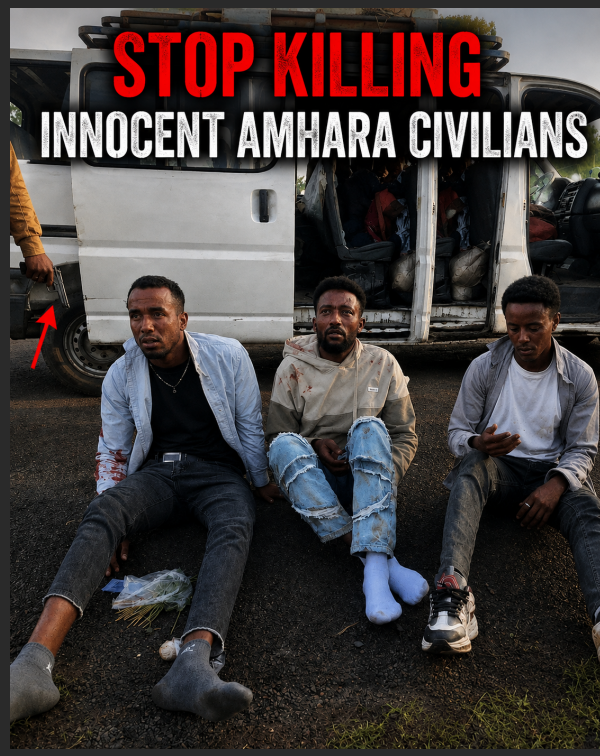
On 10 August 2026, Meseret Media reported the alleged killing of three Amhara civilians: Temesgen Getachew, Yitagesu Asegidew, and Gizaw Girmaye in Agena, Abeshge Woreda, Gurage Zone, Central Ethiopia Regional State.
Based on the local sources cited by Meseret Media, the three young men were traveling on public transport when they were forcibly removed after being accused of being “Amhara Fano Members”. The report states that their hands were tied behind their backs, that they were subjected to severe mistreatment, and that they were subsequently shot dead. Meseret Media alleged that government security forces carried out the killings in collaboration with members of the local police.
The reported mistreatment did not end with their deaths. According to the same report, their bodies were taken to their home area, where residents were initially prevented from collecting and burying them. The bodies were reportedly left in the open for approximately three days, allegedly with their hands tied.
Even more troubling are subsequent allegations concerning the victims’ families. Sources reported that relatives were threatened and pressured to deny government involvement in the killings. They were allegedly instructed to say that they did not know how the men had died and that government forces were not responsible. If substantiated, these allegations raise serious concerns about intimidation, accountability, and possible attempts to suppress information about the incident.
The case quickly gained wider public attention. On 11 August 2026, journalist and Horn of Africa commentator Martin Plaut shared the allegations on X, identifying the three victims and reporting that they had been forced from public transport and killed after being accused of being Fano members. Photographs and information concerning the incident have also circulated across social media.
On 13 August 2026, Addis Standard reported that Temesgen Kassa, head of the Central Ethiopia Regional State Peace and Security Bureau, had stated during a regional government press briefing on 12 August that authorities had taken “measures” against “armed men” in Abeshge Woreda who had allegedly rejected calls to surrender. However, Addis Standard noted that the official did not directly address the reported killings of the three named men.
This incident raises a broader and deeply troubling question about how security is being pursued in Ethiopia. Security cannot legitimately be achieved by treating accusations as proof, bypassing judicial procedures, or subjecting suspected individuals to arbitrary punishment. When people accused of association with an armed group are allegedly detained, restrained, and killed without a transparent legal process, such actions do not strengthen the rule of law.
Reports of incidents of this nature contribute to serious concerns that abusive security practices risk becoming normalized in the name of maintaining order. If authorities believe an individual has committed a crime or belongs to an armed organization, the lawful response is arrest, investigation, evidence, and a fair judicial process, not punishment outside the law. National security and the rule of law must reinforce each other, not become competing principles.
These accounts raise urgent questions:
- Were the three men armed combatants, or were they civilians removed from public transportation, restrained, and killed without due process?
- Who ordered and carried out the killings?
- Why were their families reportedly pressured to deny what happened?
The circumstances surrounding these deaths warrant an independent, impartial, and transparent investigation. No person should be arbitrarily killed merely because they are accused of association with an armed group. An accusation of being “Amhara Fano” cannot substitute for evidence, due process, and a fair trial.
The deaths of Temesgen Getachew, Yitagesu Asegidew, and Gizaw Girmaye demand justice, not intimidation, silence, or impunity. Security cannot be built through unlawful violence; lasting security depends on justice, accountability, the rule of law, and respect for human life.
Sources: Meseret Media, 10 August 2026; Martin Plaut on X, 11 August 2026; Addis Standard, 13 August 2026.
Editor’s Note: Views in the article do not necessarily reflect the views of borkena.com
__
Join our Telegram Channel: t.me/borkena
Like borkena on Facebook
To submit a press release, send the submission to info@borkena.com
Add your business to Ethiopian Business Listing / Ethiopian Business Directory
Join the conversation. Follow us on X (formerly Twitter) @zborkena to get the latest Ethiopian news updates regularly.