
From Exclusion to Expulsion: Is Ethiopia’s Expanding Campaign Against Amharas Crossing the Genocide Threshold?
By Caleb Ta (Dr.)
Independent Researcher in African Political Affairs; Human Rights Advocate
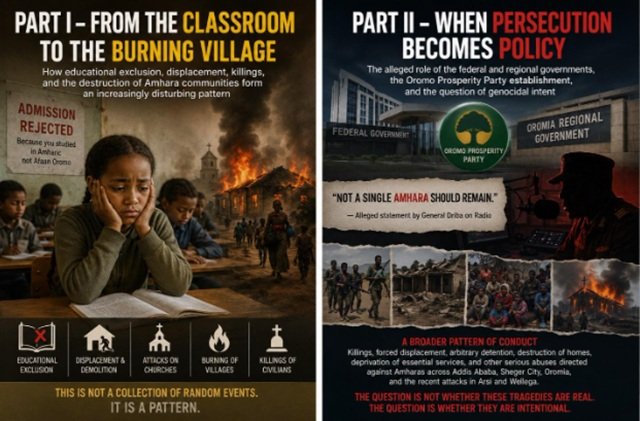
PART I —From The Classroom To The Burning Village
How educational exclusion, displacement, killings, and the destruction of Amhara communities form an increasingly disturbing pattern
Introduction
There are moments when events that initially appear unrelated begin to form a pattern that can no longer be ignored. A child denied an educational opportunity because of the language in which he or she studied may appear to be an administrative matter. A family forced from its home may appear to be another consequence of Ethiopia’s continuing conflict. A burned church, a destroyed village, a murdered civilian, or a community forced to flee may each be presented as an isolated tragedy.
But what happens when these events repeatedly affect the same ethnic population?
What happens when exclusion reaches the classroom, displacement reaches the home, violence reaches the village, and the institutions responsible for protecting civilians repeatedly fail to provide protection?
And what happens when these events are accompanied by allegations that political and administrative structures are contributing to the conditions under which an ethnic community is being marginalized, displaced, and attacked?
Those are the questions at the center of this investigation.
The issue is not to label every discriminatory act or every episode of violence as genocide. International criminal law establishes a high threshold, including the requirement of specific intent to destroy a protected national, ethnic, racial, or religious group, in whole or in part. But that legal threshold does not justify examining each event in isolation. On the contrary, it makes the cumulative pattern more important.
The story that follows begins with children and their education. It moves from the classroom to housing, from housing to displacement, and from displacement to the violence reported in communities across Oromia. By the end of Part I, the question is no longer simply why individual Amhara families are suffering.
The question is whether these experiences constitute part of a broader, increasingly systematic pattern directed against the Amhara as an ethnic group.
For years, the persecution of Amhara communities in Ethiopia has appeared as a collection of separate tragedies: a killing here, a demolished home there, a village emptied, a family detained, a church burned, a community displaced, or a child denied an educational opportunity because of the language in which he or she studied.
Each incident, when viewed alone, can be explained away. One may be described as an administrative decision. Another may be attributed to local ethnic conflict. A third may be dismissed as a consequence of Ethiopia’s continuing instability.
But when these incidents are placed side by side, a much darker picture begins to emerge.
The central question is no longer simply whether Amharas are experiencing discrimination. It is whether a sustained pattern of targeting, exclusion, displacement, deprivation, physical violence, and destruction is being directed against Amharas as an ethnic group—and whether the cumulative evidence warrants investigation under the legal framework of genocide.
The latest episodes begin in an unlikely place: the classroom.
But the classroom may only be the beginning of the story.
When a Child’s Language Becomes a Marker of Ethnicity
Families from Sheger City in the Oromia Region say their children were denied admission to special boarding schools in Addis Ababa after being told that they could not qualify because they had completed Grades 1 through 8 in Amharic.
According to the parents, their children applied for opportunities provided by the Addis Ababa City Administration to continue their education in the city’s special boarding schools. Some applied to the Empress Menen and Gelan special boarding schools.
Their applications, the families say, were rejected because the children had not studied Grades 1 through 8 in Afaan Oromo.
On the surface, this might appear to be a dispute about educational language policy.
But the deeper question is much more troubling:
Is language being used as a proxy for ethnicity to exclude Amhara children from educational opportunities available to other Ethiopian children?
A government has the authority to establish educational policies and language requirements. Yet when such requirements systematically exclude children because they were educated in Amharic, the policy deserves scrutiny—particularly when the affected population is predominantly associated with an identifiable ethnic community.
For the parents, the consequences are not merely bureaucratic.
They say their children have experienced psychological distress after discovering that the language in which they had previously received their education could itself become a barrier to their future.
These are children who did not choose their ethnicity.
They did not choose the language in which their parents enrolled them in school.
They did not create Ethiopia’s political conflicts.
Yet they may now be confronting the consequences of those conflicts inside the classroom.
The Genocide Convention recognizes causing serious bodily or mental harm to members of a protected group as one of the underlying acts that can constitute genocide when accompanied by the required specific intent. That does not mean that every rejected school application constitutes genocide, nor that every instance of psychological distress automatically meets the legal threshold. The critical question is whether educational exclusion forms part of a broader and intentional pattern of serious harm directed against a protected ethnic group.
That is why this educational controversy cannot be examined in isolation.
From the Classroom to the Home
The allegations extend far beyond education.
Amhara residents have reported being displaced from areas where they and their families have lived for generations. Homes have been demolished. Families have been forced to leave. Some have reported difficulties finding housing because landlords fear penalties or other consequences for renting to Amhara or Amharic-speaking families.
If verified, such practices would represent something far more consequential than an ordinary housing dispute.
A population does not have to be physically killed to be systematically removed from a community.
A community depends upon homes, schools, businesses, property, places of worship, security, and the ability to remain where generations of families have established their lives.
When homes are demolished, residents are expelled, landlords are discouraged or punished for renting to members of a particular ethnic group, and displaced families are prevented from returning, the social and economic foundations of community life begin to disappear.
The legal question, therefore, is whether such conduct is merely discriminatory or whether it forms part of a deliberate effort to permanently remove or destroy an ethnic population in particular areas.
The Genocide Convention specifically identifies the deliberate infliction of conditions of life calculated to bring about the physical destruction of a protected group as one of the acts that can constitute genocide when accompanied by the requisite intent. Displacement and ethnic cleansing can also become relevant to a genocide inquiry where they are carried out with the specific intent to destroy the protected group.
The distinction is crucial.
Forced displacement alone does not automatically constitute genocide.
But forced displacement occurring alongside killings, destruction of homes, attacks against civilians, deprivation, and explicit language concerning the destruction of an ethnic population demands examination as part of the larger pattern.
A Population Being Driven from Its Communities
The allegations become even more troubling because the displacement is not described merely as an unavoidable consequence of fighting.
Families say Amharas have been deliberately removed from places where they established homes and communities. Houses have been demolished. The property has been destroyed. People have been prevented from remaining in or returning to their communities.
In some cases, the allegations go further: Amhara families reportedly face obstacles to renting homes simply because of their ethnic identity or their use of Amharic. This represents institutionalized exclusion that extends to the most basic conditions of civilian life.
A person needs a home.
A child needs a school.
A family needs security.
A community needs the ability to live, work, worship, own or rent property, and raise its children without being targeted because of ethnicity.
When these foundations are progressively undermined, the question becomes unavoidable:
Is the objective merely political control, or is the purpose to make continued existence as a member of the targeted community increasingly impossible?
The Violence Is Not Confined to One Location
The physical violence against Amhara civilians extends across multiple areas throughout the Oromia region.
Reports described by Amhara communities include killings, forced displacement, arbitrary detention, destruction of homes and property, attacks on churches, and deprivation of protection and essential services.
In Arsi, there have been reports of Amhara civilians being killed and homes, churches, and property being burned. Families have questioned why federal and regional authorities failed to provide adequate protection.
In Oromia more broadly, Amhara communities have repeatedly reported attacks and displacement.
And now, according to accounts circulating from Wellega, the violence has reached another alarming level.
The material supplied for this article alleges that more than 300 Amhara people have been killed in approximately one week, while homes and property have been burned and entire villages destroyed. The remaining Amhara residents are reportedly being forced to flee their communities simply to save their lives.
These casualty figures require independent verification. But if the reported numbers and destruction are substantiated, the implications would be enormous.
Hundreds of members of one ethnic community were killed within a short period.
Entire villages reportedly burned.
Homes and property destroyed.
Churches attacked.
Survivors displaced.
A population forced to flee simply to remain alive.
At that point, the story can no longer comfortably be reduced to isolated ethnic tension.
It becomes a question of whether a systematic campaign is being conducted against a protected ethnic group.
The evidence presented so far takes the investigation from the classroom to the home and from the home to the burning village. It reveals allegations of educational exclusion, displacement, destruction, killings, attacks on churches, and communities forced to flee for their survival. Yet one question remains unanswered, and it may be the most consequential question of all.
What happens when the institutions responsible for protecting a population are repeatedly unable, or unwilling, to protect it?
And what if the explanation is not simply governmental failure?
Part I has examined what is happening to Amhara communities. Part II turns to the question of who may be enabling, coordinating, facilitating, or tolerating that pattern—and whether the evidence concerning government institutions, the Oromo Prosperity Party establishment, and statements about the destruction of Amharas changes the question from persecution to possible genocidal intent.
The story, therefore, does not end at the burning village.
It moves upward to the institutions, policies, authorities, and intentions behind the pattern.
Part II: WHEN PERSECUTION BECOMES POLICY
The role of the federal and regional governments, the Oromo Prosperity Party establishment, and the question of genocidal intent
Continue to Part II →
Editor’s Note: Views in the article do not necessarily reflect the views of borkena.com
__
Join our Telegram Channel: t.me/borkena
Like borkena on Facebook
To submit a press release, send the submission to info@borkena.com
Add your business to Ethiopian Business Listing / Ethiopian Business Directory
Join the conversation. Follow us on X (formerly Twitter) @zborkena to get the latest Ethiopian news updates regularly.