 living in the Gerado shelter site in Ethiopia’s South Wollo Zone facing evictions. Read more.)
By: Getahun Tsegaye
Staff Reporter
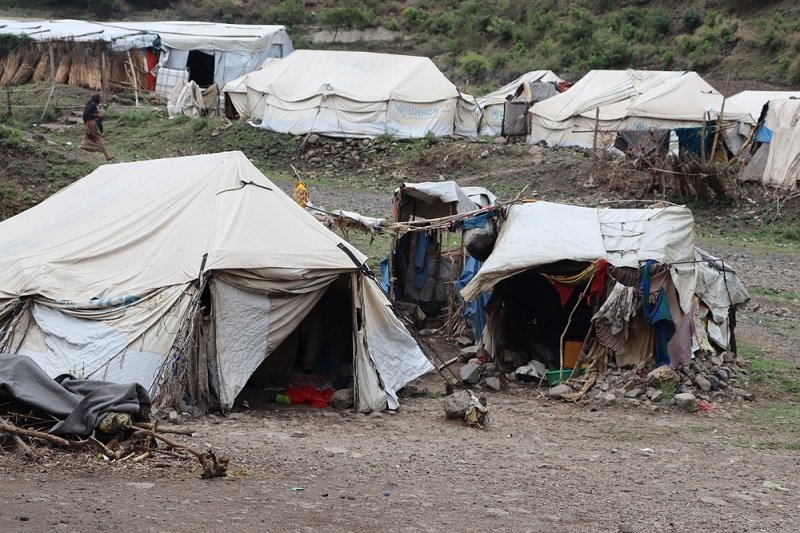
Addis Ababa, Ethiopia – Over 700 internally displaced persons (IDPs) living in the Gerado shelter site in Ethiopia’s South Wollo Zone say they are facing forced eviction and the demolition of their temporary homes, without being offered an alternative place to live.
The IDPs, originally displaced from Horo Guduru Welega Zone in Oromia Region in 2022 due to conflict, have been living in makeshift shelters in Gerado for nearly three years. Many now say their homes are being bulldozed under the claim that the land has been reallocated for investment purposes, DW reported.
“Our residential tents are being demolished, claiming that the area has been given to investors without an alternative site being prepared for us,” said one IDP resident.
Yimer Legesse, a representative for the displaced community, said approximately 13 shelters have already been taken down. He claims the demolitions are being carried out by individuals representing the new landholder. “They told us to leave, saying the area has been granted for development. I went to the Mayor of Dessie to plead for a solution, but I couldn’t get a response,” he told the media.
The situation has been confirmed by officials. Mohammed Seid, head of the Early Warning and Response Team at the South Wollo Zone Disaster Prevention and Food Security Office, acknowledged that the demolitions are taking place. “The city administration should have prepared an alternative location before taking this action,” he said. “The displaced persons came to us complaining that they were told to vacate the site while their tents were being torn down.”
The investor in question, Ibrahim Adem, head of Gerado Poultry and Animal Feed Enterprise, said the land was officially granted to his company years ago. However, he claims delays caused by regional conflict and instability have postponed their development plans. “Now we’ve requested that the area be cleared, but we haven’t demolished any homes,” he said. “We are willing to support efforts to resettle the IDPs, but the land needs to be prepared for our work.”
Efforts to reach Dessie City Administrator Samuel Molalign for further clarification were unsuccessful. While he initially said he was in a meeting, repeated calls and messages in the days that followed went unanswered, DW alleged.
This development comes amid ongoing reports of deteriorating conditions in IDP camps across the Amhara region. In April, Borkena highlighted the worsening state of temporary shelters provided to displaced persons. Tents intended to last six months are now in use for over three years, with severe wear from rain, heat, and wind.
One mother, Fatuma Nur, who recently gave birth to twins in the Haik Mekane Eyesus camp, shared her suffering. “It leaks badly; water comes up from below, and the sun beats down from above. The children are suffering greatly. My whole body is burning from the heat, and my operation wound keeps opening,” she said.
In other camps like Jara and Turke, displaced families describe how their canvas shelters are collapsing. “We were told we would be here for six months. Now, it’s been three years,” said one resident in Jara. “The tents are falling apart. Rain pours in. Being outside is sometimes better than being inside.”
In Turke camp, residents are attempting to make repairs themselves. “The sun has torn the tents to pieces. Now that it’s dry, we fix what we can, but when it rains, it won’t hold anyone,” said one camp representative.
According to Ali Seyid, head of the South Wollo Zone Disaster Prevention and Food Security Office, over 34,000 IDPs are hosted in the zone, with nearly half still living in fragile shelters. “We are aware of the problem and have requested support from the regional authorities,” he said. “Previously, international partners helped, but many have left. Now, we are waiting on the federal government.”
Despite Borkena’s repeated attempts, no response was received from the Amhara Regional Disaster Prevention and Food Security Commission.
The crisis in Gerado reflects a broader humanitarian emergency in the Amhara region, where an estimated 664,000 displaced people rely on humanitarian assistance. Aid groups warn that conditions in IDP camps remain critical due to overcrowding, collapsing shelter infrastructure, and a lack of basic necessities.
__
Subscribe : https://borkena.com/subscribe-borkena/
Join our Telegram Channel : t.me/borkena
Like borkena on Facebook
Add your business to Ethiopian Business Listing / Ethiopian Business Directory Business Listing Toronto
Join the conversation. Follow us on X (Formerly Twitter) @zborkena to get the latest Ethiopian News updates regularly. Subscribe to YouTube channel To share information or for submission, send e-mail to info@borkena.com
The name Samuel Molalign does not sound like some one made of that ‘Umma’ thing. Aha!!! He has that ‘Amhara-umma’, another variety thing. This ‘umma’ thing is everywhere man! I was having my breakfast today when suddenly the ‘umma’ thing popped out of my cup of tea. Just like that, just like Bewitched!!!
The dream of an orromuma utopia is dying before our eyes. What kind of people destroy a nation in less that 8 years when all powers failed to do so in time past? The Orromuma party that’s in 4 kilo can’t govern a village let alone a nation. Time is fast approaching for the demise of these foolish government and its blind followers. Soon, Ethiopia will be free from this brutal genocide loving dictatorship.