
Military Training, Ideological Conformity and the Threat to Independent Thought in Ethiopia
Eyassu Epheraim G Hanna
London UK
Who should read this article?
This article is intended particularly for Prime Minister Abiy Ahmed and his ministers, senior civil servants, diplomats, military leaders, Ethiopian intellectuals, academics and all those engaged in the country’s political affairs. It invites them to examine the political implications of Hurso, the future of independent judgement in government, and the kind of political culture being shaped for Ethiopia.
The question is not simply why civilian ministers are being trained like soldiers. It is what kind of governing elite is being produced, what political relationship is being established between that elite and the Prime Minister, and what the consequences may be for independent thought, constitutional government and the future of Ethiopia.
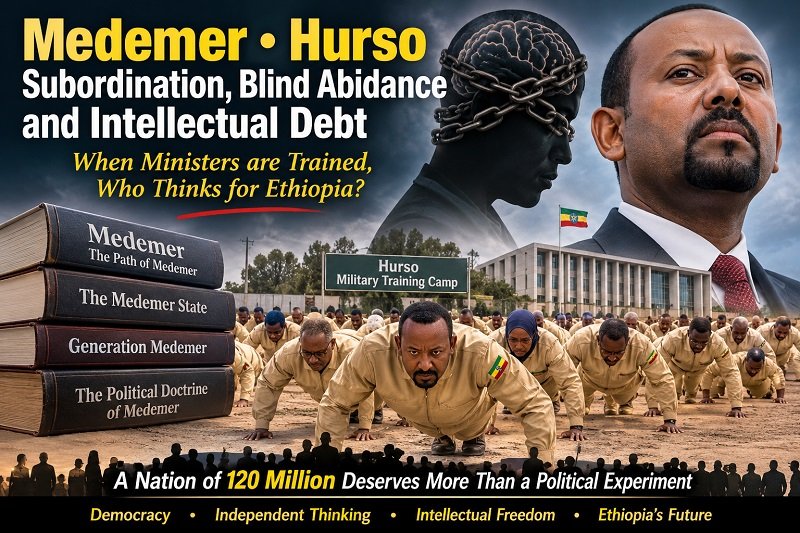
The sight of Ethiopia’s Prime Minister, Abiy Ahmed, alongside cabinet ministers and senior government officials undertaking military-style training at Hurso deserves much more serious examination than it has so far received. Public discussion can easily become absorbed by the immediate spectacle: the uniforms, the exercises, the photographs, the physical demands of the programme and the question of whether ministers, some of whom enjoy considerable public privileges, deserve such treatment.
These are not necessarily unimportant matters. But they are not the central issue.
The more consequential question is political. Why is a civilian governing elite being subjected to a military environment, and what political values, habits and relationships are being cultivated through this experience? What does it mean when ministers responsible for civilian government are brought together for military training under the leadership of the Prime Minister? What message does this send about the relationship between the individual minister, the governing party, the state and the leader?
My argument is that Hurso should be examined as a political experiment in the production of obedience and subordination within the civilian governing elite. It is not simply a programme of physical exercise, teamwork or leadership development. Considered alongside the political emphasis on Medemer, the reported ideological study of the Prime Minister’s publications, the examination of political knowledge and the wider insistence on discipline and coordinated implementation, Hurso becomes part of a much larger question about the political formation of those who govern Ethiopia.
The issue is not whether discipline has a place in public administration. Of course it does. Nor is it whether ministers should be accountable, hardworking or committed to public service. They should. The issue is whether discipline is being used to strengthen independent public responsibility or to cultivate conformity to a central political authority.
Those are fundamentally different political projects.
1. The significance of transferring military discipline into civilian government
According to reports published at the end of October 2026, Prime Minister Abiy Ahmed joined cabinet ministers, deputy ministers and senior officials in military-style training at Hurso. The official explanation emphasised discipline, accountability, coordination, patriotism, leadership, national security and the implementation of the Medemer vision. Abiy reportedly explained the relationship between military and civilian work in the following terms: “Soldiers have targets while civilians have goals. The objective of both is victory.”
That statement deserves attention. It may sound like a general appeal for determination and effectiveness. Yet political language matters, particularly when it is used by a head of government to explain the purpose of a programme involving the country’s senior civilian leadership.
A military organisation and a constitutional civilian government are not interchangeable institutions. Military effectiveness depends upon a defined chain of command, operational discipline and the capacity to carry out orders under demanding conditions. Civilian government, by contrast, must accommodate disagreement, independent assessment, public scrutiny, legal constraints, competing interests and the possibility that the leader may be wrong.
A minister is not simply an officer executing the Prime Minister’s instructions. A minister has a responsibility to the public, the constitution, the law and the institution of government. The minister must be able to challenge a policy, identify an error, refuse an unlawful instruction and explain why a proposed course of action is damaging to the country.
The capacity to disagree is not a weakness in civilian government. It is one of its essential safeguards.
This is why the transfer of military discipline into civilian political leadership cannot be evaluated simply by asking whether the training improves teamwork or physical endurance. We must ask what understanding of authority is being transferred with it. Is the purpose to make ministers more capable of independent public service, or to make them more compliant members of a governing formation?
The publicly reported details of the Hurso programme remain incomplete. The precise curriculum, duration, assessment arrangements and consequences of non-participation have not been fully disclosed. That absence of information makes public scrutiny more important, not less. But the political significance of the programme can already be examined through its stated rationale, its setting, its symbolism and its relationship with the wider political culture being developed under Abiy Ahmed.
2. From public servants to a disciplined political formation
The composition of the Hurso gathering is important. These are not ordinary recruits joining the armed forces. They are senior civilian officials who occupy positions of public authority. Their responsibilities involve finance, health, administration, political coordination, public services and the management of institutions that affect millions of people.
When such officials are assembled in a military training environment, the exercise communicates something beyond physical discipline. It places the civilian governing elite within a collective structure in which uniformity, coordinated action and common purpose become highly visible.
The photograph of the gathering reinforces this impression. The matching training clothes, the collective arrangement and the presentation of the participants as a unified body create an image of political and organisational uniformity. A photograph cannot establish the private intentions of its organisers, and it would be irresponsible to claim that its composition proves a particular ideology. Nevertheless, political images have meanings. They communicate how those in power wish the governing group to be seen.
The image invites the public to see the ministers not primarily as independent holders of constitutional offices, each with distinct responsibilities and judgement, but as members of a single disciplined collective.
There is nothing inherently wrong with collective government. Cabinets must coordinate. But a cabinet is not supposed to become an assembly of people who think identically. Its strength should come from the presence of capable individuals who can bring different knowledge, experience and perspectives to the same political table.
A government that cannot tolerate disagreement may look united, but its apparent unity can conceal institutional weakness. If ministers learn that advancement depends more on demonstrating loyalty than on exercising judgement, they will increasingly tell the leader what they believe the leader wishes to hear. The result is not necessarily better coordination. It may be a system in which information becomes distorted, criticism disappears and policy errors are allowed to grow.
This is a central danger of political subordination: the leader may acquire greater control over the governing elite while losing access to the honest information necessary to govern effectively.
3. What does Abiy Ahmed mean by victory?
The Prime Minister’s comparison between military targets and civilian goals raises a further question. What is the meaning of victory in civilian government?
In a democratic and constitutional system, the government is not an army engaged in a permanent campaign in which every institution must march towards a single leader-defined victory. Political success must be judged against public welfare, constitutional obligations, the rule of law, economic and social development, the protection of rights and the ability of citizens to hold their representatives accountable.
A government may have ambitious national objectives. It may require discipline, determination and long-term planning. But the achievement of those objectives cannot be separated from the means used to pursue them.
If victory means the successful implementation of a leader’s programme, what happens when that programme is mistaken? If victory means the removal of obstacles to central policy, what happens when those obstacles are legitimate constitutional safeguards? If victory means the coordination of all officials around one political vision, what place remains for independent judgement?
These are not abstract philosophical questions. They go directly to the relationship between power and accountability.
The distinction between a public objective and a leader’s personal political ambition must remain clear. The state belongs to its citizens. It is not the personal project of the person who occupies the highest office. Ministers are entrusted with public responsibilities; they are not instruments through which one individual extends his will throughout the state.
A political culture that treats disagreement as disloyalty risks confusing the success of the leader with the success of the country. That confusion is particularly dangerous in a country as large, diverse and politically complex as Ethiopia.
4. Medemer and the ideological dimension of political discipline
Hurso cannot be fully understood in isolation from the political ideas promoted by Abiy Ahmed. One important part of that wider context is Medemer.
Medemer has been presented as a philosophy, a national vision and, increasingly, a governing framework. The Prosperity Party adopted it as a guiding principle, while Abiy’s government has presented The Medemer State as an institutional expression of the idea. The political significance of Medemer therefore extends beyond the contents of a book. It concerns the relationship between an individual leader’s intellectual project and the institutions of the state.
The question is not whether a Prime Minister is entitled to write books, develop political ideas or advocate a national philosophy. Of course he is. Nor is the question whether a governing party may have an ideological programme. Political parties necessarily have ideas and policies.
The more important question is what happens when the philosophy associated with one political leader becomes the intellectual framework through which officials are expected to understand, explain and implement government policy.
Academic analysis of the transition from the EPRDF to the Prosperity Party has described the adoption of Medemer as a guiding principle and discussed the expectation that officials at different levels of government engage with and disseminate the doctrine. This is significant because it shows that Medemer is not merely a private intellectual interest. It has been incorporated into the political and administrative environment of the governing party.
When an official is expected to demonstrate knowledge of a leader-associated philosophy, the question of intellectual independence becomes unavoidable. Is the purpose to encourage officials to read, debate and criticise political ideas? Or is the purpose to establish a common ideological vocabulary and measure political reliability through familiarity with an authorised doctrine?
The distinction matters enormously.
A genuinely open political philosophy should be strengthened by criticism. Its ideas should be examined, challenged, revised and compared with alternative approaches. Officials should be able to disagree with its arguments without jeopardising their professional standing. If, instead, knowledge of the philosophy becomes a test of loyalty, intellectual engagement is transformed into political conformity.
5. Who actually produced the Medemer books?
There is another dimension that deserves serious attention: the intellectual authorship of the Medemer publications.
Several books have been publicly associated with Abiy Ahmed, including Medemer, The Path of Medemer, Generation Medemer and The Medemer State. Their public presentation has contributed to the image of the Prime Minister as the principal intellectual architect of the political philosophy that bears the name Medemer.
However, testimony provided by Dr Milkessa Midega Gemechu raises questions about the process through which the first Medemer book and related political material were developed. In the interview transcript supplied for this analysis, Dr Milkessa describes a process involving a group of individuals with different areas of expertise, including policy specialists, writers, advisers and people involved in preparing presentations, training material and political speeches.
He identifies individuals whom he says contributed to the work, including Mohammed Hassan, Daniel Kibret, Mihret Debebe and Wondwesen Abay. He also describes contributions to economic and foreign-policy material by other individuals, Dr. Markos Tekle. His account suggests that the development of Medemer involved a wider intellectual and administrative process than the public attribution of the books to one person might lead readers to assume.
This testimony should not be treated as a court judgment. The full documentary record of the drafting process has not been established here, and the precise contribution of each individual would require further corroboration. But testimony from someone who says he was involved in the political environment and the development of the early Medemer project is relevant evidence. It deserves examination rather than dismissal.
The central issue is not simply who typed a manuscript or who supplied a paragraph. It is the distinction between intellectual authorship, political sponsorship, editorial contribution and public attribution.
If a political philosophy is collectively developed by specialists and advisers but publicly presented primarily as the intellectual creation of one leader, a process of personalisation takes place. Collective intellectual labour becomes associated with individual political authority. The leader acquires the image of the principal source of the doctrine, while the people who contributed to its development become less visible.
That matters because intellectual authority can become a form of political authority. When the leader is presented not only as the head of government but also as the principal source of the country’s governing philosophy, challenging the philosophy can begin to look like challenging the leader himself.
This is the connection between the Medemer authorship question and Hurso. The two issues may appear separate, but together they illuminate a possible political structure: ideological authority is concentrated around the leader, while the civilian governing elite is organised and disciplined around the implementation of that authority.
6. From intellectual contribution to political orthodoxy
Dr Milkessa’s account also raises questions about the institutional and financial circumstances surrounding the production and distribution of Medemer publications. He makes allegations about the involvement of public institutions, the purchase and distribution of books, pressure on officials and organisations to obtain copies, the use of public resources and the handling of proceeds.
These are serious allegations. They should be investigated and reported with clear attribution rather than presented as established findings without supporting records. The same applies to his account of the employment arrangements and financial compensation of some contributors, and to his claims about the use of particular texts or research in the preparation of later publications.
Nevertheless, the broader political question is important even before every financial allegation is resolved. When a philosophy associated with a political leader is disseminated through party and government structures, it is necessary to ask whether public institutions are being used to promote an intellectual project that should remain open to public scrutiny.
The issue becomes more serious if officials are expected to acquire the books, study them, pass examinations or demonstrate familiarity with their contents as part of their political and administrative responsibilities. The distinction between voluntary intellectual engagement and institutionalised ideological conformity must be protected.
It is also important to recognise a counterpoint. Abiy has publicly encouraged people to read, discuss and criticise some of the Medemer-related publications. Such statements should be taken into account. But an invitation to criticism in public rhetoric is not sufficient by itself. The real test is whether officials, party members, academics and citizens can reject the philosophy or disagree with its central propositions without suffering political or professional consequences.
The measure of intellectual freedom is not whether a leader says criticism is welcome. It is whether criticism is safe, meaningful and capable of influencing policy.
7. The political psychology of obedience: what happens to independent judgement?
The danger of Hurso is not confined to the immediate behaviour of the officials participating in the training. It concerns the longer-term political habits that may be cultivated within the governing elite.
Political systems do not always produce obedience through direct threats or explicit orders. They can produce it through repeated practices, institutional expectations, career incentives, public rituals and the gradual narrowing of what officials consider safe to say.
An official does not need to be told every day to agree with the leader. If the official learns that promotion follows demonstrations of loyalty, that criticism creates professional risk and that disagreement is interpreted as a failure of discipline, the official may begin to regulate his or her own thinking and speech.
This is how conformity becomes internalised.
The political theorist Max Weber’s distinction between legal-rational and charismatic authority is useful here. In a legal-rational system, officials derive their authority and
responsibilities from established rules and institutions. Their professional obligations are not reducible to personal loyalty to the individual occupying the highest office. In a personalised system, by contrast, the authority of the leader can increasingly overshadow the authority of institutions.
Michel Foucault’s work on discipline also helps explain why the physical and organisational dimensions of Hurso deserve attention. Discipline is not merely the enforcement of rules. It can be a process through which institutions shape conduct, habits, bodies and expectations. Repeated practices teach individuals how to behave, how to relate to authority and how to understand their place within a hierarchy.
This does not mean that every military exercise is an instrument of authoritarian control. It means that the political meaning of a disciplinary programme depends on its institutional context, its objectives and the relationship between those directing it and those being trained.
Hannah Arendt’s analysis of ideology and the erosion of independent judgement offer another important warning. The danger in an ideologically controlled political environment is not necessarily that every official becomes intellectually incapable. It is that officials become accustomed to accepting prescribed explanations rather than examining reality independently. They may learn to repeat the correct language while losing the habit of asking whether the language corresponds to the facts.
Dietrich Bonhoeffer’s reflections on what he called socially induced stupidity are relevant in a similar way. His argument was not that people become unintelligent. It was that political and social conditions can lead individuals to surrender independent judgement and become instruments of a collective mentality.
The lesson is uncomfortable but important: an educated governing elite can still become intellectually subordinate. Academic qualifications, professional experience and technical competence do not automatically protect people from political conformity.
Indeed, a government may possess highly educated officials and still suffer from a profound shortage of independent thought if those officials are unable or unwilling to challenge the political authority above them.
8. Historical warnings: when a leader’s book becomes an instrument of the state
History provides several examples of political leaders whose personal doctrines or publications became instruments of ideological formation. These examples are not identical to Ethiopia, and they should not be used to claim that the Hurso programme is equivalent to the atrocities of other regimes. Their value lies in identifying mechanisms through which political authority can become attached to an official doctrine.
Turkmenistan under Saparmyrat Niyazov provides one of the clearest institutional examples. Niyazov’s Ruhnama was elevated far beyond the status of an ordinary political or philosophical publication. It became embedded in education and public life, and knowledge of the book was reportedly used in examinations and assessments affecting public employees and students. The leader’s text became a measure of ideological familiarity and, in important settings, political conformity.
The significance of this example is not that Ethiopia is Turkmenistan. It is that a leader associated book can be transformed into an institutional instrument. A text that might otherwise be debated as political writing becomes a standard against which citizens and officials are assessed.
Muammar Gaddafi’s The Green Book offers another example. It presented Gaddafi’s Third Universal Theory and was used to articulate the ideological basis of his political system. Libya’s education policy included the study of parts of the book. Again, the important question is how a leader’s political ideas become embedded in state institutions and how the space for alternative political thinking is affected.
Mao Zedong’s Quotations from Chairman Mao Tse-tung, commonly known as the Little Red Book, became a powerful symbol and instrument of political mobilisation, especially during the Cultural Revolution. Its significance lay not only in the text itself but in the political rituals, mass circulation and public demonstrations of ideological allegiance associated with it.
Adolf Hitler’s Mein Kampf also belongs in a discussion of leader-associated political texts, but the historical distinction must be made explicit. The book articulated an explicitly racist, antisemitic and expansionist ideology that became central to the Nazi movement and regime. It was promoted and widely distributed under Nazi rule. The comparison here is not a claim of moral or historical equivalence between the Nazi regime and the Ethiopian government. It is a warning about the danger of allowing a leader’s political doctrine to become inseparable from the identity and authority of the state.
These cases demonstrate that the institutionalisation of a leader’s ideas can serve several purposes: it can establish an authorised political vocabulary, create tests of ideological familiarity, elevate the leader’s intellectual authority and make dissent appear to be a rejection of the national project itself.
The most relevant comparison for the institutionalisation of a leader-associated book may be Niyazov’s Turkmenistan. The other examples help illuminate different aspects of the same wider problem. They should be used as analytical comparisons, not as predictions that Ethiopia must follow an identical historical path.
The question for Ethiopia is whether the country is moving towards a political environment in which the leader’s ideas become the accepted intellectual framework of government and the governing elite is expected to demonstrate conformity to that framework.
9. The danger of an ideologically uniform governing elite
A country does not become politically healthy simply because its ministers are united. It becomes healthy when its institutions are capable of bringing different forms of knowledge and judgement together while remaining accountable to the public.
The production of an ideologically uniform governing elite is dangerous for several reasons.
First, it weakens the quality of decision-making. Ministers who fear contradicting the Prime Minister may fail to communicate the full consequences of a policy. They may withhold information, minimise difficulties or present a misleading picture of implementation. The leader may then receive an increasingly distorted account of the country he is governing.
Second, it weakens institutional responsibility. A minister who sees himself primarily as an instrument of the leader may become less willing to defend the independence of his or her ministry. Public institutions risk becoming extensions of a central political will rather than bodies with their own legal duties and professional standards.
Third, it undermines the capacity for innovation. Creativity depends upon the freedom to question established assumptions, test alternative ideas and admit that a prevailing approach is mistaken. An environment in which ideological conformity is rewarded will tend to discourage precisely these qualities.
Fourth, it damages the relationship between government and citizens. A political elite that has become accustomed to repeating a prescribed political vocabulary may become less capable of listening to the complex and sometimes uncomfortable realities of the population.
Finally, it weakens the constitutional order. A constitution is not protected merely because officials publicly affirm their commitment to it. It is protected when they are willing to uphold its limits on power, including when those limits inconvenience the leader.
The most serious danger is therefore not simply that ministers might become obedient. It is that obedience may gradually replace the independent judgement that makes civilian government legitimate and effective.
10. The public debate about ministers’ privileges misses the central issue
Some public discussion of the Hurso programme may be influenced by resentment towards the privileges enjoyed by ministers and senior officials: their salaries, vehicles, security arrangements and other benefits. There is a legitimate public interest in examining whether such privileges are justified, whether public resources are being used responsibly and whether officials are delivering the services for which they are paid.
But these questions must not be confused with the political meaning of military training.
A minister’s privileges do not justify the erosion of his or her constitutional independence. An official who receives an excessive salary should be held accountable through transparent rules, public scrutiny, parliamentary oversight and lawful administrative procedures. The answer is not to subject that official to a political culture of unquestioning obedience.
Indeed, the public should be concerned about both issues. It should demand accountability for the use of public resources while also defending the right and responsibility of ministers to exercise independent judgement.
A government cannot claim to be strengthening public service if it improves the appearance of discipline while weakening the institutional conditions that make officials accountable to the people.
11. The consequences extend beyond the governing party
Ethiopia is a country of more than 120 million people, with a complex political history, considerable cultural diversity and serious questions about the relationship between the state
and its citizens. The political culture cultivated at the highest level of government does not remain confined to the cabinet.
It influences the governing party, the civil service, regional administrations, public institutions, universities and the wider society. The example set by senior officials shapes what younger public servants believe is expected of them. It influences whether people see disagreement as a legitimate part of public life or as a sign of disloyalty.
This is why the political formation of the governing elite matters so much. If the people at the top of the state are encouraged to subordinate independent judgement to a single political authority, the consequences can travel down through the administrative system.
Universities and schools require an environment in which students can question accepted knowledge. Public administration requires professionals who can identify failures and propose alternatives. Scientific and economic development require people who can challenge assumptions and test new ideas. Democratic government requires citizens and representatives who can disagree without fear.
An ideological culture that prizes uniformity over independent thought threatens all these foundations.
The future of Ethiopia cannot depend upon producing a population that repeats the same political language or a governing elite that regards disagreement as a disciplinary failure. The country needs institutions that can accommodate intellectual difference, political pluralism and competing visions of national development.
12. The questions that must be answered
The public should not have to rely on speculation about the purpose of a programme involving the country’s senior civilian leadership. The government should explain its objectives and disclose sufficient information to allow meaningful scrutiny.
What is the exact curriculum of the Hurso training? What are the political, educational and military components? How long does it last? Is participation voluntary or mandatory? How are participants assessed? What happens if a minister disagrees with the programme or refuses to participate? Is the programme intended to improve professional capacity, or does it include ideological instruction and political evaluation?
How does the programme relate to the expectation that officials study and disseminate Medemer? Are examinations or other assessments used to measure knowledge of the Prime Minister’s publications? Can officials openly criticise Medemer without jeopardising their careers? Can a minister publicly argue that a policy associated with the Prime Minister is wrong and remain in office based on professional competence?
What is the actual process through which the Medemer books were developed? What contributions were made by advisers, academics, writers and policy specialists? How were those contributions acknowledged? What role did public institutions play in producing, purchasing or distributing the publications? These questions should be investigated through testimony, manuscripts, correspondence, contracts, financial records and the accounts of those involved.
Most importantly, what safeguards exist to ensure that ministers remain accountable to the constitution and the public rather than becoming personally subordinate to the Prime Minister?
These are legitimate questions in any constitutional system. They should not be dismissed as hostility to discipline, national development or the government itself.
Conclusion: What kind of political human being is Hurso intended to produce?
The central question about Hurso is not whether military training can teach civilian officials’ discipline, teamwork or physical endurance. It is whether the programme forms part of a wider political process through which the civilian governing elite is being trained to think and act in accordance with a central political authority.
Taken together, the military-style formation at Hurso, the political language of victory and discipline, the institutional promotion of Medemer and the questions surrounding the production and dissemination of the Prime Minister’s publications deserve examination as parts of a connected political development.
I am concerned that this development may be producing something more consequential than a disciplined cabinet. It may be producing a governing elite whose members become increasingly uniform in their political outlook and increasingly subordinate in the exercise of their judgement.
That is the experiment Ethiopia should be discussing.
The historical examples are warnings about what can happen when a leader’s ideas become institutional doctrine and when officials learn to demonstrate political conformity rather than exercise independent judgement. The academic literature on authority, discipline, ideology and political thought helps explain why this process matters. And the testimony concerning the development of Medemer raises questions about how intellectual authority is constructed and concentrated around a political leader.
None of these elements, considered separately, proves the entire argument. But together they provide a serious basis for examining the political direction in which Ethiopia’s governing institutions are being taken.
The distinction between military obedience and civilian constitutional responsibility must never be lost. Soldiers operate within a chain of command. Ministers serve the public under the constitution. They must have the courage to question, challenge and, when necessary, oppose the leader. A minister who cannot do so is not fulfilling the responsibilities of civilian government.
The danger is not simply that Ethiopia may have ministers who follow orders. It is that the country may develop a political culture in which independent thought itself becomes a liability, ideological conformity becomes a qualification for advancement and loyalty to one individual gradually takes precedence over responsibility to the nation.
The question Ethiopia must confront is therefore not simply why its ministers are undergoing military training. It is what kind of political human being this experiment is intended to
produce—and whether the result will serve the Ethiopian people or increasingly subordinate their government to the authority of one leader.
Bibliography
1. Ayele — Ethiopia’s constitutionalism and electoral authoritarianism.
2. Weber — political authority and responsibility.
3. Foucault — discipline and the formation of behaviour.
4. Bonhoeffer — the surrender of independent judgement.
5. Arendt — ideology and political domination.
6. Gramsci — political hegemony.
7. Human Rights Watch — the Ruhnama example.
8. Gregor — political religion and leader-centred doctrine.
9. Dr Milkessa’s interview — Medemer’s reported intellectual origins. 10. Abiy Ahmed’s original Hurso statement.
11. Abiy Ahmed’s Medemer and The Medemer State.
12. Contemporary reporting on the Hurso programme.
Editor’s Note: Views in the article do not necessarily reflect the views of borkena.com
__
Join our Telegram Channel: t.me/borkena
Like borkena on Facebook
To submit a press release, send the submission to info@borkena.com
Add your business to Ethiopian Business Listing / Ethiopian Business Directory
Join the conversation. Follow us on X (formerly Twitter) @zborkena to get the latest Ethiopian news updates regularly.