
By Ayele Addis Ambelu
(ayeleradio@gmail.com)
This investigative story examines what happens after foreign capital is announced, contracted and disbursed: who negotiates the financing, who controls the contracts, who benefits from the project, what guarantees and foreign-exchange risks are created, how transparently those obligations are reported, and whether project-level economic benefits are large enough to justify the public risks. Its central focus is the gap between the headline value of investment and the ultimate fiscal, governance and accountability cost carried by the Ethiopian state and taxpayers. The reporting uses foreign direct investment, railway financing, public debt, currency depreciation; the Eurobond restructuring and debt-transparency evidence to test whether capital is constructive or can become corrosive when transparency, competition and oversight are weak.
The Investment Boom: What the US$4.32 Billion Figure Really Tells Us
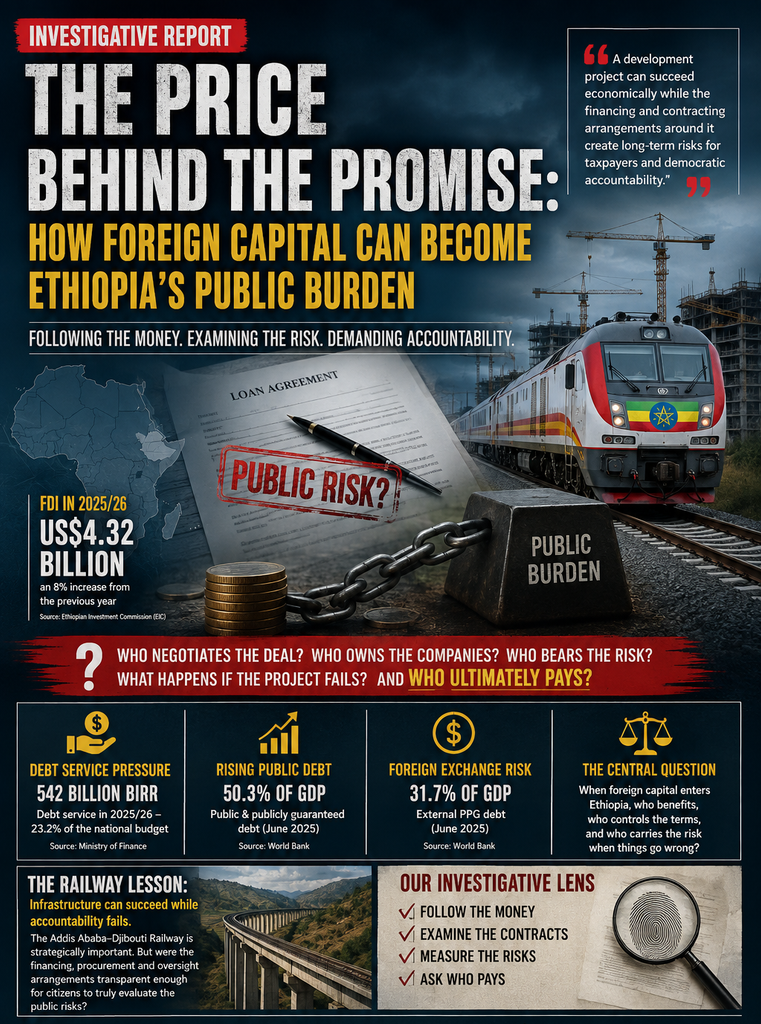
Ethiopia is attracting foreign capital at a scale that would once have seemed extraordinary. In the 2025/26 Ethiopian fiscal year, the country recorded US$4.32 billion in foreign direct investment, an 8 percent increase from the previous year, according to the Ethiopian Investment Commission (EIC). Commissioner Dr. Zeleke Temesgen said the figure was presented at the Commission’s annual performance review and that 528 new investment licenses were issued during the year.
The number is an important economic signal. But it does not answer the question at the heart of Ethiopia’s next investment challenge: what happens after the money arrives? Who negotiated the deal? Who owns the companies receiving the contracts? How competitive was the procurement process? What guarantees did the Ethiopian state provide? Who carries the foreign-exchange risk? What happens if the project fails? How much of an announced investment has actually been disbursed? And, most importantly, when a private or state-owned project cannot meet their obligation, who ultimately pays?
These questions matter because foreign capital is not automatically either good or bad. The governance framework surrounding it can determine whether it becomes constructive capital supporting competition, productivity and accountable institutions or what the Center for International Private Enterprise (CIPE) describes as “corrosive capital,” financing whose lack of transparency, accountability and market orientation can weaken institutions and allow political considerations to override competitive market principles.
Source and analytical framework: CIPE’s definition and comparative infrastructure work distinguish the quality of capital by the institutional conditions surrounding it, rather than by the nationality of the lender. CIPE – Center for International Private Enterprise
That distinction is crucial for Ethiopia, a country that needs enormous amounts of external capital to expand energy, transport, manufacturing, agriculture and digital infrastructure, while simultaneously struggling with foreign-exchange shortages, debt restructuring and fiscal pressure.
The Ethiopian industrial park expansion loan & the railway projects examined for this investigation exposes governance vulnerability: a development project can be economically valuable while the financing and contracting arrangements surrounding it still create long-term risks for taxpayers and democratic accountability. But the investment number itself contains a warning for investigative reporters.
The 8 percent increase is a flow indicator, not a measure of realized public value. For investigative purposes, the US$4.32 billion figure should be decomposed into at least five stages — pledged, licensed, contractually committed, actually disbursed and productive capital. The difference between those stages is itself a finding: a country can report a large investment pipeline while receiving much less cash, employment, exports or tax revenue. The reporting should therefore request Ethiopian Investment Commission project-level data showing promised value, license date, investor identity, sector, location, financing source, amount disbursed, project status, incentives granted and whether the investment generated foreign-exchange earnings or imports. This is also where beneficial-ownership and procurement checks become relevant.
A billion-dollar announcement is not necessarily a billion dollars transferred into Ethiopia. The EIC said the US$4.32 billion figure did not include investments pledged at the fourth Invest in Ethiopia forum by companies that subsequently obtained licenses. The distinction between pledged capital, licensed capital, committed capital, disbursed capital and productive capital is therefore fundamental. That is why this investigation follows the money beyond the announcement.
CIPE’s comparative ‘Tale of Two Railroads’ research frames the railway cases around opaque financing, procurement, oversight and democratic resilience. Its core contribution to this investigation is methodological: infrastructure performance and governance performance must be measured separately. CIPE research: Infrastructure Financing and Democratic Resilience
The railway lesson: infrastructure can succeed while accountability fails
CIPE’s comparative study, Infrastructure Financing and Democratic Resilience: A Tale of Two Railroads, provides another lens. It compares Ethiopia’s Addis Ababa–Djibouti Railway with Kenya’s Standard Gauge Railway, focusing not on whether the railways physically function but on the institutional environment surrounding their financing, procurement and oversight. The study argues that opaque financing, non-competitive procurement and weak oversight can create fiscal and democratic risks even when infrastructure itself is economically useful. That distinction is particularly important for Ethiopia.
The Addis Ababa–Djibouti Railway is a strategically important piece of infrastructure connecting landlocked Ethiopia to the Djibouti port corridor. The project can reduce transport constraints and support regional trade. The investigation therefore does not argue that the railway is evidence of corruption. Instead, the question is whether the financing and procurement arrangements were sufficiently transparent to allow Parliament, auditors, journalists, companies and citizens to independently evaluate the public risks.
The Global Infrastructure Hub records that the Addis Ababa–Djibouti project cost about US$5.09 billion in 2011 values, with governments financing 30 percent and Chinese lenders financing the remaining 70 percent; it also records financial risks from lower-than-forecast traffic and exchange-rate movements because debt was structured in US dollars while costs and revenues were largely in Ethiopian birr. The debt maturity was subsequently extended from 15 to 30 years.
The railway is therefore a test of institutions, not a simple test of whether the train runs. The available project evidence identifies several indicators that should be tracked together: (1) the share of project financing supplied by debt versus domestic equity; (2) whether procurement was genuinely competitive or concentrated among a small group of pre-selected firms; (3) whether the lender, engineering contractor, equipment supplier and operator occupy closely connected commercial positions; (4) the currency mismatch between dollar-denominated debt and birr revenues and operating costs; (5) whether traffic and revenue forecasts matched actual demand; (6) whether guarantees or restructuring shifted project risk toward the public balance sheet; (7) whether project annexes, amendments, repayment schedules and contingent liabilities are accessible to Parliament and the public; and (8) whether journalists, auditors, courts and civil society can challenge decisions after contracts are signed.
Coercive-capital perspective — this does not mean that the railway financing was necessarily corrupt or that Chinese capital is inherently harmful. A more precise investigative question is whether financing structures can create a form of economic dependence or bargaining asymmetry in which the borrower has fewer realistic options once debt, procurement, operations and refinancing are tied together. In that sense, “coercive” is best treated here as a risk mechanism, while “corrosive capital” remains the CIPE analytical term. The warning indicators are not nationality but opacity, restricted competition, weak disclosure, creditor leverage during renegotiation, foreign-currency exposure, limited local supplier participation, weak independent oversight and the transfer of downside risk to the public sector. Carnegie’s comparative study of African media Cultures and Chinese Public Relations Strategies in the Kenyan SGR and Ethiopian ADR is also useful because it documents differences in the media environments surrounding similar railway projects: Kenya saw stronger investigative, legal and civic scrutiny, while Ethiopia’s more constrained media environment limited comparable scrutiny.
CIPE’s analysis identifies a critical difference between the two countries: Kenya experienced stronger public scrutiny through investigative journalism, litigation, parliamentary inquiries and civic activism, while Ethiopia’s more restricted civic environment limited comparable scrutiny. That is the deeper meaning of “corrosive capital.” It is not necessarily about the nationality of the lender. It is about what happens when money enters a system where information cannot easily follow it.
“Business needs trust”
Hailemelekot Asfaw, CIPE Country Director for the East Africa Regional Office, made the economic consequence of weak institutions unusually clear in an April 2023 interview with Capital “Business needs trust.”
Hailemelekot argued that transparent policies, consistent enforcement of regulations, rule of law and peace are essential for both domestic and foreign investment. That argument is more important today because Ethiopia is attempting simultaneously to attract investors and restructure its debt. Investor confidence cannot be built only through large investment announcements. It depends on whether investors believe contracts will be enforced, regulations will be predictable and public institutions will operate transparently. The same institutions that protect citizens from opaque investment deals can therefore also make Ethiopia more attractive to responsible investors.
When an Ethiopian investment becomes a bill for taxpayers
The most revealing evidence of this risk comes from Ethiopia’s debt experience. A development enterprise may borrow money to build infrastructure or expand production. If the project succeeds, the debt can be serviced from revenues. But if the enterprise cannot repay, the obligation can migrate to the government. That is precisely why the government’s treatment of state-owned enterprises deserves scrutiny.
Ethiopia’s Finance Minister, Ahmed Shedie, reviewed for this investigation, foreign-debt repayments associated with the Ethiopian Railways Corporation and Ethiopian Sugar Industry Group were incorporated into the 2026/2027 (2019 E.C) federal budget because the enterprises had limited debt-repayment capacity. The same material records a substantial increase in government debt following the transfer or assumption of obligations.
This creates the central chain in the corrosive-capital investigation: foreign capital → project → contract → guarantee or liability → debt → government budget → taxpayer.
542 billion birr is roughly 23.2 percent of a 2.34 trillion-birr federal budget. The investigative significance is not that debt service is automatically excessive, but that nearly one birr in every four budget birr cited here is committed to debt repayment. That creates an opportunity-cost question: what public services, infrastructure maintenance or productive investment compete with these mandatory payments? The answer should be tested against the budget’s sector allocations rather than assumed.
The danger is not that borrowing itself is corrupt. The danger is that the original borrower may enjoy the economic or political benefits while the state eventually absorbs the financial losses.
The Ethiopian Investment debt numbers reveal the pressure
The World Bank’s debt-transparency work also places Ethiopia among countries rated inadequate across most or all Debt Reporting Heatmap categories in 2025. That is not proof of hidden wrongdoing in any individual contract; it is evidence of a system-level information gap that makes project-level verification more difficult.
The movement from 35.4 percent to 50.3 percent of GDP means the public-and-publicly-guaranteed debt ratio increased by 14.9 percentage points in one year, or about 42 percent relative to its 2023/24 level. External PPG debt more than doubled as a share of GDP, from 15.7 percent to 31.7 percent. The World Bank attributes much of the increase to external disbursements and the depreciation following the July 2024 FX reform. This matters because the debt burden can rise even without a matching increase in the face value of every loan: a weaker birr raises the local-currency value of dollar liabilities.
The Ethiopian budget data reviewed for this investigation show how rapidly debt service became a major fiscal obligation.
A federal budget (2026/2027) of about 2.34 trillion birr allocated more than 542 billion birr to domestic and foreign debt repayment. The Finance Ministry’s budget documents described debt service as a mandatory expenditure. Its investigative significance is different: it demonstrates how borrowing decisions made years earlier can eventually compete with current government spending.
Minister of Finance Ahmed Shedie shows government debt rising from approximately 745.5 billion birr to about 1.6 trillion birr over the 2025/2026 (2018 E.C) examined, while a nine-month implementation report placed combined domestic and external debt at US$51.8 billion, including US$33.5 billion of external debt.

The World Bank and IMF provide a more recent warning. The World Bank’s January 2026 debt analysis found that Ethiopia’s public and publicly guaranteed debt had risen sharply relative to GDP, with total PPG debt reaching 50.3 percent of GDP at end-June 2025, while external debt accounted for 62.9 percent of the PPG stock. The World Bank attributed much of the increase to external disbursements and currency depreciation following the July 2024 foreign-exchange reform.
World Bank comparison above should remain in historical terms — 57 birr/US$ at end-June 2024 and 136 birr/US$ at end-June 2025 — because those are the rates used in the debt analysis. For present-day readability, the latest market data available before the weekend put USD/ETB at about 161.37 birr per US dollar on 20 August 2026. At that indicative rate, US$1 billion is about 161.37 billion birr; US$880 million is about 142.01 billion birr; and US$90 million is about 14.52 billion birr. These are current-rate equivalents, not the historical birr cost of the original transactions and should not be mixed with the World Bank’s historical debt calculations. The National Bank of Ethiopia explains that its daily indicative rate is a reference weighted average from the previous day’s bank FX transactions and is not a mandatory transaction rate.
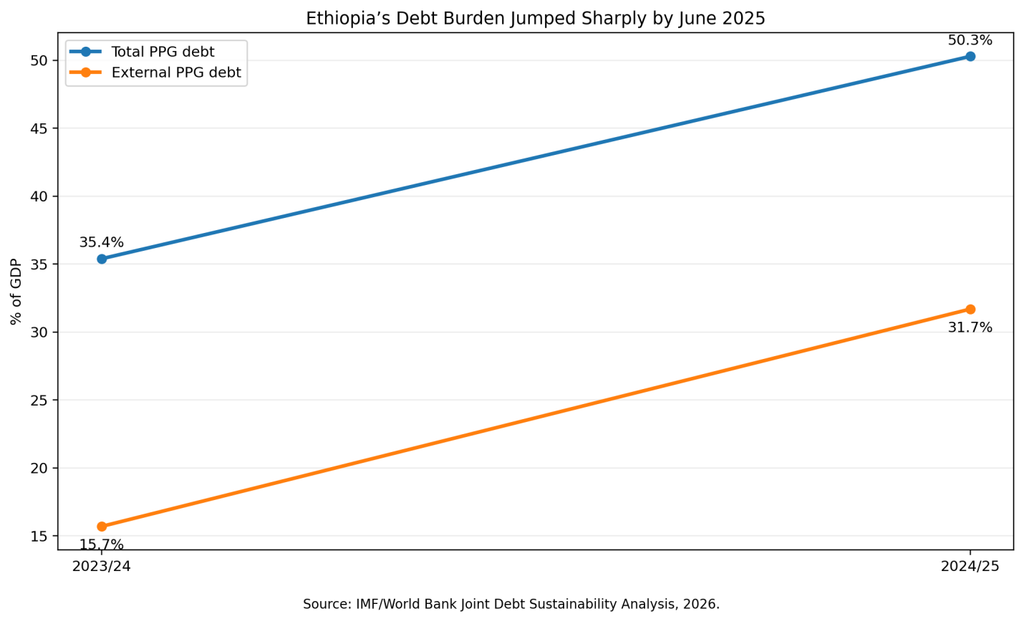
Figure 2: Ethiopia’s debt burden — 2023/24 to 2024/25
This shows total public and publicly guaranteed debt rising from 35.4% of GDP to 50.3%, while external PPG debt rose from 15.7% to 31.7% of GDP. The IMF/World Bank attribute much of the external-debt increase to new IFI disbursements and the sharp depreciation of the birr after the July 2024 FX reform.
Data interpretation: the restructuring reduces the immediate face value from US$1 billion to a new US$880 million instrument, but it does not mean Ethiopia has received US$120 million of free fiscal relief. Missed coupons, compensation, consent fees and the new-money warrant must be included when calculating the total economic cost. Reuters reported on 21 August 2026 that official creditors approved the preliminary agreement in principle but flagged the warrant as a potential risk because it could give bondholders terms more favorable than official creditors. This is an important accountability indicator: debt relief should be assessed on net present value, cash-flow timing, contingent obligations and downside scenarios, not only on the headline reduction in principal.
The IMF’s debt sustainability analysis was even more direct: before restructuring, Ethiopia’s debt remained unsustainable and in distress, with risks concentrated in external debt-service obligations relative to exports. This is where the investment story meets the debt story.
Financial-management expert Dr. Abdulmanan Mohammed Hamza highlights “a cost that is easily missed when a project is presented only through its headline investment value: interest. He explained that short-term domestic government borrowing through Treasury bills can carry interest rates exceeding 16 percent. At that rate, 100 billion birr borrowing would generate approximately 16 billion birr in annual interest before considering principal repayment.”
His point goes beyond Treasury bills. A foreign-financed project must be evaluated over its entire financial life, not simply by asking how much money entered on day one. The true cost includes the principal, interest, fees, guarantees, foreign-exchange exposure and possible contingent liabilities.
Reporters should map the full transaction chain: lender, borrower, sovereign guarantor, EPC contractor, subcontractors, equipment suppliers, operator, insurers, banks and beneficial owners. Then compare contract prices with independent benchmarks, identify amendments and extensions, examine whether local firms competed, and trace any state guarantees or minimum-revenue commitments. The key question is not whether commercial relationships exist; it is whether the structure leaves enough competitive and oversight space for Ethiopian institutions to obtain value for money and for citizens to see who carries the risk.
Currency movements can make that burden much larger. When a government earns most of its revenue in birr but owes dollars, depreciation of the birr increases the domestic-currency cost of servicing the same dollar debt. The World Bank has documented exactly this vulnerability: Ethiopia’s official exchange rate moved from 57 birr per US dollar at end-June 2024 to 136 birr per dollar at end-June 2025.
The distinction between ‘not publicly available’ and ‘improper’ must be maintained. A transparency gap becomes an investigative lead when it prevents verification of ownership, pricing, guarantees, repayment schedules, amendments or contingent liabilities. The reporting standard should therefore be: identify the missing document, identify the institution that controls it, request it formally, record the response, and seek independent corroboration before drawing conclusions.
The debt contract may not change at all. But the cost to the Ethiopian budget can. That is one of the least visible ways foreign financing can become a public burden.
Ethiopia’s first international bond provides perhaps the clearest case of how apparently successful access to international capital can later become a national fiscal problem. The government raised US$1 billion through a 10-year international bond carrying a 6.625 percent coupon in 2014 for industrial parks expansion. The bond attracted more than US$2.6 billion in investor orders. At the time, the transaction represented an important milestone: Ethiopia had entered the international capital market. Years later, it became a central element of the country’s debt crisis.
Ethiopia missed a US$33 million coupon payment in December 2023, triggering default on the bond, and the US$1 billion principal became due in December 2024. The IMF’s debt analysis says Ethiopia remained in debt distress after missing three coupon payments and the principal. The episode demonstrates why the initial interest rate is not the same thing as the final cost.
The government’s parliamentary-approval argument should be tested rather than dismissed. The relevant documents are the parliamentary approval record, the full loan agreement and annexes, guarantee instruments, amendments, repayment schedule, interest and fee structure, procurement method, project appraisal and any side letters. If these documents are available, the investigation should say so and assess their contents. If only the headline agreement is public, the missing annexes themselves become a transparency finding.
The restructuring eventually produced a preliminary agreement in June 2026 under which Ethiopia would issue a new US$880 million bond maturing in 2029 at 6.15 percent, compensate bondholders for missed coupons and provide a new-money warrant that could create additional obligations of up to US$90 million. Finance Minister Ahmed Shide said that the IMF considered the structure consistent with Ethiopia’s debt-sustainability objectives and that China and France, co-chairs of the Official Creditor Committee, raised no objections.
This is not simply a story about bondholders demanding repayment. It is a story about who ultimately absorbs the cost of the financing decision. Tim Jones, the organisation’s policy director describes an interim bondholder committee representing about 45 percent of the bonds and including Morgan Stanley Investment Management, Farallon Capital Management and VR Capital Group.
Economist Habtamu Girma Demiessie’s work on Ethiopia’s foreign-exchange shortage argues that structural import dependence and policy distortions can intensify FX pressure. That literature supports treating foreign-currency exposure as a central indicator in investment and debt investigations, while his research should not be presented as evidence about any individual contract.
Data-analysis framework: the four-part test can be converted into a project scorecard: economic benefit (jobs, output, exports, productivity), financing cost (principal, interest, fees and refinancing), governance cost (procurement competition, disclosure, ownership, oversight and enforcement), and downside allocation (FX risk, guarantees, minimum-payment obligations and contingent liabilities). A project should not be called successful simply because it creates an asset; the investigation should compare the asset’s measurable public value with the full financial and institutional risk attached to it.
Debt Justice has taken a much more critical position. Tim Jones, argued that the proposed new financing instrument could carry market interest rates around 9 percent for seven years and that Ethiopia could face payments of up to US$90 million even if it chose not to borrow through the facility.
These views should not be treated as proof that bondholders acted improperly. They reveal something more important: the same financing arrangement can distribute benefits and costs very differently among investors, government and citizens. That is exactly why transparency matters.
It raises a market question: When the lender, contractor, equipment supplier and technology provider operate within closely connected commercial ecosystems, how much competitive space remains for Ethiopian firms and alternative international suppliers? That question goes directly to CIPE’s distinction between constructive and corrosive capital.
The World Bank has made debt transparency a central issue internationally, arguing that public debt should be reported accurately, comprehensively and on time. Its 2025 “Radical Debt Transparency” report warns that gaps in legislative frameworks, fragmented institutions and increasingly complex financing instruments can create hidden debt and weaken public trust. More strikingly, the World Bank’s 2025 debt-transparency assessment identifies Ethiopia among countries with inadequate performance across most or all categories of the Debt Reporting Heatmap.
That does not prove that individual Ethiopian loan agreements are secret or improper. It does show why the transparency question deserves scrutiny. The negotiation room may matter more than the construction site.
Researcher Yohannes Assefa, whose work focuses on Ethiopia’s FDI landscape, points to “perhaps the least visible stage of the investment cycle: negotiation. That is where governments and investors establish financing conditions, procurement procedures, dispute-resolution mechanisms, sovereign guarantees, confidentiality provisions and operational responsibilities. Once the project is under construction, many decisions have already been made.”
If the financing terms are opaque at the negotiation stage, Parliament and citizens may discover the true fiscal exposure only years later, when a government guarantee is called, a state-owned enterprise cannot repay or a foreign-exchange crisis makes dollar debt more expensive. This is why a serious investigation into foreign investment must begin with documents, not photographs of construction sites.
The government disputes the idea that major borrowing operates outside parliamentary oversight. Dr. Mihret Shanko, Minister of State for Government Affairs, says loan agreements are discussed and approved by Parliament after consultation and deliberation in the House of People’s Representatives.
He also points to the Government Loan Management and Guarantee Policy No. 46/2009, issued under the authority of the Financial Administration Proclamation No. 648/2001, as part of the framework for managing and guaranteeing domestic and foreign borrowing. That position is important and must form part of any fair account. But it produces another investigative question: Does parliamentary approval automatically mean that the public can inspect the full economic consequences of the agreement? That means looking beyond the headline loan. Are annexes available? Are guarantees disclosed? Are side arrangements disclosed? Are beneficial owners identifiable? Are amendments published? Can citizens see the repayment schedule, interest rate and contingent liabilities?
From “big investment” to “who carries the risk?”
Economist Habtamu Girma Demiessie provides the conventional economic test: jobs, productivity, growth, exports and technology transfer. Those indicators remain essential. But they are incomplete. An investment can create employment and still impose a disproportionate fiscal liability. A railway can improve logistics while leaving the state with expensive debt. A power project can expand electricity generation while embedding long-term payment obligations in a state-owned utility.
A factory can create jobs while receiving tax or customs concessions whose public cost is never measured. This is why the investigation applies a broader test: What is the economic benefit? What is the financing cost? What is the governance cost? And who bears the downside?
The debt restructuring has bought time but not erased the problem Ethiopia has made substantial progress in restructuring its external debt. The IMF reports the country is implementing a four-year, US$3.4 billion Extended Credit Facility program and that reforms have improved macroeconomic conditions. In June 2026, IMF staff reached agreement with Ethiopian authorities on the fifth review, potentially unlocking about US$468 million.
But the IMF’s own debt analysis remains cautious. Its December 2025 assessment classified Ethiopia as being in debt distress and described pre-restructuring debt as unsustainable. It said successful completion of debt treatment and implementation of reforms could restore sustainability, with the risk rating expected to improve to moderate by the end of the program in 2028.
The real dividing line: constructive or corrosive? The evidence assembled for this investigation suggests that Ethiopia should not judge foreign capital simply by asking where it comes from. The better question is how it operates inside Ethiopia’s institutions.
What the evidence can and cannot establish: the assembled evidence demonstrates fiscal exposure, currency mismatch, debt-service pressure, transparency weaknesses and differences in civic scrutiny. It does not, by itself, establish bribery, fraud or corruption in a particular transaction. Such allegations require contract-level evidence, documentary verification, beneficial-ownership records, procurement files, payment trails or credible on-record testimony. This distinction is essential to maintain fairness and avoid turning the corrosive-capital framework into a presumption of wrongdoing.
Constructive capital should be accompanied by transparent contracts, competitive procurement, identifiable ownership, parliamentary scrutiny, independent regulation, environmental safeguards and publicly understandable debt obligations.
Corrosive capital risks emerging when those safeguards are weakened, when contracts disappear behind confidentiality clauses, when competition is restricted, when politically connected actors gain advantages, when guarantees shift private risk to the state, or when citizens cannot determine the ultimate cost.
CIPE’s research makes this distinction explicit: the concern is institutional, not national. That means China is not automatically corrosive. Western private investors are not automatically constructive. A multilateral lender is not automatically risk-free. Nor is every opaque arrangement evidence of corruption.
The test is whether Ethiopia’s institutions are strong enough to negotiate, disclose, monitor and enforce the deal in the public interest. The final question is not how much money Ethiopia attracts; Ethiopia will need foreign capital for decades.
The country needs electricity, industrial parks, transport corridors, digital infrastructure, agricultural investment and export-oriented manufacturing. The answer is therefore not to close the door to foreign investment. It is to make the door transparent.
Ethiopia’s investment boom will become economically transformative only if the country can move from measuring announcements to measuring actual capital, from measuring project size to measuring public value, and from celebrating financing secured to explaining risk allocated.
The most important document may not be the press release announcing a US$10 billion investment. It may be the guarantee buried inside the financing agreement. It may not be the photograph of a newly built railway. It may be the loan schedule that determines how much Ethiopia pays for it over decades. It may not be the headline saying that a geothermal project will generate hundreds of megawatts. It may be the PPA clause that determines who bears the foreign-exchange risk when the birr falls. And it may not be the amount of foreign capital entering Ethiopia.
It may be the amount of public money that eventually has to follow it out. That is the central lesson of Ethiopia’s debt experience, its foreign-investment drive and the growing international debate over corrosive capital.
Capital builds economies when institutions govern it. Without those institutions, capital can begin to govern the institutions themselves.
Editor’s Note: Views in the article do not necessarily reflect the views of borkena.com
__
Join our Telegram Channel: t.me/borkena
Like borkena on Facebook
To submit a press release, send the submission to info@borkena.com
Add your business to Ethiopian Business Listing / Ethiopian Business Directory
Join the conversation. Follow us on X (formerly Twitter) @zborkena to get the latest Ethiopian news updates regularly.