
Editor’s Note : Views in the article do not necessarily reflect the views of borkena.com
By Ayele Meshesha
By now, almost all Ethiopians know that Abiy Ahmed is not able to govern the country, at least not in the way his predecessors did in the past. There is no rule of law. There is a lack of security, with sustained and ongoing conflict. It is unsafe to travel in many parts of the country, as reflected in the restrictions issued by most embassies residing in Addis Ababa. Corruption is widespread, economic prospects for the majority of the population are bleak, and economic disparity continues to widen. It is only Abiy and his associates who present the situation as though things are functioning in Ethiopia, pointing to changes in the streets of Addis Ababa as evidence of progress. Otherwise, much of Oromia, Amhara, and Tigray are not effectively under his control. Ethiopia appears to be on the verge of collapse under his leadership. How poor is his leadership? How does he intend to lead the country? What is his vision for leadership? What strategies does he have to govern? These are important questions to ask. Let us focus only on how he intends, or wants, to lead.
- Through Drone and Digital Army
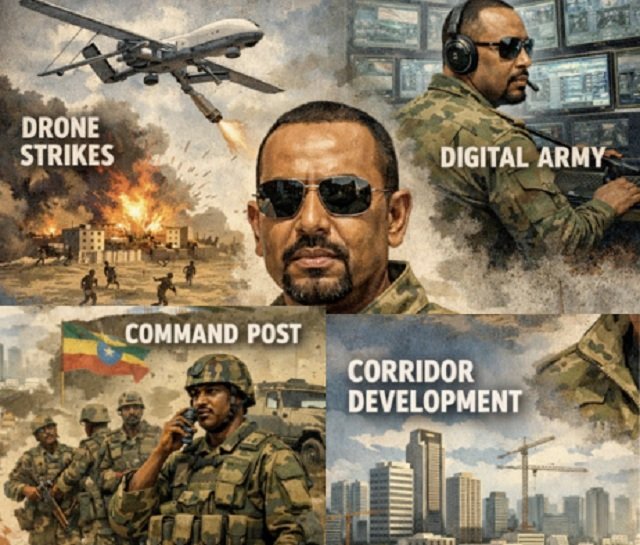
Abiy uses drones and a digital army as means to govern the country. He believes he has an open mind toward technology and wants to use it to achieve his objectives. In particular, to consolidate power, he relies on drone technology as a military tool and a digital army as a propaganda machine. First, where did he get the idea of using drones to overpower his enemies? It is possible to suggest three examples from which he may have learned. (i) Ukraine has used drones against Russia, just as Russia has used them against Ukraine. (ii) The United States has used drones to target terrorist cells in Afghanistan, Iraq, and elsewhere. (iii) Turkey has used drones against Kurdish rebels within its territory. In fact, Turkey has become one of the leading and most efficient drone producers, having invested heavily in designing and manufacturing robust drones to combat Kurdish separatists.
Abiy has reportedly acquired drones from Turkey and the UAE and used them during the war with the TPLF/TDF. Since then, he has invested heavily in drone technology. He has established drone stations in Bahir Dar, Debre Zeit, and Assayita in the Afar region, as well as in other locations. Drones have been used intensively in the Amhara region. A significant portion of the national budget appears to be directed toward drone-related expenditures. He has even commented publicly on the electricity consumption of drones, stating that “drones consume a lot of electricity.” He has reportedly purchased large numbers of loitering (suicide) drones. Recently, drones were reportedly used multiple times in Debre Tabor, which critics argue was intended to intimidate the population and discourage support for Fano. At present, drones appear to play a central role in his security strategy and in his leadership philosophy.
The second strategy Abiy invests heavily in is the use of a digital army composed of social media influencers, media personalities, and activists both inside the country and in the diaspora. Many are reportedly paid substantial amounts to promote his narratives and shape his public image. This includes the use of TikTokers, Facebook commentators, YouTubers, and numerous participants in X Spaces. If one listens carefully to these voices on X Spaces, TikTok, or other platforms, it becomes apparent what kinds of narratives are being promoted. Critics argue that many members of this digital army function as paid cadres. It is possible to identify various figures on X Spaces who present themselves as belonging to different groups or perspectives, yet are alleged to be aligned with Abiy and his associates.
There are also claims that some well-known Orthodox Church deacons are being used to influence public opinion, particularly in ways that affect the Amhara struggle. Some of these deacons are strong and persuasive speakers who appear to represent the interests of the Amhara people, and many lay Amhara may believe they are acting in good faith. However, certain individuals are financially supported to advance narratives that ultimately benefit Abiy’s political position. A thorough and evidence-based study would be necessary to examine these claims, identify coordinated influence networks, and assess their broader impact on the country’s political and social landscape. Dictators have a huge demand for propaganda to survive the opposing narrative, that is why Abiy is paying a lot for his digital army. It is good to dismantle such networks used by him.
- Corridor Development and Command Post
Another dimension of how Abiy believes he is leading the country is through corridor development projects and the use of military-led administration, often referred to as command posts. As one can see, Addis Ababa is visibly changing. For any reasonable observer, development in itself is something positive. However, important questions remain: How is this development being carried out? For whom is it intended? Is it contributing to a widening gap between the rich and the poor? Many people have reportedly been displaced from their homes in the name of development, often without adequate compensation. Some critics view this as a strategy to alter the demographic composition of the city. The most painful aspect, however, is the suffering of those who have been uprooted from their communities.
At the beginning of his tenure, Abiy held discussions with Bill Gates. Abiy has publicly mentioned advice he received, if the government owns all these land, about developing properties and making business with it. Critics now claim that national assets and land are being sold or leased to wealthy foreign investors, including from the UAE and other Arab countries. Allegations have also been made regarding transactions involving Debre Zeit Airport and farmland in Arusi and Bale. Meanwhile, many ordinary citizens, including teachers, doctors, health workers, and police officers, are struggling with low salaries and a high cost of living. This contrast raises serious concerns about whose interests’ current policies are serving.
Since Abiy is not governing the country through strong institutions and effective administrative structures, and since he has neglected the central responsibilities of national leadership, focusing instead on developing Addis Ababa, effectively taking on the role of a mayor, the country has fallen into chaos. Problems are evident everywhere. One consistent strategy he has relied on is the use of military command posts. Within six months of coming to power, he established a military command post in Wellega. Critics argue that the deployment of federal forces there had long-term destructive consequences for the region. After the first round of war in Tigray, he imposed a military command post that lasted for about eight months. For the past three years, he has attempted to govern the Amhara region through similar military command structures. Although a few individuals present themselves as regional leaders, many cities under Abiy’s control are effectively administered by military generals rather than civilian authorities. There is a continuing war with the Amhara people going on right now. He has set up command posts in many places including Gambelia, the recent conflict place. Despite these measures, stability has not been achieved.
Where did he miss the point? ¨
His problem is not the use of technology or the resources available to govern a country with complex challenges. The main issue, critics argue, is that he does not seem to understand how and when those resources should be used, or for what purpose. For example, the United States has not used drones indiscriminately against its own civilian population. But, some of his own military officials have publicly emphasized the acquisition and use of drones as a strategic priority. But this raises a broader moral and political question: should such weapons be used within one’s own country? Critics claim that drone strikes in the Amhara region over the past three years have resulted in civilian casualties, yet they argue there has been limited international condemnation. Some Ethiopians may one day question foreign embassies in Addis Ababa, asking why stronger pressure was not applied and whether they truly stood with the Ethiopian people, particularly the Amhara community. Such questions may arise in the future.
One might point to Turkey, which has used armed drones against Kurdish militant groups, particularly the Kurdistan Workers’ Party (PKK), designated by Ankara as a terrorist organization. Turkish drone operations have taken place in southeastern Turkey as well as in northern Iraq and northern Syria. However, whether such a strategy produces long-term stability or reconciliation remains debated. The larger question is whether a heavily militarized approach can resolve Ethiopia’s deeply rooted political and ethnic tensions, particularly in regions such as Amhara, Oromia, and Tigray, or whether it risks deepening divisions further.
Governing requires wisdom. It demands complex thinking and discernment. It requires broad knowledge, strong teams, and functioning institutions. It calls for the ability to solve complex problems through well-designed short-, medium-, and long-term plans. Abiy appears not to fully grasp these requirements. His desire to lead seems greater than the competence required for the position. He does not appear to demonstrate the level of critical thinking shown by his predecessors, such as Meles Zenawi or Hailemariam Desalegn, who recognized the complexity of the country’s challenges, one of whom eventually stepped down from office. Abiy has fallen more in love with power than with the responsibility that comes with it. Power itself appears to have become the priority. It is here where things have gone wrong in Ethiopia. It is like chronic cancer affecting both the country and its people.
For the sake of maintaining power, millions have died. Millions have been displaced. Millions continue to live under the shadow of conflict. Over the past five years, tens of millions of people have lived in areas affected by war. As long as Addis Ababa, and the political center around 4 Kilo, remains secure, critics argue that the suffering elsewhere receives insufficient attention.
People with Sound Mind Should stop Abiy
Ethiopia has many potential leaders. These people from every walk of life have to come together and remove this cancer from the nation. It is healthy to love the country and the people more than the love of power. This should not be accepted in the 21st century. One person should not be the head of the whole land. Of course, he might have a few people who are loyal to him since they are benefiting from his power. But the rest of the army, the scholars, and the civil servants should say enough is enough before this power-hungry man destroys the country. He is now preparing for war with Tigray and Eritrea just for the sake of his own power consolidation. The question is, are all the sound-minded people in Ethiopia so corrupted, blackmailed, or paralyzed? What happened to the Oromo, Amhara, Afar, Tigray, and Somali people? Why did they keep quiet? All have to join to stop this madman before he brings more suffering to the country and the people.
Editor’s Note : Views in the article do not necessarily reflect the views of borkena.com
__
Support Borkena : https://borkena.com/subscribe-borkena/
Join our Telegram Channel : t.me/borkena
Like borkena on Facebook
Add your business to Ethiopian Business Listing / Ethiopian Business Directory Business Listing Toronto
Join the conversation. Follow us on X (Formerly Twitter) @zborkena to get the latest Ethiopian News updates regularly. Subscribe to YouTube channel To share information or for submission, send e-mail to info@borkena.com