
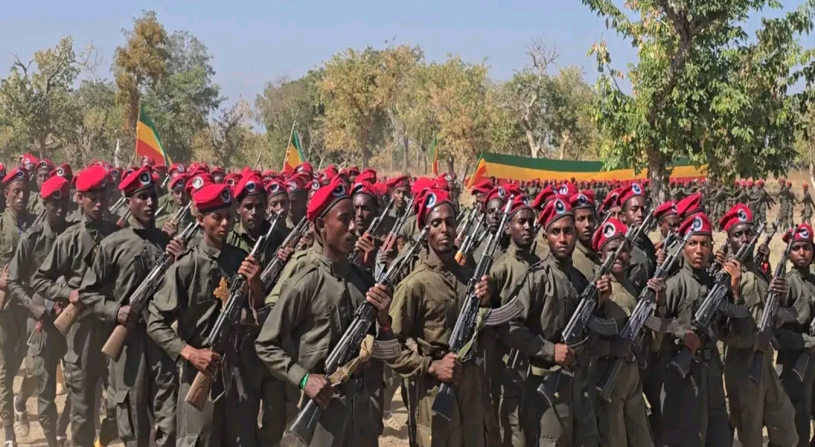
Nama Nekemto
A concerted cooperation among diverse entities is essential for challenging and reforming existing structures. This approach emphasizes strategic collaboration on shared objectives, allowing different groups to contribute their unique strengths without necessarily requiring immediate organizational amalgamation to topple the dictatorial regime.
In the ongoing efforts to transition from the present authoritarian system to a democratic framework, a crucial strategic discussion revolves around the most effective engagement of collaborative efforts for various forces operating within the Amhara region and other areas in Ethiopia.
The overarching goal of Fano’s struggle is to cultivate a robust democratic system where a multitude of political parties can engage in open discourse and compete ideologically, ultimately shaping policies through fair and transparent processes.
Wolf in Sheep’s Clothing Hiding Among the Herds of Sheep:
A concerted effort is underway to propagate inaccurate rumors concerning the Fanon movement. These narratives systematically attempt to depict Fano’s movement as fragmented, disorganized, and lacking cohesive leadership without a unified vision.
These distortions are being disseminated primarily through digital media channels by individuals and groups affiliated with the Prosperity Party, often under the guise of legitimate concern. The transparent objective behind these actions is to diminish the collective spirit of the struggle and fundamentally misrepresent the true identity and purpose of the Fano movement.
In light of these challenges, it is incumbent upon all Fano leaders and supporters of the struggle to proactively counter these misleading arguments. All stakeholders must collectively and accurately present the true essence of Fano to the domestic public and the international community.
This necessitates a transparent, methodical, consistent communication strategy that clearly articulates Fano’s legitimate aims, elucidates the core principles guiding its struggle, and demonstrates its steadfast dedication to the welfare of the nation and its citizens.
It is essential to reiterate that the enduring strength of Fano struggle is rooted not only in its organizational unity but, more profoundly, in its shared objectives, the collective yearning for freedom, and the unwavering commitment to justice for the Amhara people.
Fano’s struggle is fundamentally a grassroots endeavor, deeply embedded within the hearts of the Amhara people. It is built upon a profound spirit of patriotism and reflects a bedrock of common values shared across the community. This is not a movement dictated by a single leader or a limited group; rather, it is a broad-based, popular uprising that embodies the collective aspirations of the people.
Never Ending Arguments on Fano Unity Should End:
The complete unification of all Fano factions in the Amhara region, while potentially advantageous under optimal conditions, should not be considered an absolute necessary prerequisite for achieving Fano’s broader democratic vision.
While the benefits of a unified front are widely acknowledged, the path to such unity is often intricate and faces numerous challenges. Specifically, concerns have been articulated regarding the preconditions proposed by certain smaller Fano factions, which constitute a minor segment of the wider Fano movement.
For Fano’s collective success, uniting new group members must deeply align with its foundational principles and integrity. Divergent values or methods can severely impede the shared objectives, undermine trust, and dilute the collective purpose. Accepting unmatched terms just for the sake of unity, risks compromising the movement’s credibility and the long-term objectives rather than enhancing its overall effectiveness.
AFPO should engage in a collaborative dialogue that duly acknowledges AFNF’s contributions and proven leadership capacity.
AFNF, despite its relatively recent formal establishment, has demonstrably accumulated significant operational experience, cultivated a substantial membership base, and developed a highly effective organizational structure.
However, it is crucial to recognize that the imposition of specific preconditions by one entity, particularly when there are notable differences in organizational scale and operational maturity, could inadvertently introduce impediments to the integration process. Such an approach risks fostering unnecessary disagreements for a cohesive and unified front.
A truly sustainable and potent merger must be founded upon a shared commitment to pragmatic assessment, mutual understanding, and an unwavering spirit of reciprocal respect. Therefore, it is proposed that AFPO engage in a collaborative dialogue that duly acknowledges AFNF’s contributions and proven leadership capacity. The focus should be on jointly developing a comprehensive roadmap for cooperation and integration, designed to actualize Fano’s common vision.
This collaborative methodology, grounded in objective realities and mutual respect, is the only viable route to constructing an integration where all parties can genuinely thrive and contribute to a stronger collective.
The Amhara Fano National Force (AFNF) involvement is particularly dominant in the direct confrontations against federal military units. Comprehensive intelligence briefings and continuous field observations indicate that AFNF elements, alongside their allied local defense structures and community-based militias, constitute an overwhelming proportion of combatants actively participating in the fighting against the invading federal army.
This collective resistance could represents a staggering estimate surpassing 85% of all engaged Amhara Fano forces, underscoring the deep roots and extensive local mobilization driving the struggle within the Amhara region.
This observed operational prevalence has led to discussions regarding the necessity of broader Fano unity initiatives, given the perception of a largely unified and effectively commanded Fano structure existence, primarily under the AFNF banner.
As mentioned above, AFNF is regarded as a well-equipped battle experienced fighting force, believed to represent the overwhelming majority of active Fano combatants, operating under a structured hierarchy and unified leadership.
On the contrary, Eskinder Nega’s AFPO inclusion of certain constituents within these broader unification efforts has raised considerable apprehension. There is suspicion that Internal affiliations have undue influence exerted by agents of the ruling Prosperity Party (PP) within the ranks. These perceptions, whether substantiated or not, have the potential to severely erode trust and undermine the perceived independence and genuine objectives of the unification.
The recent political defection experienced by certain former top leaders within AFPO, coupled with suspicions of their past or present connections to the PP, significantly exacerbate these concerns. Such circumstances raise critical questions about leadership integrity, potential factionalism, and the risk that the broader movement could be compromised by external political agendas, thereby impacting its credibility and its ability to genuinely represent the interests it purports to serve.
From this perspective, certain unity endeavors are occasionally viewed as potentially counterproductive or ineffective in contributing to a cohesive and potent front for the Amhara cause.
While Fano unity discussions drag, promising reports indicate a sophisticated and growing operational synergy among various respective regional forces. Specifically, in Gonder and Wollo, AFPO-affiliated and AFNF groups are collaborating deeply, evident in their unified actions, shared logistics, and synchronized maneuvers. This collaborative trend is also prominent in Shewa, where AFNF units and Meketau-aligned Fano factions have established close and effective partnerships. This collaboration might be another opportunity to get out of the unity quagmire.
Conclusion
Looking forward, the precise dynamics by which these smaller factions might eventually align with the broader Fano movement, along with the timeframe for such developments, will likely be shaped by evolving circumstances. The overarching focus remains on strategic alignment and the diligent pursuit of a genuinely democratic future for Ethiopia.
Editor’s Note : Views in the article do not necessarily reflect the views of borkena.com
__
Support Borkena : https://borkena.com/subscribe-borkena/
Join our Telegram Channel : t.me/borkena
Like borkena on Facebook
Borkena Ethiopian News Youtube Channel
To submit Press Release, send submission to info@borkena.com
Add your business to Ethiopian Business Listing / Ethiopian Business Directory
Join the conversation. Follow us on X (Formerly Twitter) @zborkena to get the latest Ethiopian News updates regularly.