
Editor’s Note : Views in the article do not necessarily reflect the views of borkena.com
By Caleb Ta
Independent Researcher in African Political Affairs; Human Rights Advocate
Abstract
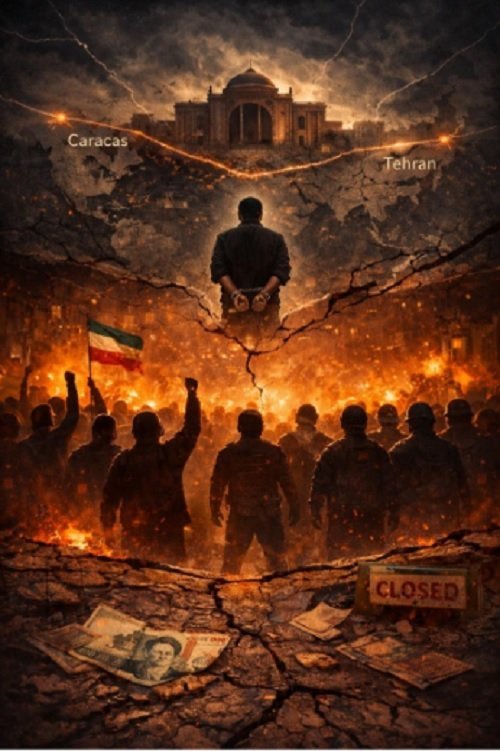
Iran is facing an unprecedented convergence of domestic unrest, economic collapse, and international pressure. Across dozens of cities, citizens are protesting in a sustained wave, challenging a regime whose legitimacy is eroding on multiple fronts. The sudden U.S. capture of Venezuelan President Nicolás Maduro—the so-called “Maduro Effect”—has further shaken the Iranian leadership, demonstrating that no authoritarian ruler is untouchable. This article explores the internal and external dynamics shaping Iran’s crisis, highlighting the interplay between domestic economic collapse, the fracturing of fear, and heightened international constraints.
Introduction
For decades, Iran’s authoritarian regime relied on a combination of economic control, fear, and ideological legitimacy to maintain stability. Citizens tacitly accepted political silence in exchange for basic subsistence and security. But the convergence of a collapsing economy, rising public defiance, and international shocks is testing the foundations of that social contract.
Recent protests—marked by chants of “Death to the Dictator”—are spreading across multiple cities and societal groups, including shopkeepers, students, and professional unions. Unlike previous protest waves in 2009, 2019, or 2022, this unrest is amplified by a unique external factor: the sudden, high-profile capture of Nicolás Maduro in Venezuela by U.S. forces. Tehran’s leadership now faces the dual reality of internal delegitimizing and external vulnerability.
Economic Collapse: The First Layer of Pressure
Iran’s economy has reached a critical tipping point. The national currency, the rial, has lost unprecedented value, eroding purchasing power and inflating the cost of living beyond what ordinary citizens can manage. Basic goods are increasingly inaccessible, and the population is facing chronic hardship without relief.
Protests originated among merchants and shopkeepers in Tehran’s historic bazaar, a hub long sensitive to political and economic shifts. From there, the unrest quickly spread to students, labor groups, and provincial cities. A recurring slogan, “Neither Gaza nor Lebanon,” highlights a key fracture: Iranians reject the regime’s prioritization of foreign proxy conflicts over domestic welfare. This layer of economic despair represents more than short-term hardship; it signifies a structural breakdown in the regime’s legitimacy.
Fear Fracture: The Second Layer
Authoritarian durability relies not only on coercion but also on the perception of inevitability. For years, the Islamic Revolutionary Guard Corps and security apparatus maintained control through fear, deterring mass mobilization. However, repeated protest cycles since 2019 have weakened that psychological dominance.
The current wave of unrest demonstrates a clear inversion of fear. Ordinary citizens are willing to confront security forces in multiple cities over consecutive days. Symbolic attacks on government buildings and public offices illustrate that the public now perceives itself as numerically and morally stronger than the state. The erosion of fear is a critical precursor to systemic change; history shows that once fear fractures, revolutions often gain momentum quickly.
The Maduro Effect: International Shock as the Third Layer
The capture of Venezuelan President Nicolás Maduro has reverberated far beyond Latin America. Venezuela served as a strategic ally for Iran, facilitating sanctions evasion, proxy financing, and logistical networks. Its sudden removal in a single night sends a stark message to Tehran: no ruler is invulnerable, regardless of geography.
This external shock compounds internal pressures. The U.S. and Israel have intensified coordination on sanctions enforcement, missile program monitoring, and precision strikes on Iran-linked proxies. Tehran now faces strategic constraints that limit its ability to redirect domestic unrest abroad through proxy conflicts. In response, the regime is caught between two paths: risking domestic legitimacy by repressing citizens or attempting aggressive regional actions to project strength.
Dual Trajectory: Internal Weakness and External Risk
Political science literature underscores that regimes under existential threat often exhibit dual dynamics: weakened at home, yet more aggressive externally. Iran exemplifies this pattern. Its internal capacity to control unrest is diminished, while its ability to pursue diversionary military operations is constrained by sanctions, targeted strikes, and international surveillance.
Proxies such as Hezbollah and the Houthis face intensified pressure, reducing Tehran’s room for maneuver. Meanwhile, strategic competition in Africa, the Horn of Africa, and maritime corridors represents Iran’s attempt to secure alternative operational depth. These actions demonstrate that external aggression can coexist with internal collapse.
Why This Moment Is Different
While Iran has endured previous cycles of protest, the current wave is distinct in three ways:
- Economic Irreversibility: The rial’s collapse and skyrocketing cost of living leave little room for stabilization.
- Psychological Contagion: The Maduro precedent shatters the perception of invulnerable dictators.
- External Constraint: Sanctions enforcement and military monitoring limit diversionary options abroad.
This convergence suggests that Iran is not experiencing a routine protest wave but a systemic legitimacy crisis with potentially historic consequences.
Conclusion
Iran stands at a crossroads familiar to collapsing authoritarian regimes: reform or fear. Historically, the regime has chosen fear, exemplified by record executions and harsh crackdowns. Yet today, repression carries higher costs than ever before, both internally and internationally.
The protests, the economic collapse, and the psychological shock of external intervention converge to form a pressure cooker that may catalyze revolutionary rupture. Whether this moment culminates in internal regime collapse or regional escalation remains uncertain. What is clear, however, is that the rules governing authoritarian survival in Iran—and globally—are shifting.
As citizens continue to chant “Death to the Dictator,” the world watches closely. The fractures in fear, finance, and foreign influence suggest that change, once inevitable, may be imminent.
Editor’s Note : Views in the article do not necessarily reflect the views of borkena.com
__
Support Borkena : https://borkena.com/subscribe-borkena/
Join our Telegram Channel : t.me/borkena
Like borkena on Facebook
Borkena Ethiopian News Youtube Channel
To submit Press Release, send submission to info@borkena.com
Add your business to Ethiopian Business Listing / Ethiopian Business Directory
Join the conversation. Follow us on X (Formerly Twitter) @zborkena to get the latest Ethiopian News updates regularly.
There might be a similar trajectory between The Fall of Woyanee’s Tigray under banner of EPDRF and Iranian Islamic party apparatus guided by revolutionary guard “basegee” to transform Iran into a reformist Islamic cadres government,once the death bed Grand Ayatoallh passed away .Revolution in Iran is unrealistic