
No Ethiopian should need political power to live with dignity
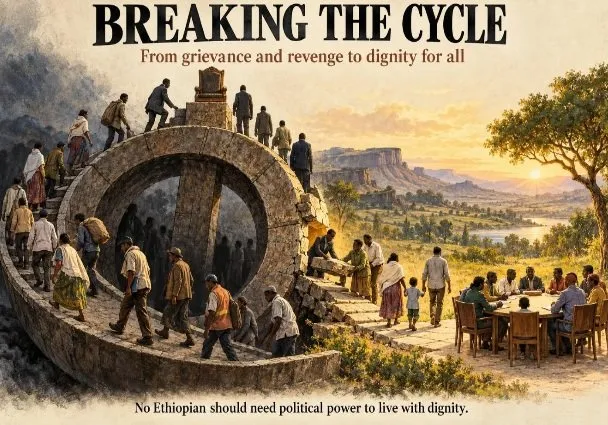
Why does the cycle continue?
Why do people who fight against exclusion sometimes exclude others once they gain power? Why does the promise of freedom give way to another struggle over who belongs, who benefits and who must wait?
These questions deserve an honest national conversation. They concern those who govern, those who oppose them and ordinary citizens who hope that the next political change will finally bring fairness.
The concern is familiar: people feel deprived of power, honour or opportunity. They organise to change their circumstances. But once they gain authority, some begin to deny others the fairness they once demanded.
The excluded become the powerful, and another group becomes excluded. Grievances grow, resistance follows, and the circle begins again.
An ancient warning about power
Proverbs 30:21–22 describes things that make the earth tremble, including a servant becoming king and a fool enjoying plenty. These images invite reflection on how people respond when their circumstances change.
A humble background does not make anyone unfit to lead. People who have experienced hardship can become compassionate and responsible leaders. Nor should an ancient proverb suggest that authority belongs to a privileged class.
For our discussion, the question is: What happens when power grows faster than wisdom?
Someone who has suffered humiliation may resolve never to humiliate another person. Another may decide that it is finally their turn to make others feel small. Suffering can deepen compassion, but it doesn’t automatically.
Leadership demands that we examine what our experiences have taught us—and what resentments we may still carry.
When “our turn” becomes another person’s exclusion
Wanting recognition after years of being overlooked is understandable. Wanting a fair opportunity is legitimate. The danger begins when the desire for fairness becomes a claim to exclusive control.
“We deserve a chance” can gradually become “only we deserve a chance.”
Under that thinking, public office becomes a reward for past suffering. Jobs become gifts to loyal supporters. Criticism becomes betrayal. People outside the winning circle begin to fear that their qualifications, effort and citizenship count for little.
This attitude can appear between ethnic or religious communities. It can also appear within them—in political parties, workplaces, neighbourhoods and households. Sharing an identity does not prevent people from dominating one another.
We therefore need to examine both who holds power and how they use it.
The price ordinary families pay
When political competition becomes a struggle over who may live securely and who must remain afraid, everyday life suffers.
A parent worries about whether children can attend school safely. A farmer hesitates to invest in the next season. A business owner delays expansion. A public employee fears losing a livelihood because of a presumed political connection.
People should be able to plan their lives without constantly calculating which group will gain power next.
No single attitude explains all Ethiopia’s political troubles. Historical disputes, economic pressures and institutional weaknesses also require attention. But the habit of answering exclusion with further exclusion makes those problems harder to resolve.
Citizenship must survive political defeat
A different political future begins with a basic agreement: losing power must never mean losing one’s rights.
People must be able to disagree with a government and still receive public services. They must be able to lose an election and remain safe. They must be able to seek public employment without having to prove political loyalty.
This protection should apply equally to people we support and people whose views we strongly oppose.
It does not excuse corruption or abuse. Anyone who misuses public authority should face a fair investigation and, where wrongdoing is established, appropriate consequences.
But responsibility must be individual and based on evidence. A shared ethnicity, religion, birthplace or former workplace is not proof of guilt.
Protect rights, challenge unfair privileges
We must also distinguish rights from privileges.
Personal safety, equal treatment and fair access to opportunity belong to every citizen. Preferential access to public money, protection from scrutiny and permanent control of institutions do not.
Removing an unfair advantage may be necessary. Doing so fairly requires clear rules that apply to everyone, including those currently in power.
The civil service is a practical place to start. Recruitment, promotion and dismissal should follow professional standards. Honest employees should not fear that a leadership change will erase the value of their service. Those treated unfairly need a credible way to appeal.
Public institutions earn trust when citizens can use them without first finding a powerful friend.
Hear grievances without passing on revenge
People cannot simply be ordered to forget suffering. Unheard grievances do not disappear because they are inconvenient.
Those who have experienced injustice need opportunities to speak, receive acknowledgement, and seek remedies. Listening does not require accepting every claim without question. It requires taking people seriously and fairly examining their experiences.
At the same time, suffering must not become a licence to harm others. Children cannot inherit guilt for their parents’ actions. Communities cannot be held collectively responsible for the misconduct of particular leaders.
Remembering injustice should strengthen our determination to prevent it from happening again.
Change begins with our own side
Political leaders carry a special responsibility. They can explain disagreements without turning every opponent into an enemy. They can accept corrections, acknowledge mistakes and prepare others to lead.
Citizens also face a test.
It is easy to condemn unfairness when it hurts us. It is harder to challenge it when it gives our relatives, friends or preferred political group an advantage. Yet that is where a shared standard becomes meaningful.
If we defend an abuse today because it benefits us, we weaken our grounds for opposing the same abuse tomorrow.
Families, schools, religious institutions, journalists and community organisations can help establish better habits: listening before judging, checking accusations, accepting disagreement and refusing to celebrate another person’s humiliation.
Build a country where dignity does not depend on power
Good intentions need support from dependable institutions. Transparent decisions, fair complaints procedures, independent scrutiny and enforceable limits on authority protect citizens when personal goodwill fails.
The aim should be a country where people can trust that they will receive fair treatment even when their preferred leaders are out of office.
This asks all of us to seek justice without demanding domination, to remember suffering without passing it on, and to defend rights beyond the boundaries of our own group.
Ethiopia can begin to break the circle when yesterday’s exclusion becomes a reason to protect others from the same experience.
No Ethiopian should have to wait for “our turn” to enjoy the rights of a citizen.
Editor’s Note: Views in the article do not necessarily reflect the views of borkena.com
__
Join our Telegram Channel: t.me/borkena
Like borkena on Facebook
To submit a press release, send the submission to info@borkena.com
Add your business to Ethiopian Business Listing / Ethiopian Business Directory
Join the conversation. Follow us on X (formerly Twitter) @zborkena to get the latest Ethiopian news updates regularly.