
Fikeru Zewdie
What can art, public reaction, and institutional response tell us about legitimacy?
What does Teddy Afro have to do with Ethiopia’s crisis of legitimacy? What can ETorica tell us about culture, public perception, institutions, and national belonging?
And what happens when artistic expression becomes part of a much larger national conversation about identity, authority, trust, and the political future?
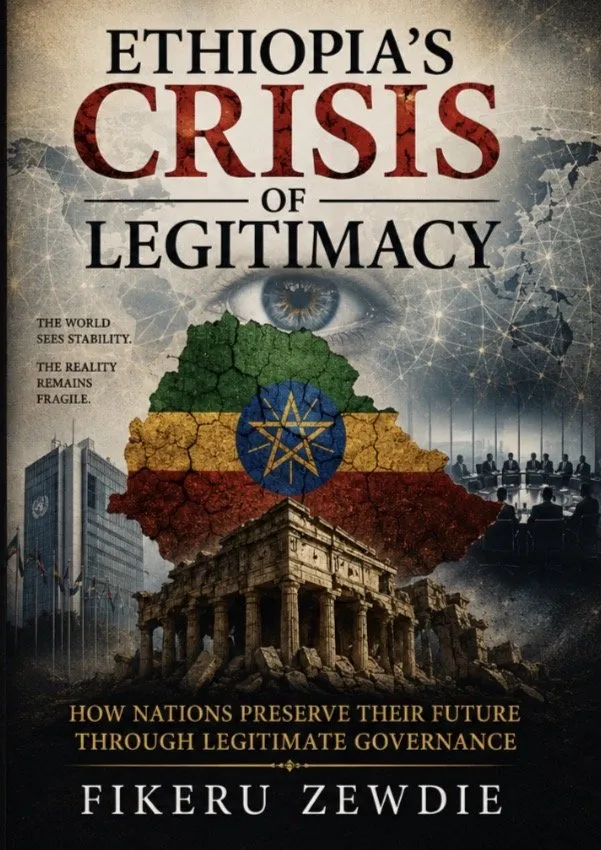
These questions may appear far removed from the conventional language of governance. Yet they form an important part of my recently published book, Ethiopia’s Crisis of Legitimacy: How Nations Preserve Their Future Through Legitimate Governance.
Three chapters approach the subject from different directions:
Chapter 23 — Teddy Afro and the Voice of a Nation
Chapter 24 — ETorica: Art, Message, and Public Resonance
Chapter 25 — Institutional Response and the Politics of Public Perception
The purpose of these chapters is not to tell readers what Teddy Afro or ETorica must mean politically.
That distinction is important.
Art belongs not only to its creator but also to the people who encounter it. Different listeners may hear the same song and draw different meanings from it. Some may hear history. Others may hear identity, grievance, hope, resistance, national memory, or simply music.
The political significance often emerges not from a single interpretation but from the public conversation surrounding the work.
That is where the question of legitimacy becomes relevant.
From Artistic Expression to Institutional Questions
When a cultural work generates strong public attention, the response can reveal something about the society receiving it.
Who feels represented?
Who feels excluded?
Why does one interpretation spread while another does not?
How do institutions respond?
And perhaps most importantly, how does the public interpret the institutional response itself?
These questions move the discussion beyond one artist or one album.
They bring us back to the relationship between citizens and institutions.
Legitimacy is not determined simply by whether institutions possess authority. It also depends upon whether citizens experience that authority as sufficiently fair, accountable, predictable, and legitimate.
A cultural moment can therefore become something larger than entertainment. It can become a window into questions that already exist beneath the surface of political life.
The Larger Inquiry
The case of Teddy Afro and ETorica represents only one part of the book.
The larger inquiry asks what happens when a state retains authority while public confidence in institutions becomes contested or fragmented.
It examines the difference between authority and legitimacy, between strategic stability and legitimate stability, and between preserving governmental continuity and rebuilding the civic trust upon which durable governance ultimately depends.
But I will leave those larger arguments to the book rather than reproduce them here.
My purpose in highlighting these three chapters is simply to offer readers another doorway into the inquiry.
One does not have to agree with my interpretation of these events—or with every conclusion in the book—to find the questions worth examining.
Indeed, disagreement is part of the purpose.
What can the relationship between art, citizens, and institutions teach us about the condition of a political community?
And more broadly:
How do nations preserve their future through legitimate governance? Those are questions I hope readers will continue to explore for themselves. Books are not monuments to finished thinking. They are invitations to continue thinking.
Ethiopia’s Crisis of Legitimacy
How Nations Preserve Their Future Through Legitimate Governance
Fikeru Zewdie
DRJJ Lighthouse Press
Ethiopia’s Crisis of Legitimacy: How Nations Preserve Their Future Through Legitimate Governance
Amazon: https://www.amazon.com/dp/B0HF19QYC3
__
If you wish to share information about your book and have it featured on Borkena, we encourage you to submit your book details to info@borkena.com.
Join our Telegram Channel : t.me/borkena
Like borkena on Facebook
Support Borkena : https://borkena.com/subscribe-borkena/
Business Listing/Business Directory
Join the conversation. Follow us on twitter @zborkena to get the latest Ethiopian News updates regularly. Ethiopia To share information or send submission, use info@borkena.com