
By: Samuel Admassu
The skies over Ethiopia’s Amhara region are heavy with more than just clouds; they are a constant reminder of escalating terror and immense human suffering. Violence here isn’t merely escalating; it’s tearing apart the very fabric of society, prompting grave warnings akin to the chilling precursors of genocides in Rwanda and against the Rohingya. Amidst this crisis, civil society groups and a newly unified Amhara resistance are issuing desperate pleas for international intervention, alleging a horrifying reality: a “genocidal war” and systematic ethnic cleansing targeting the Amhara people.
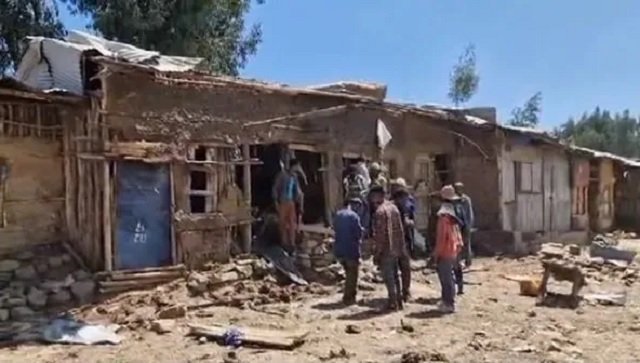
Reports from the ground detail indiscriminate military actions and a pervasive reliance on drone warfare by the Abiy Ahmed-led government. These alleged aerial assaults have not only killed thousands of civilians across the Amhara Region and surrounding areas but have also systematically devastated critical civilian infrastructure—including schools, health centers, marketplaces, religious sites, and residential areas—inflicting widespread trauma and destruction upon the populace. Conservative estimates, based on available data, cite at least 449 civilian deaths in the Amhara region from August 2023 onwards (ACLED data), figures believed to be significantly understated given the challenges in data collection. This conflict, pitting government forces against various militant groups, has tragically claimed countless lives, destroyed property, and shattered families, leaving entire generations to face unimaginable hardship.
The humanitarian situation is dire, characterized by a profound collapse of essential services. Education has crumbled, with 4,678 schools closed due to ongoing armed conflicts and insecurity, leaving over 4.5 million children out of school. An additional 362 schools have been damaged and 350 rendered non-functional, while over 1.5 million children are in urgent need of school feeding services (UNOCHA). Healthcare access is similarly shattered. Critical health facilities and hospitals are reportedly being ransacked, raided, and repurposed as military camps or storage sites for military equipment. This systemic destruction, coupled with a recent nationwide strike by Ethiopian health workers protesting severe pay disparities, deplorable working conditions, and government repression including the arbitrary arrest of over 121 medical professionals, has left hospitals operating at minimal capacity (Amnesty International). Reports indicate that doctors from various hospitals have been taken to undisclosed locations, and many health workers have been forced into hiding.
Government Negligence and Divisive Leadership
The government’s handling of the ongoing conflict faces scathing critiques. Many believe its apparent negligence in ending the fighting stems from the “interests of those in power who benefit from the ongoing war and its destruction.” Despite the clear determination of Amhara Fano National Force (AFNF) to fight, the government has focused primarily on controlling major cities, politically significant areas, and key highways. This narrow strategy has led to the effective neglect of rural districts and towns, even those near Addis Ababa, which critics argue displays tactical approval for the region and its people to remain in a state of vulnerability and deprivation.
While the government showcases determination in large-scale development projects like corridor development and green legacy initiatives, these efforts are perceived as failing to address the fundamental fear and unrest gripping the region. Senior federal government officials, including Prime Minister Abiy Ahmed, Oromia regional president Shimeles Abdissa, and Addis Ababa’s mayor Adanech Abiebie, have openly made divisive speeches that are seen as deepening conflicts with the Amhara people. Even after immense hardship, the government appears to believe that the conflict can only be resolved through war, a stance reinforced by state media narratives that aim to prevent national grief from escalating by portraying the country as a single entity that will not tolerate division.
Within Amhara society, a critical leadership vacuum is observed. Political leaders are often seen as failing to deeply resonate with the people’s sentiments, lacking the necessary new ideas, innovation, and dedication. This disconnect has inadvertently made it easier for the federal government to manipulate and control the region by placing weak leaders in power, further exacerbating the complexity of border, political, and economic issues.
The Amhara People’s Struggle for Self-Defense
Confronted with what they perceive as an existential threat, a significant portion of the Amhara people feel compelled to defend themselves, believing they need a unified and disciplined force for protection. This sentiment is intensified by the perception that national security and defense institutions, once serving the Tigray People’s Liberation Front (TPLF), now primarily serve Oromo politicians, with Oromo natives placed in key security positions, adding to the narrative of suffering.
In response to these dire circumstances, over 85 percent of Amhara Fano armed groups have unified to form the Amhara Fano National Force (AFNF), established on 1 May 2025. This new force, consolidating factions from Gojjam, Wollo (Bete-Amhara), Gondar Unity, and Shewa, states its primary mission is to coordinate the “struggle for existence” and a “popular revolution,” rooted in Amhara nationalism. The AFNF asserts its unwavering commitment to Ethiopia’s sovereignty and unity, with the goal of overthrowing the “Abiy Ahmed led Prosperity Party regime” and establishing a transitional government.
The AFNF’s demands are extensive and reflect the severity of their claims: they call for “Formal recognition of the decades-long Amhara Genocide including atrocities constituting war crimes and crimes against humanity perpetrated during the current war throughout Ethiopia.” They also demand formal recognition of contested identity and border demarcations in Amhara-majority districts annexed to neighboring regions—specifically Welkait Tegede Setit Humera (Gonder), Raya (Wollo), Metekel (Gojjam), and Dera (Shewa)—along with the repatriation of displaced communities. The broader Amhara Fano Movement aims to address historical grievances, end perceived oppression, ensure equality for Amhara people across Ethiopia, and facilitate the safe return of displaced Amhara individuals and restitution of their land. Disturbingly, civil society organizations explicitly allege that an “armed group organized and supported by the Oromia regional government top leaders and local authorities is carrying out the ongoing Amhara genocide in the country.” The AFNF, in an official communication to the U.S. Embassy in Addis Ababa, also accused the regime of coordinating its drone and air strikes with the United Arab Emirates, while reaffirming its own adherence to international humanitarian and human rights law, including in its treatment of prisoners of war. The strength and spirit demonstrated by the Fano fighters are clear indications of the people’s resilience, even as they face the government’s modern and expensive military equipment, including mechanized and aerial forces, and drones.
Escalating Political Volatility and Regional Destabilization
The Amhara region and its people have suffered greatly from the ongoing conflict, experiencing mass displacement, numerous civilian casualties, widespread human rights violations, and disruptions to essential services like healthcare and education infrastructure with reports of atrocities committed by government forces.
Furthermore, critical analyses of the current political situation in Ethiopia suggest a trajectory towards significant regional destabilization, attributed to what is described as the “poor management style and political illiteracy” of Prime Minister Abiy Ahmed. His administration’s initial misguided strategy to merge Eritrean interests into Ethiopian politics was perceived as an attempt to gain targeted support during the war against the TPLF in Tigray. This destructive campaign, which devastated Tigray, Amhara, and Afar regions, was reportedly undertaken with the belief that Eritrea, due to its historical animosity with Tigray, would unequivocally support the federal government’s efforts to dismantle the TPLF and solidify the Oromuma government’s power in Addis Ababa. With the Pretoria agreement now perceived as having completely failed, and Getachew Reda having returned to the federal government for cover and rescue, new and alarming predictions are emerging. There are growing concerns of an impending alliance forming between the TPLF and the Eritrean army. This coalition is anticipated to wage a renewed war against the federal government of Ethiopia. Critically, these predicted future conflicts are overwhelmingly expected to unfold on the already desperate Amhara land, further exacerbating the suffering of the Amhara people without respite, regardless of which side gains ground. This prolonged state of conflict, it is argued, may inadvertently benefit Abiy Ahmed’s Oromuma government by facilitating the eradication of the Amhara people from their ancestral lands across Ethiopia, while simultaneously allowing for the exploitation of Amhara territory under the guise of defending against these aligned forces.
Civil society organizations assert that “thousands of innocent Amhara civilians have been victims of gross human rights violations and ethnic cleansing” since Prime Minister Abiy Ahmed came to power.
Urgent Appeal to the International Community
Amidst these dire circumstances, civil society organizations and various pro-Amhara groups dedicated to the fate of the Amhara people have issued a fervent plea for immediate international intervention, articulating a series of critical demands:
- Denounce and Stop: The international community, including the UN, EU, AU, and human rights organizations, must “denounce and stop this senseless ethnic cleansing and genocide against the Amhara community.”
- Investigate Atrocities: An independent body must be established to investigate allegations of genocide and other atrocious crimes committed against the Amharas.
- Provide Humanitarian Access: Urgent access must be provided for national and international humanitarian actors to provide aid to survivors and the displaced.
- Ensure Justice: All perpetrators of these alleged atrocious crimes, including responsible regional and federal government authorities, must be brought to justice.
As a lasting solution, justice, law, and order must prevail in Ethiopia. Only then, these groups argue, should the international community support national dialogue, peace, and reconciliation, and advocate for constitutional revisions to abolish the divisive ethnic federalism. The consolidation of the AFNF, combined with escalating violence and alleged widespread atrocities, represents a critical and alarming phase in Ethiopia’s crisis, demanding immediate and decisive international attention to prevent further humanitarian catastrophe.
Editor’s Note : Views in the article do not necessarily reflect the views of borkena.com
__
Subscribe : https://borkena.com/subscribe-borkena/
Join our Telegram Channel : t.me/borkena
Like borkena on Facebook
Add your business to Ethiopian Business Listing / Ethiopian Business Directory Business Listing Toronto
Join the conversation. Follow us on X (Formerly Twitter) @zborkena to get the latest Ethiopian News updates regularly. Subscribe to YouTube channel To share information or for submission, send e-mail to info@borkena.com