
By Aba Habtu
I am composing this message in response to a concerning statement made by Ambassador Massinga on Twitter. The Ambassador suggested that the resistance to significant demolitions in Addis Ababa mainly stems from a lack of communication. He drew parallels between these demolitions and community resistance against redevelopment projects in other global regions. As the highest representative of the United States, the most resourceful country globally, it is hard to believe that the Ambassador is unaware of the primary dynamics driving Ethiopian political factions, which center on ethnicity.
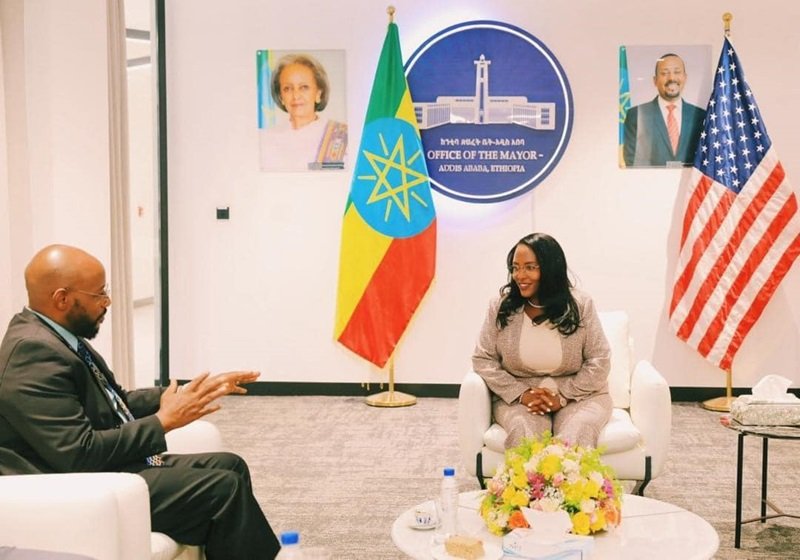
Moreover, it is well known that the Oromo political powerhouse, which currently dominates the political, security, and economic sectors in Ethiopia, is openly working towards establishing Oromo dominance in all aspects of the country’s governance. This intention is no longer a secret operation. The comments made after the Ambassador’s meeting with the tyrannical and brutal mayor of Addis Ababa are, therefore, particularly alarming. They show a clear disregard for the lives lost and livelihoods destroyed by her oppressive policies.
To fully understand the issue at hand, one must delve into the reasons behind Ethiopia’s current predicament. Anyone genuinely interested in contributing to Ethiopia’s stability and prosperity should comprehend the core principles driving the political forces in the country. The current Oromo political leadership views Ethiopia as a colonial empire and is actively trying to rewrite its history. President Shimelis Abdissa of Region 4 (Oromia) has openly declared that initiatives are underway to reaffirm Oromo ownership of Addis Ababa, thus legitimizing claims of demographic engineering.
His statements clarify that the demolitions in Addis Ababa aim to reshape the city’s demographic composition through meticulous ethnic profiling. These facts reveal that the redevelopment projects are a guise for the ethnic cleansing of Amharas from a city where they represent over 60% of the population. Consequently, the Ambassador’s direct support for these projects amounts to complicity in ethnic cleansing and demographic manipulation.
The #WarOnAmhara represents more than mere state-sponsored violence; it is a calculated political strategy by the Oromo political establishment. The government led by the Oromo is not only engaging in an illegal and immoral conflict against the Amhara people, but it is also crucial to comprehend the ideological and motivational underpinnings of this aggression. Central to Oromo’s political ideology is a constructed narrative that falsely accuses the Amhara of historical injustices, a narrative promoted by the Oromo leadership to consolidate support and unify their constituents.
This narrative’s fabrication was openly acknowledged by Ambassador Lencho Bati, a founder of the Oromo Liberation Front, who admitted that the anti-Amhara and anti-Ethiopia storyline was crafted to mobilize the Oromo populace. Moreover, Negasso Gidada, a former Ethiopian President of Oromo descent, revealed in his autobiography his inability to find historical evidence supporting the claims made against the Amhara by Oromo politicians. This admission underscores how the Oromo political leadership has perpetuated baseless accusations and fueled hostility without any significant proof.
The propagation of this animosity is particularly evident among the Oromo youth, influenced heavily by the Oromo political elite who have instilled a deep-seated hatred towards the Amhara. Lemma Megersa, a former President of the Oromia region and Defense Minister, has publicly voiced concerns over the extreme hatred indoctrinated in Oromo youth and the potential for a genocidal campaign against the Amhara. These developments highlight both the intentions and the extensive strategy of the Oromo political leadership to further their own objectives.
Documents such as party manifestos and academic publications from politically aligned Oromo scholars further exacerbate the violence inflicted on the Amhara people. It is alarming that those harboring intense animosity towards the Amhara are not only becoming prominent political figures but also influential voices within the Oromo political sphere. Thus, it is essential to recognize that the #WarOnAmhara is not merely a product of state-sponsored violence but a deliberate and strategic approach by the Oromo political establishment. The responsibility for this genocidal campaign rests not only with the current leaders but also with the broader Oromo political apparatus, including the prejudiced academic sector. Understanding these factors is critical for addressing and resolving the ongoing conflict in Ethiopia.
Despite widespread public knowledge, the US Embassy in Addis and Mike Hammer have been notably silent or visible only in regime-sponsored media events. This is concerning, especially since it has been a year since the hateful ideology against the Amhara people escalated into full-blown state terrorism. The deaths of tens of thousands and the displacement of millions have yet to elicit a meaningful response from these entities. Over 35 million Amharas are facing economic and social blockades, yet the U.S. State Department , U.S. Embassy in Addis, and Mike Hammer have failed to demonstrate genuine concern or take action. The contrast is stark compared to their proactive statements during the conflict initiated by the TPLF. The apparent disregard for the conflict in the Amhara region seems to be a deliberate decision to withhold the necessary attention and assistance that should be accorded to the #AmharaResistance.
This lack of response not only shows a deficit in diplomatic sensitivity but also highlights a lack of empathy and moral principles. By ignoring the war crimes committed by the ENDF against the Amhara people and the ongoing humanitarian crisis, the US diplomatic mission in Ethiopia indirectly supports the genocide of the Amhara people. This indifference to human rights principles is at odds with the core values the United States claims to support.
Moreover, the failure to address the situation in the Amhara region suggests a dereliction of duty by the US Embassy and Ambassador Hammer. By overlooking the atrocities in the region, they fail to protect innocent lives and risk compromising the United States’ long-term strategic interests. The US’s silence on the violence in Amhara is damaging its reputation as a nation committed to democracy and human rights.
The comparison made by Ambassador Massinga between minor misunderstandings in urban development projects and the systematic ethnic cleansing and demographic manipulation in Addis Ababa is alarming. By downplaying the hardships of displaced individuals and trivializing ethnic targeting in property demolitions, the embassy effectively condones these reprehensible actions.
It is crucial for the US Embassy and Ambassador Mike Hammer to address their bias against the Amhara people and begin playing a positive, impactful role to halt the #AmharaGenocide and restore the severely eroded public confidence in America’s commitment to its stated principles. Most importantly, they must recognize that ignoring the Amhara people’s struggle against #OromoFascism will not silence their fight.
In summary, the plight of the Amhara people in Ethiopia represents more than just a local conflict; it embodies a profound crisis where ethnic targeting and historical grievances are being weaponized for political dominance. The comments and actions of the U.S. Ambassador and the broader international community highlight a distressing lack of genuine engagement and understanding of the ethnic dynamics and political intricacies at play. This indifference not only exacerbates the humanitarian crisis but also undermines the core values of human rights and justice purportedly championed by these entities. Moving forward, it is imperative for the U.S. Embassy and international bodies to reevaluate their positions and actively engage in meaningful interventions. Acknowledging the real drivers of conflict, addressing the orchestrated violence against the Amhara, and fostering an inclusive dialogue are crucial steps towards restoring peace and stability in Ethiopia. The international community’s role should not just be as observers but as active participants in preventing further escalation of violence and ensuring accountability for the atrocities committed.
Editor’s note : Views in the article do not necessarily reflect the views of borkena.com
__
To Publish an Article On borkena , please send submission to info@borkena.com for consideration.
Join our Telegram Channel : t.me/borkena
Like borkena on Facebook
Add your business to Borkena Business Listing/Business Directory
Join the conversation. Follow us on X (formerly Twitter ) @zborkena to get the latest Ethiopian news updates regularly. Ethiopia To share information or for submission, send e-mail to info@borkena.com