 in Ethiopia's Amhara region are facing a critical lack of shelter,reporting that the canvas tents ...Read)
By: Getahun Tsegaye
Staff Report
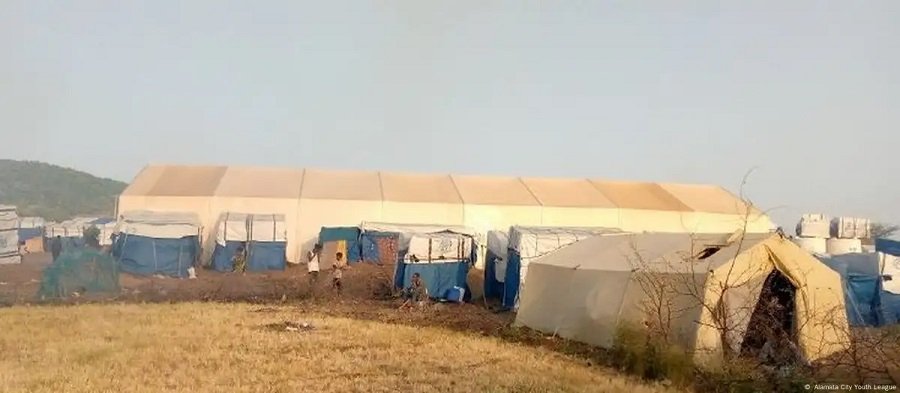
Addis Ababa, Ethiopia -Internally Displaced Persons (IDPs) in Ethiopia’s Amhara region are facing a critical lack of shelter, reporting that the canvas tents provided three years ago – meant to last only six months – have worn-out beyond use due to sun and rain exposure, according to a report by DW.
The unsuitable conditions of these shelters are reportedly leading to illness among mothers and children. IDPs residing in camps in the North and South Wollo zones of the Amhara region, having been displaced from various parts of Ethiopia, say their tents have become uninhabitable after prolonged use, offering no protection from the elements.
One displaced individual poignantly described their plight: “When it rains, the ground becomes muddy, and while rain is good for the crops and the market, for us, when it rains, we cry ‘God help us!’ because we have nowhere to sit. We spend the day standing, and we will spend the night standing. Today, the rain didn’t just stop; it has killed us.”
Challenges for Pregnant Mothers
Pregnant mothers in the camps face particularly severe hardships. Fatuma Nur, who recently gave birth to twins in the Haik Mekane Eyesus camp, highlighted the dire situation: “It leaks badly; water comes up from below, and the sun beats down from above. The children are suffering greatly; their bodies are covered in rashes. For me, having had an operation, the heat is intense, my wound is opening, and the doctors keep bandaging me. My whole body is burning.”
In the Jara refugee camp in the North Wollo zone, reports indicate that shelters are collapsing due to prolonged use. “We were told we would be here for six months. Now, it’s almost three years. Termites are eating it from below, and the wind and sun are strong, causing it to collapse; the canvas sheets. Many sheets were repaired, but they are also tearing apart. When it rains, being outside is better than inside; it offers no real shelter from the rain,” one resident explained.
Unfulfilled Promises
In the Turke refugee camp in Tehuledere Woreda, the shelter situation is also dire, with displaced representatives saying they are trying to make do with repairs. “We have been told there will be a response; they say it will be done today or tomorrow. It has been torn apart by the sun and is severely damaged because it is old canvas. Now that it is sunny, we repair what we have and sit. But if it rains, it won’t hold anyone.”
In the Turke Mekane Eyesus, Jara, Gerado, and other camps, where there is no movement to replace the dilapidated shelters, there is not even a suitable place to rest for the sick. “It is very difficult for someone living in this tent. This tent was made for six months when we first arrived, but now it is nearing three and a half years. When you look at it now, it might seem torn; even the untorn parts are leaking. On top of that, there are health problems. Even when they are very ill, there isn’t even an opportunity to take them inside the canvas house to rest. It’s not suitable for day or night.”
South Wollo’s Burden
The South Wollo zone, which hosts 34,000 displaced individuals, including 15,000 in shelters, acknowledges the problem. Ali Seyid, head of the Disaster Prevention and Food Security Office in the South Wollo zone administration, stated that they are aware of the issue and have submitted a request to the regional Disaster Prevention and Food Security Commission. “We cannot provide it ourselves now; it should be provided by the federal government, or previously, there were foreign organizations that provided it, but many of them have left, creating this gap. On our part, together with our partners, we have identified the problem and confirmed its existence by visiting various shelters. Based on that, we have requested the region, and they have told me that they have also requested the federal government, but there has been no response so far.”
Attempts to reach officials from the Amhara Regional Disaster Prevention and Food Security Commission via phone and text to obtain a response to the IDPs’ complaints were unsuccessful.
Echoes of Debre Birhan’s Crisis
This report from DW aligns with earlier reporting by Borkena, which detailed the worsening living conditions and severe shortages of food and basic necessities faced by thousands of IDPs in Debre Birhan, also in the Amhara region. Those IDPs described a constant struggle against hunger, cold, and deteriorating health, with inadequate and often expired food supplies, lack of proper clothing and blankets, and unfulfilled promises of relocation. The situation in Debre Birhan, where resources are stretched thin and shelter conditions are dire, reflects a broader humanitarian emergency across the Amhara region, with over 664,000 IDPs relying on aid. International humanitarian organizations warn of dire conditions in IDP sites across Amhara due to overcrowding, prolonged shelter use, and lack of maintenance, increasing protection risks and leaving displaced communities trapped in a cycle of uncertainty and suffering.
__
Subscribe : https://borkena.com/subscribe-borkena/
Join our Telegram Channel : t.me/borkena
Like borkena on Facebook
Add your business to Ethiopian Business Listing / Ethiopian Business Directory Business Listing Toronto
Join the conversation. Follow us on X (Formerly Twitter) @zborkena to get the latest Ethiopian News updates regularly. Subscribe to YouTube channel To share information or for submission, send e-mail to info@borkena.com