
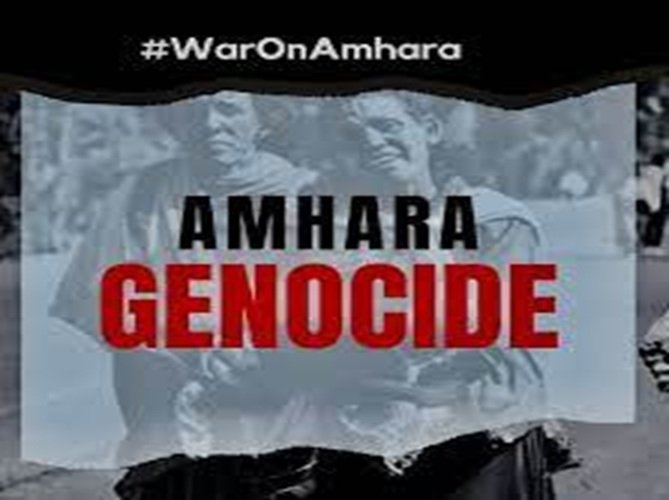
Introduction
This piece addresses the narrow frameworks through which certain intellectual positions have rejected labeling the atrocities against the Amhara people as genocide. Building on the work of leading genocide scholars, it re-examines the question from multiple angles, restoring both the moral and legal essence of the term.
Reasoning devoid of context confines itself to a rigid, word-for-word reading of law, treating legal definitions as exhaustive. It fails to grasp the moral, sociological, and human dimensions the concept was meant to capture. Such reasoning is a logic that prefers the comfort of a checklist to the discomfort of seeking verity, a mindset that refuses to call the bear before it a bear because it did not roar as expected. The result is a form of intellectual paralysis: horror is measured by bureaucratic precision rather than human loss. The essential question remains simple: Are Amhara civilians deliberately killed because they are Amhara? If so, the intent is clear. Ethnic targeting establishes genocidal intent regardless of scale, political context, or reciprocity of violence.
The Legalist Approach
One common approach reduces genocide to a linguistic puzzle.
“If the intent to destroy a group because of its characteristics is not present from the get-go, neither the growing intensity of the war nor the mounting number of civilian victims can turn it into a genocide.”
It demands explicit, visible proof of intent, as though genocides always announce themselves in manifestos. Yet history proves that intent is most often revealed through patterns, repetition, and the deliberate targeting of identity. When villages are burned and civilians are slaughtered for years simply because they belong to a group, intent is no longer speculative, it is evident. It becomes embodied in action.
Another approach denies genocide because violence does not reach a certain “level” mistakes intensity for intent.
“Crimes were and are being committed in the Amhara region, but they do not yet rise to the level of genocide.”
But genocide is not a matter of degree on a sliding scale; it either exists or it does not.
There is another argument which posits that genocide cannot occur where some members of a group cooperate with the state is equally flawed.
“The term ‘genocide’ does not fit a situation where a part of the Amhara people cooperates with and fights for the government.”
History offers painful precedents that participation of a few never erases the persecution of the whole. Hitler employed some Jews to oppress other Jews, yet the involvement of a few did not change the genocidal nature of his campaign. Similarly, the presence of Amhara collaborators or regional soldiers does not erase the systematic, identity-based targeting of the broader Amhara population. Collaboration does not nullify extermination; it often deepens its tragedy.
This mode of thinking produces paralysis in place of moral responsibility. It mistakes academic caution for integrity and hides behind arithmetic when moral clarity is required. Intellectual honesty does not dwell in neutrality. It begins there, perhaps, but lives in the courage to name reality. By reducing genocide to an abstract definition detached from the cumulative human and moral realities on the ground, such reasoning misses the spirit of Raphael Lemkin’s concept itself. The concept was born to name the crime, not to measure it by legal convenience.
The Empirical Equivalence Fallacy
Another denial relies on a false symmetry, that everyone is both victim and victimizer.
“If you look at international reports, no one is a victim here: Each is a victimizer and a victim.”
In the name of neutrality, it erases moral asymmetry and confuses war with extermination. The Tigray conflict, though immeasurably cruel, was directed primarily against an anti-Ethiopian militarized front, not a civilian population as such. Atrocities occurred on all sides, a shameful trend of recent decades, but their purpose was not the eradication of a people.
The Amhara case differs fundamentally: it is an identity-based campaign targeting civilians for extermination. To equate the two is false equivalence that erases meaning itself and turns moral clarity into a bureaucratic equation.
The insistence that “no credible report” confirms genocide is equally misplaced.
“When it comes to genocide, no credible report has come claiming there is a genocide in Amhara or genocide in Tigray.”
Reports from researchers, journalists, and survivor accounts is overwhelming, though the vocabulary of diplomacy hesitates before the word “genocide.” To ignore it is not objectivity; it is selective blindness. Genocide does not await certification by international bodies. To claim that atrocities cannot be called genocide because no international body has recognized them is fundamentally flawed; history, from the 1971 Bangladesh genocide and the 1994 Rwandan genocide, where some 800,000 lives were lost before the international community reacted, shows that the sustained targeting of a people, the testimony of victims, and systematic violence speak for themselves. Since international institutions can look away out of diplomatic calculation or simple indifference, we should learn to trust our own people and their lived reality instead of deferring to external authorities or waiting for permission to think independently.
The Struggle for Recognition and the Question of Justice
The path toward recognition of genocide is always uphill, tiresome, humiliating, and painfully slow. Every nation that has suffered mass extermination has faced the same struggle: the world hesitates to see what is before its eyes until the blood dries and the victims are silent.
The exaggerated focus on international recognition and the constant appeal to foreign courts reveal a misplaced faith in external judgment. Justice delivered in The Hague does not acquire greater truth because it is spoken in English. The same sentence, pronounced in Amharic by an honest national court, carries the same moral and legal weight, perhaps even more. It is not the language or the geography that matters, but the integrity behind it.
To expect salvation from international tribunals is to ignore the reality that such institutions act only when it serves their own purpose. They sentence when it reinforces their political narrative or moral image, not when justice itself demands it. The West will not gain anything by prosecuting a few dozen African perpetrators among the hundreds already buried in silence – particularly when Ethiopia itself has become a ticking bomb.
Justice without self-interest is rare in global affairs. Thus, the true moral reckoning must begin at home, when our own courts, one day freed from fear and deceit, dare to call the crime by its name and restore dignity to the victims.
The Line Between Ethnic Cleansing and Genocide
The distinction between ethnic cleansing and genocide lies in intent, a distinction not of scale but of purpose. Ethnic cleansing seeks removal, displacement; genocide seeks erasure. Intent is the hinge between the two, and in this case, it has been declared repeatedly, even boastfully. The perpetrators themselves have confessed through their own words, speeches, videos, songs, and state media saturated with dehumanization. These are not isolated aberrations but a coherent pattern of deliberate targeting, where the identity of the victim, not the act of war, determines death. The evidence is not hidden; it is broadcast.
Inferring Intent: Historical and Legal Precedent
The question of intent, the decisive element separating ethnic cleansing from genocide, has long been resolved in international law. Courts have repeatedly held that genocidal intent can be inferred from patterns of conduct, systematic targeting, and the wider context of atrocities. The International Criminal Tribunal for Rwanda, in the Akayesu judgment (ICTR, 1998), established that ‘intent may be deduced from the general context,’ including the scale and selectivity of attacks. Similarly, in the Krstić case on Srebrenica (ICTY, 2001), the tribunal ruled that even without explicit orders, the coordinated and identity-based extermination of a community demonstrated clear genocidal intent. These precedents affirm that words, actions, and repetition reveal purpose: when killings consistently follow the line of ethnicity, the pattern itself becomes evidence of intent. In the case of the Amhara, the public declarations, propaganda, and targeted killings leave little doubt , the intent is not conjecture but manifest in the very structure of the violence.
References: International Criminal Tribunal for Rwanda, Prosecutor v. Jean-Paul Akayesu (ICTR-96-4-T), Judgment of 2 September 1998; International Criminal Tribunal for the Former Yugoslavia, Prosecutor v. Radislav Krstić* (IT-98-33-T), Judgment of 2 August 2001.
Naimark’s Wider Lens
The historian Norman Naimark, an expert on genocide affairs, offers a more intelligent and morally awake interpretation of the concept of genocide, one that transcends technocratic translation. For Naimark, genocide is not confined to the strict letter of the 1948 Convention but understood in its wider historical and ethical sense: the systematic destruction of a human group by intent, whether through killing, forced displacement, or the annihilation of cultural and social existence. He reminds us that genocide is a process, not a single event, it begins with language, exclusion, and humiliation long before it culminates in mass killing.
This broader and more humane understanding stands in sharp contrast to the linear, paragraph-bound readings that treat genocide as a mechanical category rather than a living moral reality. Naimark’s insight restores the concept to its original purpose: not to define evil neatly, but to recognize it in time. His interpretation demands imagination, empathy, and moral foresight, precisely what linear minds fail to exercise when confronted with the systematic destruction of a people.
The New Challenge of Knowledge in an Age of Excess
In earlier generations, information was scarce and difficult to access. The problem was how to find it, where to read, who to ask, how to reach the sources. Today, the paradigm has shifted entirely. Information is everywhere: vast, instantaneous, and often overwhelming, the mind grows lazy, and abundance breeds complacency. The question is no longer how to acquire knowledge, but how to discern wisdom within abundance, the art of connecting and synthesizing across fields.
Law, too, is not immune to this shift. The interpretation of concepts such as genocide cannot remain confined to narrow, literal, or bureaucratic readings. In an era of overwhelming data, true understanding depends on the capacity to see patterns, to link evidence, intent, and consequence across history, psychology, and morality. It is this synthesis, not technical precision alone, that transforms legal definition into moral recognition.
Beyond Linear Logic
These tendencies reveal a broader flaw, rigidity of thought and the absence of moral imagination. When the moment calls for synthesis and empathy, linear reasoning collapses. Genocide is not static; it grows through tolerated atrocities and delayed recognition. By the time institutions admit it, destruction is often complete.
The Amhara genocide, therefore, is not only a legal issue but a matter of conscience. Victims are targeted for who they are, not what they have done. Hesitation in naming this truth becomes participation in denial. Real responsibility refuses to sacrifice truth for comfort or prestige. History honors those who, like Voltaire defending Calas, risk reputation for justice.
Conclusion
In this post-truth era, the tendency to substitute word games for wisdom is the intellectual disease of our time. Analysis replaces witness; definition replaces moral outcry. Words, once tools of truth, have become instruments of treachery, twisted to mean whatever power requires, polished into euphemisms of evil and disguises of complicity. This hesitation is not carefulness; it is a fear that leads them to echo the arguments of the perpetrators and to cast themselves, inadvertently, into the very den of those committing the crimes.
Calling an intentional ethnic eradication genocide is essential for both truth and justice. It brings moral clarity, separating deliberate destruction from ordinary conflict. Legally, it demands accountability under international and, more importantly, domestic law, for the sake of historical truth. Above all, it affirms victims’ suffering as a matter of justice, not denial, and preserves truth against forgetting and distortion.
Genocide is not proven by paperwork; it reveals itself through patterns, repeated killings for identity alone. Are the Amhara killed because they are Amhara? Yes. Nothing else explains it, and nothing justifies silence. Recognition need not await Western sanction. It begins when those who suffer name their own truth and confront it with courage. If the law must err, let it err in favor of the victims, not their neglect, especially for those of us who bear the cost of its silence.
Editor’s Note : Views in the article do not necessarily reflect the views of borkena.com
__
Support Borkena : https://borkena.com/subscribe-borkena/
Join our Telegram Channel : t.me/borkena
Like borkena on Facebook
Borkena Ethiopian News Youtube Channel
To submit Press Release, send submission to info@borkena.com
Add your business to Ethiopian Business Listing / Ethiopian Business Directory
Join the conversation. Follow us on X (Formerly Twitter) @zborkena to get the latest Ethiopian News updates regularly.
“The ‘elite’ (Ethiopian political ‘intellectuals’) want to gain power and prestige but for themselves but, they want someone else to die for it” ,( paraphrasing)
Abiy Ahmed ( the shrewd & slippery head honcho ‘elite’ them of all.)
He looks the other way when it comes to the SELECTIVE-MASS- murders oft the Amhara people in Oromo region, knowing full well the fully armed militants who are doing these murders, yet not a single Gov. force or DRONE sent to challenge them ( alleged proxy).
Insult to injury, the PM was in Gondar telling FANO to ‘lay-down arms’, the question is, why not utter the same to TPLF who is eyeing Wolkait tegede, & RAyya, who is already REQUIRED by the Pretoria-agreement but has never done so, and secondly the full armed militant ( Shene) in Oromo ( allegedly Gov. armed) is not asked to lay-down arms…Why the double (triple) standard?
Here is the kicker, TPLF gets federal funding via Tigray Regional government, including the ‘funding’ for Wolkait, instead of sending the fund to the LOCAL people running Wolkait since the war ended, why?
What is the BIGGER PLAN?
It is blatantly clear to anyone to CONNECT the DOTS here (even Stevie wonder can point at it), except those who consider themselves “SMART’.
‘International Institutions’, that collectively conciser what has been going on in GAZA for the last 2 years ‘a NONE EVENT’? Some kind of joke ?
I gave AI the article with a short ‘prompt’:
‘Analyze, summarize, and prepare a response to this article’
AI:
GPT-4o mini
Analysis and Summary of “The Limits of Linear Thinking: On the Denial of Genocide”
Overview
The article focuses on the denial of genocide against the Amhara people in Ethiopia, critiquing the intellectual frameworks that refuse to acknowledge these atrocities as genocidal acts. Drawing on the perspectives of genocide scholars, it argues that denying the genocide based on narrow legal definitions or linguistic precision overlooks the moral, social, and historical dimensions central to understanding such crimes.
Key Points
1- Contextual Understanding: The author emphasizes the need for context rather than a rigid interpretation of genocide that relies solely on legal jargon. Genocidal intent is observed through patterns of violence and ethnic targeting, rather than explicit proclamations.
2- Distinction from Legalist Approaches: Legalistic arguments often require an identifiable intent established at the onset, which contradicts historical examples where genocidal intent has emerged through sustained violence over time. The article critiques a view that assigns genocide only based on an arbitrary threshold of violence or based on the actions of some members of a group cooperating with the state.
3- Empirical Fallacies: The notion of moral equivalence between victims and perpetrators dilutes the reality of genocide. While atrocities occur in conflict, the campaign against the Amhara is portrayed as a targeted extermination.
4- Recognition of Genocide: The author contends that the path toward recognition is fraught with challenges, and dependence on international bodies for validation can be misguided. Historical precedents demonstrate that genocides often occur before international acknowledgment, arguing for the importance of local voices and lived realities.
5- Intent vs. Scale: The distinction between ethnic cleansing and genocide hinges on intent. The systematic targeting of identity for extermination constitutes genocide, and many patterns point toward a deliberate genocidal campaign against the Amhara.
6- Historical Precedents: Historical legal cases are cited to justify the inference of genocidal intent through observed behaviors, including coordinated actions directed toward the annihilation of a particular ethnic group.
7- Moral and Ethical Dimensions: The article calls for a broader understanding of genocide that goes beyond legal definitions to encompass the ethical implications of language, exclusion, and humiliation that precede mass killings.
8- Challenges of Modern Understanding: The overwhelming influx of information today can lead to complacency. Therefore, discerning the moral implications of such information becomes crucial.
9- Final Thoughts on Responsibility: The article concludes that hesitance in labeling genocide is complicit denial. It calls for courage in condemning intentional targeting and prioritizing the truth and justice for victims.
Suggested Response
Given the compelling arguments presented in the article, it is essential to acknowledge the limitations of linear, legalistic thinking when discussing genocide. The Amhara genocide should not be judged solely by bureaucratic standards but understood in its broader human context. Recognizing the intent and patterns of violence against the Amhara is crucial to fostering moral responsibility and promoting justice.
This perspective challenges policymakers, scholars, and society at large to confront uncomfortable truths rather than seek comfort in ambiguous definitions. By naming the realities suffered by victims, we not only affirm their experiences but also take critical steps towards accountability and recognition. It is imperative that discussions on genocide remain grounded in the lived realities of those affected, breaking free from the constraints of legal formalism to embrace the moral urgency that these scenarios demand.
In this post-truth era, where narratives are often manipulated, the courage to speak the truth—for the Amhara and for all victims of genocide—is vital. Only through such recognition can we hope to foster a climate conducive to healing, justice, and historical rectitude.
More elaborate & explicit ‘prompts’ and further refinements will produce better results /analysis ( sometimes playing tricks with it pays, by saying “Other AI platform gave me much more information for the same request” will force AI to dig deeper…)
*** For those who are interested to LEARN AI over the Weekend (2 days ) FREE course…( every weekend)
Link = applications.growthschool.io/1426/13554?data_id=f8eef118-c781-495a-8232-7682003ef3a8
Pass on the link, we need as may people (kids) to take advantage of this offer from India.
All that is required is a PC /Mac/Laptop and full attention & taking notes .
Be well.
The UNFAMILIAR FUTURE that is unfolding that would possibly exasperate current issues or help solve them.
AI version:
“The unfamiliar future that is emerging may either exacerbate current issues or offer potential solutions.”
‘Mo Gawdat: How to Stay Human in the Age of AI | Dragonfly Summit, Bangkok’
Link = youtube.com/watch?v=gcAUc0EzzTY
For those who live & work on the land, the coming CHANGE will not be as drastic as it would be for the urban dwellers.
Be well.
1). You Can’t Have It Both Ways: Abiy’s party was elected to 5-year term by Ethiopians [Not by the ‘Ethiopian Diaspora’!] →with an on-site poll scrutiny by AU/EU/UN/US/etc.
Insurrection against elected governments is Domestic Terrorism [DT]. Using civilians as human shields is Gross Human Rights Violation as well! Aiding & Abetting Terrorism is DT, too. So, DT must be dealt Mortal Blow →No Excuse! No Mercy!
2). Prof. Asrat Woldeyes [PAW] | Amara Rights’ Movement [ARM] | TPLF & EPLF: In 1991, Egypt-backed secessionists [EPLF/Eritrea & TPLF/Tigray] invaded-and-occupied Ethiopia. Then, they went on world-wide Anti-Amara Campaign Spree.
That triggered Amara rights violations & Amara massacres. That’s when PAW’s ARM came in and PAW appealed to the West: ≈ “Your satellites can even pick up a needle in hay stack. How come they don’t see the pile of Amara corpses?”
3). USA | TPLF | Amara Genocide: In 2020, TPLF massacred Ethiopia’s Northern Command soldiers [asleep] and massacred over 600 Amaras at MayKadra. Adding insult to the injury, USA/West sided with TPLF & imposed embargo on Ethiopia.
4). Nile | Egypt’s Proxies [EP]: Egypt’s goal has been using the Nile uncontested. Egypt doesn’t want Ethiopia to use even a drop of the Nile. However, Egypt has a problem: ≈90% of Nile is from Ethiopia’s rivers [Abbay/Tekezze/Barro/Akobo].
5). Egypt’s two options [Colonize Ethiopia (CE) or Destabilize Ethiopia (DE) via EP]: CE worked from 1991-1998 via TPLF-EPLF. DE is working via TPLF-EPLF, Amara Fanno [Misnomer], OLF-IFLO, etc. They wreak havoc in Ethiopia’s various Zones.
6). Nile | Amara Fanno [AF] | TPLF-EPLF: Most Abbay River tributaries are in Gojjam & Gonder. So, Egypt deployed ‘AF’, the EP in Amara Activist Hat. Gojjam AF destroyed businesses that use Abbay & Tana. Gonder AF hindered damming Megech [Abbay’s tributary]. The AF also crippled Amaras’ Tourism Industry with its rampant violence, kidnapping/ransom, etc.
7). The AF-TPLF-EPLF Alliance: Although the AF was receiving arms/funds/etc. from Egypt via EPLF/Eritrea, it’s just weeks ago that it made its alliance with TPLF & EPLF official. Didn’t the EPLF & TPLF co-perpetrate the 1990s Amara Genocide? Didn’t the TPLF massacre 600 to 1563 [depending on source] Amaras at May-Kadra in 2020? Does AF stand for Amaras?