
By Debebe Seifu
There is a claim being advanced in Ethiopian politics today that deserves to be named plainly, examined on its merits, and rejected. It is the claim that Addis Ababa, the capital of a nation of more than eighty ethnic groups, belongs by right to one ethnic group, because that people’s regional state happens to surround the city geographically. Dressed in the constitutional language of a “special interest,” this claim is not a modest administrative request. It is a demand that the government, economy, and future of Ethiopia’s federal center be handed to one ethnic political project. It deserves to be met with the same seriousness with which it is being pursued, and with none of the euphemism in which it is currently wrapped.
To understand why this claim is dangerous, and why it cannot be waved through as a routine feature of federalism, it helps to look at the pattern it belongs to, not in isolation, but as the latest and most consequential move in a sequence that stretches back years.
The hijacked national dialogue that was captured before it began
When Ethiopia’s National Dialogue Commission was established at the end of 2021, it was presented to a shattered country as its best remaining chance to step back from the ethnic conflagrations consuming it. This was not a small promise. It was meant to be a structured, national conversation that would finally address the grievances driving the ethnic animosities and forge some shared national consensus before those grievances tore the state apart entirely. Millions of exhausted Ethiopians, who had watched years of bloodshed with no end in sight, genuinely wanted it to work. It had a legal mandate under Proclamation 1265 of 2021. It had eleven commissioners endorsed by parliament. It had outreach offices planned for universities and regions across the country. On paper, it was everything a credible national reckoning should be.
Unfortunately, it failed almost as soon as it began, and it failed for reasons that were entirely foreseeable and, we can argue, entirely by design. From the outset, independent observers accused the Commission of being effectively an instrument of the ruling Prosperity Party, with a commissioner selection process that sidelined any real independence and left oversight concentrated in the hands of the very parliament the ruling party dominates. Major opposition forces refused to take part at all, and their absence alone should have told the country something about whose interests the process actually served. Tigray remained absent through most of the process because of the very war the Commission was supposedly convened to help resolve. War raged on, largely untouched by the dialogue, in Amhara regions that represent a third of the country’s population. The Caucus of Opposition Parties, a coalition of eleven separate opposition groups, went on record accusing the Commission of being used for political purposes and of failing to deliver anything resembling genuine inclusivity.
Rather than building trust from a neutral starting point, the process tabled agenda items and follow-on procedures shaped by the structures and priorities of the party already in power, and it did so while federal forces were conducting a documented campaign of state terror against Amhara civilians, using aircraft, drones, and heavy artillery in operations that rights groups have characterized as war crimes and worse. A process meant to heal a fractured nation instead became one more forum in which one side set the terms and everyone else was simply expected to accept them or walk away. Most walked away.
This matters enormously for how the Addis Ababa claim should be understood. It is not an isolated administrative proposal floated in good faith by a government working sincerely to hold the country together. It is the latest instance of a now-familiar pattern, in which the party currently controlling Ethiopia’s federal institutions treats national conversations, and national assets, as opportunities to advance its own faction’s position rather than as genuine negotiations among equals. Once that pattern is visible, the Addis Ababa claim stops looking like an isolated policy dispute and starts looking like exactly what critics say it is: the next installment.
The displacement and marginalization narrative does not survive contact with the record
The history of the area needs to be understood before trying to defend the city by confronting the “Oromo was first there” theory. Long before Menelik II’s court arrived at Entoto in 1886, let alone the area on which present-day Addis Ababa is found, the entire Shewa existed as an Amharic-speaking, Christian kingdom within the Ethiopian Empire, one of the historic core provinces of the country. In the early sixteenth century, this kingdom, along with the rest of Christian Abyssinia, faced a devastating invasion led by Ahmad ibn Ibrahim al-Ghazi, known to history as Ahmad Gragn, whose forces overran Shewa by 1531 and went on to bring three quarters of the Christian kingdom under his control, destroying churches and dismantling Christian institutions across the highlands as a matter of policy. Gragn’s campaign was increasingly reinforced by the Ottoman Empire, which supplied him with firearms and Turkish troops, and by the early 1540s Ottoman soldiers were fighting directly alongside Adal’s forces against the Ethiopians. It was the Amharic-speaking Christian kingdom, in alliance with a Portuguese expeditionary force, that fought back against this externally reinforced invasion, culminating in the 1543 Battle of Wayna Daga, where Emperor Gelawdewos’s combined army defeated and killed Gragn, ending the invasion and preserving Shewa and the wider Christian highlands as part of the Ethiopian state. It was only in the decades that followed this devastating war, amid the depopulation and upheaval it left behind, that Oromo clans migrated northward into the weakened and thinly held Shewan highlands, settling the very land on which Addis Ababa would eventually stand. However, there had never been an organized Oromo rule in an inch of Ethiopian territory until the TPLF gifted Oromia to the OLF.
The other moral architecture behind a special Oromo claim on the capital rests on a story of historical exclusion, a narrative in which Oromo Ethiopians were systematically shut out of power for generations by an Amhara-dominated state, and in which control over Addis Ababa now represents a kind of overdue correction. It is a powerful story. It is also one that collapses the moment it is measured against who has actually governed the country.
Consider the record of the past fifty years alone. Tafari Benti, who served as head of state from 1974 to 1977 as chairman of the Derg, was of Oromo descent. Mengistu Haile Mariam, who then ruled the country for the following fourteen years through some of the most brutal repression in modern Ethiopian history, also carried Oromo heritage. Abiy Ahmed, in power continuously since 2018, is Oromo. Set that against Meles Zenawi’s seventeen years and Hailemariam Desalegn’s shorter tenure, and the picture that emerges is not one of a community locked out of the highest office in the land. It is one in which Oromo leaders have held the top position in Ethiopian government for a large majority of the last five decades, including through the darkest chapters of state violence the country has endured.
What makes the exclusion narrative even harder to sustain, and this is the part rarely said aloud, is that the group being cast as the excluding power, the Amhara, has not straightforwardly monopolized that position either. Trace the country’s rulers back across a century and a half and the pattern breaks down almost immediately. Only Tewodros II, in the nineteenth century, can reasonably be described as a purely Amhara ruler in the narrow ethnic sense that nationalist rhetoric invokes today. His successor, Yohannes IV, was Tigrayan. Menelik II and his daughter Empress Zewditu were Amharas whose government was made up of all sorts of ethnicities, including the famous non-Amharas Habtegiorgis Dinegde and Gobena Dachew. Even Haile Selassie, routinely cast as the very face of Amhara imperial dominance, never established an exclusive Amhara ruling class. Since the 1974 revolution alone, the country has been led in succession by an Eritrean, an Oromo, a man of mixed Wolayta and Oromo background, a Tigrayan, a Wolayta, and now an Oromo once again. If the last hundred and fifty years of Ethiopian leadership are examined honestly rather than through the lens of present-day political convenience, the group most conspicuously absent from any long, uncontested hold on power is not the Oromo. It is a narrowly and purely Amhara ruling line, which barely exists in the historical record its accusers insist upon.
Add to this the deeper history of Oromo incorporation into the imperial aristocracy itself, which nationalist narratives tend to pass over in silence. Prominent noble families of Oromo origin, including lines that intermarried directly into the Shewan royal house that produced Ethiopia’s modern emperors, held rank, land, and real influence under the empire for generations. This was not a token or symbolic presence. It was structural participation in the ruling class of the state. The image of a monolithic Amhara elite ruling uninterrupted over an excluded Oromo periphery, an image that does enormous work in justifying today’s claims, is a retrospective simplification. It does not survive serious scrutiny of who actually held power, generation after generation, family after family.
None of this is to say that every Oromo farmer or every Oromo village enjoyed the same proximity to power as the aristocracy and the generals plainly did. But this qualification applies with equal force to every other community in Ethiopia, including the Amhara peasantry, who endured the same imperial and Derg-era land policies, the same conscription, the same famine, and the same repression as rural communities elsewhere in the country. Poverty and powerlessness at the village level were not experiences unique to one ethnic group; they were, tragically, close to universal under both the empire and the Derg. A grievance narrative constructed as though only one community suffered this fate, extracted selectively from a history that was harsh across the board, is not history. It is political mobilization wearing history’s clothing, and it deserves to be identified as such rather than accepted as settled fact simply because it has been repeated often enough.
Addis Ababa is not an Oromo city, and the census proves it
Set the historical argument aside for a moment and look instead at who actually lives in the capital today, because this is where the special interest claim runs into its most immediate and inconvenient obstacle. The 2007 national census, still the most recent full census Ethiopia has conducted, found Addis Ababa’s population to be roughly 47 percent Amhara and under 20 percent Oromo. Gurage residents, at over 16 percent, outnumber Oromo residents in the city. Tigrayans make up a further significant share. This is not a marginal statistical footnote to be waved away. It means that any policy granting Oromia’s regional government privileged administrative or political control over Addis Ababa would hand authority over a major world capital to a regional establishment whose own ethnic group constitutes roughly one resident in five of the people who actually live, work, and raise families there.
This is the arrogance sitting at the center of the claim, and it needs to be stated without softening. It is not a request for representation proportional to who actually populates the city. It is a request for control derived entirely from the ethnic character of the surrounding countryside, asserted over an urban population the claim itself does not represent and was never designed to represent. Amhara residents, Gurage residents, Tigrayan residents, Silte residents, and the many other communities who built their lives, businesses, and families in Addis Ababa over generations are effectively being told that the governance of their own city should bend to a claim rooted in regional ethnic geography rather than in who they actually are, what language they speak at home, or which community they belong to. There is no democratic principle, federal or otherwise, that justifies handing a city’s political fate to the ethnicity of the land beyond its borders rather than to the people inside them.
The economic stakes are not abstract, they are the whole country’s
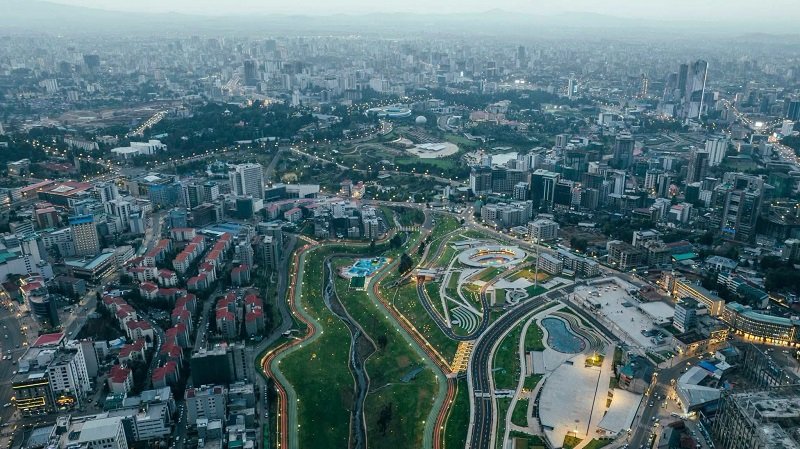
Addis Ababa is not one city among many in Ethiopia’s federal system, interchangeable with any other regional capital. It is the seat of the federal government. It is the headquarters of the African Union and a central node of African diplomacy. It is the country’s primary connection to international investment, foreign missions, and global commerce. And by a wide margin, it is the largest single concentrator of Ethiopia’s economic activity, industrial capacity, and formal employment.
The numbers make this concrete rather than rhetorical. Addis Ababa alone generates roughly 29 percent of Ethiopia’s entire urban GDP and accounts for close to a fifth of the country’s national urban development, all concentrated in a city that holds only a small fraction of a national population well over one hundred million. Manufacturing, finance, wholesale and retail trade, and the overwhelming bulk of formal private sector employment in Ethiopia cluster in the capital, drawn there precisely because of the infrastructure, banking access, and logistics advantages no other Ethiopian city can currently match. Ethiopia’s export economy, its diplomatic relationships, its access to foreign direct investment, and its position as a commercial hub for the entire East African region all run substantially through this single city.
A move to place the capital under the specific political control of one regional state’s ethnic establishment is therefore not a matter of local administrative housekeeping, no different in kind from redrawing a municipal boundary somewhere in the provinces. It is a claim on the single largest concentration of the entire nation’s economic output and governing capacity, pursued through ethnic entitlement rather than through the ordinary political processes that would govern any comparable decision about any other Ethiopian city. Handing privileged control of Addis Ababa to Oromia’s regional political establishment is not a marginal adjustment to a peripheral town somewhere on the map. It is a claim on the engine room of the entire Ethiopian economy, and everyone who depends on that economy, which is to say every Ethiopian, has a stake in how this claim is resolved.
A country whose politico-economic capital’s political fate is decided by which ethnic group happens to surround it geographically, rather than by the people who actually inhabit it and the entire nation it is meant to serve, is a country whose federal center has effectively been placed up for ethnic auction. That is not a stable foundation on which to build the future of a state home to more than seventy distinct ethnic groups, not one of which commands anything close to a national majority on its own.
Now the demolitions tell their own story
There is a piece of this argument that cannot be understood through census figures and constitutional language alone. It has to be understood through what has actually been done, physically and deliberately, to the ground surrounding Addis Ababa, because the bulldozer has told a story that speeches have carefully avoided.
For years, the animating grievance behind Oromo nationalist mobilization was the displacement of Oromo farmers from land surrounding the capital, most visibly during the fight over the 2014 Addis Ababa Integrated Master Plan, a development scheme that triggered mass protests, a violent government crackdown, and eventually a nine-month state of emergency before the plan itself was shelved. That grievance, real suffering experienced by real families losing real land, became the organizing cause that helped propel the current political establishment into power in 2018. It fueled the protests that swept Abiy Ahmed to the premiership as the country’s first Oromo leader in the post-1991 era. It is entirely fair, at this point, to ask what has actually followed from that grievance now that the people who mobilized around it hold the levers of the state.
In October 2022, the government created Sheger City, consolidating Sebeta, Burayu, Legetafo, Legedadi, Sululta, and Gelan, the ring of towns that surround Addis Ababa on every side, under a single Oromia-administered authority. What has happened in that ring of towns since is not abstract, and it is not disputed by the people who documented it firsthand. Human rights investigators, including the Amhara Association of America, documented that in a single three-week span in January 2023 alone, close to six thousand houses belonging to non-Oromo residents, overwhelmingly ethnic Amharas, were demolished. Churches and mosques were torn down alongside private homes. Residents displaced from the Jemo Terara Medhanialem, Fanuel Church, and Lencho Sefer areas alone numbered in the thousands, left living in open fields with nowhere else to go, and the total displaced across the broader campaign has been estimated in the tens of thousands. Displaced residents reported being told directly and explicitly by the demolition task force that Amharas should leave and go settle in Wolkait, a statement that removes any ambiguity about whether ethnicity was incidental to these demolitions or central to them. The Ethiopian Human Rights Commission opened its own formal investigation after complaints poured in from Burayu, Sebeta, Legetafo, Legedadi, and Menabchu. Independent analysts writing for outlets that track Ethiopian political risk have warned explicitly that the Sheger City project risks encircling Addis Ababa and fueling a deep and lasting sense of Amhara victimization, one that could feed calls for armed mobilization in response.
Put the timeline together, and the pattern is difficult to dismiss as coincidence, however much comfort there might be in trying. A grievance about displacement was used for years to build common political cause among Oromo constituents, to give a fractured and factional political movement a single, emotionally resonant story around which to organize. Once that mobilization delivered political power, the demolitions that followed did not reverse the earlier displacement or deliver the promised justice. They redirected it entirely, clearing non-Oromo residents, overwhelmingly Amhara, from the very ring of towns surrounding the capital, under the authority of the very regional government now simultaneously asserting special political claims over the city itself. Whatever the precise intentions inside closed-door planning meetings, and no outside observer can claim perfect knowledge of that, the effect unfolding on the ground speaks for itself: a demographic clearing operation that conveniently precedes, and materially reinforces, a political claim to the capital that would otherwise be undermined by the capital’s actual population. A grievance that began as a legitimate call for justice on behalf of displaced Oromo farmers has, in its second act, become the justification for displacing everyone else, and for engineering, one demolition order at a time, a demographic reality on the ground that the ballot box and the census could never have delivered on their own.
A mandate betrayed
It is worth pausing to remember, plainly and without nostalgia, what Abiy Ahmed was actually given power to do. In 2018, he arrived as the answer to a country that was exhausted, genuinely and desperately, by years of ethnic factionalism, having watched successive waves of protest and repression under a ruling coalition that had calcified into competing, mutually suspicious ethnic power blocs. Ethiopians across the country welcomed him, and this point deserves emphasis: not only Oromo Ethiopians, but Ethiopians of every background who were simply tired of a politics organized around which ethnic faction controlled which lever of the state. He released political prisoners by the thousands. He invited exiled opposition figures home, including armed groups that had spent decades outside the political process. He promised, explicitly and repeatedly, to move Ethiopian politics beyond narrow ethnic bases toward something more genuinely national. The world rewarded that promise with a Nobel Peace Prize. The mandate handed to him was never to become an improved or more effective representative of one particular ethnic constituency. It was to dismantle the very architecture of ethnic entitlement that had brought the country to the brink in the first place.
What Ethiopians have witnessed since is very nearly the opposite. Under his tenure, the country has fought a devastating civil war in Tigray that claimed hundreds of thousands of lives. It has faced a running insurgency and documented drone strikes on civilians in the Amhara region. It has watched the Addis Ababa question migrate from a fringe nationalist talking point into live, active government policy, backed by demolition orders and new administrative structures. A leader who was entrusted with power specifically because the public had grown sick of ethnic politics has, in the judgment of a great many Ethiopians who once genuinely celebrated his rise, spent that tenure consolidating power and advancing claims that disproportionately benefit his own ethnic base, at the direct expense of the national unity he was elevated, and internationally honored, to build. That is not a footnote buried in the fine print of his record. It is a betrayal of the precise mandate that put him in office, measured against his own stated promises and the expectations of the coalition of Ethiopians who trusted him. And it is exactly the kind of politics, a leader using the machinery of national power to entrench one group’s position at the expense of every other, that a fragile, multi-ethnic federation, already stretched to its limits by war and insurgency on multiple fronts, cannot be expected to survive indefinitely.
Unity when it is convenient, exclusion when it is not
There is a question buried in all of this that deserves to be asked out loud, because it exposes the contradiction at the heart of the entire claim. On every issue that requires the sacrifice, cooperation, and shared burden of the whole Ethiopian population, whether it is conscripting the country’s youth to fight wars, taxing the entire nation to fund federal projects, calling on every region to defend the territorial integrity of the state, or asking the diaspora and citizens alike to rally behind national development schemes like the Grand Ethiopian Renaissance Dam, the Oromo political establishment has been perfectly willing to invoke the unity, sacrifice, and common destiny of all Ethiopians. Addis Ababa is treated as the capital of everyone when the demands of the state require everyone’s contribution.
But the moment the conversation turns to who governs that same capital, who controls its land, and who benefits from its wealth, the unity argument disappears and is replaced instantly with an exclusive ethnic claim rooted in the geography of one surrounding region. This is not a minor inconsistency. It is a fundamental double standard, and it should be named as such. A political establishment cannot credibly ask the Amhara, the Tigrayan, the Gurage, the Somali, the Sidama, and every other community in Ethiopia to bleed, pay, and sacrifice for a shared national project while simultaneously telling those same communities that the crown jewel of that shared project, the capital city itself, belongs to one ethnic group alone. Unity cannot be a demand made only when the state needs something from its people and an inconvenience discarded the moment there is something to be gained. Either Addis Ababa is a national asset that belongs to all Ethiopians, in which case it must be governed and shared accordingly, or it is not, in which case the entire premise that Ethiopia is a single nation deserving of collective sacrifice collapses along with it. The Oromo political establishment cannot have it both ways, and the fact that it has tried to is itself one of the clearest signs of how instrumental, rather than sincere, its commitment to national unity actually is.
This is precisely why the attempt to seize Addis Ababa, using power that was entrusted to this establishment by a broader Ethiopian public in 2018, not handed to it for the exclusive benefit of one ethnic constituency, cannot be understood as anything less than an existential threat to the country’s continued existence as a unified state. Power obtained through a national mandate, built on votes and support far beyond any single ethnic base, is now being turned around and used to seize, by administrative fiat and demographic engineering, the one city that was supposed to belong to every Ethiopian equally. That is not the exercise of legitimate federal authority. It is the conversion of a national trust into an instrument of ethnic conquest, dressed in constitutional language to make the seizure look procedurally normal. If this bid succeeds, other regions and other communities will draw the only reasonable lesson available to them: that federal power in Ethiopia is not held in trust for the whole nation but is simply captured, in turn, by whichever ethnic coalition manages to seize the state, to be used against everyone else the moment the opportunity arises. Once that lesson is learned, and it is already being learned, no community will have any remaining reason to invest its loyalty, its taxes, its soldiers, or its future in a shared Ethiopian project. That is not a prediction of gradual strain on the federation. It is the description of its ending, and the Addis Ababa claim, pursued in this manner, by this establishment, using this power, is the act that will be remembered as having brought it about.
What this claim actually reveals, and where it leads
Put the pieces together, because none of them make full sense in isolation, and together they tell a story none of them tell alone. A national dialogue process that was supposed to be the country’s shared, neutral forum for resolving exactly these disputes was captured from the outset by the governing establishment and abandoned by the very communities whose participation it needed most. A leader who rose to power on an explicit mandate to dissolve ethnic entitlement has, in the assessment of a large share of the public that once placed its trust in him, spent his tenure entrenching that entitlement instead, this time under his own ethnic banner. The land surrounding the capital, ground zero of the original grievance that brought this political establishment to power, has in the years since become the site of mass demolitions overwhelmingly targeting non-Oromo residents, clearing the ring around the city of the very communities whose presence complicates a political claim to it. And now the capital itself, the seat of the federal government, the country’s economic engine, a city in which the claimant group makes up under one resident in five, is being asserted as the special political property of one regional establishment.
This is not a series of unrelated disputes that happen to share a headline. It is a single, coherent pattern, and it points toward a conclusion that Ethiopians, and anyone who cares about the country’s survival, should be willing to state plainly rather than continue managing with euphemism. A politics that captures the national dialogue meant to include everyone, that converts a reform mandate explicitly designed to end ethnic entitlement into a vehicle for one group’s advancement instead, that clears the land around a capital city of its non-Oromo residents through mass demolition, and that now reaches for the capital itself on the basis of ethnic geography rather than the democratic will of the people who actually live there, is not pluralist politics operating responsibly within a federal system. It is assimilationist politics operating under federal cover, a project that treats every national institution, the dialogue commission, the premiership, the land around the capital, and now the capital itself, as territory to be absorbed into a single ethnic project rather than held in common among all of Ethiopia’s peoples.
A country cannot survive that trajectory indefinitely, and pretending otherwise serves no one, least of all the Ethiopians who will bear the consequences. Ethnic federalism was sold to the country as a framework for accommodation, a structure meant to hold Ethiopia’s extraordinary diversity together by giving every group a genuine stake in the state. What the Addis Ababa claim exposes, when placed alongside the captured dialogue, the betrayed reform mandate, and the demolitions in Sheger City, is a governing establishment using the language and legal architecture of federalism to accomplish something close to its opposite: converting shared national assets into the possession of one group, one region, one political base, one claim at a time. If this pattern is allowed to stand unchallenged and unnamed, there is no principled reason it stops at the capital. It will continue eroding whatever remains of the founding idea that Ethiopia belongs to all Ethiopians, until the federation it claims to be building has instead been hollowed out entirely from within, leaving only the shell of a state and the memory of what a shared country once looked like.
That is the abyss this path leads toward. It is why the claim on Addis Ababa cannot be treated as a routine administrative dispute to be managed through technical committees and quiet diplomacy. It has to be named for exactly what it is, and it has to be refused, clearly, publicly, and now, before the next demolition order makes the argument moot and the next census makes the argument impossible.
Editor’s Note: Views in the article do not necessarily reflect the views of borkena.com
__
Join our Telegram Channel: t.me/borkena
Like borkena on Facebook
To submit a press release, send the submission to info@borkena.com
Add your business to Ethiopian Business Listing / Ethiopian Business Directory
Join the conversation. Follow us on X (formerly Twitter) @zborkena to get the latest Ethiopian news updates regularly.
Addis Ababa is also an international cosmopolitan city. Its very neighbourhoods, their names, the various religious and cultural institutions, cemeteries, reflect the long history of each of regional and international communities that over the years and various historical “ encounters” made up the city. From traders to craftsmen, exiles, faith leaders, advisors etc the city grew as a reflection not only of local regional histories but world history and importantly Ethiopia’s relationship/engagement/ contact:/influence by with and from world historical events stretching back centuries. In the 1940s 1950s 1960s it was a city where just walking around and listening to languages being spoken by ordinary people was a lesson in its historical and regional antecedents Arabic, Armenian, Greek, coptic , Italian, French, Amharic ,Oromignya Adere, Tigrignya,Gurage, Somali etc All this that gradually expands and broadens as international organizations such as African Unity, UN and others expand into today. Such a shame that all this should be forgotten and erased. A capital city reflects and celebrates its people, its histories and showcases all the nations cultures arts and influences. It should belong to all its citizens and be a place where all heal, grow and flourish.
Thank you for sharing your views, Angel!
This is perfect! Abiye has hijacked the so called EPRD reform ajenda and dictated everything to stay in power. He is using Oromos against all other Ethiopians just to consolidate power. The current PM and President positions will be consolidated in the new President who is Abiye Ahmed, the barbarian. He is elected by Beshasha residents in a remote area, not by all Ethiopians.
It is the ambiguity of the wording in the Constitution that has led to revisiting again and again the question of Addis Ababa’s status as the Capital of Ethiopia. What does it mean for Oromia to have ‘Special interest in Addis Ababa’ (Article 49.5)? One is forced to wonder if this statement has been inserted to further confuse matters, instead of providing clear guidance. The fact that in the recently ended National Dialogue gathering, the Oromia delegation could not reach any agreement with the rest of the delegation from the other regions on this matter is further proof that the clause was intended deliberately to confuse matters. If the region of Oromia has peace and reconciliation in mind, it should consider seriously adopting Adama as its capital to preserve the true and unambiguous meaning of article 49.1, i.e. “Addis Ababa shall be [is] the capital city of the Fedeal state”.
‘አስታራቂ ሐሳብ’:- How about moving Ethiopia’s Capital to Gonder, Bahir-Dar, Debre-Marqos, or Debre-Birhan? That way, that city will belong to ALL Ethiopians! Besides, Oromos/‘Gallas’/Abiy/etc. will be out of the equation! If the diplomats in Addis Ababa [AA] don’t like it, they can move to Egypt’s new Diplomatic Capital 30 km from Cairo.
Q-1: Would ‘my proposed solution’ go against the Gojjam & Gonder [G&G] Amaras’ Expansionist Mentality [“Amara Land ONLY for Amaras & the REST of Ethiopia first-and-foremost for Amaras, too!]?” Else, why are Ethiopia’s cities & towns predominantly G&G Amaras? I met no Oromo in G&G, but met a few Guragés/Tigrés/Eritreans/etc.
AA | Shèwa Amaras [SA] | Shèwa Oromos [SO]: For argument’s sake, let’s just start from the Menelik-II Era [ME]. From ME to Derg Era, AA remained the Capital of BOTH Shèwa & Ethiopia. Population-Wise, Shèwa is/was: ≈40% SA & ≈60% SO. Geography-wise: ≈65% SO & 35% SA. Yet, AA is ≈70% Amara [SA+G&G].
AA & SO: Although SO form a belt of several kilometers around AA [Go & See!], they never even made 10% of AA. However, lately, AA kept annexing the surrounding SO Land [SOL], expanded its city limits, and incorporated more SO. Note that AA gets water, food, electricity, etc. from SOL. AA also dumps its sewage & industrial waste on SOL.
Q-2: How come ‘Oromo Intellectuals’ even fail to address such simple issues efficiently? What a shame!
‘Addendum’:
When Egypt’s Proxy Secessionist Rabid Dogs [EPLF-TPLF] Invaded-and-Occupied Ethiopia in 1991, their malicious schemes set off division/animosity/conflict/violence.
Although the constitution they co-crafted for Ethiopia [to suit their malicious schemes] has had contributive flaws, ALL the Pre-1991 inequality/injustice/discrimination is on us.
Consequently, the Pre-1991 Ethiopia was much like a country of only three ethnics [Amara/Oromo/Tigré] and followers of the Ethiopian Orthodox Church. Hence, that left 83 ethnics out in the cold for ages.
In any case, we can still solve such problems fairly if we stop over-politicizing them & drop our Ethnic Activist Hats. For example, “Governorate” status with Direct Parliamentary Representation for some cities/towns, ethnics close to extinction, etc.:
1). Predominantly Multi-Ethnic Cities/Towns: Addis Ababa, Dire-Dawa, Hawassa, etc.
2). Direct Foreign Investment Favorites: Addis Ababa, Debre-Birhan, Nazreth, etc.
3). Tourist Destinations: Addis Ababa, Gondèr, Bâhir-Dâr, Hârâr, Ârba-Minch, etc.
4). Federal Protectorate Ethnic Minorities: Hâmmèr, Irôb, Hâdèré, etc.
5). ….