
By RA
Introduction
NAKBA is an Arabic word meaning catastrophe. Palestinians mark Israel’s occupation of Gaza and the West Bank and the subsequent mass deportation of native Arabs from these areas on May 15, 1948 as day of NAKBA. They lost their land, their sovereignty, their statehood, birthright, freedom of movement, right to education, health care, right to self-determination everything. They still live under the mercy of a brutal apartheid regime, which enjoys enormous military support and diplomatic and legal patronage from Western powers who ironically claim to stand for democracy and human rights.
In this article we examine how Abiy Ahmed high jacked a popular revolution and turned Ethiopia into a butcher house waging one civil war after another, devastating the economy and creating a solid autocracy where the personality cult of the PM is the manifesto of the ruling party as well as the ideology of the state.
Pre-Abiy Ethiopia
Until the spring of 2018 Ethiopia was known to be one of the fastest growing economies in the world and one of the relatively peaceful states in Africa. Beginning in the mid-1990s, the government of Meles Zenawi adopted ethnic federalism and introduced multi-party democracy which with all its limitations served to accommodate the country’s diversities and reduce political tensions. The opening of the country to a free market economy highly attracted foreign investment and pulled millions out of poverty. Hundreds of schools, universities and health care centers were constructed, roads and bridges connected urban and rural areas, in the manufacturing sector various factories and industrial parks benefited millions. Private media flourished although freedom of expression was still a luxury. The national army effectively repulsed Eritrean aggression in 1998-2000 and chased out Al-Shabab militants from Mogadishu and most of Southern Somalia beginning in 2006. It also served as a peacekeeping force in war-torn regions such as Darfur, Rwanda, Liberia, Abei (Sudan) and elsewhere. In the diplomatic arena, Ethiopia exercised tremendous influence in the African Union, Inter-Governmental Authority on Development (IGAD), G-20 as well as G-8 (now G-7). Although there were popular dis-satisfactions on good governance, regional states more-or-less enjoyed relative autonomy exercising full freedom to express their culture, elect local leaders and administer their own finance. The regime was known for rigging consecutive elections and intimidating voters, never-the-less, opposition groups still operated and challenged the establishment, at least holding some seats in the parliament. since the end of the guerrilla war between the Mengistu regime and the Eritrea/Tigray rebels in May 1991, the country enjoyed nearly three decades of peace except the two-year border conflict with the Asmara regime in 1998-2000. There was no civil war as even two of the biggest armed groups, the Oromo Liberation Front (OLF) and the Ogaden National Liberation Front (ONLF) were nearly crushed and forced to operate outside of Ethiopia.
Popular unrest
The sudden death of PM Meles Zenawi in August 2012 ultimately resulted in the division of the ruling party and the subsequent decline of the state. PM Hailemariam Desalegn possessed neither the charisma nor the will to carry on the legacy and vision of his iconic predecessor. Some states within the federation began to re-assert their autonomy in the wake of potential harassment from the federal government and other rival states; the powerful governor of Somali state at the time was Abdi Mohammed Oumar (Abdi Elie) who succeeded in setting up the ‘Somali special forces’ to protect his region particularly from incursion by his Oromo neighbors. In the coming years, all regions followed the Somali example and organized their own special forces. These forces would later play a major role in fighting in the Tigray war alongside the federal government. The popular uprising which broke out in Oromia state in 2015 against the imposition of so-called ‘Integrated Master-Plan’ by the Addis Ababa city administration gradually matured into an insurrection and spilled over into the Amhara state, home to the second largest ethnic group in the country. Among the demands of the protesters was the removal of the influence of TPLF proxies on local administration. There were border conflicts in different parts of the federal structure; one of these was between Amhara and Tigray states over disputed territories which Tigreans refer to as ‘Western Tigray’ and Amharas refer to as ‘Welqayt-Tegedie-Setit-Humera’. Amhara activists and politicians in Ethiopia and abroad stepped up their campaign to regain control of the territories as Tigray People’s Liberation Front (TPLF)’s grip on power began to reflex.
The group which took advantage of all these developments was the Oromo People’s Democratic Organization (OPDO) which was nothing but a puppet created by the powerful TPLF that dominated the Ethiopian People’s Revolutionary Democratic Front (EPRDF), the ruling umbrella party. The OPDO allied with the Amhara National Democratic Movement (ANDM), another offshoot of the TPLF which governed the Amhara region. These two satellite groups high jacked the popular resentment against the regime and succeeded in deposing the TPLF from the Federal government in the spring of 2018; the latter was forced to be confined in Tigray state, although some of its prominent members such as Getachew Assefa, head of the intelligence agency still remained in federal position. The unarmed insurrection in Oromia state was spearheaded by the urban youth who called themselves ‘Qerro’ and their counterparts in Amhara were named ‘Fano’; the latter differed from the former in that it was partly an armed struggle. Out of all this chaos an obscure figure Abiy Ahmed emerged to assume the office of the prime minister left vacant by the resignation of Hailemariam Desalegn back in March of that year amidst national crisis. Essentially what these uprisings achieved at the end of the day was to replace mild oligarchs (TPLF) with another far worse brutal autocrat (Abiy Ahmed).
Abiy’s Ascent to Power
Abiy largely remained an elusive person in his previous career. As a young person he joined the army and took part in the Ethio-Eritrean war (1998-2000). He also served in the Information Network Security Agency (INSA) and since 2010 as a member of parliament but was never heard asking or commenting on any issue as a legislator. Although he was appointed as minister of science and technology in 2016, he was dismissed a few months later and became deputy governor of the Oromia state. Being an Oromo nationalist and agitator, Abiy was disliked and mistrusted by TPLF officials who viewed him and his collaborators as a serious threat to their political hegemony. Some of them have even accused him of spying for Eritrea and Egypt, Ethiopia’s arch enemies. In a series of fierce debates among cadres of the four EPRDF parties i.e. TPLF, OPDO, ADNM and SEPDM (Southern Ethiopian Peoples’ Democratic Movement), dozens of his opponents from at least the three parties except OPDO, violently criticized Abiy’s previous credentials and strongly opposed his nomination as chairman of the umbrella party and subsequently as PM of the country. Although, Abiy failed to defend himself, most of the attendees elected him to both posts; party chairman and Prime Minister. His appointment and opening speech deceived most Ethiopians and the international community that this man would change the country’s political landscape for the better. This was how Tom Gardner described the mood at home and abroad; ‘Ethiopians all over the country clapped and cheered…All around the world, Ethiopian diaspora sang and danced into the night…The rest of the world was catching Abiymania too….’
However, it didn’t take too long for the incumbent to strip off his facemask (reformist, unifier, pacifist, modernizer etc.) and reveal his true identity (butcher, liar, reactionary, power-monger etc). Abiy’s assent to political power on April 3rd, 2018, as stated in the title, is a dark day (NAKBA) for Ethiopia.
The past eight years of Abiy’s premiership (2018-2026) witnessed Ethiopia’s drift into a semi-failed state and below are listed some of the evidence to this claim.
- Bloody civil wars: Since Abiy’s take over, one civil war after another is being waged mainly to protect the fragile position of the PM and his central government. The parliament endorsed the sending of the national army into several regions; Somali, Oromia, Benishangul-Gumuz, Tigray and Amhara. The war in Tigray came just a year after the PM received the Nobel Peace Prize for ‘ending two decades of hostilities with neighboring Eritrea’, but many observers have questioned the sincerity of such awards which are inalienable once given and therefore notorious war criminals and mass murderers like Abiy Ahmed are still referred to as Nobel laureates. Apart from its failure to win any of these wars, the regime shows no interest to provide political solution to armed conflicts. Millions of dollars are spent every year to procure drones and other munitions; all these at the expense of basic needs such as the provision of food and health care.
- Inter-ethnic and intra-ethnic violence: one of Abiy’s divide and rule policy is displayed in his instigation and promotion of hostilities among different ethnic groups. Instead of facilitating peaceful settlement of border and other disputes, the government strove hard to saw lasting hostility among regional states and even among clans of the same ethnic group. In the years leading up to the regime change in 2018, OPDO cadres forged a political alliance named ‘OROMARA’ meaning Oromo-Amhara which was largely responsible for displacing hundreds of thousands of ethnic Tigreans mainly from Oromia and Amhara states. By inciting anti-Tigrean racist propaganda, the unholy alliance succeeded in facilitating the conquest of the Tigray state in November 2020. The regime also promoted and sponsored the land dispute over so-called Welqayt-Tegede-Raya (western Tigray) between Tigray and Amhara. The federal government armed and financed Amhara militias and the FANO troops to overrun and occupy these places which are rich in resources particularly in sesame production. In return, the Amharas fought alongside the federal army in its bloody battle with the TPLF in Tigray. The regime also promoted and financed border skirmishes and land grabs by ethnic militias between Somali and Afar, between Oromia and Somali, between Oromia and Guji (South), between Amhara and Benishangul-Gumuz etc. While addressing parliament in October 2025 the PM said that Dire Dawa (an autonomous city-state in eastern Ethiopia) was once part of the Oromia region. By making this false and inflammatory statement, Abiy hoped to stir hostilities between Oromos and Somalis, the two dominant ethnic groups in and around the city.
- Gross human rights violations and worst humanitarian crisis: the despotic rule of Abiy is responsible for serious human rights abuses and created man-made humanitarian crisis, in a scale unprecedented in the country’s recent history. The national armed forces, members of the police and regional militia have all been involved in violations which amount to war crimes, crimes against humanity and ethnic cleansing. The main drive behind these rampant abuses is that the regime has allowed them to act with absolute impunity. In the civil wars which took place in Oromia, Tigray and Amhara regions, summary executions, deliberate burning of houses and farmland, child conscription of soldiers, rape and other sexual assaults, economic blockade, bombing of civilian towns and infrastructure, arbitrary detention and torture of non-combatants and other similar crimes were widely reported by Ethiopian Human Rights Commission, the United Nations Human Rights Council, Amnesty International, Human Rights Watch and other rights groups.
Since the first year of Abiy’s premiership, horrible modes of execution were introduced and implemented on ‘enemies of the state’ which include burning alive, throwing into pit, hanging upside-down, beheadings and drowning into rivers and lakes. Such executions have been carried out in Oromia, Tigray, Amhara, Benishangul Gumuz, Gambella and other states at different periods.
In Tigray alone hundreds of thousands probably a million people were killed, millions were internally displaced, several schools, hospitals, factories and other facilities were destroyed mainly by drone strikes and hundreds of thousands of women and girls were either raped or sexually assaulted by men in uniform both from Ethiopia and Eritrea.
The regime has also intensified its brutal crackdown on critical voices stamping out private media, jailing and torturing journalists, political activists and opposition leaders. A notorious death squad with the name of ‘Kore-Negegna’ has been empowered to secretly hunt down and eliminate potential individuals who were viewed as serious threat to the Abiy monarchy. In June 2019, with the intention of creating hostility between Tigray and Amhara, the regime facilitated the assassination of Saare Mekonnen (General), the national army’s chief of staff (a Tigrean by birth) and Ambachew Mekonnen, the governor of the Amhara state along with Asaminew Tsige (General), head of Amhara’s security forces. Notable men like Hachalu Hundessa, the popular Oromo singer and Bete Urgessa, a senior official of the Oromo Liberation Front (OLF) were murdered by agents of this state machinery in broad daylight. An investigative report by Reuters and also by Ethiopian Human Rights Commission (EHRC) revealed that fourteen members of the Kereyu Oromo Abba Gada (traditional elders) were summarily executed in December 2021 in Fentalie district (Oromia) after they were labeled as fighters of the Oromo Liberation Army (OLA).
- Entrenched autocracy: although Ethiopia has been home to sworn autocrats in the past, the totalitarian power that Abiy exercises surpasses all limits. Since taking office and consolidating his position, collective decision is effectively replaced by personal ambition. The Prosperity Party (PP) which he invented in 2020 by a forced merger of the eight sister parties of the EPRDF (with the exception of the TPLF), enabled him to push his personal agendas without serious debates at federal and regional levels. Abiy willfully assigned and dismissed ministers, officials and regional governors without the consent of the Council of Ministers and the parliament. In Amhara state alone, Abiy has hired and fired six governors within a period of five years. The introduction of new currency, the declaration of war against ‘armed insurgents’ in Somali, Oromia, Tigray and Amhara states, the launching of projects to build lodges, palaces, smart city, riverside development etc. were all carried out by the direct order of the PM without the prior knowledge and approval of the concerned government bodies. Abiy publicly rejected calls by some opposition MPs for financial scrutiny into his ‘personal projects’. Having secured and reinforced his political position, Abiy turned against most of his colleagues who opposed some of his decisions and measures. Lemma Megerssa and Geddu Andargachew, former governors of Oromia and Amhara states respectively, were exiled abroad while Taye Dendaa, deputy minister at the Ministry of Peace was sentenced to seven years behind bars for describing the PM as ‘a cold-blooded murderer’.
Abiy’s orders for the detention and imprisonment of his critics such as Christian Tadelle, an Amhara opposition MP, was swiftly implemented even before the latter’s legal immunity was stripped. The PM personally initiated and authorized vital issues of national interest such as the foreign purchase of arms and the signing of bilateral treaties with other countries. In a televised speech Abiy was bold enough to assert that ‘he is Ethiopia’s signature’ clearly expressing the fact that he has absolute power over the country. Although, a commission for national dialogue has been formed and continues to collect agendas for discussion, the PM made it no secret that some important issues like the establishment of a transitional government are off the table. Constitutional amendment is another endeavor which Abiy promised to undertake whatever public opinion.
- Electoral Fraud: Abiy faced stiff opposition when he decided to postpone the national election which was scheduled for May 2020 citing coronavirus as an excuse, and he used the time gap to jail his main political opponents (Jawar Mohammed, Bekele Gerba, Lidetu Ayalew and Eskinder Nega to mention some). When the election was finally held in June 2021, civil wars were on going at least in Oromia, Tigray, Afar and Amhara regions. The Prosperity Party claimed to have won 98 % of the vote while several opposition parties either boycotted or were barred by the electoral board from running. In Oromia, the largest state in the country, no other political party run for election except the ruling PP. In Tigray, the election was held in early September 2020 exactly five years after the previous election as prescribed in the constitution. However, the regime in Addis Ababa refused to accept the legitimacy of this election which granted a landslide victory for the TPLF and two months later, Abiy sent Federal troops and local militia from other regions to punish Tigray. Although there was a legal obligation on the Federal government to hold election every five years, Abiy chose to postpone the election for more than a year; he did this by ordering the so-called Council for Constitutional Inquiry (CCI) to ‘interpret the constitution’ in favor of postponing the election. The electoral board is another tool for the regime and it facilitated the election of the ruling party by ignoring alleged irregularities such as voter intimidation and sabotage on vote counting. Many of the well-known international observers refused to send their teams to Ethiopia. By all standards this is an illegitimate government never truly elected by the people.
- Theocracy: the intimacy of politics and religion in Ethiopia has remained an important feature for several centuries until the revolution of 1974 which realized the creation of a secular state. However, since Abiy took office in 2018, a resurgence of theocracy became visible with the PM publicly claiming that he had a prophecy from his mother that he would be the seventh king of Ethiopia.
Although the current constitution explicitly sanctions any collusion between state and religion (FDRE Constitution, Article 11), Abiy regularly summons evangelical pastors and prophets to the national palace for prayer and guidance. At the order of the PM, the mayor of Addis Ababa, Adanech Abiebie, also an evangelical, has provided land grants to these churches and in return the pastors and prophets preach to their followers to show absolute loyalty to the state. During the early years of his rule, Abiy boldly claimed that he was sent by God just like Moses to deliver Ethiopia from tyranny and poverty; the irony is that the country under his watch was sliding from one tragedy to another. He has also persuaded protestant leaders to establish the Ethiopian Council of Gospel Believers’ Churches whose primary task is to counter the influence of Orthodox Christianity and Islam, the two biggest religions of the country.
Abiy delivers political messages to the public on religious holidays citing verses and stories from the bible and the Quran. The manifesto of the Prosperity Party (PP) accuses Orthodox Christianity and Islam to be impediments to Ethiopia’s development. The regime often promotes and sponsors sectarian violence on minority groups; Orthodox believers have been targeted in Muslim dominated areas such as Arsi and Harrarghe and the fact that most of these Christians are Amharas adds ethnic elements to the religious conflict. So far no individual has been held responsible for all these crimes. In responding to questions why his government failed to stop the killing of Christians and the burning of churches, the PM simply stated that such incidents are not new to Ethiopia and they will definitely continue in the future; a clear indication that his administration is behind these deliberate attacks.
Commenting on the ongoing wars in the country, while speaking on a military parade at the Mesqel Square Abiy claimed that ‘No one will defeat us because the Almighty God is with us!’ Many observers, however, question why a person who is such a devout Pentecostal believer, shows no remorse for the brutal murder and displacement of millions of citizens and turns a deaf ear to repeated calls for peace. The extent of the PM’s brutality was clearly seen in his response to concerned individuals’ plea for him to stop the bloodshed in the country; on one occasion Abiy said that a mother will bleed when she gives birth to a child, don’t focus on the blood focus on the new-born baby and in another he quoted from the bible ‘there is no remission of sins without the shedding of blood’ (Hebrews 9:22).
- Abductions: prior to the change of government in 2018, Ethiopians knew nothing about abductions of citizens by armed groups except what they heard through the news about student kidnappings by Boku Haram in Nigeria. When scores of students from Dembi-Dolo University (Western Ethiopia) were first kidnapped by gunmen in 2019, the country woke up with shock and unbelief. Ever since, abductions have become widespread and common. Travellers, students, factory workers, pilgrims, drivers, merchants and public servants have been taken captives by ‘unknown bandits’ who often demand huge ransom from their family members to secure their release. Although the abductors use cell phones registered by the national telecom company and they also provide official bank account numbers to receive the ransom, the police make no serious efforts to detect and arrest them and the police themselves usually request bribes from the family members of the detainees. In most cases, the loved ones of the kidnapped had to sell their properties (house, farmland, oxen) if they could afford or beg on the streets to pay the requested ransom. These abductions don’t find coverage by mainstream media and local officials either refuse to give comment or they simply respond by saying the government cannot deploy a police force or militia for every village and street to protect citizens. The abductions seem to mature into an industry where the police, local militia, bankers and brokers operate in collaboration to cultivate profit at the cost of human suffering. As a result of these abductions, citizens are so afraid of travelling freely to rural centers and thus they are forced either to pay more to travel by plane or to abandon journeys altogether if they can’t afford to pay. Dozens of captives have been murdered by their abductors; some because of the failure of their families to pay ransom but others were not spared even after ransom was paid. Many families have failed to attend the funerals of their close relatives living in rural areas because of lack of security.
- Gross Corruption and Hyper-Inflation: state corruption in Ethiopia has sky-rocketed in recent years to the extent that it is almost impossible for citizens to get some public services without offering bribes and kickbacks to government functionaries. Although corruption is a global challenge, the country never had such a tainted name in the past when it comes to this issue. State officials at all levels are deeply involved in lucrative businesses such as illegal gold mining, cement industry, currency exchange and real estate; governmental houses and cars are randomly distributed to civilian and military personnel as well as party loyalists. The high-ranking military officers are often awarded private houses and huge sum of money for leading bloody battles to safeguard the power of the PM. Millions of dollars are spent every fiscal year to renovate the offices and residences of federal and regional state officials while peasants are suffering from lack of fertilizers and urban dwellers are languishing because of high cost of living. Although the regime has publicly denied the prevalence of state corruption, citizens are expressing their frustration in government bureaucracies particularly those which are responsible for providing public services such as land administration and taxation.
- Muzzling of the press: since the introduction of multi-party democracy in Ethiopia in the early-1990s, private media which were often violently critical of the regime were mushrooming. Although many of these newspapers and magazines have been banned and their owners were sometimes jailed, the outlets reorganized themselves and continued to politicize the public and challenge the establishment. Under Abiy’s dictatorship independent media became the target of not only systematic harassment and attack but a complete shutdown. The PM never sat down with any international media for an interview not that much for lack of proficiency in the English language but mainly for fear of ‘harsh’ interrogations which would expose his criminal legacy. He even avoided giving press conferences to domestic journalists and preferred to be interviewed by his own subordinates (the deputy PM or one of his advisors) who often pose questions aimed at glorifying the premier and amplifying his achievements.
Thanks to his brutal crackdown on critical voices, the country has ranked among worst journalists in the world. Bloggers and You Tubers who dared to point out the mistakes and misdeeds of the Prosperity Party are often detained, abducted, jailed, tortured, exiled and sometimes executed. Meskerem Abera, Yayesew Shimelis, Sisay Gobeze, Temesgen Desalegn, Meaza Mohammed, Fanuel Kinfu and Bekalu Alamirew are few examples of those outspoken journalists who were severely persecuted for speaking the truth and exposing the brutality of the regime. Being unable to censure or jam media outlets that operate outside of the country, the regime seldom resorts to sporadic internet shut down at least to mitigate their influence.
- Disregard for the motherland: Abiy and his cabinet have repeatedly shown their complete disregard to the statehood of Ethiopia. Within a period of few years, the country was invaded by three of its immediate neighbors and attacked by three more others. In 2020, with the aim of surrounding and defeating the TPLF, the PM secretly invited Eritrea and Sudan to cross the border and occupy Ethiopian territory in the north and north-east respectively. Having expelled Ethiopian farmers and traders, Sudan still occupies the Al-Fashaga region on the border and Eritrea has penetrated deep inside northern Ethiopia and still controls dozens of localities in Tigray state. South Sudan, the third neighboring state to conquer Ethiopia has incorporated a county (wereda) with its capital city. The response of Abiy to these humiliating developments was denial and complacency; initially he and his officials flatly denied the presence of Eritrean troops inside the country and when they were no longer able to conceal it, they defended their northern neighbor calling it ‘a friend in need’. However, the army of Isayas Afeworki has been accused of genocide and crimes against humanity including murdering civilians and raping women and girls. Whereas Djibouti sent its drones to attack suspected armed groups inside Ethiopia’s Afar state, Kenyan ground troops repeatedly encroached southern Ethiopia with the aim of protecting the interests of its nomadic population on the border areas. Lastly, the Somali radical Islamist group Al-Shabab has intensified its attacks on Ethiopians on both sides of the border. For the first time in their history, the Jihadists were able to infiltrate into the Ogaden region of eastern Ethiopia inflicting heavy losses on the army. Although one of the major duties and responsibilities of any head of state is to protect the sovereignty and territorial integrity of his/her country, Abiy as commander-in-chief has so far refused to respect and defend Ethiopia’s land and airspace. Thus, the country is being targeted from every corner.
The economic sovereignty of Ethiopia has also been violated when the regime chose to bow down to the austerity demands of the International Monetary Fund (IMF) and the World Bank in order to secure loans which in turn will be used either to finance the ongoing civil wars particularly in Oromia and Amhara states or to spend on luxurious projects of the PM i.e. splendid palaces, road-side fountains, amusement parks and lodges.
The other sector that witnessed Abiy’s disdain to Ethiopia is his handling of the Grand Ethiopian Renaissance Dam (GERD). Being Africa’s largest hydro-electric power plant, the GERD was the hope of Ethiopians’ quest for energy independence. Between its commencement in 2011 and Abiy’s rise to power in 2018, this mega project was more-or-less efficiently implemented with the able leadership of its manager, Simegnew Bekele. However, the undertaking became the target of the reactionary PM who viewed the entire undertaking as a living legacy of the old regime. Having travelled to Cairo, Abiy pledged in the name of Allah on a live TV show that Ethiopia won’t harm Egyptian waters; the statement not only admits that the Nile is exclusively Egyptian water but also surrenders Ethiopia’s rights to utilize its natural resources. In the following months Abiy kept his promise by ordering the capacity of the dam to be reduced by 1300 MB. The death [assassination] of Simegnew Bekele, the project manager in a mysterious circumstance at Mesqel Square in Addis Ababa highlighted Abiy’s commitment to implement Cairo’s agenda of sabotaging the construction of the GERD. There is no doubt that the acts of the PM amount to treason. Although the dam was finally inaugurated in September 2025, Abiy is still dissatisfied because most Ethiopians and members of the international community give the highest credit for the success of the project not to him but to Meles Zenawi and Simegnew Bekele.
- Fatal education policy: like most African dictators, Abiy entered politics before even completing high school and hence he tends to be afraid and jealous of all intellectuals fearing that if more youth are educated they will be a serious threat to his regime. Within few years prior to becoming PM, he succeeded from grade 7 to Ph.D. status; questions remain on the authenticity of his degrees. This could be one of the reasons why Abiy usually fails to understand the complexities of such topics as political economy, ethnic federalism and diplomacy. Due to inferiority complex, he frequently makes derogatory remarks about university professors and political elites; he went as far as claiming that most innovators in world history didn’t have a degree and that failing to join the university is not a big deal. A country which is ruled by a person with such a negative attitude toward education is not expected to make any progress in fighting illiteracy, producing skilled manpower or modernizing agriculture.
Hence the PM appointed a certain Berhanu Nega, former opposition leader as minister of education to carry on his plan of systematically weakening the education sector. Birhanu, professor in economics, began implementing a so-called reform program aimed at significantly minimizing the number of students who aspire to join state universities and the PM has proudly stated that he has no vision to open new universities arguing that paying for student accommodation was wastage of government budget. The result of this paradigm shift is that more and more youth are faced with the choice of either being recruited by government or rebel forces to fight in the endless wars or migrate outside of Ethiopia to embark on desperate journeys across the Red Sea or the Mediterranean to find a better life in Europe.
Moreover, in Oromia, Tigray and Amhara regions the regime has deliberately used its drones and jets to attack schools and universities and in the majority of cases, many public schools are serving as either shelter for IDPs or as camps for government or rebel fighters, which means children are indefinitely displaced from their classes. As one scholar puts it ‘this educational blackout is a direct consequence of Abiy’s militarized approach, prioritizing control over classrooms.’
- Dwindling Legal System: since the time of the imperial regime, the Ethiopian legal system barely experienced such principles as judicial independence, speedy trial or presumption of innocence especially when it comes to political detainees. However, during the rule of Abiy the entire legal system was dwindling. Where there is no state of emergency, security forces are authorized to conduct house to house searches, detain individuals (usually opposition members, journalists, human rights activists etc.) without an arrest warrant and carry out physical and mental torture on suspects. Although the police are obliged to take suspects to court within 48 hours of their detention, political prisoners often remain in detention for days, weeks and even months without being prosecuted. The prison administration frequently violates the constitution by restricting or even prohibiting the rights of these prisoners to access medical treatment, legal counseling or visits by family and friends. Court rulings on acquittal and subsequent release of detainees have repeatedly been ignored by the police who under direct orders from the executive (most probably the PM) continue to hold the person under their custody or sometimes they release him/her only to re-arrest after a few hours or days. There are several under-ground prisons and detention centers at different places across the country. Legal attorneys to these political prisoners often encounter intimidation and threat by police or intelligence officers; one of these was Abdu Jabar, who was gunned down by a state sponsored assassin.
- Failed Diplomacy: Ethiopia had a successful diplomacy for many years; being the only African country un-colonized by European powers, it was a beacon of independence for the continent. It was the founding member of the Organization of African Unity (OAU) now AU, the League of Nations (later the UN) and several other regional and international blocs including the Non-Aligned Movement (NAM) during the Cold War. It began sending peace keeping forces as early as the 1950s. Since the early 1990s Ethiopia established friendly relations with the west while it maintained even stronger ties with nations like Russia, India, Turkey and China. However, all these achievements were quickly dismantled and the country is suffering a diplomatic backslide because of the blind and reckless adventures taken by the PM in the face of the international community. The country’s diplomatic mess began in 2019 when Abiy blindly decided to implement the so-called ‘Treaty of Algiers’ which has repeatedly been violated by Eritrea whose leaders chose to expel the border commission and the United Nations Mission in Ethiopia and Eritrea (UNMEE) set up as a result of that treaty. In late 2020 the PM authorized the deployment of Eritrean mercenaries in Tigray in violation of Ethiopia’s sovereignty and territorial integrity. Although most of the international community denounced this crime by both governments in Addis Ababa and Asmara, foreign troops still occupy parts of Tigray. The genocide and war crimes committed especially in Tigray have hugely tarnished the image of the Ethiopian army; whereas Sudan has ordered the withdrawal of Ethiopian army from the volatile Abiye region, the United Nations Human Rights Council has recommended the Security Council not to permit the deployment of Ethiopian army in any peace keeping missions in the future. Since Abiy came to power the office of the country’s foreign ministry has been effectively paralyzed; its major duties and functions were overtaken by the PM who engages with heads of states on political, economic, strategic and military issues without the prior knowledge of either the foreign minister or the respective ambassadors.
Moreover, the media brigade whom Abiy created seems more reliable for the regime than the professional diplomats; as one researcher put it “[Abiy] dismantled the foreign ministry in favor of what he called the ‘twitter lions’”. Ethiopia’s relations with some countries such as the UAE is not based on common interests and shared values but on personal friendship and/or boss-subordinate approach between Abiy Ahmed and Mohammed Bin Zaid. In the past few years, Ethiopia’s arch enemy, Egypt has succeeded in creating a political blockade around Ethiopia by signing military agreements with almost all of the latter’s immediate neighbors. In a childish and greedy move to ‘get access to the Red Sea’, Abiy signed a Memorandum of Understanding (MoU) with the breakaway region of Somaliland in January 2024. The severe backlash from several African, Arab and Western governments, particularly Turkey, compelled Abiy to abrogate the MoU and restore ties with the Federal Republic of Somalia in mid-2025. The incident also helped Egypt to gain a military foothold in the horn of Africa for the first time since its withdrawal from the region in the late 1880s. Similarly, the official threat of war from Abiy and his officials to occupy the Port of Assab, prompted Eritrea to seek allies and the so-called ‘Red Sea Forum’ was formed as an alliance between Eritrea, Egypt and Saudi Arabia.
Moreover, Abiy is currently paving the way for the conflict in neighboring Sudan to spill over into Ethiopia; in February 2026 Reuters has exposed a secret military camp built in Benishangul-Gumuz regional state to train fighters for the Rapid Support Forces (RSF) which is battling Sudan’s National Army. The camp is built and sponsored by the United Arab Emirates which is actively engaged in fuelling similar bloody wars in Yemen and Libya. Ethiopia was known for sending peace- keeping troops to war-torn regions and also for brokering peace talks among warring parties; now thanks to the Abiy regime, it is threatening to invade Eritrea and aggravating the civil-war in Sudan.
Last but not least, Abiy so far ordered the closure of about thirty Ethiopian embassies abroad, his reason being to reduce the wastage of dollars on chanceries and residences of ambassadors. He is very short-sighted if not blind to comprehend the political, economic and strategic benefits of post-modern diplomacy. When a given country opens more embassies in several countries, it widens the opportunity for foreign markets, it will be easier to protect the safety of its nationals residing in those countries and it will also enable it to recruit as many allies and friends as possible. These benefits far outweigh the expense of running an embassy. However, for Abiy and his sympathizers much expense on diplomacy is extravagance. Therefore, they have decided to close down Ethiopian embassies in dozens of countries; one of these is in Kuwait which resulted in the latter’s suspension of exporting cheaper oil to Ethiopia and also thousands of Ethiopian nationals who are working in the rich Gulf country are left without a legal representative which could plead their case.
Conclusion
Since 2018 Ethiopia finds itself in the middle of political, economic, diplomatic, strategic and social crises unprecedented in its long history. Although popular calls for reform prior to April of that year succeeded in persuading the EPRDF to crumble, the revolution was quickly high jacked by an OPDO official who was a former army captain. Emerging as a party chairman and PM, Abiy initially won the support of most Ethiopians by chanting slogans such as ‘long live Ethiopia’ and ‘synergy (Medemer)’. However, it didn’t take too long before the country sunk into a bloody civil war accompanied by all forms of war crimes and crimes against humanity. Fully implementing the techniques of divide and rule, Abiy saw lasting hostility between varying ethnic groups, the best example being the armed conflict between the forces of Tigray and Amhara in 2020-2022. Letting neighboring states conquer and occupy Ethiopian territories, the PM displayed his disdain for the homeland. Focusing on fanciful endeavors such as the construction of splendid palaces, he effectively hindered the country’s progress towards agricultural and industrial development. Abiy’s theocratic rule saw not only the promotion of evangelical Christianity and the humiliation of the Orthodox Church but also the crippling of a secular state. Stretching an iron fist on critical journalists, opposition parties, activists, the PM made every effort to stamp out critical voices. Abiy is a genocidal, war-criminal, the worst mass-murderer in Ethiopia’s recent history. As the head of a brutal regime, he is directly responsible for the killing, amputation, starvation and displacement of millions of people. His ascension to power on the 2nd of April, 2018 is an occasion that should be mourned not celebrated; it is NAKBA, day of catastrophe for Ethiopia and Ethiopians.
Editor’s Note : Views in the article do not necessarily reflect the views of borkena.com
__
Support Borkena : https://borkena.com/subscribe-borkena/
Join our Telegram Channel : t.me/borkena
Like borkena on Facebook
To submit Press Release, send submission to info@borkena.com
Add your business to Ethiopian Business Listing / Ethiopian Business Directory
Join the conversation. Follow us on X (Formerly Twitter) @zborkena to get the latest Ethiopian News updates regularly.
Certain atrocities mentioned in this article about the current regime back in the old country could be true. But it did not utter a word about those being committed by the TPLF and the goons in Asmara. Why not? Just asking.
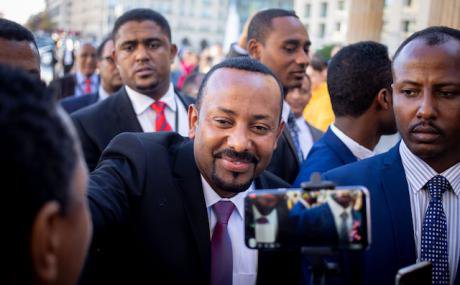
The other issue with this article is the photo used as part of the headline. It shows PM Abiy in company of other officials who are said to be born to Oromo parents. Was that meant to prove that the regime is dominated or exclusively ruled by those with Oromo heritage? You know all this stupid diatribe about the nonsensical ‘Oromummaa’ boogeyman, It is all the rage these days by some worthless intellectuals who do not realize their own bigotry that has irredeemably gripped them. It is the sad part of the story these days.
Also, what irrefutable evidence does the writer has in his assertion that the renowned singer Hachalu Hundessa was murdered by the regimes death squad agents? He was being accused and demonized by bigots here among us and inside the for getting a loan from domestic banks to finance his new business ventures. He was egged by bigots to make news songs demonizing ‘neftegnas’ which he declined. Then he was gone.
In asking these questions, I am not so blind or naive to negate facts that the hoodlums allegedly working in the regime’s outfits have committed atrocities. There has been a mountain of reports and complaints by human rights organizations both inside and outside that country by which I was not surprised. But we have to be careful when accusing others because we will end up victimizing innocent individuals just like during the dark days of the late 1970′
s and 80’s.
Very exception idea!!!Your article provides a detailed and passionate critique of the current political landscape. By documenting specific events—from human rights reports to diplomatic shifts—you offer a clear, alternative perspective on the “reform” era. Continuing to record these observations is vital for preserving a diverse historical record and encouraging deep public discourse on Ethiopia’s future. Keep going!!!!!! Your Basse.H