
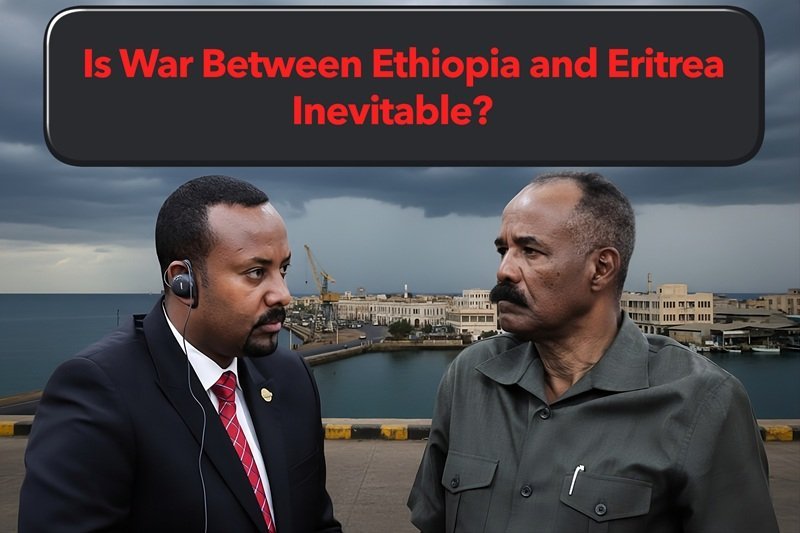
As tensions escalate between Ethiopia and Eritrea, with both nations mobilizing troops along their shared border, the specter of war threatens to unleash a humanitarian catastrophe that could dwarf even the devastating 2020-2022 Tigray conflict, which claimed up to 600,000 lives. Yet this potential disaster appears driven less by necessity than by one man’s ambition: Prime Minister Abiy Ahmed’s determination to cement his legacy as the leader who restored Ethiopia’s access to the sea.
One Man’s Ambition for Legacy
Abiy Ahmed has made his ambitions unmistakably clear. Speaking at the inauguration of the Grand Ethiopian Renaissance Dam, he declared that regaining control of Eritrea’s Red Sea port of Assab is merely “a matter of time,” framing it as correcting a historical mistake. His military officials have been even more provocative, with one general stating that Ethiopia’s population of 130 million gives it the right to simply take what it wants from Eritrea’s 2 million people.
These statements reveal dangerous psychology driving the crisis. Regional analysts suggest Abiy is seeking to deflect attention from Ethiopia’s mounting internal crises, seven years of civil war, insurgencies in Amhara and Oromia, and economic collapse by manufacturing an external enemy. A war for sea access offers him a nationalist cause that could rally public support and secure his place in history, regardless of the human cost.
The Humanitarian Nightmare
The civilian toll would be catastrophic. The last conflict in Tigray provides a grim preview: an estimated 600,000 deaths, with over 286,000 women and girls experiencing gender-based violence. Mass extrajudicial killings, ethnic cleansing campaigns, and widespread use of rape as a weapon of war marked the fighting, with soldiers from all sides committing atrocities against civilians.
This time, the crisis would likely be worse. A renewed conflict would not be confined to Tigray but could engulf multiple Ethiopian regions simultaneously as various armed groups coordinate against the central government. Ethiopia’s 3.5 million internally displaced persons would be joined by millions more fleeing violence, while famine conditions would spread across regions already teetering on starvation.
The Proxy War That Multiplies Suffering
What makes the potential conflict even more devastating is that it would not remain a bilateral war. External powers have already chosen sides, transforming the Horn of Africa into a proxy battleground where civilians become collateral damage.
The United Arab Emirates has been a longtime backer of Abiy Ahmed, supporting Ethiopia’s push for Red Sea access as part of Abu Dhabi’s strategy to become the dominant maritime power in the region. Opposing Ethiopia stands an axis of Egypt, Eritrea, and Somalia, formalized in an October 2024 security partnership. Egypt’s motivation is clear: countering both Ethiopia’s Grand Renaissance Dam, which threatens Cairo’s Nile water supply, and preventing an Ethiopian naval presence in the Red Sea.
This web of external support means both Ethiopia and Eritrea could sustain prolonged warfare even as their populations suffer mass casualties. The lesson from Sudan is instructive: as long as regional powers back opposing sides, conflicts continue indefinitely, with civilians bearing the brunt of violence.
Is War Inevitable?
Despite the grim outlook, most regional experts believe full-scale war remains unlikely. Professor Clionadh Raleigh of the Armed Conflict Location and Event Data Project notes that direct confrontation is improbable despite military threats. Ethiopia is already stretched thin fighting internal insurgencies, while Eritrea faces a severe manpower crisis with widespread desertion from its military.
However, a proxy conflict is already taking shape. The Tigray People’s Liberation Front, which fought against Eritrea just years ago, may now align with their former enemy against Addis Ababa, creating opportunities for conflict without direct confrontation.
The tragic irony is that this looming disaster is entirely preventable. Ethiopia could pursue sea access through diplomatic agreements with Kenya’s Lamu port or Djibouti’s proposals, as suggested by the December 2024 Ankara Declaration. But such pragmatic solutions would not fulfill Abiy’s desire for historical glory or provide the nationalist rallying cry his weakening government desperately needs.
For civilians caught in the crossfire, the women who will be raped, the children who will starve, the families who will be massacred, the ambitions of leaders, and the proxy wars of external powers offer no protection, only suffering. The question is not whether war is inevitable, but whether the international community will act decisively to prevent a foreseeable humanitarian catastrophe driven by one leader’s quest for legacy. Time is running out.
Sources
- Armed Conflict Location and Event Data Project (ACLED)
- Human Rights Watch, “Sexual Violence in Tigray Conflict.”
- Foreign Policy, Analysis by Michael Woldemariam
- UN Office for the Coordination of Humanitarian Affairs (OCHA) –
- BBC News, Ethiopia-Eritrea Tensions Coverage
- Rene Lefort, The Addis Standard, “Ethiopian Politics Analysis.”
- Ankara Declaration on Ethiopia-Somalia Relations
Abel Tewodros can be reached at: abeltewodrosarticles@gmail.com
Editor’s Note : Views in the article do not necessarily reflect the views of borkena.com
__
Support Borkena : https://borkena.com/subscribe-borkena/
Join our Telegram Channel : t.me/borkena
Like borkena on Facebook
Borkena Ethiopian News Youtube Channel
To submit Press Release, send submission to info@borkena.com
Add your business to Ethiopian Business Listing / Ethiopian Business Directory
Join the conversation. Follow us on X (Formerly Twitter) @zborkena to get the latest Ethiopian News updates regularly.
Ethiopia’s Principled Pursuit of Sea Access: A Case for Economic Survival and Regional Integration
Ethiopia’s quest for guaranteed sea access is not a bid for territorial conquest but a legitimate, existential economic necessity. As a nation of over 120 million people, Ethiopia’s landlocked status is an acute strategic vulnerability, incurring exorbitant port fees and supply chain risks. Prime Minister Abiy Ahmed’s public statements have consistently framed this within a diplomatic and legal framework, advocating for peaceful negotiation and mutual benefit. The core proposition is not war but the recognition of a legitimate need within the complex tapestry of regional politics, seeking a resolution through dialogue and shared economic interest.
The narrative that this drive is solely for “legacy” ignores the profound national consensus on the issue across Ethiopian society. Successive governments and the public have long viewed affordable, sovereign port access as critical for development. This is a strategic imperative, not a personal ambition. Ethiopia’s official diplomacy actively explores multiple pathways, including deepened partnerships with Djibouti, the Lamu Port in Kenya, and discussions with Somaliland—demonstrating a pragmatic, multi-vector approach wholly inconsistent with a single-minded march to war.
Furthermore, characterizing regional dynamics as a simplistic proxy war overlooks Ethiopia’s ongoing diplomatic engagements. While tensions exist, Addis Ababa maintains channels with all neighbors, understanding that stability is paramount for its own prosperity. The suggestion that conflict is inevitable discounts Ethiopia’s heavy burden of internal conflicts, which makes a costly new war profoundly illogical. The government’s stated position emphasizes economic integration, proposing port usage agreements in exchange for shares in Ethiopian airlines or telecoms—a model of cooperation, not coercion.
Ethiopia’s stance is a call for a just and equitable regional order that addresses its developmental handicap. It is a diplomatic campaign rooted in economic reality and enshrined in the principle of peaceful coexistence, fundamentally misrepresented by claims of belligerent ambition.