
By: – Habte H.
Not long ago, teachers were among the most respected figures in Ethiopian society. My uncle often tells me how they were admired-almost revered. There is even a traditional saying: “marrying a teacher brings respect to the family.” Today, that respect has evaporated. In fact, if I am being blunt, becoming a teacher is now one of the least desired paths in Ethiopia. Can we call teaching the most neglected profession in the country? I think so.
And the tragedy does not end with teachers. I remember when we were kids, the dream professions were clear: be a doctor, a scientist, or maybe an engineer. But now, even medicine-once the pinnacle of ambition-has become a cautionary tale. Doctors, who were supposed to be lifesavers and national heroes, are now overworked, underpaid, and demoralized. Some have been reduced to driving cabs after long hospital shifts just to survive. Yes, you heard that right-a trained physician picking up passengers part-time because their state salary is not enough to feed a family.
The same story repeats across the civil service: university professors, public health workers, bureaucrats-once considered elite careers-are now among the lowest paid. Meanwhile, small private traders, informal dealers, and even petty middlemen are living far better lives. Something has gone terribly wrong.
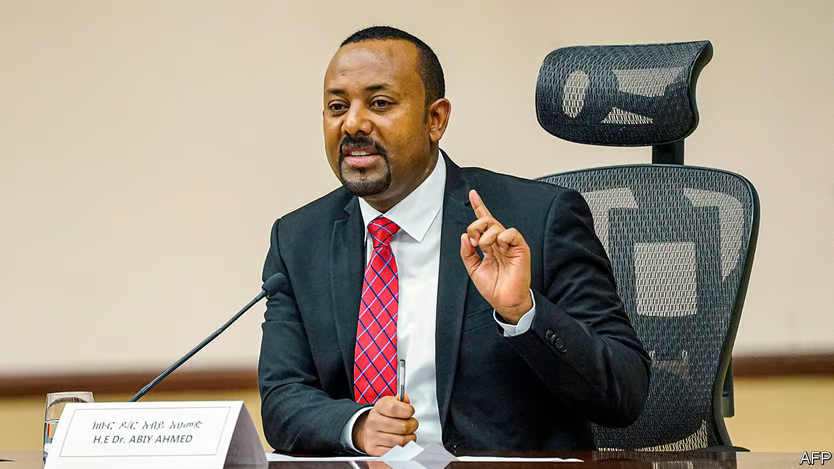
So, we must ask: Why is Abiy Ahmed, and his PP, deliberately starving Ethiopia’s civil servants? Is this just poor leadership-or is there a darker intention behind it? Here are six possible explanations.
1. The War Machine Eats First
Let us follow the money. Ethiopia’s national budget has ballooned from about 700 billion birr to nearly 1.7 trillion birr in just one year – a 140% increase. But where has that money gone? There are no new mega-projects, no massive infrastructure, no nationwide stimulus for the poor. Except for a few ornamental parks in Addis Ababa, the country looks worse.
The real answer: war. Defence spending has surged-some say it is eating up 40% of the national budget. In essence, the government is funding its own survival, not the people’s prosperity.
2. A Leader Who Loathes the Educated
Abiy’s speeches reveal a deeper disdain. Repeatedly, in public forums-be it Parliament, Millenium Hall, or during regional tours – he has mocked Ethiopia’s intellectuals and civil servants, calling them lazy, unproductive, or worse. This contempt seems personal. Abiy’s rise through informal education tracks may have shaped his resentment toward formal knowledge structures. But punishing the educated class is not leadership-it’s sabotage.
3. A Hunger for Praise, Not Humanity
Abiy is obsessed with appearances: flower gardens, ceremonial parks, artificial lakes. But while the capital blooms with cosmetic projects, the country’s human capital withers. Teachers, nurses, and civil administrators are barely surviving. His policies reflect someone more concerned with pleasing the eye than feeding the stomach. This is governance by illusion.
4. A State That Distrusts Its Own Workers
Abiy’s regime has also become deeply paranoid. There is a growing belief within the government that civil servants are infiltrated by opposition groups-whether affiliated with OLA, Fano, or others. Many officials see the bureaucracy as a threat rather than an asset. Worse, there is a creeping ethno-religious bias in federal hiring and budget allocation, suggesting the regime may see some civil servants as simply not “belonging” to its favoured base.
5. A Collapsing Economy Behind the Curtain
While official figures talk of growth, real GDP in USD terms tells a harsher truth. Ethiopia’s economy has shrunk from $121 billion in 2018 to around $100 billion now. Inflation is rampant. The birr has lost enormous value. Bread costs are raised by almost ten folds; fuel is unaffordable. Meanwhile, public salaries remain frozen, eroded daily by the market. Abiy’s regime might be broke and trying to mask it.
6. No Strategy, No Advisors, No Listening
Finally, it may just be incompetence. Abiy has repeatedly shown he prefers loyalty over expertise. Those who dare to offer real economic advice are either ignored or pushed aside. The result? A chaotic budget with poor prioritization-money poured into vanity projects while essential services go hungry.
Conclusion: Ethiopia Is Bleeding Its Backbone
The civil service is not a luxury-it is the backbone of national development. Teachers shape minds. Doctors save lives. Bureaucrats implement policies. Starving them is starving the country’s future.
Whether by design, neglect, or ideology, Abiy Ahmed’s government has chosen not to pay its most critical workers a liveable wage. It is a choice that reveals his priorities: spectacle over substance, control over competence, and fear over service. And unless something changes soon, Ethiopia will not only lose its civil servants-it will lose its soul.
Editor’s Note : Views in the article do not necessarily reflect the views of borkena.com
__
Subscribe : https://borkena.com/subscribe-borkena/
Join our Telegram Channel : t.me/borkena
Like borkena on Facebook
Add your business to Ethiopian Business Listing / Ethiopian Business Directory Business Listing Toronto
Join the conversation. Follow us on X (Formerly Twitter) @zborkena to get the latest Ethiopian News updates regularly. Subscribe to YouTube channel To share information or for submission, send e-mail to info@borkena.com