
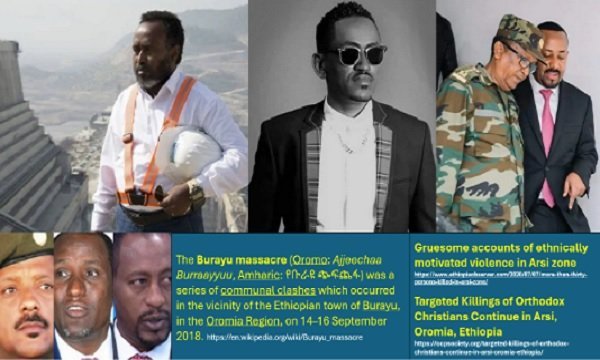
By Taye N. Milkesa
In the past, Ethiopians were confused about who was responsible for various killings and massacres over the last seven years, leading to much speculation and conspiracy around these cases. Thanks to former ministers such as Mr. Taye Dendea, Dr. Milkesa Midhaga, Dr. Gedu Andargachew, influential Oromo politician Jawar Mohammed, and prominent opposition leader Lidetu Ayalew, light has been shed and clarification provided on who planned and carried out these individual murders and massacres in different locations, including Burayu, Shahemene, Arsi, Wellega, and others. All have squarely pointed to the current man occupying 4-Kilo through state capture. These politicians have presented evidence, procedures, motives, and intentions derived from their personal conversations with Abiy Ahmed Ali. The question remains: how did he manage to cause such devastation in such a short time? Readers may offer several reasons, but the author proposes the following three strategies and tactics behind this charming genocider of the 21st century.
- Abiy Ahmed Ali’s first strategy was setting up a hidden killer squad.
According to Dr. Milkesa, before Abiy assumed top power, while holding a position within the Oromia administration, he carefully recruited ruthless killers—those with no humanity—who would obey every order without hesitation. Some call these people ‘Koree Nageenyaa,’ while others suggest that several such networks were created and led by Abiy Ahmed. No one suspected this, especially during the first few years of the past seven years. Abiy Ahmed succeeded in hiding these squads by blaming all atrocities on TPLF members, OLF, Shene, and other opposition groups. Everyone remembers “የቀን ጅብ,” a term used to refer to the TPLF after the bomb detonated on June 23 amid tens of thousands attending a rally in support of Abiy at Addis Ababa’s Meskel Square. Now, according to Dr. Milkesa’s testimony, it has become clear that the bomb was deliberately detonated by Abiy’s hidden squad. The purpose was to gain more popularity and acceptance among the people through victimhood while simultaneously building a rationale to go to war with the TPLF, OLF, and those resisting his power.
How did he hide these killing and torture squads? Abiy Ahmed was determined to become a king. Within the system of ethnic federalism, he saw an opportunity as the country’s political elites were divided along ethnic lines and not effectively interacting with one another. He navigated this divide and built various networks. For example, there is evidence that when he was minister at the Ministry of Science and Technology (MoST), he traveled to different universities across the country, recruiting university presidents, vice presidents, and other scholars—creating the appearance that he was uniting scholars nationwide. However, he carefully selected those loyal to him, who would say “yes” to his orders. These individuals later became part of the ministerial cabinet, helping make Abiy Ahmed’s government appear credible not only to people within the country but also internationally. This was one of his main strategies for hiding his true intentions. It appeared that Abiy was leading the country with a highly educated and inclusive cabinet—even featuring several women. But most of these were not his real partners in crime but those who are at the back, according to Dr. Milkesa.
- He carefully identified the persons and people to be killed and massacred
Abiy had personal conversations with many high-profile and influential individuals who were later killed or targeted for assassination by his squad, including Engineer Simegnew, Artist Hachalu Hundessa, Dr. Ambachew Mekonnen, General Seare Mekonnen, Mr. Taye, Dr. Lemma Megersa, Dr. Gedu Andargachew, Dr. Milkesa, Mr. Jawar Mohammed, Mr. Lidetu Ayalew, and others. All of these individuals—whether dead or alive—had firsthand discussions with Abiy Ahmed Ali. Many of them recall that he demanded their submission to his authority, warning that refusal would bring his wrath upon them. One thing is clear: Abiy does not tolerate strong, independent-minded individuals. He resents those with strong opinions, those who outshine him, and those who are popular and respected by the public. He deliberately targets prominent politicians, scholars, artists, and religious leaders. He wants all of them to remain under his shadow. If he feels threatened by someone’s charisma or influence, that person may be handed over to his secret killer squad. Now, detailed information has emerged about how Abiy’s squad killed Engineer Simegnew, Artist Hachalu Hundessa, Dr. Ambachew Mekonnen, General Seare Mekonnen, General Asaminew, and others. Meanwhile, individuals like Dr. Lemma have narrowly escaped attempts by the killer squad. In addition, he actively designs and orchestrates operations aimed at eliminating his opponents.
First, for Abiy, politicians and people from Welega were a major source of frustration. As Dr. Gedu recalled, Abiy once said, “How do you trust Oromos from Welega?” Many of the most prominent Oromo politicians—such as Dr. Lemma Megersa, Mr. Bekele Gerba, and Obbo Dawud—are from Welega, and he specifically targeted them using his covert squads. Initially, he sent OLF forces that had returned from Eritrea into Welega, and later established his first command post in the region to assert control. Second, Abiy was deeply fearful of the TPLF. To eliminate them, he mobilized forces from the Amhara region and later brought in Eritrean troops to crush the TPLF during the two-year war. That war was not accidental—it was deliberately orchestrated by Abiy himself. According to Dr. Milkesa’s testimony, Abiy told 2,500 OPP members that he was the one who initiated the war. Third, Abiy turned against the Amhara forces shortly after signing the Pretoria agreement with the TPLF. He used the agreement as a pretext to disarm regional armed forces. However, this plan backfired. A genuine grassroots resistance—the Fano movement—rose up, not only to protect the Amhara region but also to defend the entire country. Finally, Abiy is now reportedly conspiring to initiate conflict with Eritrea and with factions of the TPLF that are aligned with the Eritrean government. Abiy can not lead without creating conflict. Mr. Taye argues that Abiy is incapable at his core to lead a big country like Ethiopia. He craves conflict to hide his incompetence and inability to lead a country.
- He always distances himself from killings and disasters, and acts innocent
Over the past four years, Abiy’s true image has gradually been exposed to Ethiopians, to countries in the Horn of Africa, and beyond. However, during the first three years, it was very difficult to connect the widespread killings and massacres across the country directly to him. One reason for this was that many of the atrocities occurred while Abiy was abroad on official visits. For example, Engineer Simegnew was killed and left at Meskel Square while Abiy was en route to the United States. At the time, many people naively believed that enemies of the Prime Minister were sabotaging his leadership by carrying out such killings and massacres in various regions. At times, Abiy would appear publicly planting trees, feeding the poor, or helping to rebuild homes for the elderly—all while devastating wars or killings were taking place elsewhere in the country. He would blame these tragedies on the TPLF, Shene, or other opposition groups. Now, it has become clear that many of these events were orchestrated by him and executed by his secret killing squads. All those people have come out describing each secrete for every body through different media. Even today, after many former allies have publicly exposed him, some still believe he is an innocent leader trying to bring prosperity to the country. However, this group has dwindled. Only those who were complicit in his actions or a few paid cadres continue to stand by him.
Abiy’s days are numbered
Most Ethiopians from all corners of the country—especially the groups he targeted for destruction, namely ATO (Amhara, Tigray, and Oromo), as noted by Dr. Milkesa and others who heard him speak—are now aware of his intentions and plans. Many people from diverse backgrounds are beginning to unite and galvanize support against him. Now, the pressing question is: Who will take over power after him? Abiy has succeeded in turning various groups against each other, fueling division and conflict. He uses this chaos as an excuse, claiming that if he is not in power, the country will collapse. But Ethiopians possess deep wisdom and historical resilience to restore order and rebuild governance. They have endured centuries of setbacks and disappointments, yet they have continuously managed to rebuild their nation, time and again. Yes, Ethiopians will survive Abiy—just as they survived the TPLF, the Derg under Mengistu, and other oppressive regimes. The path forward now must involve serious dialogue and negotiation, as opposition forces gather the strength and unity needed to remove him from 4 Kilo—the seat of power he captured by surprise.
Editor’s Note : Views in the article do not necessarily reflect the views of borkena.com
__
Subscribe : https://borkena.com/subscribe-borkena/
Join our Telegram Channel : t.me/borkena
Like borkena on Facebook
Add your business to Ethiopian Business Listing / Ethiopian Business Directory Business Listing Toronto
Join the conversation. Follow us on X (Formerly Twitter) @zborkena to get the latest Ethiopian News updates regularly. Subscribe to YouTube channel To share information or for submission, send e-mail to info@borkena.com
The Honorable Taye N. Milkesa,
Your attempt to tie Abiy to calamitous events of the past seven years is a failure. Sorry. This is not to say Abiy was/is an innocent bystander. He indeed is a sociopath capable of committing heinous crimes. Problem is that your arguments are unconvincing because former accomplices he outwitted were your sources. Secondly, you naively attributed qualities that Ethiopians do not possess; that is, “deep wisdom and historical resilience to restore order and rebuild governance.” Haileselassie’s government was brought down in 1974. And a group of soldiers and hotheaded and poorly educated students took over followed by bloodthirsty ethnic imbeciles. Then a bull in a china shop by the name of Abiy Ahmed. Majority Ethiopians were so disorganized and clueless that they went along with the new victor-vagabonds. In other words, the public hardly had input to “restore order and rebuild governance.”