
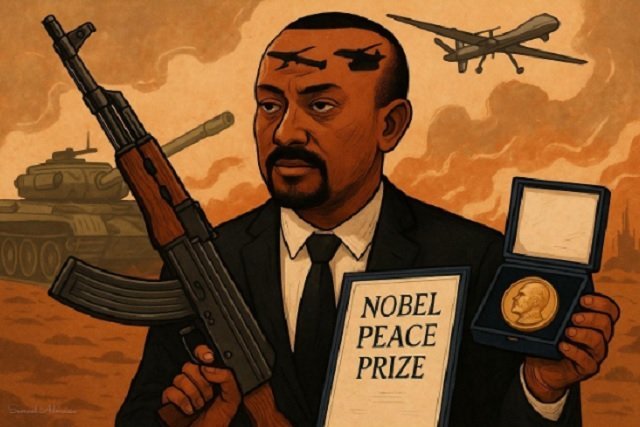
By Samuel Admassu
The Nobel Peace Prize, born from Alfred Nobel’s vision, stands as a beacon for those who advance “fraternity between nations, for the abolition or reduction of standing armies and for the holding and promotion of peace congresses”. Awarded by the Norwegian Nobel Committee, it embodies an aspiration for global harmony and peaceful resolution. Yet, the path of some laureates after receiving the honor has ignited profound debate, notably in the case of Ethiopia’s Prime Minister, Abiy Ahmed Ali.
In 2019, Abiy Ahmed was celebrated worldwide, receiving the Nobel Peace Prize for his “efforts to achieve peace and international cooperation, and in particular for his decisive initiative to resolve the border conflict with neighboring Eritrea.”
His prize recognized several key actions, including formally ending a 20-year post-war stalemate with Eritrea, which was a significant step in regional stability. Furthermore, his early tenure was marked by a wave of hope and democratic reforms, characterized by the release of political prisoners, lifting bans on opposition parties, and promoting press freedom. He also actively engaged in diplomatic efforts across the Horn of Africa, particularly in Sudan and Somalia, fostering regional cooperation.
The Nobel Committee praised him for what they saw as decisive steps towards peace and cooperation, setting a hopeful trajectory for Ethiopia and the wider region.
However, the period following his Nobel recognition has plunged Ethiopia into extensive internal conflicts and drawn sharp international criticism, making his prize increasingly controversial. This apparent contradiction—receiving the world’s highest honor for peace and then leading a country into civil war—has sparked global debate. Barely a year after the award, a brutal conflict, known as the Tigray War (2020–2022), erupted in November 2020 between Ethiopian federal forces and the Tigray People’s Liberation Front (TPLF). Abiy launched what he called a “law enforcement operation” in Tigray, which rapidly escalated into full-scale war. This conflict led to tens of thousands, possibly hundreds of thousands, of deaths, making it one of the deadliest conflicts of the 21st century. It also caused mass displacement of populations, leading to a severe humanitarian crisis, and widespread allegations of war crimes and ethnic cleansing committed by all sides, including federal forces, Eritrean troops, and regional militias, profoundly contradicting the spirit of “fraternity between nations.” Furthermore, a prolonged communications blackout and severely restricted access to journalists and humanitarian aid exacerbated suffering and hindered independent reporting.
Beyond the conflict, critics argue that after a promising start, Abiy’s government began to centralize power aggressively and crackdown on dissent. Reports from human rights organizations detail the use of heavy-handed tactics against ethnic and regional opposition, including arbitrary arrests, censorship, internet shutdowns, and mass detentions. These actions are seen by critics as a reversal of the initial democratic reforms for which he was partly recognized. The Nobel Peace Prize itself was awarded based on early reforms and a wave of optimism. However, the peace with Eritrea has, at times, remained fragile, with borders re-closing and trade normalization lagging. Some critics argue that the Eritrean peace was partly a strategic alliance against the TPLF rather than a solely peace-driven initiative. Furthermore, many commentators claim the prize was premature, awarded before long-term results could be genuinely judged, and before his commitment to peace under pressure was fully tested. Adding to the controversy, Abiy Ahmed was notably stripped of the Hessian Peace Award in 2021 (publicized in 2023). This German prize, which he also received in 2019, was formally withdrawn by its trustees. Their reasoning explicitly cited his government’s role in the escalation of violence in Tigray and a “return to an authoritarian style of government” as undermining the intentions of the award. This marked a rare and direct judgment by another peace-awarding body against a laureate’s post-award conduct.
Abiy Ahmed’s story has forced a global reckoning with several fundamental questions about peace, power, and international recognition. One such question pertains to the complexities of leadership in fragile states: Ethiopia, with its diverse ethnic groups and historical regional power struggles, exemplifies the immense challenges facing leaders in such contexts. Experts on the Horn of Africa highlight how deep-seated grievances and a contested monopoly on force can quickly escalate. Critics argue that Abiy’s approach, focusing on power consolidation and a “securitized response” rather than inclusive dialogue, exacerbated existing tensions and fueled the conflicts, rather than finding peaceful resolutions to complex internal issues. This underscores the immense moral and ethical burden of wielding power during national crises, where decisions regarding the use of force, civilian protection, and national unity versus regional autonomy carry profound consequences.
Another significant question raised is whether peace prizes should be given for intentions or outcomes. Abiy’s case, much like that of Barack Obama (2009), who also received criticism for being awarded early in his presidency, intensifies the debate on whether Nobel Prizes should recognize concrete past achievements or serve as encouragement for future behavior. The Nobel Committee’s tradition is to base decisions on achievements up to the point of the award, often with an inherent hope for a continued positive impact. However, the rapid deterioration of peace in Ethiopia has led many to question the prudence of awarding such a high honor before a sustained commitment to peace in a volatile context can be demonstrated.
Finally, the situation prompts questions about the role of the Nobel Committee in accountability. The Norwegian Nobel Committee maintains that its statutes do not permit the revocation of a prize once awarded. While they have issued rare admonitions expressing concern over the humanitarian situation and reminding Abiy of his “special responsibility” as a laureate, critics argue that the inability or refusal to officially address a laureate’s subsequent actions diminishes the award’s credibility and moral authority. This enduring stance prompts questions about Nobel’s role—is it merely historical recognition, or does it carry a continuous expectation of upholding the values it represents?
Leaders of nations grappling with civil conflicts bear an immense moral and ethical burden. They face agonizing decisions regarding the use of force, protection of civilians, and the pursuit of national unity versus regional autonomy. In Ethiopia’s conflicts, Prime Minister Abiy Ahmed’s government has been accused by human rights organizations of widespread abuses, including extrajudicial killings, civilian casualties from drone strikes, and the deliberate obstruction of humanitarian aid—actions that directly contradict international norms for protecting civilians in conflict. The decision to prioritize an “over-securitized response” and suppress dissent, rather than engage in inclusive political dialogue, places the responsibility for the human cost squarely on the leadership. This raises critical questions about the moral obligations of a Nobel Peace laureate, whose very honor implies a commitment to peaceful means and the prevention of suffering, even in the face of grave national challenges.
This perceived disconnect from immediate humanitarian and societal concerns is further illustrated by a recent incident. During a televised interview on the Ethiopian Broadcasting Corporation (EBC) on June 4, 2025, Prime Minister Abiy Ahmed recounted a recent trip to Europe, stating he was bothered by the constant sound of ambulance sirens. He noted, “I was in Europe recently. And during this stay, I noticed something amazing. There are so many ambulances here, not like here where they don’t usually wail, and it was very disturbing in Europe. When you go from one place to another, the ambulance wails. It’s not just ambulances; there are fire trucks and motorcycles, so it’s noisy. It’s noisy everywhere, and it’s very disturbing”. His companion, however, responded by emphasizing the life-saving purpose of these sirens, pointing out they are essential for assisting mothers in labor, reaching accident victims, and responding to medical emergencies like strokes and cancer. Abiy Ahmed used this anecdote to draw a parallel to his decision to allow exiled political forces to return to Ethiopia, arguing that while some might perceive the resulting political activity as disruptive or “noisy,” it ultimately served a greater purpose of national reconciliation and contribution.
However, critics have pointedly contrasted this analogy with the situation in Ethiopia. They argue that equating the sound of life-saving ambulances in a functioning healthcare system to the consequences of a brutal civil war and widespread human rights abuses reveals a troubling insensitivity to the scale and nature of the suffering in his own country. They suggest that while managing political discourse is important, it cannot be ethically compared to the urgent need for emergency medical services and the protection of civilian lives in a conflict zone, especially given the allegations of government actions contributing to that suffering.
Abiy Ahmed’s story is a stark and incredibly surprising reminder of how complex and fragile peace can be—and how quickly the global narrative around a leader can shift from a Nobel laureate to one criticized for choosing war over peaceful means. It forces us to reckon with the limits of symbolic awards in the face of real-world governance, internal power struggles, and the profound human cost of conflict. The ongoing situation in Ethiopia continues to challenge the international community to critically examine the pathways to peace and the responsibilities of those entrusted with leading nations, especially a Nobel Peace laureate.
Editor’s Note : Views in the article do not necessarily reflect the views of borkena.com
__
Subscribe : https://borkena.com/subscribe-borkena/
Join our Telegram Channel : t.me/borkena
Like borkena on Facebook
Add your business to Ethiopian Business Listing / Ethiopian Business Directory Business Listing Toronto Join the conversation. Follow us on X (Formerly Twitter) @zborkena to get the latest Ethiopian News updates regularly. Subscribe to YouTube channel To share information or for submission, send e-mail to info@borkena.com
1). ‘አንገብጋቢ ሠበር Nobel Prize News’: Abiy deserves THREE MORE Nobel Prizes!
i). Keeps Ethiopia safe from Egypt’s Dogs [TPLF/TDF (Tigray), OLF-IFLO (Oromia), Fake Fanno (Amara), EPLF-ELF (‘Eritrea’)]. [Watch: youtu.be/cD7r-c6ZHzg?t=124 ]
ii). Catapulted Ethiopia from Wheat Beggar to Africa’s #1 Wheat Producer! Egypt & its Dogs couldn’t stop GERD & Wheat! [The Stifled Good News: youtu.be/f8Ou-fTqoyw ].
iii). Gives free fully-furnished new apartments for those who have been living in squalor for ages! Never heard of G-7 Nations doing that! [Check it out: youtu.be/KJD0Tmysfyc ]
2). TPLF-TDF’s Ethnic Putschist War: The ‘TPLF-TDF’ massacred Ethiopia’s Northern Command troops stationed in Tigray [in their sleep] & started the war! Isn’t it Savagery?
3). Law Enforcement [LE] vs. Human Rights [HR]: Halting Ethnic Putschists/Anarchists [Fake Amara Fanno, OLF-IFLO, TPLF-TDF, etc.] and their abettors from terrorizing civilians is not HR violation. It is Law Enforcement & Keeping the Peace!