
By Addissu Admas
In a piece I wrote for this site last year titled “Ethiopia Needs a Confederal Arrangement” (4 July 2025), I elaborated an alternative form of federalism to replace the ethno-federalist model in force today in Ethiopia. I will not repeat here the reasons I provided there for why Ethiopia needs such a kind of federalism, but I will add more reasons why ethnic federalism, as implemented in Ethiopia, not only has not worked as it was hoped it would, but has most probably contributed to the current state of affairs in the country. If Ethiopians desire to become one sovereign, democratic, and stable country, I firmly believe that she need to adopt a confederal form of state.
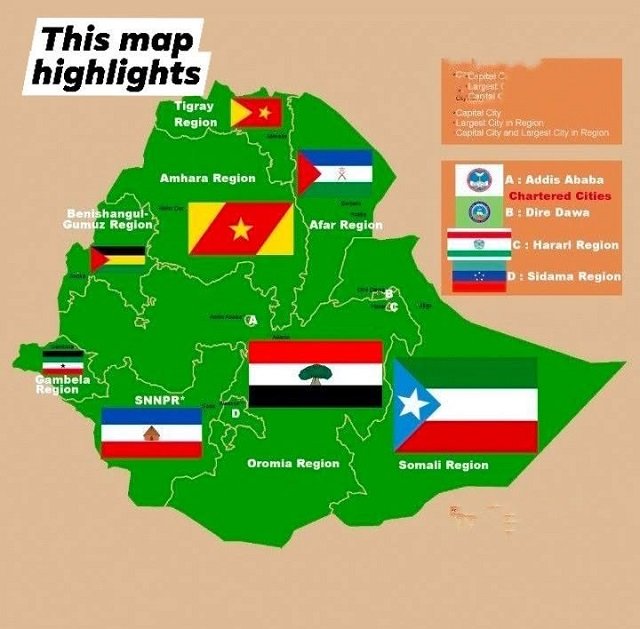
Ethno-federalism, for all its great promises on paper, has turned out to be more problematic and fraught with complications and difficulties. In essence, it has basically amounted to dividing up the country into smaller countries and finding ways to glue them together to form some kind of state. First, the components, the so-called “nations, nationalities, peoples…”, are not of comparable area or population. Furthermore, they differ vastly in resources. Take, for example, the differences between the Oromia and Harari regions. How could one consider them legally equal and comparable for all practical purposes? Their contributions, in terms of resources, whether human or material, could never be comparable in any meaningful way.
Secondly, the way ethno-federalism has been designed and implemented in Ethiopia appears to be more a preparatory stage for the eventual separation of its component regions into separate and independent countries than a means of strengthening their ties to the centre. This appears to align far better with the final goals of the TPLF, OLA, and the armed liberation parties active in Ethiopia than with the objectives of the other non-ethnic-based political parties. What we see are constantly diverging pulls that threaten to undo the Ethiopian state.
Thirdly, Ethiopia’s ethno-federalism, at least on paper, was intended to thwart all authoritarian and centralising tendencies of the central government for the benefit of the regions. We have not seen the realisation of this objective in any meaningful way. What we have seen instead during the EPRDF’s 27-year rule is more the continuation of the autocratic and centralising rule that has always characterised our country. Rather than terminating autocratic rule, our version of ethno-federalism appears only to have extended its life.
Ethno-federalism was presumed to be a more logical compromise between administrative federalism, like the kind adopted in many countries, and the unitary state at the opposite end. In Ethiopia’s case, it has turned out that it has neither fulfilled federalist objectives nor met the basic mandates of a unitary state. If Ethiopia is to become one, united, and democratic country, continuing with either ethno-federalism or reverting to the old unitary state system will not only fail to achieve our most hoped for goals, but could very well lead to the country’s disintegration. As I previously proposed, a better alternative for fulfilling the aspirations of self-determination while maintaining Ethiopia’s unity would most likely come through the adoption of a confederal arrangement.
What I mean by a confederal arrangement is a form of federalism that, while it takes into consideration the distinctive characteristics of each ethnic enclave, does not aim to make an autonomous or self-determining body out of it. Rather, while it respects ethnic, linguistic, cultural, and religious distinctiveness and the freedom to preserve it, it superimposes upon its administrative subdivision that ultimately preserve and solidify the whole confederal arrangement. It does so first by preventing and discouraging the tendencies of ethnic enclaves to form separate statehoods. Secondly, by creating a direct relationship between the confederal subdivisions and the centre, it allows more effective representation of the constituent subdivisions.
A good example of such an arrangement has emerged from an unlikely quarter: the recent division of Oromia into six regional clusters, each formed out of two, three, or four zones. It was approved by the Oromia Regional Council (Caffee Oromiyaa), but most likely initiated by the government of Abiy Ahmed. The officially stated reasons for such subdivisions of Oromia, though perfectly plausible, may not be the true ones. However, since this is not an analysis of the Prime Minister’s or the Oromia Council’s presumed hidden reasons, I will refer only to the stated reasons and their possible consequences.
The stated reasons for dividing Oromia into six administrative clusters were, among others, to streamline administrative processes, reduce duplication of government structures, improve service delivery, strengthen coordination among zones, etc. There is no question, of course, that this division may not fulfil its intended goals. However, it could also bring forth several unstated advantages to the federal government. In fact, the contention has been that it was done more for the unstated reasons than for the stated ones. No point debating that here!
It is not my intention to speculate here on what advantages the government of Abiy Ahmed will derive from the division of Oromia into clusters. What I want to propose is that this kind of subdivision be applied to all the other regions, with one important additional proviso. That is, instead of the regions remaining the units of the federal government, as in the case of Oromia, the clusters themselves must be turned into the component units of the federal arrangement. In other words, they would have the status and function of the current Killils, replacing them for good.
The benefits of such an arrangement are several and significant. First, it would greatly discourage the constant irredentist tendencies that are always beneath the surface and threaten to undo the very federal arrangement. Furthermore, each cluster, as in Oromia’s case, would have a distinctive linguistic, cultural, or religious heritage that it would want to preserve and not sacrifice for some perceived general benefit or objective of the larger Killil. In fact, this kind of subdivision provides subgroups with a greater opportunity to fulfil the promises of self-determination than remaining part of a larger Killil.
Secondly, as mentioned above, what Ethiopia’s ethno-federalism has completely overlooked is the absence of any semblance of proportionality among its regions. If the regions, especially the larger ones, are maintained as the component administrative units of the state, not only will they possess a disproportionate quantity of resources, but they will also hold exponentially greater power to determine the direction of the country in ways that may be detrimental to the smaller regions. In other words, there cannot be any genuinely democratic relationship among the regions, but rather one of subordination. That means, in essence, that smaller regions will always be at the mercy of the larger ones.
I do not believe that Ethiopia’s ethnic groups, especially the larger ones, need to be gathered into single regions for them to acquire the benefits of self-determination. They can enjoy all these benefits even if they are subdivided into smaller units, provided that the guiding principle of self-determination is codified in the Constitution.
Thirdly, and most importantly, in the case of Ethiopia, there are dozens of smaller ethnic groups that would fare much better if they were placed within smaller administrative units instead of larger ones. Their presence would not only be magnified, but their voices would also be heard more clearly. In essence, they would acquire more effective representation and participation in the political life of the country.
Finally, when sovereignty is embedded in ever-smaller units, the result is that power rises from the bottom up rather than from the top down. Throughout Ethiopia’s history, power has always been held de facto by one person and has devolved from the centre to the periphery. Even though our ethno-federalist system’s main aim was to permanently do away with centralised power, it has not only failed to succeed in doing so but has also found new ways of maintaining it. When regional presidents act as heads of state, it becomes almost inevitable that the head of the federal government becomes a power broker.
The reasons given by the governing party or by the Caffee Oromiyaa for the subdivision of the Oromia Killil into six clusters are perfectly legitimate and reasonable. They can serve as a model for the rest of the country. However, unlike the Oromia Council’s determination that these clusters be merely subdivisions headed by vice-presidents, a confederal arrangement, as indicated above, would consider them autonomous confederal components headed by their own presidents, or whatever term one may wish to adopt.
The subdivision into clusters in Oromia could be a model for the rest of Ethiopia because it represents a good middle way between the zones, which are too small and too numerous to become the component units of a confederal system, and the regions or Killils, which can be too large, unwieldy, and diverse in many respects. Also, dividing the country at the zone level could be administratively onerous and complicated given Ethiopia’s resources. More manageable representation at the federal level could be achieved at the cluster level (or whatever name one chooses to give it), where a few zones, while maintaining their existing configurations, are grouped together to form a distinct administrative and autonomous unit. This unit could appropriately be called an awrajja.
If the country is reconfigured along the cluster model that Oromia has ushered in, with the proviso that each cluster acquires the legal status of a region (Killil), then, besides the benefit of proportionality discussed above, the dispute over further Killil creation would become moot. The clusters themselves, whatever name they may ultimately bear, would obviate the demand for smaller ethnicities to have their own Killils.
If Ethiopians are truly committed to becoming a united, democratic, and economically growing country, the way forward must be a federal system designed not for the eventual or possible separation of its component units, but rather one intended and structured to make continued unity desirable and necessary for as long as possible while providing the greatest possible autonomy, sovereignty, and stability.
Editor’s Note: Views in the article do not necessarily reflect the views of borkena.com
__
Join our Telegram Channel: t.me/borkena
Like borkena on Facebook
To submit a press release, send the submission to info@borkena.com
Add your business to Ethiopian Business Listing / Ethiopian Business Directory
Join the conversation. Follow us on X (formerly Twitter) @zborkena to get the latest Ethiopian news updates regularly.