. Read.)
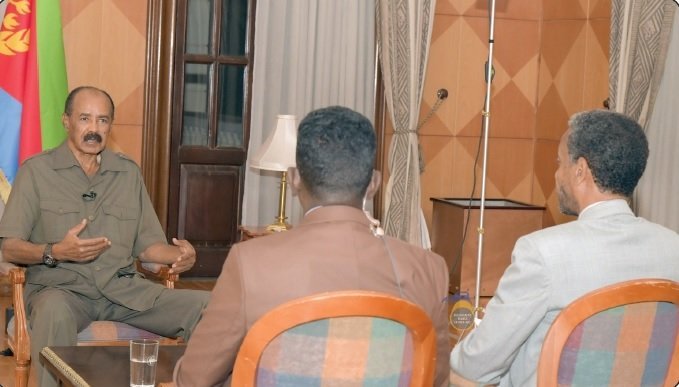
Tigrigna to Arabic translation by Mahmoud Abdullah (Abu Kifah)
Q: Mr. President, in your previous interviews you explained in detail the current global and regional situation and its background. Therefore, our questions today will be directed briefly to its current developments. We will begin with the global situation and then move to regional and local issues. Current global events—accompanied by coups, instability, sensitive behaviors, and unclear trends—highlight the transitional phase of global governance. Although the full picture is still unclear, what are the implications of this for Africa and the region?
President Isaias: If we want to talk about the future on a global scale and understand the current situation, we must understand where we started. The Cold War had its defining characteristics and ended in the early 1990s with the collapse of the Soviet Union. Then the concept of a unipolar world emerged. Who put it forward? And how did it reach this state? This idea has a long history. What did Fukuyama say at the beginning? And what did Huntington say? Much can be said regarding the current situation. Thirty years have passed. What has the doctrine of creating a unipolar world—where the world must remain under their control and where there must be no power to compete with them economically, technologically, or militarily—led to? Did it bring peace, stability, justice, and growth? What are the consequences of this philosophy?
In our assessment, the first thing we must look at is the situation in the United States. The global impact of the situation in the United States is not insignificant, without exaggeration. So, what are we witnessing in the United States? What might we witness in the coming few years? What is the driving force behind what we saw during President Donald Trump’s first term and the behavior we are seeing now? As for the United States’ standing globally, the strength of the American system has been weakening and deteriorating over the past thirty years. We can talk about how this decline occurred gradually, beginning with the Clinton era. How was the United States’ economic, technological, and military power then? What is its situation now? How was U.S. influence and acceptance around the world? And what about now?
[Part two Thursday 01/16/2026 – thirty-fifth year – Issue (79)]
We have witnessed the decline of the United States over the past thirty years, since it sought to establish a unipolar global order. Economically alone, the United States currently owes more than 36 trillion dollars. But it is not only about measuring debt. Does the United States truly possess economic power? Comparing the past with the present, U.S. economic power is declining for many reasons. The same applies to what is called military power or influence, as well as technological superiority, which is no longer what it once was.
Trump’s arrival carrying the slogan “Make America Great Again” reflects a line of thinking that says: “America is not great or strong, so I will make it strong; I will make it great again.” It is good that Trump recognizes the reality. This belief cannot be considered the opinion of one person alone; rather, it represents the thinking of what are called influential people in the United States. But what might this slogan achieve for the United States? What is its potential impact globally? What actions can Trump take based on this belief? Are the steps he is taking right or wrong? Will they bear fruit or not? Many questions may arise.
If we ask what Trump did during his first term starting in 2016, those four years were wasted. Then Biden came and undermined the plans and programs that had been initiated. One year of this second term has already passed, with only three years remaining. What steps can he take to make America great during these three years?
Let us take, for example, the measures taken in Venezuela. What impact can this step have on Venezuela or Latin America, as well as globally? The declared reason was drug trafficking. Now, after the abduction of Maduro, the issue has almost faded. But this issue will not end in Venezuela; other countries have been granted years of waiting: Greenland, Canada, Mexico, Cuba, Colombia, and Panama are all at stake. Measures are already being taken in Cuba similar to what happened in Venezuela. And if we move closer to home, we find Iran. So, assuming that the United States may take military action under the principle of “Make America Great Again,” what would be the consequences?
If we take Greenland as an example, what would be the impact on Denmark and Europe? How would this affect NATO? What would the global situation look like if these issues continue? They raise many questions. Tomorrow, perhaps, what might Iran’s defeat bring to our region? Whatever the label, it is difficult to imagine the consequences of military action.
The measures taken to make America strong or great are not limited to these steps alone; there are other steps: tariffs, aggressive behavior, attempts to impose will and bully, withdrawal from international organizations, and presenting itself as a mediator in Ukraine, the Congo, Azerbaijan and Armenia, and Thailand with Cambodia. Do these measures really aim to make America great? What is the ultimate objective?
The results of these measures indicate that the primary objective is to possess or control natural resources. Venezuela’s wealth is not limited to oil alone; its natural minerals are inexhaustible, as is the case in Latin America and the Congo. The driving force behind the policies of “Make America Great Again” is these natural resources. And with the decline of U.S. economic power globally, measures are taken to control resources in order to bolster it.
When such measures are taken in different regions or countries, there are likely to be reactions in every country or region. Many of the measures we have seen so far have been sensitive. Are they pursuit? Control or intimidation? Were these measures well thought out? It is unclear whether this situation will continue or whether it will be used as a temporary pretext.
If we return to this point, we find the issues of Gaza, Somalia, Sudan, and Ethiopia, and the issue of oil-rich neighbors on the Red Sea. How do the policies of “Make America Great Again” view these issues? To understand the equation correctly, it is necessary to measure the behavior, objectives, and actions of every power, as well as to consider the actions of others.
Finally, if we want to talk about global governance, the world must live in fair and equitable relations, moving beyond Cold War concepts and what is called the “one-city world.” The desire of the peoples of the world is to live in peace and dignity, in justice and mutual respect and cooperation. If a new global order is to emerge, this foundation must be laid; otherwise, the world will not enjoy peace.
We are in a critical transitional phase. Will this phase lead us to the right path, or will it further complicate matters? It is not limited to the position of the United States; it also includes the roles of China, Russia, India, Japan, Korea, Pakistan, Malaysia, and others. The situation in Europe is also worrying; the NATO crisis continues, as does the weakness of the European Union’s effective influence.
In Africa, despite possessing vast resources, its participation in these global developments is limited due to weak existing structures. As for our region—the Horn of Africa, the Red Sea, the Arabian Gulf, and East Africa—despite its developmental distance, its geostrategic importance makes it strongly affected by global developments.
With all this in mind, our issues must be assessed over the next three years, with a focus on development, stability, and peace, monitoring the impact of global developments on us and on our neighborhood, without being drawn into media noise, and with a balanced view that includes all international powers.
Finally, China and Russia are major targets within the doctrine of “Make America Great Again,” as are Europe and NATO allies. Policies on tariffs, taxes, and immigration are aimed primarily at internal regulation and addressing what the U.S. administration considers factors of weakness.
Part Three (final)
Saturday, 17/01/2026 thirty-fifth year – Issue (80)
Q: Your Excellency the President, as you mentioned earlier the importance of regional issues, let us turn toward our region, where the greatest challenge facing our region is the situation in Sudan, which is heading toward the worst due to foreign interventions. In the recent past, the UN Security Council warned that if Sudan’s situation does not find a quick solution, it could spill over into other countries. What contribution can the American initiative known as “Make America Great Again,” together with Saudi Arabia, Egypt, and the UAE, make to end this war? How has the initiative taken earlier by neighboring countries continued? How does the bilateral consultation conducted by Eritrea with regional countries look in light of the situation in Sudan? In brief, where are things heading in Sudan?
President Isaias It is important to view Sudan’s situation now within its historical context by looking back. The stability, peace, development, and growth of Sudan have not been easy matters. If we look at the situation not only at the bilateral level, but also at the general, regional, and neighborhood levels, the matter is not simple. We can see this by going back in time: how change came to Sudan yesterday, when the National Congress Party seized power in 1989 through a coup. We can begin the discussion from 1983 during the Nimeiri era, and we can even talk about what preceded that. We can say that events had been evolving since 1956.
The National Congress Party regime, through its orientations, had a direct relationship with Eritrea and the Eritrean people, and its strategic orientations were not easy, especially after independence. Relations became tense to the point of severing diplomatic ties. The Sudanese people endured and endured, and more than thirty years passed. In the end, the National Congress Party regime was removed through open popular demonstrations, without a coup by any political force or army. The people said, “Enough,” and they had the right to do so. They endured and finally removed the regime. We take this as a positive development, as a positive evolution appeared in Sudan, but the positivity was not limited to that alone.
When the National Congress Party regime ordered the army—specifically the security forces—to kill demonstrators, the army refused the orders and sided with the Sudanese people. There is no need to go into the details of what happened then, but the army performed its duty, and there was no other responsibility beyond this for the army as a sovereign institution of independent Sudan.
Accepting the people’s choice, rejecting orders for suppression, and standing with the Sudanese people placed Sudan in general into a transitional phase and a modern historical moment. When Sudan entered the transitional phase, what was established? A “temporary transitional council” from the army was established.
What does “temporary transitional” or “temporary transitional council” mean? It means that the authority it administers is a trust. Call it whatever you want or give it any name; in the end, the Sudanese people who endured and removed the regime through popular demonstrations must obtain a system that represents them. How does such a system come about? Until that system comes, the army has borne the trust and assumed power temporarily.
When this happened initially, a positive development appeared—not from our perspective, but from an objective perspective for our region. This positive development must reach its intended goal. The Sudanese people, after all this injustice, must move forward and end the transitional phase. Based on experience from our past experiences, we must build a direct partnership without waiting for others. If we want to build a partnership, we must read the situation, understand its trajectory, present our own ideas, and consult in the end.
We said we need cooperation, and we will implement it. We set a partnership policy and began working with the transitional council that was formed—not through words only, but in writing. We began the partnership in the years 2021 and 2022, and we presented our vision, which was not a vision exclusive to us alone. We explained our reading of the realistic situation in Sudan and the type of partnership that would arise between us and how it would be conducted, and we reached a collective understanding with them.
The transitional council should continue for at least two years and at most three years, and then hand over power to the Sudanese people. This is our vision and the understanding between us and them. By what method power is handed over cannot be specified by saying this or that. A document must be prepared clarifying that the Sudanese people removed the previous regime and are demanding the establishment of a government that represents them. What type of government do these people need? How is it designed? How is it skillfully structured? And finally, how is it ratified?
Ultimately, the policies, political forces, organizations, and various phases that came after 1956 brought Sudan to this level of destruction.
The destruction caused by the National Congress Party in Sudan during its thirty years of rule is not small. Moreover, the problems it created in the region are difficult to contain, especially the policies it followed after 2011, which affected not only Sudan but also had a significant impact on neighboring countries.
Therefore, the stability, peace, and development of Sudan are of direct importance not only to us but also to all neighboring countries. This transitional period must proceed as it should, peacefully. Frankly, there was no one saying “this for me and that for you,” and no one denied this objective reading. Accordingly, the army assumed responsibility as part of its duties and began the journey. While the journey was progressing, foreign intervention occurred. Here we can ask: for what reason did this foreign intervention come? It is viewed within the context of conspiracies being carried out with some actors in this environment.
Sudan entered into turmoil. If Sudan is plunged into instability or controlled, it inevitably affects Egypt, Libya, Chad, the Central African Republic, South Sudan, Ethiopia, Eritrea, and the Red Sea. This brings effects that are difficult to contain. We say that this is being done through the agency of the UAE. But in general, what is happening in Sudan is not a war between the army and civilians, nor is it a civil war. There has not been a civil war in Sudan, and even today there is no such war. If one says there were divisions within the army, on what issues did the division occur, and why did they not reach an understanding? This is not a conflict among generals. These generals and the entire army remained a sovereign institution for Sudan, moving forward while bearing a temporary responsibility, and there was no reason for them to compete for power.
Editor’s Note : Views in the article do not necessarily reflect the views of borkena.com
__
Support Borkena : https://borkena.com/subscribe-borkena/
Join our Telegram Channel : t.me/borkena
Like borkena on Facebook
Borkena Ethiopian News Youtube Channel
To submit Press Release, send submission to info@borkena.com
Add your business to Ethiopian Business Listing / Ethiopian Business Directory
Join the conversation. Follow us on X (Formerly Twitter) @zborkena to get the latest Ethiopian News updates regularly.