
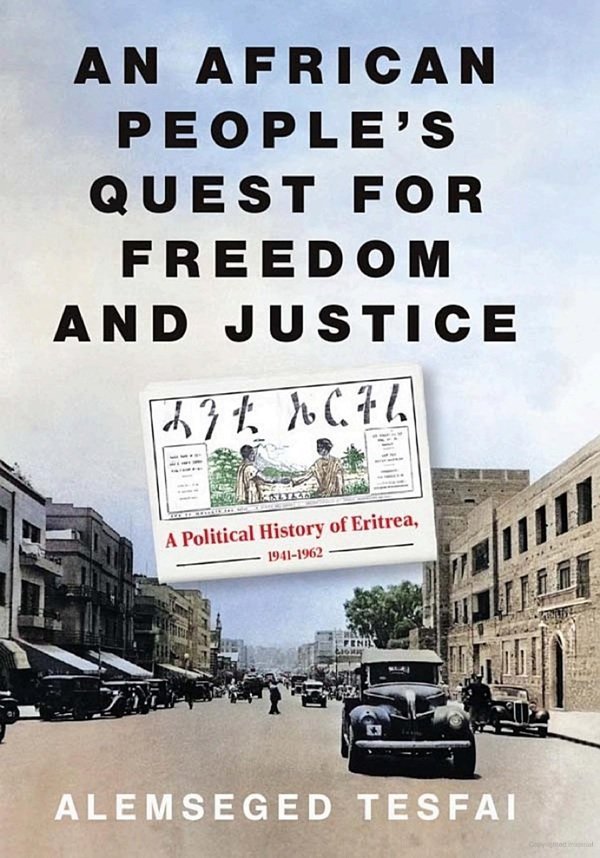
A Book Review
Title: An African people’s Quest For Freedom And Justice
Pages: 509
Author: Alemseged Tesfai
Publisher: Hurst & Company
Year Published: 2025
By Solomon Gebreselassie
July 2025
This book is written with clarity, and the flow of ideas and the organization are superb. It has 25 chapters, over 1,340 footnotes and about 75 photos showing that it is a well-researched book. We will divide this book review into 8 parts and flesh out the main thrust of the book’s theses occasionally accompanied by our comments.
The subject of this book, Eritrea, was under Italian colonialism from 1890-1940 for 50 years, where in 1890, the Italian Parliament gave the land the name Eritrea. This was followed by the British Administration of Eritrea from 1942-1952. It was under a Federal arrangement 1952-1962. The Federation was abrogated in 1962 and Eritrea was annexed to Ethiopia that same year(ባገር ፍቅር ጉዞ ቅጽ 1፣ 2018፣ በአቢዩ ብርሌ፣ ገጽ 676-678).
Alemseged starts with the last days of Italian colonialism leading to the British Administration and then the start and end of the Federation- 1941-1962.
- SOURCES
“The past resembles the future more than one drop of water another”. Ibn Khaldun, a Middle Ages Tunisian Historian whose image is on their 10 dinar note.
Of all his sources, the primary sources are the most admirable and include archives, manuscripts, newspapers, individual files and interviews. Of the archives and manuscripts, the following are notable: Institute of Ethiopian Studies, Research & Documentation Center at Asmera, Government of Eritra documents, Documents of the British Administration in Eritrea, documents of the Imperial Government of Ethiopia, the Foreign Office of the UK, US Government documents- that of the State Department, DOJ and NSC, and ELF collections.
With regard to archives, there is one curious hurdle that the author faced at the British Foreign Office (FO). He says, “ in the FO dossier that documents Stafford’s (a British colonial officer) disclosure about his mission to dismantle the Independent Bloc, there is a blank file- FO 371 180876 673 66, JT 1015/165. Written on a blank page are the words “following document(s) retained in the Department of origin under Section 3(4) of the Public Records Act of 1958”. The decision to impound it was made in March 1980”(p.143). Wondering “what could be so sensitive to warrant such impound”, the author solicited the help of Martin Plaut and Michela Wrong, two experts on the region, to help decipher the mystery using their connections at the FO. They were not successful. According to the author, they were told that the document would be permanently impounded with no release date (p.448). It leaves readers in a suspense as to the contents of the classified document.
Another primary source, as indicated is personal interviews. Obviously, these are not as reliable as documents, especially as most, or all, of the interviewees are in old age -the vagaries of health and memory, and personal agendas might color their stories, and I believe this has to be factored in.
- DEBATING MULTIPLE POINTS OF VIEW
“The strong do what they can and the weak suffer what they must”-Thucydides, an Athenian historian during the Athens-Sparta war in the 5th Century B.C.
The author deals with the period 1941-1962. 1941 was the year in which Italy lost its East African colonies and 1962 was the year in which Eritrea was annexed (united) with Ethiopia. The author shows us that in those 21 years, Eritreans, Ethiopians, Italians, the British, the US and the UN were the significant political players. As regards to Eritrea’s connection to Ethiopia in history, the author says “…there is no question that, especially since the mid-18th century, historical contacts of varying degrees and frequency existed between the two populations-closer and more frequent in the proximate kebessa also known as Mereb Mellash; intermittent in the Bogos-Habab areas of the north; and virtually non-existent (except for raids and invasions) in the western lowlands”(p.3).
As is well known, there is another point of view on the question of the connection of Eritrea with Ethiopia. According to this view, the Mereb Mellash area (most of today’s Eritrea) was under the Axumite Empire and after the breakup of this Empire, the relation continued with ebbs and flows.
Flowing from these positions, in the 21 years beginning in 1941, the author narrates the political parties that coalesced around the narrations, such as the Moslem League and the Unionist Party, the Liberal Progressive Party, and their mutations and permutations and the swapping of party membership. As one of the players, the Ethiopian Government had a close relationship with the Unionist Party and later with its youth league Andnet, which itself metamorphosized into contrarian components. The Italians, as major players, had a political party called Pro-Italy party and that allied with the Independence Bloc (which included at its height the Moslem League, the LPP and Pro-Italy). The Independence Bloc itself had a youth league called Shuban that was contesting its counterpart Andnet. Just as the 5-power commission for Eritrea arrived in Asmera in February 1950, the two youth leagues engaged in a mortal fight where hundreds died and got injured. The author gives us examples of Independent Bloc victims killed by unionist activists, such as Abdel kadir Kabire (metahit) and Azmach Berhe G/Kidan of Seraye.
The author shows how the Unionist Party overplayed its hands and, more often than not, failed to listen to its moderate voices. A case in point was one Gebremeskel Weldu who pleaded with the senior leadership to moderate its tones and actions and got demoted instead. The author concludes that Gebremeskel was “one of the earliest of a long list of Ethiopia loving Eritreans to be thrown to the side once his usefulness had come to an end”(p.98). Similarly, as the UP hardened its position, or perhaps due to religious schism, UP’s section in Massawa split and formed “Independent Moslem Party for Union of Eritrea with Ethiopia”.
The British both during their colonial rule and long after that insisted on a policy of dividing Eritrea and handing over the western part (largely Moslem and pastoralist) to Sudan and the kebessa and Denkalia to unite with Ethiopia. Prior to the 1950 fights, in the 1940s, there were sporadic flare-ups of violence which the author attributes to unionists who used their Ethiopian connection to stir up trouble (p.73).
One debatable conclusion by the author (and based on an oral interview) is that cleavage in Eritrea in this period was limited to political and not religious, Moslem versus Christian differences (p.154). Perhaps belying the above was the statesmanship shown by Ibrahim Sultan, one of the luminaries of the Eritrean struggle. At the 1950 convention of the Independent Bloc, when the convention deadlocked to elect a party president, he suggested for the two religions to exchange leadership annually (p.136). Although he was the leader of the largest party in the bloc, the Moslem League, he forwarded a progressive suggestion for a political problem that still haunts fronts and political parties to this day.
The debate among Eritreans was not only left to them, as the disposal of Eritrea was the paramount issue, the 4-power commission and later the US and the UN attempted to understand the people’s preferences and tastes. After extensive hearings, the author tells us the 4-power commission in 1947 estimated people’s party choices as follows: UP-44.8%; ML-40.5%; LLP-4.4%; and Pro-Italy-9.2% (p.106).
In May 1947, the foreign ministers of Italy and Britain announced a plan for the disposal of Eritrea- the western part(metahit) going to Sudan and the rest uniting with Ethiopia, with Asmera and Massawa under a UN-sponsored special status (p.122). On May 13, the partition of Eritrea was approved by majority vote at the General Assembly, but in the second round of votes, when the whole package of Italian colonies was defeated, the vote on Eritrea was null and void.
Finally, the commission for Eritrea was established on November 12,1949 delegating Pakistan, Guatemala, Burma, South Africa and Norway to go to Eritrea where they arrived in February 1950 with a mandate to report back their findings with their recommendations (p.145). ‘The commission carried out its inquiry over 51 days. It visited 37 centers, met with representatives of 64 different sections of the population (p.149).
After the commission returned, the UN General Assembly adopted a Resolution 390-A(V) that stated “Eritrea was to constitute an autonomous unit federated with Ethiopia under the sovereignty of the Crown”. On December 2, 1950, a vote was taken and the results were 46-yes; 10-no, and 4-abstentions. The Federation was due to start in September 1952(p.162).
In the front cover blurb, Alemseged curiously states that “….in the early 1950s, the UN General Assembly federated Eritrea as an autonomous unit under Ethiopian sovereignty; a decade later, Addis Abeba annexed it as a province- in neither case was the population consulted, sparking a civil war”. While the case of annexation may be supported by evidence, it is perplexing how Alemseged can refute the evidence he himself amply presented about the numerous consultation of the Eritrean people, directly and through their political representatives.
On 9 February 1951, the Bolivian Ambassador to the UN, Eduardo Anze Matienzo arrived in Eritrea to implement the federation by drafting and ratifying a constitution and supervising elections with the outgoing administrative authority (p.165).
The drafting and ratification of the Eritrean constitution and the agreement on the Eritrean flag (blue cloth adorned with green olive branches in the middle), and the election of the Eritrean Assembly of 34 Moslems and 34 Christians[notice the balancing act] were arguably exciting moments in Eritrea’s path to autonomy. However, following these positive developments, literally everything was contested between the two parties. Villa allocation, road, post, customs authority, positions, the hoisting of the Ethiopian flag, the Federal Act creating the Imperial Federal Council, the Federal High Court, etc. were all contested and variously interpreted. The Eritrean side felt aggrieved and often in vain complained to the Emperor’s representatives Andargatchew Messay and later to his successor, Abiy Abebe.
Federalism presupposes the practice of democracy, power demarcation, and a strong legal system to adjudicate differences. Neither party was equipped with that. The second iteration of the Ethiopian federal system first implemented by Meles in 1995 and continued by Abiy knows neither democracy nor separation of powers. In addition to complaints to Federal authorities, Eritreans engaged in demonstrations, strikes, appeals to the UN as the arranger of the system, all to no avail.
The Chief Executives, first Tedla Bairu, and after his ouster in1955, Asfha Woldemichael, were caught between a rock and a hard place (more on them later).
The Eritrean Assembly, although characterized by the author as mostly illiterates and local chieftains, had lively moments where it hotly debated issues on issues such as election of a Chief Executive, to force the resignation of a vice president, to appoint his replacement, to debate the Eritrean Labor Law, and to approve the budget.
Separation of powers between the Chief Executive of the Assembly and the Eritrean Supreme Court was a thorny issue. Issues such as who was responsible for establishing an electoral commission and whether the Chief Executive can increase the justices number generated a bitter fight.
The author shows us the Eritrean Assembly in its later days lost its color; its noisy exchanges; absenteeism was common, and motion adoption by acclamation instead of vote counting started. Such was the case when the Eritrean flag was changed to the Ethiopian tri-color on December 24, 1958. In the third and final legislation election in September 1960, only 6 of the original independent bloc members took their seats out of the 68 seats.
Suppression of civil dissent led to the formation of the Eritrean Liberation Movement in Sudan on 2 November 1958.
Aklilu Habtewold, to his credit, opposed every step of the attempt to make the Eritrean Federation extinct. Knowing Aklilu would oppose the idea of annexation, the Emperor excluded him and his cabinet from a fateful meeting and met instead with only Abiy Abebe and an ardent unionist later Axum Nibure Id by the name of Dimetros. The Emperor gave his permission for the abolition of the Federation on November 13, 1962.
Asfha, after a brief speech introduced the motion to nullify the Federation and merge with Ethiopia. No votes were taken. Applause and acclamation followed by a party at the Asmera Palace concluded the day.
The author tells us that regrettably there was no objection from the UN or the 4 powers. Only Eritrean MPs in Ethiopia’s Parliament raised their voices in objection. In 1965, Hareka sent a small armed group into metahit that was quickly disbanded by ELF, (p.373) which took over the mantle of armed struggle from here on.
3. THE ERITREAN NEWSPAPERS
“The philosophy of one generation is the literature of the next”. Will Durant, an American philosopher
Under 50 years of Italian occupation, the Eritrean people were mostly limited to an educational level of grade 4. Under 10 years of British rule, this showed a marked improvement which was even much better when the Federation took effect. During the first year of the Federation, according to the report given by the Chief Executive, the total number of Eritrean students had risen to 14,974, of whom 3,590 were girls, an increase of approximately 1500 students from what the British had registered. There were 456 teachers in government schools alone (p.459, footnote 18).
Eritrean newspapers were as expected allied with institutions such as political parties and religions as the following breakdown shows:
- Hanti Ertra (depicted on the front cover underneath the book’s title) – the Independent Bloc’s newspaper, with Woldeab Woldemariam as the first editor, printed the first issue on 28 January 1950(p.135). It generally editorialized and attacked the Unionist Party and the Eritrean Orthodox Church which had blessed Italy’s invasion of Ethiopia. It also riled against the British Administration’s keen desire to partition Eritrea and warned the UN about the dangers of the Eritrean Federal status. It had an Arabic section called Wehdet Eretria and its own weekly, Sau al Eretria (p.153). It was replaced in early 1952 by Dehai Ertra (Voice of Eritrea) after the Independent Bloc transformed itself to the Eritrean Democratic Front (EDF) in preparation for the Federation (p.214).
- Dehai Ertra- The first editors were Mohammed Saleh Mahmud and Elias Teklu, both polemicists and fearless critics who were charged of crimes in March1953 and the paper was closed down. Dehai contested all the flagrant violations of the Federal Act, but at times went too far invoking ethnic slurs like ሸዋና ምስጥ ወደ ዉስጥ። (p.228). A year later its editors were pardoned and the paper was back in circulation.
- Ethiopia: On 4 January, 1947, the first issue of the unionist party newspaper, Ethiopia, was published. The first Chief Executive Tedla Bairu, a Protestant Evangelist edited the first 14 editions, followed by Gebremichael Gurmu (p.93). During the British Administration, the Unionist Party leader and the editor of Ethiopia, GMG, were charged for inciting violence and their sentences commuted to suspended sentences (p.112). Ethiopia mainly dealt with unionist issues, went tete- a -tete with the above Independent Bloc newspapers so much so at times, shimagelles had to bring the editors of the various papers together to steer them towards a civil dialogue(p.188).
- Nai Ertra Semunawi Gazeta (ESG)– ESG was a weekly launched during the British Adminstration in 1943 and the first editor was Woldeab Woldemariam. The paper initially focused on the British project of Tigrai-Tigrigni. Later, it turned to the familiar debates of Eritrea’s future and leadership punctuated by the numerous articles Woldeab wrote on the subject. It was bequeathed to Zemen, the Eritrean Government’s official newspaper.
- Zemen- Although the Unionist Party’s paper Ethiopia seemed to speak on behalf of both the Ethiopian and Eritrean Governments behalf, Zemen at times played an independent role (p.234, 258, 275). However, at critical times when the editors felt foreign interference was endangering Eritrea’s future, the paper aligned with the UP line. After annexation, it was renamed Hibret.
- There were also papers belonging to churches- Finote Berhan of the Eritrean Orthdox Church and Veritas et Vita of the Catholic church. Also, Italian leftists distributed a newspaper called La Carroccio during the colonial time for a limited time, and after the British take over, the mainland Italian Communist Party’s paper L’Unita printed a few issues before it was sold off to the Independent Bloc’s above-mentioned papers. The British Administration may have had Eritrean Daiy News in 1943(p.18).
While educated Eritreans debated and learned about political issues through these papers, decades earlier their counterparts in Ethiopia, the educated class was reading Afework Gebreyesus’ first novel Tobia, and a year later Hakim Workneh’s “Geography of the World” and Negadras Gebrehiwot Baykedagn’s mengistna astedader. This is on top of the daily and weekly papers urbane Ethiopians were exposed to beginning with the weekly Aemro, a paper that was started in 1906 during the late years of Emperor Menelik. So, as quoted by the author himself, Professor Tekeste Negash had it right, when he is quoted to have said, “Eritrean claims to a democratic past and to a more advanced political institution than Ethiopia were a distortion of dangerous magnitude” (p.358).
The two peoples are intertwined by geography, history and fate, and for one community to outdo the other is a futile exercise.
4-THE ROLE OF WOMEN
“I am not free while any woman is unfree even when her shackles are very different from my own”. Audre Lorde, a Black American woman poet
The role and story of Eritrean women came of age during the long armed struggle. However, in prior years just as in Ethiopia, patriarchy ruled supreme. In preparation for the Federation, Proclamation 121/1952 was issued regulating the first ever Eritrean elections to convene a representative assembly (which later transformed itself into a legislative assembly). With the exception of Asmera and Massawa, the British ruled out election by direct ballot on the grounds of time constraint and the nomadic lifestyle of the people p.184). Instead, a constituency based electoral college would represent the populace.
Candidacy was open only to Eritrean male citizens over 30 years of age and women were excluded from voting as well. Voting was reserved for male citizens over 21 years of age. Neither the British nor the political parties objected to the exclusion of women from candidacy and from voting (p.185). As far as the British were concerned, even women in Britain got the full right to vote 24 years earlier so with the colonial mentality, the need to empower Eritrean women was starkly absent. As to the silence of the usually noisy Eritrean political parties, again, religion and patriarchy may be to blame.
In 1957, five years after the Representative Assembly Election, the Ethiopian Government announced its schedule for national elections to its Chamber of Deputies. Eritrean representation was raised from 5 to 13. Unlike the Eritrean elections of prior years, these were to be conducted by universal suffrage and allowed women to vote and stand for election (this was two years after the 1955 Ethiopian Constitution which gave for the first time that right to Ethiopian women as well who also participated in the 1957 election). Women of influential families like Sendu Gebru, Tsehaiwork Dagne and Werkitu Yirgu might have been the first women to join the lower Ethiopian Parliament.
The elections in Eritrea took in mid-September. Of the 16 candidates in Asmera, two were women, Aregash Kassa and Tsehaytu Berhe (Gual Zinar), both famous figures, bar owners and prominent members of the Unionist Party (p.329). The author does not indicate if either of the women were among the 14 candidates elected, ten Christians and two Moslems. As expected, women’s participation in the election was dismal.
5- NARRATIVE IMPEDIMENTS TO CLOSE AND PEACEFUL RELATIONS
“History has a double meaning as history in the past, also as description of the past. So, every author of a work of history is an interpreter, a filter, with his or her own input”. John Lukacks, a Hungarian-American historian
In the front inside cover of the book, the author states that Eritrea was excluded from self-determination, among other reasons, “because of Ethiopia’s imperial claim, based on mythical historical connections”. This is obviously so untrue, Alemseged quickly corrects himself a few pages later. In the Introduction, p.3, he states that “there is no question that, ‘especially since the 18th century’, historical contacts of varying degrees and frequency existed between the two populations-closer and more frequent in the proximate kebessa”. Other Eritrean writers and ambassadors have totally denigrated the 3,000- year history of Ethiopia as “mythical”. Alemseged himself after correcting himself as shown above, perhaps due to force of habit, repeats the “3,000-year history as myth” on page 390-1. Many Ethiopian and Ethiopianist writers have documented the historical relations between Abyssinia and what is now Eritrea since the Axumite Kingdom, and not just since the 18th century as the author states. Bahru Zewdie, in his biography, ህብር ህይወቴ states that Ethiopia’s statehood extends at least 2500 years (p.208). In fact, Bahru shares an incident where Bereket Simeon came to the University with Andargatchew Tsgie, and Bereket trying to teach history to the university professors, stated that Eritrea had never associated with Ethiopia.
Regardless, there is something Alemseged tells us that is so true. He says “the issue, however, is not whether the precolonial history of the peoples of Eritrea was or was not connected to that of Ethiopia of the same period”. There is no need to try to obliterate a history that has been mutually agreed on by many, and furthermore that can be used as a launching pad for establishing good and mutually beneficial relations.
- Again, in the blurb of the front cover, Alemseged states that “..in the early 1950s, the UN General Assembly federated Eritrea as an autonomous unit under Ethiopian sovereignty; a decade later, Addis Abeba annexed it as a province- in neither case was the population consulted, sparking a liberation war”. Alemseged, by conflating the two events, does an injustice to the truth of the process by which a decision on the Federation was arrived at. He himself details the works of the 4-Power Commission of 1947, and later the work of the commission of inquiry of Eritrea in 1950. In fact, the author, quoting Hanti Ertra, tells us the Commission of Inquiry for Eritrea carried out its inquiry for 51 days, visited 37 centers and met with representatives of 64 different sections of the population (p.149). Therefore to say that Eritreans were not consulted is incredible.
- ‘The Brirish Liberated Ethiopia”: Hasn’t the big elephant in the room been ignored? On page 21, the author states, “after all, upon liberating Ethiopia, the British treated it almost like an occupied territory”. To say, Ethiopia was liberated by the British is at best half-true and at worst a lopsided narration. The Ethiopian patriots, who were crucially helped by their Eritrean brothers, had valiantly fought against the Italians and liberated the country. To mask this history is not helpful and lacks balance.
- The use of “Amhara” interchangeable with Ethiopia and often in a derogatory sense. Perhaps there is no other concept misused and abused as the ethnolinguistic notion of “Amhara”, often out of malice and intellectual laziness. This is directly related to the recent rise of Amhara nationalism to which we will return later and which the author also grapples with respect to Eritrean nationalism at a normative level in the first few pages of the Introduction part of the book. Starting us off, a Tigrean writer by the name of Alemseged Abay is quoted saying of Ethio-Eritrea relations, “…contact with the Amhara of Ethiopia further created a sense of subjugation by a less developed (sic) people and led to the Eritrean armed struggle of 1961” (p.1). This is the typical case of ethnocentrists of all stripes heaping insults on the Amhara, of whom a large percentage is subsistent farmers, all the blame while sanitizing their own ethnic group.
Eritrean notables from different walks of life at the time used the term often disparagingly to ill-speak of Ethiopia. A one time Eritrean Secretary of Finance, Grazmach Teklehaimanot Bokru, reminiscing about what he perceived as Eritrean dignitaries accommodating behavior to Ethiopians, says,” they would go to Asmera Palace to blacken each other and flatter the Amhara” (p.247). Elias Teklu, as the editor of Dehai repeatedly maligned the Amhara. Melles Fre, a Justice of the Eritrean Supreme Court, wondered about the first Eritrean Chief Executive, “what drove him towards the Amhara?”. This disparaging was not limited to the Eritrean notables. Edward Clark, an American consul in Asmera talking about Woldeab, said that “he would not bow to the Amhara”. His predecessor, Matt Looram, commenting on the 1960 Neway Brothers attempted coup d’etat, “Eritreans shrugged off the event as an Amhara internal affair” (p.394).
Amhara disparaging and substituting for Ethiopia was not only an affair of those times. Professor Gebru Tareke in his, “The Ethiopian Revolution: War in the Horn of Africa” book tells us an incident where the former Eritrean Defense Minister, Sibhat Efraim, talked about “how the Amhara are good administrators but bad fighters”. Gebru goes on to mock Sibhat’s inability to understand that the Ethiopian Army was not exclusively Amhara, even if his murky assertion was correct(p.327).
- Self-aggrandizement: Alemseged tells us about three airplane hijackings in Ethiopia in two of which both Eritreans and Ethiopians participated. He says “the Eritrean Amanuel Gebreyesus led the first Ethiopian Airlines hijacking with the future Berhane Meskel Redda in 1969. The third hijacking, which resulted in the killing of the would-be hijackers by security personnel on the flight, was also organized and led by the EPLF’s Amanuel Yohannes…”(p.475, footnote#46).
Iyassu Alemayehu and Abdissa Ayana, who were part of the hijacking team of the first and know something about the third, sizzle at this attempt to monopolize history. Both Ethiopians and Eritreans jointly and equally planned and executed the hijacking.
Going back to the disparagement of the Amhara, the ethnocentrists of the TPLF and OLF took from the Eritrean notables narrative, and the former wrote a manifesto categorizing the Amhara as the enemy. Not stopping there, when they assumed power, both engaged in genocidal activities against the Amhara that has even gotten worse by scale and reach under the Prosperity Party of Abiy Ahmed and Shimelis Abdissa in different geographic areas of the country where Amharas live. This has given rise to the amalgamation and crystallization of the aspiration of people who consider themselves Amhara to express their unity in organized politics and armed struggle. Alemseged’s normative question in the introduction “is nationalism a sudden happening? Or is it a historical process whose beginning and end one can neither determine nor predict/(p.2) seems to have been answered by the Amhara in a dramatic fashion.
To his credit, Alemseged has been generally careful throughout the book in not lumping or interchanging Amhara and Ethiopia. One piece of information he attributed to the Emperor of saying “we need the land and not the people of Eritrea(p.400)” needs additional evidence other than citing one Asfha Khasai about whom and his credibility the reader does not know anything about.
6- THE NOTABLE PERSONALITIES
“All wars are fought twice; the first time on the battlefield and the second time in memory”. Viet Thanh Nguyen, a Professor of English at USC
In this section, we will look at the brief roles of famous Eritreans and foreigners in the roles they played to shape Eritrea’s history, 1941-62. We will not include 4 notables as we will devote separate sections for them, Tedla Qubit (in part 7), Aklilu, Awate’ and Osman Salh Sabe’ (in part 8).
- Ibrahim Sultan-
He started his political career as most Eritrean politicians of the time by membership in the Mahibere Fikir Hager (MFH) which he helped found in May 1941. He later withdrew as Unionists took it over and formed a loose association called “Eritrea for Eritreans”. He was instrumental in the serf freedom movement among the Tigre and the metahit. Around 1947, he was influenced by the Pakistani Moslem movement that severed Pakistan from India. With the assistance of Trevaskis of the British Administration, he formed the Independent Bloc with others of the LPP and the Pro-Italy Party. When the Federation was inaugurated, he was key in changing the Bloc’s name to Eritrean Democratic Force (EDF). To the surprise of all, he had to win a runoff to win a seat in the Representative Assembly. He did not run for the second election as he had a 2-year suspended sentence for “insulting a head of state”. He was exiled in Sudan in 1959 along with the President of the Assembly Idris Mohammed Adem, and later Woldeab Woldemariam where they were instrumental in forming the ELF.
- Woldeab Woldemariam
Like Ibrahim, he too founded MFH. He was a gifted orator, writer and poet. He was one of the signers of the Bete Giorgis Agreement where Eritrean autonomy within Ethiopia was originally stipulated, an idea which later developed into Federation with international input. He was initially ambivalent about Ibrahim Sultans’s Moslem League. He dabbled in the Tigrai-Tigrigna Movement for some time. He gave the eulogy for the first Eritrean politician to be murdered, Abdulkader Kebire. He himself was the victim of 7 attempts on his life. Like Ibrahim, he too was unsuccessful in the first Representative Assembly election. Later in a byelection, he won, but was prevented from taking his seat, a lot that another Eritrean from Denakalia, Mohammed Akito, faced later. When editors of Dehai and Ethiopia exchanged furious polemics, he tried to mediate and force a civic dialogue. He helped organize labor unions in 1952. After the 7th attempt on his life, he fled to Cairo. Radio Cairo was broadcasting before Woldeab’s arrival in Amharic, Swahili and Arabic. Woldeab was allowed for 9 months to broadcast in Tigrigna into Eritrea with another colleague in Arabic which was effective in mobilizing, especially the Eritrean youth.
C.Omar Qadi:
Blatta Mohamed Omar Qadi consistently struggled for conditional unity with Ethiopia. He allied with the UP, then with the ML, from which he split and founded the Independent Moslem Party for the Union of Eritrea with Ethiopia- Massawa Branch. In 1950, he went to Ethiopia and met the Emperor and Aklilu Habtewold. In June 1951, he had a loose merger with the UP. During the Federation, he was a member of the Imperial Federal Council, but worried about its effectiveness. He was a lawyer for the Federalsiti youth group that struggled to defend Eritrea’s Constitution. In May 1956, he was a lawyer for the plaintiff ML party which brought a case to the Eritrean Supreme Court opposing Proclamation 121 which gave the legislative the power to establish an electoral commission. ML lost the case. That same year, he was summoned to a police station by Tedla Qubit, but suspecting imprisonment, he fled to Cairo where along with Woldeab, they wrote letters to the UN on Eritrea’s grievances. They were asked to come to New York to explain their case, and with Woldeab denied a visa, he made a solo diplomatic trip. He is alleged to have dropped expressing the grievances after consulting with Ethiopian officials at the UN.
FOREIGN STAFF SUPPORT DURING THE FEDERATION
- Fergus McCleary: He was an Assembly clerk or secretary. In 1952, he convened the rep of the British Adminstration, the UN Commissioner and the Ethiopian liaison officer to facilitate for the Representative Assembly to elect its officers. He drafted letters to the UN regarding questions raised in the Assembly for clarifications, and relayed constitutional questions to the Eritrean Attorney General (AG).
- FS Russell: an American who succeeded Norman Methven as AG. He clashed with Chief Justice Shearer on the legality of Proclamation 121. AA Canner was also in the post.
- James Shearer: a Chief Justice of the Eritrean Supreme Court along with Justices Nordstrom (Sweden), Clarence Smith, the Italian Ruolo, and the British O’Hanlon. He was instrumental in freeing the jailed Federalisti youth in a majority decision. He was generally fair and stood up to the excesses of the Unionists. He fought with Asfha (Chief Executive) on which institution had the power to increase judges on the Supreme Court (Shearer won), but Asfha undercut the victory by empowering local chieftains to be judges. They also disagreed on Asfha’s 1957 Banditry Act to curtail banditry. Shearer opposed it saying it had no provision for appeal.
To complete Tekeste Negash’s quote, he said, “whatever traces of democracy that may have existed, they were due to the presence and advocacy of Chief Justice James Shearer”.
- Allen Smith: He was the auditor General. He reported to the Assembly on the need for securing custom revenue and decreasing taxation rates. He was removed from his position and made a financial advisor, which prompted him to resign and leave Eritrea.
- David Cracknell: He was the Police Commissioner during the Federation. He suspected Tedla’s hand in the assassination attempt on Woldeab. He suspended the paper Dehai for its extremist and anti-Ethiopian propaganda. He was succeeded by Colonel C.W. Wright.
In addition to these foreign experts, the consuls in Asmera, especially that of Britain and the US had heavy hands in influencing events.
THE CHIEF EXECUTIVES
- Tedla Bairu- He was the editor of the Unionist paper Ethiopia for 14 of its editions. He was educated in Italy and he was from Hamasien. He was a luminary in the Unionist Party. He was elected the first Chief Executive of Eritrea by the Representative Assembly, with Ali Redai as an Assembly President and Demsas Woldemichael as vice president. He was caught between a rock and a hard place- on one hand trying to unite Eritrea with Ethiopia at his own pace by gauging the political temperature of the Assembly, and on the other dealing with the suffocating heat from Ethiopia’s side for an immediate union. In 1955, he resigned and went to Addis Abeba for a post in the Senate. Later in the 1960s, he was made Ambassador to Sweden. He eventually joined the ELF and was reportedly there the vice president of Idris Mohamed Adem, the second President of the Assembly. He died in 1982.
- Asfha Woldemichael- In October 1952, the Emperor appointed him as deputy representative in Eritrea under Andargatchew Messay. During the Italian occupation, he is alleged to have been Graziani’s right hand man. He was elected the 2nd Chief Executive in August 1955. He worked on a 4-point plan to bring Eritrea into the fold: introduce Amharic as the official language in Eritrea; scrapping of the Eritrean flag, scrapping of the Eritrean coat of arms and ensuring the appointment of the Chief Executive by the Emperor and not by the Assembly as the Constitution mandates. He had his fights with Chief Justice Shearer. He was a more determined unionist than Tedla although his was more refined than that of the Ethiopian government’s (p.352). Asfha combined the Chief Executive title with the Deputy Representative, thus at times approving and ratifying his own decisions in two capacities.
The author interviewed him in 1996, and hectored him to elicit an answer on how he voted on the 1993 referendum for Eritrea’s independence. Asfha was paralyzed and bedridden and did not want to reveal his vote, based on his answers. The author tried three times, and on the third, Asfha relented and told the author perhaps what the author wanted to hear: that he voted “yes” for independence. We will never know if this was what he really did, or if he wanted the victors to hear what they want. He appeared to be adamant to the last in his beliefs. In the same interview, he accused Major Dawit W/G of lying to the Dirgue about him by saying that Asfha had delayed the annexation of Eritrea for which and in his capacity as the Minister of Justice, he was imprisoned by the Dirgue.
7. TEDLA UKBIT
“ አያሌዉ ሞኙ፤ ሰዉ አማኙ፤ ሰዉ አማኙ”
A popular folk song in Gonder and among the Amhara originating in the story of Dejazmach Ayalew Biru, a Wogera Governor. During the fight between Ras Gugsa Wole’ ( a relation of Ayalew) and the Emperor Haileselassie, the Emperor promised Ayalew to give him Gugsa’s Wollo region if he stood with him and fight Ras Gugsa. Dejach Ayalew believed the Emperor and fought against Gugsa who lost his life in battle. After securing victory, the Emperor broke his promise and sent Ayalew empty-handed, hence “አያሌው ሞኙ”
Tedla Ukbit was born in 1924 in Seraye. In his young days, he washed mules for the Italians. He was a naturally a bright young man who stood out. Under the British, he was recruited as a police man and sent in 1951 to Britain for police training. He was one of 4 police inspectors Tedla Bairu tried to promote to Lt. Colonel, but was overruled by the Emperor’s Eritrean Representative, Andargachew Messay. Tedla Ukbit was furious and refused to accept the humiliation. Later, under Asfha, he replced the departing Police Commissioner, Colonel Wright. His politics, according to records and his personal secretary, Kinfe Tesfagaber, was unionist/federalist based on a fear of “Eritrea being swamped by Arabs and Moslems”(p.306). He also believed if Eritreans are smart enough, there was no reason why they should not lead Ethiopia.
He was frugal, incorruptible and efficient as a police officer. He could be compassionate one minute and cruel the next. Through a network of security system, he turned Eritrea into a police state. The Research and Document Center in Asmera has troves of intelligence files compiled on citizens, including on the personal lives of unionists and others. In June 1962, when the Emperor visited Eritrea, he promoted Tedla Ukbit to Brigadier General.
His world collapsed around him when Eritrea was annexed to Ethiopia. He was angered by the act, and to add insult to injury, a Moslem League member, Tesfayohannes Berhe, was appointed by the Emperor to be the vice representative of the Emperor in Eritrea under Lt. General Abiy Abebe, and to be Tedla’s boss. He was furious. After restoring law and order by breaking student and labor unrest, Tedla thought the Emperor had gone senile to take such measures. He stopped taking phone calls from Abiy and others. His insubordination was frequent. As a result, with the Emperor’s knowledge, he was removed from his post and summoned to Addis Abeba. Refusing to go to Addis, he barricaded imself in his office and shot and killed himself . An autopsy confirmed the suicide. He was only 39. Tedla Ukbit’s suicide is a manifestation of self-destruction when one believes their dignity and the country’s honor had been violated, and hence the devotion of a special section for Brigadier General Tedla Ukbit.
8- THE THREE MODELS FOR ETHIO-ERITREA COMMON GROUND
“It was only a matter of time before laws of history would be found, like the laws of science” Murray Gell-Mann, winner of the 2008 Physics Nobel Prize
After Eritrea got its formal independence in 1993, peace between the two people has been only intermittent; wars in 1998-2000, and then the 2020 war against TPLF. Today in 2025, there is another war drum beat that makes the following question pertinent to ask: can the two peoples ever live in peace?
I find three people, each on their own merit that we can draw inspiration and understanding from to use as models. One is Ethiopian while the other two are Eritrean.
The Ethiopian Prime Minister Aklilu Habtewold of all his peers was far sighted enough to see the consequences of overplaying one’s hand. Although he was instrumental in making sure Eritrea was federated with Ethiopia, he was opposed every step of the way against its forcible annexation. Whenever imminent dissolution of the Federation surfaced, he argued that doing so could provide international condemnation and economic sanctions. He advised the Emperor that his Eritrean representatives had to restrain themselves and refrain from working for immediate union (p.278). Another area where Aklilu showed his acumen was the proposal that the Chief Executive Asfha presented to the Emperor for him to appoint the Chief Executive among candidates presented to him contrary to the existing practice of the Assembly choosing its Chief. Again, Aklilu came to the rescue and provided legal rebuttals forcing the Emperor to reluctantly agree (p.301).
Thus Aklilu, who opposed Tedla Bairu’s rush to immediate union in 1954. And again Asfha’s in 1956, was excluded from the final decision of annexation and became the work of Abiy Abebe, Asfha Woldemichael and the Emperor. Asfha, in his 1996 interview with the author, calls Aklilu a weak man. Worse, the brutal Dirg murdered him along with his colleagues without giving him the platform to tell us all what he has done to save both Ethiopia and Eritrea. However, history has absolved Aklilu Habtewold and it is up to the new generation of Eritreans and Ethiopians to learn from his moderation and foresight for a peaceful existence.
Next comes Hamid Idris Awate. The man credited for starting the Eritrean armed struggle was a shifta most wanted by the British Administration. He was a Beni Amer born around WW1. It is reported that his father had escaped Italian rule to raise his family in Welqait in Gonder from whom Hamid acquired his lifetime penchant for arms and sharpshooting and his knowledge of Amharic (p.380). In the 1930s, Awate saw battlefield action in Gonder, perhaps as a member of the contingent of the patriot Amoraw Wubneh. He then served as a corporal in the Italian army. Following Italy’s defeat in 1941, he went back to his home, started a family until the British provoked him unjustifiably, thus forcing him to start a shifta band. In 1947, he relocated his family back in Wolqait and continued to lead up to 20 local shiftas making raids on the Kunama, of the Gash River. What got him in trouble with the British was his attack on police garrisons. As the lone shifta leader who did not accept British amnesty, in 1951 high British officials came to convince him to give up his banditry life. They succeeded and he and all his men surrendered. In 1956, he demanded that the Administration provide him and his men with more weapons. Told to be a salaried officer, he rejected the offer and went back to the field.
He established contacts with high Moslem religious leaders and politicians like Idris Mohamed Adem and nagged them about starting an armed struggle. We see his transformation from a shifta to a politician in his reaching out to influential folks to start a meaningful struggle. His legendary first shot was not done under the auspices of the ELF, but in his group’s confrontation twice or three times with the police in 1961-62.
Awate’s significance as a role model is for the ability of man to transform himself. The peoples of Eritrea and Ethiopia can transform their relations from contestation to cooperation. He died of natural causes.
The last one we will see is Osman Sala Sabbe’. Sabbe’ was born near Massawa in 1933. He trained in Addis Abeba under the mentorship of Saleh Kekia Pasha, educator and former vice president of the Unionist Party. Back near Massawa, he established in mid-1950s a group that mingled religion and politics. He left Eritrea in 1960 for Saudi Arabia. Although he may have been intense in Christian hatred in his youth, the pragmatism he showed as a young man must have taken over.
He started working for the Eritrean cause immediately, such as forming in Somalia an Eritrean association. Sabbe’ has been in the thick of ELF’s mutations and permutations, trying to make peace and using his external relations as leverage. It seems his final affiliation was with EPLF as chief of their external affairs. Ethiopian revolutionaries training and working for the cause around the Middle East who met him remember him fondly. Perhaps because of his exposure to Ethiopia and finding combatants who hated the same system he hated, he tried to facilitate them in networking and materiel procurement. This camaraderie shown by the older generation of Eritreans and Ethiopians can be built upon by the current and future generations.
& & & &
We, as communities, have talked so much about peace. The more we talk about it, we are the further from it. It reminds of one what Karl Marx quipped about himself: “there is no one who had written so much about money, but had so little of it”. Hopefully, this would change as the old generation gives way to the new, among whom in the Diaspora, we are witnessing intermarriages, and a shared Ethio-Eritrean heritage, and with the passage of time we will break Ibn Khaldun’s saying with which we started with, that the past resembles the future more than one drop of water another.
__
Support : https://borkena.com/subscribe-borkena/
Join our Telegram Channel : t.me/borkena
Like borkena on Facebook
Business Listing/Business Directory
If you wish to share information about your book and have it featured on Borkena, we encourage you to submit your book details to info@borkena.com.
Join the conversation. Follow us on twitter @zborkena to get latest Ethiopian News updates regularly. Ethiopia To share information or send submission, use info@borkena.com
Problem #1: Eritrean “scholars” came up with a made-up historiography to declare that Ethiopia had colonized them (of course later changing the statement several times). It was a lie and they knew it.
Problem #2: One Eritrean, Professor Mesfin Araya, published “The Eritrean Question: an Alternative Explanation” in J of Modern African Studies (1990) and was reviled for it for standing up to current propaganda-cum-scholarship. Guess what? He was right and the lot were damn wrong (with Isaias virtually turning the small impoverished strip of land into a ghetto and tens of thousands scouring for a living in merciless deserts and turbulent seas!). You pay a price for your choices.
Problem #3: Eritreans to this day had to work from British colonial documents to legitimate their identity and “history.” How foolish! Local history would have more than sufficed to choose practical ways to live with Ethiopia, a vastly resourceful domain, instead of war-making a way to silence diversity of opinion and hence, devastating prospects of two generations of Eritreans. One simple example is that in the past 30 years, Assab port (legally Ethiopia’s) was left undeveloped for use by Ethiopia, thus depriving Eritrea of enormous goodwill and economic benefits!
Problem #4: Observe how in the past three decades Eritrean scholars have acted first by presenting themselves as invincible and then as peacemakers who never could work out alternatives amenable to all sides, and finally, withdrawing to the ether world by their own liberator (initially named a George Washington). Remember all that crap? Old man Dr. Bereket H. Selassie & Co. engaged in dishonest brokering (as in organizing Peace Conference in Addis, etc. always making sure Eritreans had the upper hand) that now have long been written off and consigned to the dustbin of history.
Problem #5: Talk of “confederal, federal” arrangements are just another underhanded attempt to grab economic and political power. Guess what? No one is going to take the bait. In short, your decades-old dishonest dealings keep viciously striking back at Eritreans’ prospects for survival and good neighborliness. Are we/you ever able to learn anything from past mistakes, or are we damned to repeat them? This is a question that the post-Isaias generation has to answer! Hopefully, Isaias now nearing 80 would be gone in a few months.
Why do Egypt’s Proxy Secessionists [EPLF/ELF/TPLF/etc.] start Eritrea’s History from the 1890s or Eritrea’s Federation with Ethiopia [1952]? What was its history before that?
1). Alsace-Lorraine [France] vs. ‘Eritrea’ [Ethiopia]: France got back its Alsace-Lorraine [twice] from German-occupation. Why didn’t the UN return Eritrea to Ethiopia as well?
2). First Italo-Ethiopian War [1895-1896]: Italy occupied Eritrea in 1895/1896. So, back then, what was Eritrea? Was Eritrea part of Ethiopia or an independent country or what?
When the Axis Powers surrendered to the Allied, Eritrea became a British Protectorate [1941-1952]. If Eritrea wasn’t part of Ethiopia, why did the UN federate it with Ethiopia?
3). Bottom Line: Whatever Eritrea’s History is, Eritrea’s 1991 annexation of Ethiopia’s Affars’ Red Sea Coast Homeland [south of Massawa to north of Djibouti] should END.
The Eritrean Affar & Ethiopian Affar crap was concocted by Egypt’s Proxy Secessionists [EPLF-ELF (Eritrea) & TPLF (Tigray)] after invading/occupying Ethiopia [1991-1998].
4). Eritreans & The Stockholm Syndrome: Eritreans had same rights as Ethiopians [even free higher education]. Yet, they vilify Ethiopia AND praise Colonizers who limited them to Grade-4 education & Isayas’ 34-year Tyranny that they flee daily.
5). Eritreans & Colonialists [ youtu.be/Yk-_YFJwDH4 ]: Eritreans’ Pride & Patriotism is Bleeding Ethiopia as proxy of ANY Ethiopia’s Enemy. [Ref.: youtu.be/We30uXDzq7s ]
Addendum: I forgot to include this link [ youtu.be/-AUyf9LvtI4?t=716 ]. It is all about Isayas/America/CIA dating back to the 1970s. I suggest that you watch it from 0:00.
The author is wrong by telling us that Eritrea was colonized by Ethiopia during the years of 1941 and 1991. The fact us Eritrea was colonized by the Republic of Oromia from 165 AD until 2002. Also Hamid Idris Awate and Osman Sala Sabbe were not even Eritreans. They were Somalis who moved to Eritrea as civil servants working for the colonizer Republic of Oromia I have their birth certificate right here in my hand. Get your facts straight.
In Defence of Eritrean Historiography and A Response to the Review of An African People’s Quest for Freedom and Justice
By Biniam Micael – Reader of The Book
August 2025
Introduction: –
The review by Solomon Gebreselassie of Alemseged Tesfai’s seminal work “An African People’s Quest for Freedom and Justice” attempts to present itself as a balanced critique, yet it is deeply embedded in an Ethiopia-centric historiographical tradition. While ostensibly praising the book’s research, structure, and documentation, the reviewer proceeds to challenge key historical facts, misinterpret the book’s core theses, and dilute the moral and political weight of Eritrea’s historical struggle by reverting to outdated narratives that conflate Ethiopian state interests with pan-Horn African history.
This response seeks to correct such inaccuracies and reaffirm the scholarly integrity, factual accuracy, and national legitimacy that Alemseged Tesfai’s book rightfully commands.
Response
The reviewer takes issue with Alemseged’s assertion that Eritreans were not genuinely consulted before the federation or annexation. This criticism not only ignores the undemocratic nature of the process, but it also conflates superficial formalities with genuine popular consent.
The so-called consultations by the 4-Power Commission and the UN’s investigative visits were little more than diplomatic theatre window-dressing conducted under conditions of foreign manipulation, coercion, and political suppression. There was no legal framework or neutral mechanism to guarantee the right of Eritreans to freely and transparently vote on their future. Most damningly, members of the pro-independence [Independence Bloc] were systematically harassed and disrupted. Shifta groups and Ethiopian-aligned Unionist Party supporters were deliberately mobilized often transported in trucks to violently interfere with rallies and public meetings organised by independence advocates.
This tactic of intimidation and sabotage directly undermined any claim of democratic process. Therefore, Alemseged’s conclusion that the Eritrean people were not truly consulted is not only valid, but essential to understanding the betrayal that ultimately sparked decades of armed resistance and national liberation.
The reviewer attempts to defend Ethiopia’s imperial narrative by referencing ancient Axumite connections and citing Bahru Zewde’s academic authority. However, the claim that Ethiopia represents a 3,000-year continuous statehood is not only historically unsubstantiated, but also politically motivated.
Alemseged rightfully undermines this myth by exposing it as a tool of imperial propaganda rather than a verifiable historical continuity. The ancient Kingdom of Axum while significant in antiquity ceased to exist as a coherent state over a millennium ago and bears no structural, demographic, or political resemblance to the modern Ethiopian state. Neither does it represent the realities of contemporary Eritrea. To invoke Axum as evidence of modern unity is to engage in historical romanticism rather than objective scholarship.
Alemseged’s critique is not a denial of historical contact, but a rejection of the manipulative repackaging of ancient legacies to justify 20th-century annexationist ambitions. In doing so, he dismantles the dangerous myth that conflates Ethiopia’s imagined past with Eritrea’s rightful quest for self-determination.
The Issue of Amhara Generalisation: Criticism or Ethnocentrism? The reviewer accuses Alemseged and, by extension, Eritrean political actors of “Amhara-bashing” and conflating the Amhara with Ethiopia.
This claim misreads the text and ignores the political context of mid-20th century Ethiopia, where the imperial state was indeed dominated by the Amhara nobility. Criticising the imperial ideology and policies of a ruling class is not ethnic incitement. Alemseged avoids simplistic ethnic generalisations and focuses on power structures and their role in suppressing Eritrean self-determination.
Self-Aggrandisement or Reclamation of Agency? The review’s discomfort with Eritrean protagonism in major historical events betrays an unwillingness to acknowledge Eritrean agency and initiative in resisting oppression. Eritrean history has been long subsumed under Ethiopian historiography.
Alemseged’s work is a corrective, not an exaggeration, restoring balance where silence or distortion once reigned.
Tedla Ukbit, Asfha, and the Politics of Memory Alemseged’s presentation of Tedla Ukbit’s tragic demise is compassionate, detailed, and rooted in archival depth. The reviewer’s suggestion that Alemseged manipulated his interview with Asfha to get a desired answer is speculative and dismissive of the author’s careful documentation.
Alemseged presents multiple perspectives, allowing the reader to draw their own conclusions.
On the Claim That “Britain Liberated Ethiopia” The reviewer’s objection to this phrasing is misplaced. Alemseged acknowledges Ethiopian and Eritrean resistance against fascism but correctly notes the decisive British military and political role in shaping the post-war order. This is not an erasure, but context.
Women’s Exclusion: Systemic, Not Isolated Alemseged accurately presents the exclusion of Eritrean women from early political life as a reflection of colonial, patriarchal systems. This is a strength of the book not a flaw.
Historical Interpretation Is Not Ethno-Nationalist Prejudice An African People’s Quest for Freedom and Justice is not a manifesto it is a rigorous, meticulously sourced historical account that restores Eritrean voices, agency, and dignity. If the book unsettles dominant narratives, it is because it challenges the silences and distortions of Ethiopia-centric historiography.
Conclusion:-
Solomon Gebreselassie’s review raises questions, but many of those questions are based on misreadings and discomfort with a post-colonial narrative.
Alemseged Tesfai’s book is a landmark in Horn of Africa historiography. It affirms that Eritrean history is no longer a footnote to Ethiopian imperialism, but a narrative of its own coherent, principled, and ultimately victorious
There you go.You are back to tired nonsense of “Ethiopian imperialism!” As I have said elsewhere you and such are addicted to lies and more lies that it has become second nature. We’re going to be inundated with Eritrean propaganda and shouting match following publication of yet another attempt at reductionist political history. These are the same group who came up with a one-sided and wretched narrative that eventually run the prospects of Eritrean public into the ground. Unrepentant, they’d rather justify their stupidity and criminality than to show a little empathy for a lost generation. These should be tried for crimes against humanity.
In Defence of Eritrean Historiography and A Response to the Review of An African People’s Quest for Freedom and Justice
By Biniam Micael – Reader of The Book
August 2025
Introduction: –
The review by Solomon Gebreselassie of Alemseged Tesfai’s seminal work “An African People’s Quest for Freedom and Justice” attempts to present itself as a balanced critique, yet it is deeply embedded in an Ethiopia-centric historiographical tradition. While ostensibly praising the book’s research, structure, and documentation, the reviewer proceeds to challenge key historical facts, misinterpret the book’s core theses, and dilute the moral and political weight of Eritrea’s historical struggle by reverting to outdated narratives that conflate Ethiopian state interests with pan-Horn African history.
This response seeks to correct such inaccuracies and reaffirm the scholarly integrity, factual accuracy, and national legitimacy that Alemseged Tesfai’s book rightfully commands.
Response
The reviewer takes issue with Alemseged’s assertion that Eritreans were not genuinely consulted before the federation or annexation. This criticism not only ignores the undemocratic nature of the process, but it also conflates superficial formalities with genuine popular consent.
The so-called consultations by the 4-Power Commission and the UN’s investigative visits were little more than diplomatic theatre window-dressing conducted under conditions of foreign manipulation, coercion, and political suppression. There was no legal framework or neutral mechanism to guarantee the right of Eritreans to freely and transparently vote on their future.
Most damningly, members of the pro-independence [Independence Bloc] were systematically harassed and disrupted. Shifta groups and Ethiopian-aligned Unionist Party supporters were deliberately mobilized often transported in trucks to violently interfere with rallies and public meetings organised by independence advocates.
This tactic of intimidation and sabotage directly undermined any claim of democratic process. Therefore, Alemseged’s conclusion that the Eritrean people were not truly consulted is not only valid, but essential to understanding the betrayal that ultimately sparked decades of armed resistance and national liberation.
The reviewer attempts to defend Ethiopia’s imperial narrative by referencing ancient Axumite connections and citing Bahru Zewde’s academic authority. However, the claim that Ethiopia represents a 3,000-year continuous statehood is not only historically unsubstantiated, but also politically motivated.
Alemseged rightfully undermines this myth by exposing it as a tool of imperial propaganda rather than a verifiable historical continuity. The ancient Kingdom of Axum while significant in antiquity ceased to exist as a coherent state over a millennium ago and bears no structural, demographic, or political resemblance to the modern Ethiopian state. Neither does it represent the realities of contemporary Eritrea. To invoke Axum as evidence of modern unity is to engage in historical romanticism rather than objective scholarship.
Alemseged’s critique is not a denial of historical contact, but a rejection of the manipulative repackaging of ancient legacies to justify 20th-century annexationist ambitions. In doing so, he dismantles the dangerous myth that conflates Ethiopia’s imagined past with Eritrea’s rightful quest for self-determination.
The Issue of Amhara Generalisation: Criticism or Ethnocentrism? The reviewer accuses Alemseged and, by extension, Eritrean political actors of “Amhara-bashing” and conflating the Amhara with Ethiopia.
This claim misreads the text and ignores the political context of mid-20th century Ethiopia, where the imperial state was indeed dominated by the Amhara nobility. Criticising the imperial ideology and policies of a ruling class is not ethnic incitement. Alemseged avoids simplistic ethnic generalisations and focuses on power structures and their role in suppressing Eritrean self-determination.
Self-Aggrandisement or Reclamation of Agency? The review’s discomfort with Eritrean protagonism in major historical events betrays an unwillingness to acknowledge Eritrean agency and initiative in resisting oppression. Eritrean history has been long subsumed under Ethiopian historiography.
Alemseged’s work is a corrective, not an exaggeration, restoring balance where silence or distortion once reigned.
Tedla Ukbit, Asfha, and the Politics of Memory, Alemseged’s presentation of Tedla Ukbit’s tragic demise is compassionate, detailed, and rooted in archival depth. The reviewer’s suggestion that Alemseged manipulated his interview with Asfha to get a desired answer is speculative and dismissive of the author’s careful documentation.
Alemseged presents multiple perspectives, allowing the reader to draw their own conclusions.
On the Claim That “Britain Liberated Ethiopia” The reviewer’s objection to this phrasing is misplaced. Alemseged acknowledges Ethiopian and Eritrean resistance against fascism but correctly notes the decisive British military and political role in shaping the post-war order. This is not an erasure, but context.
Women’s Exclusion: Systemic, Not Isolated Alemseged accurately presents the exclusion of Eritrean women from early political life as a reflection of colonial, patriarchal systems. This is a strength of the book not a flaw.
Historical Interpretation Is Not Ethno-Nationalist Prejudice An African People’s Quest for Freedom and Justice is not a manifesto it is a rigorous, meticulously sourced historical account that restores Eritrean voices, agency, and dignity. If the book unsettles dominant narratives, it is because it challenges the silences and distortions of Ethiopia-centric historiography.
Conclusion:-
Solomon Gebreselassie’s review raises questions, but many of those questions are based on misreadings and discomfort with a post-colonial narrative.
Alemseged Tesfai’s book is a landmark in Horn of Africa historiography. It affirms that Eritrean history is no longer a footnote to Ethiopian imperialism, but a narrative of its own coherent, principled, and ultimately victorious
I welcome Eng Solomon’s extensive comments on my book, An African People’s Quest for Freedom and Justice. I also appreciate the initiative that he has taken to engage me on our respective perspectives on the history of our region. I will provide a more extensive response to his comments as soon as I settle back home from my trip abroad. I am hoping that this beginning will open the way to constructive dialogue on matters pertaining to history and beyond.
Alemseged Tesfai
Eritrea: The Myth|The Fable|The Reality|The Tyranny → youtu.be/AuYr8mU33ns
ኢትዮጵያ ውስጥ ላላችሁት ኢትዮጵያውያን በሙሉ:- ሻብያ/ጀብሃ/ወያኔ እና ሌሎችም የግብፅ ጉዳይ አስፈጻሚዎች – የኢትዮጵያውያን ደም በየቀኑ እንደ አባይ ውሃ ቢፈስ ደስታቸው ነው::
ለኃይለ ሥላሴ/ለደርግ-ኢሕአፓ-መኢሶን/ለወያኔ-ሻብያ/ወዘተ – ደጋፊዎች:- ለዚህ ትውልድ ኢትዮጵያውያን ሰላም ሰጧቸው! በሐገራቸው በሰላም ይኑሩበት! ለመሆኑ – ሕሊና አላችሁ?
በእናንተ – የማሰብ/የማመዛዘን/የማገናዘብ-ደሃ በሆነ — የሻብያ/የጀብሃ/የወያኔ/የግብፅ ተላላኪ እና ጉዳይ አስፈፃሚ በሆነ ትውልድ ምክንያት – ኢትዮጵያ ሌላ ትውልድ እንዳያልቅባት ያሠጋል! ከስህተታችሁ የማትማሩ ጉዶች! አሁን ደግሞ የሻብያ የመፅሐፍ አሻሻጭ ደላላ ሆናችሁ መጣችሁ?
It seems that EPRP’s Advisors/Leaders never gave a damn about the >300 Ethiopian kids gunned down by the Derg while out on a Pro-Eritrea demonstration called by the ‘EPRP’. They died holding slogans like “የኤርትራ ጥያቄ በሰላማዊ መንገድ ይፈታ!”
The Irony: The Ethiopian families paid [500 Birr(!?)] for ‘Wasted Bullets’ to collect corpses from Menelik-II Hospital. EPLF’s Addis Ababa Bureau Chief, Engineer T-Y Y. said, “NO Eritrean participated in that demonstration. They were advised not to!” [I was in the same cell with T-Y Y. for a few days in the last prison Derg threw me in.]
Months ago, I saw a video clip about a female ‘EPRP’ representative in the Parliament blaming Abiy for the soured Ethio-Eritrea relations and asking him where Ethio-Eritrean relations stand. Was that a stunt she pulled just to claim refugee status abroad days later?
Notice front cover photo of the book. Author obviously took pride in Italian colonisation; those cars and buildings mostly belonged to Italians, of course, and few subservient locals. Something to be ashamed of, indeed. Most Eritreans lived outside the city or in kitchens barefoot cooking, driving, doing chores for their masters. Their children limited to fourth grade education that included reciting Imperial Italy’s anthems and glory. Women were impregnated at will by Italians. I am not making this up. In fact, prostitution and gambling became a respectable trade. Eritreans are the only group who took pride in being colonised! That experience was so addictive that three or so decades later they eagerly claimed Ethiopia as an additional colonial master. Of course they’ve changed the wording at least three times when it suited their violent politics.
The only group in Africa in constant need of a tyrant ruling over it. Every attempt at appearing ‘superior’ to Tigrayans, for example, is an act of denial and a show of inferiority complex. Remember 1993? the time Isaias was proclaimed George Washington? The talk was how civilised Eritreans were in that, unlike Ethiopians, they ate pasta with forks and not injera by hand. Ouch! And that Asmara looked European, aso. Not making this up! The tale was endless and gets bizarre by the ounce. I think the only hope left to the young generation is to wait for the demise of Isaias and his cronies and not let another chance be stolen.
To Borkena,
The idea ‘seems’ to rebuild bridge b/n Ethios & Eris. Pls keep this discussion alive! I would like to hear back from the author and the rest. As usual. Eris are playing saints & victims at the expense of Ethios. Thanks! I appreciate it!
The conversation between Ethiopians and Eritreans is very useful. Please let us maintain civility.