
By: Getahun Tsegaye
Staff Reporter
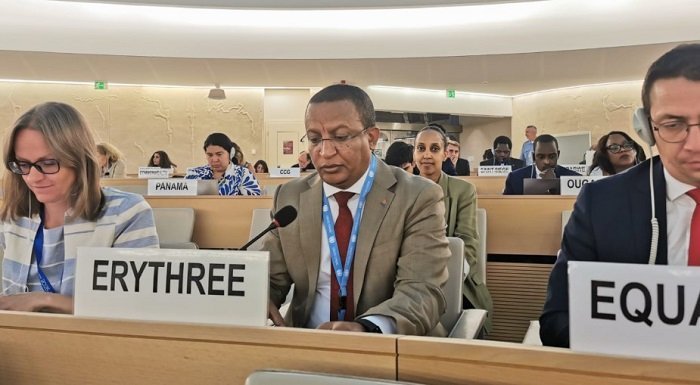
Addis Ababa, Ethiopia – During a recent address at the United Nations, Eritrea’s Chargé d’Affaires, Habtom Zerai, sharply criticized Ethiopia’s statements regarding Resolution A/HRC/59/L.7, which addresses the human rights situation in Eritrea.
In a statement released by the Eritrean Ministry of Information, Habtom asserted that Ethiopia’s “inconsistency unfortunately insults the memory and collective intelligence of the Council.” He characterized Ethiopia’s position as contradictory to its past actions and statements.
During his presentation, he highlighted what he described as “certain pertinent facts.” He alleged that over the past two years, Ethiopia has openly and repeatedly expressed its intention to seize Eritrean ports, stating, “legally, if possible, and militarily if necessary.” He further accused Ethiopia of “unlawful and irredentist” ambitions, which he claimed also threaten Somalia and Djibouti.
Ethiopia, the world’s most populous landlocked nation, has long sought direct sea access to bolster its economic growth and address security concerns. This ambition gained significant momentum with the controversial Memorandum of Understanding (MoU) signed with Somaliland in January 2024. This agreement was meant to grant Ethiopia a 50-year lease on 20km of coastline near the port of Berbera for naval and commercial use, with the understanding that Ethiopia might recognize Somaliland’s sovereignty in return.
However, the practical status of the agreement remains unclear. Some reports suggest the MoU’s implementation may have been secretly halted, possibly influenced by the Ankara Declaration between Ethiopia and Somalia.
Ethiopia has a long history of access to the Red Sea. It lost direct coastline access, including the strategically important port of Assab, when Eritrea gained independence in 1993. Prime Minister Abiy Ahmed has repeatedly emphasized this as an “existential” issue for Ethiopia, highlighting the nation’s right to peaceful and beneficial access to the Red Sea while denying the threat of war and stressing the value of collaboration and mutual development with its neighbors.
Although not explicitly mentioned in the statement, Habtom was likely referring to the Tigray War (also known as the Northern Ethiopia Conflict), which lasted from November 3, 2020, to November 3, 2022. Regarding this conflict, he stated, “When Ethiopia stood on the precipice of utter State collapse four years ago, Eritrea supported it unreservedly for reasons of regional stability as well as its own imperatives of self-defense. That historical reality cannot be distorted, diminished or disregarded now for contemporary political expediency.”
However, many human rights defenders have criticized Habtom’s claims, arguing that Eritrea’s involvement compromised Ethiopia’s sovereignty and that Eritrean troops committed widespread human rights abuses during the conflict, including mass killings, sexual violence, looting, and destruction of civilian infrastructure. Despite these allegations, the Ethiopian government initially denied Eritrean troop participation in the war.
Habtom maintained, “As we speak Eritrean forces remain strictly within their internationally recognized borders. Claims to the contrary are false and maliciously designed to ignite and rationalize conflict.” He further accused Ethiopia of promoting a “destabilizing agenda,” marked by explicit threats, illicit arms buildup, and subversive regional activities that, according to him, undermine regional peace and security.
A new movement involving Eritrea, Somalia, and Egypt has emerged in the Horn of Africa. This alliance appears to be a response to Ethiopia’s push for port access and its announcement that the Grand Ethiopian Renaissance Dam (GERD) will become fully operational, with its inauguration planned for September 2025 as per PM Abiy’s recent announcement during his last week’s parliamentary address.
This alliance was formalized at a summit in Asmara in October 2024, where the presidents of Somalia, Eritrea, and Egypt met. They agreed “to enhance regional security cooperation, focusing on stability and mutual respect for sovereignty”, in what is widely seen as a strategic counterbalance to Ethiopia’s growing regional influence.
According to most Horn of Africa observers, this alliance formed due to the three countries’ concerns about Ethiopia’s regional actions. Egypt views the GERD as a direct threat to its water supply, while Somalia considers Ethiopia’s recent agreement with Somaliland for naval access a violation of its sovereignty, despite having signed the Ankara Declaration with Ethiopia. Eritrea is concerned about Ethiopia’s intentions in the Red Sea and feels excluded from the peace negotiations pertaining to Tigray, where the Pretoria Agreement ended the war.
On January 23, 2025, Somali President Hassan Sheikh Mohamud met with Egyptian President Abdel-Fattah El-Sisi in Cairo. Somalia’s national news agency SONNA reported that their discussions centered on strengthening “joint efforts to combat terrorism and accelerating cooperation in the fields of security and peace in the region.”
Habtom further accused Ethiopia of “launching a campaign to scapegoat Eritrea,” seeking to divert international and domestic attention from its escalating, self-inflicted crises, including deepening political fragmentation, widespread civil unrest, and an erosion of its legitimacy.
Last week, the United Nations Human Rights Council decisively rejected Eritrea’s attempt to end international scrutiny of its human rights record, voting overwhelmingly to renew the mandate of the Special Rapporteur for another year. This decision, supported by 25 countries including Ethiopia, sends a strong message that the international community is not swayed by Eritrea’s claims that its human rights issues are minor “capacity constraints.” This comes despite extensive reports detailing systematic abuses like arbitrary detentions, enforced disappearances, severe religious restrictions, and indefinite national service.
Furthermore, concerns were raised about the continued involvement of Eritrean forces in human rights violations in Ethiopia’s Tigray region, echoing a decade of alarms from UN inquiries, which Eritrea has consistently dismissed while refusing to cooperate with the Special Rapporteur.
Support Borkena : https://borkena.com/subscribe-borkena/
Join our Telegram Channel : t.me/borkena
Like borkena on Facebook
Add your business to Ethiopian Business Listing / Ethiopian Business Directory Business Listing Toronto
Join the conversation. Follow us on X (Formerly Twitter) @zborkena to get the latest Ethiopian News updates regularly. Subscribe to YouTube channel To share information or for submission, send e-mail to info@borkena.com
How come this ‘Black Italian’ thing, Habtom Zerai, did not talk anything about ‘Uni-polar’ during his mumbling? I’m gonna tell on him! I’m gonna call and tell my longtime homeboy Al-Toweel Isu about it. Also he did not lecture those present at the UN meeting about the ‘Umma’ boogeyman. In fact, I’m gonna call my buddy Isu right now. Slacker!!!