

By Sally Abrham
Your Vote Matters Less Than You Think
Every election season, millions of Ethiopians register to vote, opposition parties organise, campaign, and urge registered voters to vote for them, yet under the current political reality in Ethiopia, the Prosperity Party is positioned to capture virtually all seats and pledge a handful of offices to a select few favoured opposition candidates. However, these conceded offices do not come with real political power.
Our political conversation rarely makes a clear enough distinction between occupying an office and holding real political power. A candidate can sit behind the desk and still be entirely unable to execute a single item from their campaign objectives. The office is real. The power is not.
The problem, however, is not only that opposition candidates rarely win elections that are structurally rigged against them. The deeper problem is that winning an election, by itself, means very little in asserting real political power.
This is the gap that most opposition politicians fail to address or communicate to their voters. Winning an election solves no problem while the structural conditions that make those offices hollow remain untouched and unexamined. Understanding that gap is where any serious analysis of Ethiopian politics must begin.
What Is Political Power?
According to Gene Sharp in The Politics of Nonviolent Action (1973), political power is the totality of means, influences, and pressures, including authority, rewards, and sanctions, available to achieve the objectives of the power-holder.
Sharp’s definition is among the most comprehensive in civil resistance and political studies. Unpacking it reveals the many misconceptions we have surrounding the concept.
At its core, the totality of means, influences, and pressures establishes that before any political actor can exercise power, they must possess a structural and material baseline. The totality of means represents the practical inventory in a power-holder’s toolbox. For a government, this encompasses structural frameworks like laws, judicial courts, and bureaucratic regulations alongside material resources such as tax revenue, infrastructure control, and the physical apparatus of law enforcement.
The totality of influences operates in the psychological, moral, and ideological realms to secure voluntary obedience. Influence is the art of shaping beliefs so that people cooperate willingly. When a government enjoys widespread legitimacy, citizens follow laws out of a sense of civic duty or patriotism rather than fear. A power-holder rarely survives on brute force alone, because constant coercion is costly, unstable, and inefficient. Power-holders therefore pivot toward influence as their primary instrument.
When persuasion fails and voluntary cooperation is withheld, the nature of power shifts from the mind to the streets. The totality of pressures represents the active, coercive, and disruptive forces deployed to compel behaviour. For the state, this looks like the application of physical or economic force, such as deploying riot police, imposing curfews, levying heavy fines, or utilising state sanctions to punish non-compliance.
Authority, Rewards, and Sanctions: The Levers of Power
To mobilise these means, influences, and pressures, power-holders must utilise specific structural levers. Gene Sharp explicitly highlights three vital mechanisms that bridge the gap between holding a tool and successfully deploying it.
Authority is the institutional and psychological right to command. It is the most efficient source of power because it generates automatic obedience. Even when the general population rejects a ruler’s legitimacy, civil servants and military personnel who believe the power-holder has the rightful authority to issue orders will obey without needing to be paid off or coerced.
Rewards represent the positive incentives used to secure compliance and maintain loyalty. Power-holders distribute material and social rewards to critical pillars of support to keep them aligned. This includes financial incentives, prestigious titles, positions within the bureaucracy, promotions within the military, and exclusive economic privileges granted to favoured elites.
Sanctions are the enforcement mechanisms most people readily recognise, namely the coercive tools that power-holders use to punish dissent and deter future attempts. Sharp notes that the threat or application of sanctions is essential to sustaining unjust political power. Sanctions can be legal, such as imprisonment and fines, economic, including confiscation of property and loss of employment, or physical, like violence and detention. They exist to instil fear and deter future non-cooperation.
Taken together, these three levers do not operate in isolation; they are always directed toward a purpose. Power does not exist as an end in itself, it exists, as Sharp puts it, purely “to achieve the objectives of the power-holder.” Whether those objectives are the maintenance of authoritarian control, the implementation of a specific economic policy, or the structural transformation of society, every piece of the power apparatus is oriented toward those explicit ends.
To sum up, Sharp democratises this concept by stating that these tools and levers of power are available to the institutions of government, the State, and groups opposing either of them. This is a significant realignment of political theory. Power is not a one-way street running exclusively from the top down.
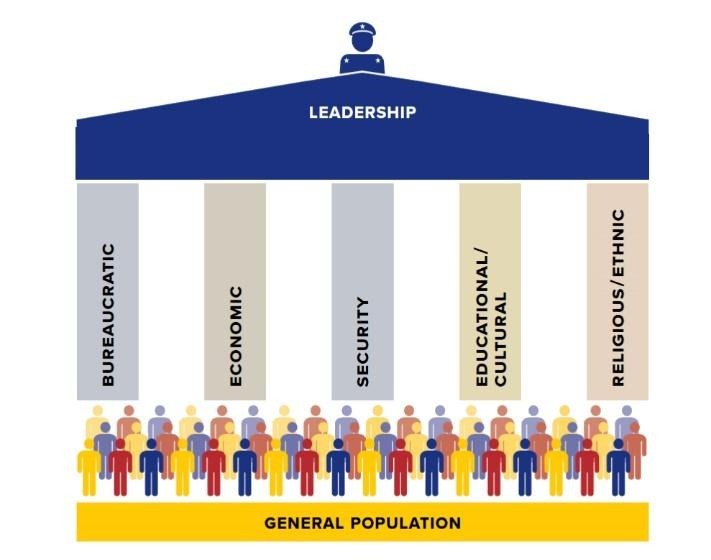
This means political power has a source, and that source is not the ballot box. It is the people whose compliance and obedience make governance possible. For that source of power to have any effect, it must be channeled through a constellation of institutions and groups that scholars call the pillars of support. In Ethiopia, those pillars include the military and security forces, the federal and regional bureaucracy, business and economic elites, media outlets, organised religious institutions, unions, civic organisations, and international partners providing aid and diplomatic recognition. Crucially, they also encompass deep-seated, traditional social networks like እድር (Iddir), እቁብ (Equb), ጻዋ (Tzawa), መረዳጃ ማህበራት (Meredaja Mahiberat), and local sports clubs, which serve as the foundational fabric of community mobilisation.
Civil resistance strikes directly at the source of power. By building parallel organisations, a movement can effectively block a regime’s command of popular compliance and obedience. When citizens deprive a regime of these sources of power, the pillars of support are starved of the “means” they need to function. Deprived of their societal foundations, these key pillars are ultimately forced to comply with the movement’s demands. An unpopular regime cannot survive the structural collapse of its vital pillars, clearing the strategic path to a movement’s victory. Regardless of what the election result says, whoever controls or disrupts those pillars holds real political power.
What Elections Actually Are and Are Not
An election is a formal process for selecting who occupies an office. But the office and the power that should come with it are two entirely different things.
In a genuine democracy, elections carry weight because they are backed by functioning institutions, such as independent courts, a professional military that serves the constitution, a free press, and a civil service that obeys the law rather than the ruling party. These institutions are what convert an election result into actual governing power.
In Ethiopia today, none of these conditions exist in any meaningful form. The judiciary answers to the party that appointed its members in the first place. The military and security apparatus are instruments of party and factional control. The media landscape is either state-owned or operating under the constant threat of shutdown and imprisonment. The civil service, from federal ministries down to the kebele level, is deeply penetrated by party loyalist structures.
In the Ethiopian reality, an election is not a mechanism for transferring power. It is a mechanism for confirming who already has it.
Why the Regime Runs Elections at All
Ruling by naked force alone is costly, fragile, and unsustainable. A government that governs purely through coercion requires an enormous and permanently loyal security apparatus, faces a constant risk of internal mutiny, and invites international isolation. Even manipulated elections solve several problems at once.
First, they provide legitimacy cover, serving as a tool to manufacture the institutional authority and right to command that Sharp highlights. Domestically and internationally, the regime can point to a process and declare a mandate, projecting the image of a government chosen rather than imposed. They divide and exhaust the opposition by forcing activists into impossible choices: participate and risk lending credibility to a rigged process or abstain and lose the chance to organise. They create space to co-opt select opposition figures, offering symbolic offices to those willing to operate within the system’s boundaries.
What This Means for the Opposition
Whether a candidate wins or loses within this system makes no significant difference to achieving the opposition’s core objectives. Exposing a rigged election process and its outcomes can damage the regime’s legitimacy more effectively than any press release. But such actions alone will not weaken or breakaway the pillars of support the regime relies on. Only organised, sustained, and strategic denial of the sources of power those pillars require to survive can.
The question every Ethiopian activist must begin asking is how do we build the kind of power that cannot be stolen, annulled, or ignored?
My next piece in this series will examine some concrete answers to that question through the lens of civil resistance.
The writer can be reached at : hizbawiabiyot@gmail.com
Editor’s Note : Views in the article do not necessarily reflect the views of borkena.com
__
Join our Telegram Channel : t.me/borkena
Like borkena on Facebook
To submit Press Release, send submission to info@borkena.com
Add your business to Ethiopian Business Listing / Ethiopian Business Directory
Join the conversation. Follow us on X (Formerly Twitter) @zborkenato get the latest Ethiopian News updates regularly.
To Support Borkena : https://borkena.com/subscribe-borkena/ – one time support or small monthly options available. Inquire information about it : info@borkena.com