
By: Getahun Tsegaye
Staff Reporter
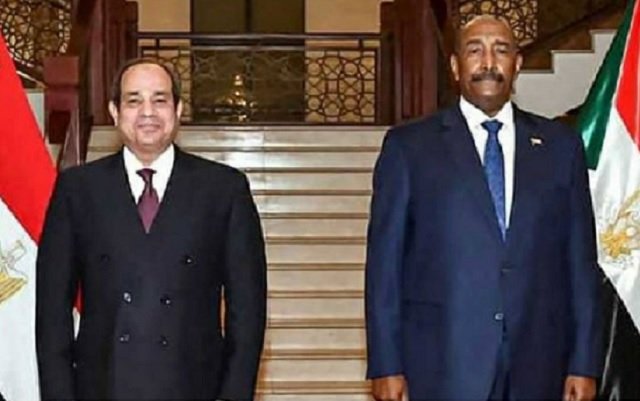
ADDIS ABABA, ETHIOPIA – In a high-stakes meeting at Al-Ittihadiya Palace on Monday, Egyptian President Abdel Fattah al-Sisi and Sudanese Sovereignty Council Chairman General Abdel Fattah al-Burhan underscored their unified stance on Nile water security and regional stability. This display of solidarity signals a deepening alliance between the downstream nations as tensions with Ethiopia intensify over the Grand Ethiopian Renaissance Dam (GERD) and broader geopolitical dynamics in the Horn of Africa.
The leaders reiterated their firm opposition to what they describe as Ethiopia’s unilateral actions concerning the Blue Nile, the primary water source for both Egypt and Sudan. “There is complete alignment between Egypt and Sudan on the strategic importance of shared water resources and the need for regional stability,” stated Egyptian presidential spokesperson Mohamed al-Shennawy, as reported by Asharq Al-Awsat.
The GERD, a $5 billion hydropower project Ethiopia launched in 2011 on the Blue Nile, lies at the heart of this ongoing dispute. While Ethiopia asserts the dam’s crucial role in its development and energy generation for its population, Egypt and Sudan contend that the absence of a legally binding agreement governing its filling and operation poses an existential threat to their water supplies.
Despite years of African Union-led and international negotiations, including a U.S.-brokered effort in 2020 that ultimately collapsed, Ethiopia has proceeded with multiple stages of filling the GERD reservoir. The 2020 U.S. mediation faltered when Ethiopia withdrew, accusing Washington of favoring Cairo’s interests. A widely criticized remark by then-President Trump, suggesting Egypt might “blow up the dam,” further inflamed regional tensions, prompting Ethiopia to lodge a formal protest with the U.S. ambassador.
Tripartite negotiations among Egypt, Sudan, and Ethiopia have remained deadlocked, primarily over legal guarantees for downstream water flow and mechanisms for dispute resolution. Egypt, heavily reliant on the Nile for over 90% of its freshwater needs, views the dam as a direct threat to its national survival. Sudan, initially more reserved, has increasingly aligned with Egypt, citing safety concerns arising from Ethiopia’s refusal to share critical data during reservoir operations. “No country should have the right to control a transboundary river on its own terms,” an Egyptian foreign ministry official told Al-Ahram earlier this year, highlighting the erosion of trust and the potential for regional instability caused by Ethiopia’s approach.
Adding complexity to the regional landscape is the Red Sea, a zone of increasing military and diplomatic competition. President Sisi’s recent discussions with Djibouti’s President Ismail Omar Guelleh underscored Egypt’s broader regional strategy to counter Ethiopia’s aspirations for maritime access. Borkena reported that both Egypt and Djibouti “categorically rejected any actions that threaten the safety and freedom of navigation in the Red Sea,” a statement widely seen as a direct response to Ethiopia’s repeated calls for direct access. Landlocked since Eritrea’s independence in 1993, Ethiopia, under Prime Minister Abiy Ahmed, has described access to the Red Sea as a “natural right” and a strategic imperative. “Ethiopia is one of the most populous nations on the continent and has no port. This is not just unfair—it’s unsustainable,” Prime Minister Abiy Ahmed declared in October 2023, sparking regional unease. While Abiy has maintained that Ethiopia seeks access through peaceful and cooperative means, his administration’s rhetoric has caused alarm, particularly given Ethiopia’s internal challenges and military presence near the Eritrean and Djiboutian borders. A professor of hydropolitics, speaking anonymously to Borkena, cautioned that “Ethiopia’s regional posturing isn’t just about development—it’s about influence and power projection. And from Egypt’s perspective, that’s a strategic red flag.”
Al-Burhan’s visit to Cairo, at President Sisi’s invitation, also underscored the deepening ties between Egypt and Sudan amidst Sudan’s ongoing civil war. Discussions focused on humanitarian aid, joint infrastructure projects, and regional stability. With Sudan grappling with a conflict that has displaced over 14 million people, including more than 1.2 million refugees in Egypt, both leaders reaffirmed their commitment to Sudan’s unity and institutional integrity, with Egyptian officials hailing the visit as a pivotal moment for future reconstruction and enhanced bilateral cooperation.
Amidst these escalating tensions over the GERD, Ethiopia remains steadfast in its position that the dam is a legitimate and essential project for its national development. While Egypt and Sudan continue to voice their opposition, framing Ethiopia’s unilateral actions as threats to regional stability, Addis Ababa argues that the GERD is an exercise of its sovereign right and a symbol of Africa’s equitable utilization of shared resources.
In response to growing criticism, Ethiopian Prime Minister Abiy Ahmed has repeatedly stressed that the GERD is intended to uplift millions out of poverty through clean energy and is not designed to harm downstream nations. In a widely cited parliamentary address in July 2021, PM Abiy stated, “The GERD is Ethiopia’s project, built by the contributions of ordinary Ethiopians. It is a symbol of our self-reliance and our right to develop without begging.” He further emphasized Ethiopia’s commitment to African Union-led negotiations but asserted that Ethiopia would not accept “historical injustices” that deny it a fair share of the Nile. “For too long, Ethiopia—where over 85% of the Nile waters originate—was denied any meaningful use of its own natural resources. This dam is not just about electricity—it’s about justice,” Abiy stated.
From Ethiopia’s perspective, the GERD represents a project of pan-African pride and a critical necessity. With over 60% of Ethiopians lacking access to electricity, the fully operational GERD is expected to generate over 6,000 megawatts of power, potentially transforming the country’s economic landscape and electrifying neighboring states.
Ethiopian legal experts argue that the 1959 Nile Waters Agreement between Egypt and Sudan, crafted without Ethiopia’s participation, is outdated and fundamentally unfair. “International water law supports equitable and reasonable use,” argued a legal scholar at Addis Ababa University, speaking to Borkena on the condition of anonymity. “No country has a veto on upstream development when it does not cause significant harm.” Ethiopia has already completed several stages of the GERD’s reservoir filling, maintaining that these actions were conducted with technical precautions to prevent downstream shocks.
Ethiopian officials have also accused Egypt of using diplomatic pressure to maintain its hydro-hegemony in the region. “The GERD is not a geopolitical tool; it’s a lifeline,” Ethiopia’s water minister stated at the 2023 AU summit. “We have invited data-sharing, we have participated in every round of talks, but we will not be held hostage by outdated treaties.”
Meanwhile, Prime Minister Abiy’s 2023 remarks regarding Red Sea access have amplified Egyptian and Sudanese concerns about Ethiopia’s broader regional ambitions. However, Ethiopian analysts contend that these concerns are overstated. “Abiy’s call for sea access is rooted in economic logic, not militarism,” argued the expert. “The GERD and Red Sea are being conflated by opponents who feel threatened by a rising Ethiopia.”
While the alliance between Egypt and Sudan strengthens in response to shared anxieties over Nile water security, Ethiopia’s stance remains rooted in its developmental urgency, a sense of historical fairness, and principles of continental sovereignty. With no immediate resolution in sight, the GERD saga continues to be a significant fault line in East African geopolitics.
As of the publication of this article, the Ethiopian government has not issued any official statement regarding this matter.
__
Subscribe : https://borkena.com/subscribe-borkena/
Join our Telegram Channel : t.me/borkena
Like borkena on Facebook
Add your business to Ethiopian Business Listing / Ethiopian Business Directory Business Listing Toronto
Join the conversation. Follow us on X (Formerly Twitter) @zborkena to get the latest Ethiopian News updates regularly. Subscribe to YouTube channel To share information or for submission, send e-mail to info@borkena.com
Do you guy know Egypt’s military is the most advanced and most feared in the world today? You don’t know that? Even China, Russia, India, Brazil and USA are scared of Egypt military might. In regards to the GERD dam, all what Egypt needs are some road guides and hammaals(coolies). Who will be more perfect of a beast of burden than someone in utter despair? Who will fit the bill better than the one who is being besieged at home? No matter who that will be, if someone tries to aggravate the GERD dam, he/she should be ready to lose The Blue Nile forever. It is natural that reservoirs created by dams tend to accumulate so much silt under the top water that any violent tremor caused by force such as bombing will create what hydrologists call an alluvial tsunami that forces the river to change its usual course and flow backwards. I was looking at that possibility and tried to figure out the new route the Blue Nile will follow. All I can say is cities like Dessie to be ready. Blue Nile is coming to your neighborhood. Omdurman, Al-Qahirah(Cairo) and Alexandria should kiss and say goodbye to your feeder, The Blue Nile forever. That is why I like to warn el-Sisi telling him ‘It-Adhab(behave).