
Wider Implications
By Worku Aberra
Fiscal Mismanagement
The Ethiopian government claims that it lacks the resources to increase the salaries of doctors; but when measured against the scale of government waste and inefficiency, this argument fails. Even within the current budget, better spending choices and the elimination of inefficiencies could raise the salaries of doctors without creating a large fiscal burden for the government. The claim of insufficient funds rings hollow when contrasted with concrete examples of wasteful spending and wastage due to mismanagement.
For instance, the government has recently procured high-end electric vehicles for official use, with some models—such as the Toyota BZ4X—reportedly costing up to 6 million birr, or approximately $105,000. In contrast, an Ethiopian general practitioner earns around 10,000 birr per month, amounting to 120,000 birr annually. At current salaries, a doctor would need to work 50 years to afford a single luxury vehicle purchased by the government.
The comparison exposes a fundamental problem: budgetary choices express political values. When a single luxury vehicle for a senior official exceeds a doctor’s lifetime earnings, it exposes the government’s distorted priorities. Diverting even a fraction of this conspicuous spending from a few officials to the health sector could improve the lives of millions of Ethiopians.
Much of the government’s budget is lost to corruption, incompetence, and waste. According to the IMF, as much as 30% of Ethiopia’s central government budget may be lost annually to corruption and inefficiency. For the 2025/2026 fiscal year, the federal budget is US $ 15 billion ; if we take the IMF estimate of 30% of government spending being wasted due to corruption and inefficiency, this would suggest that government budgetary wastage amounts to $4.5 billion in the current fiscal year alone.
If redirected, this sum could pay the salaries of 375,000 doctors at $1,000 per month, the amount demanded by striking physicians. Yet ,Ethiopia has only 12,000 doctors in 2025. Allocating the lost $4.5 billion to the existing physicians would translate into an annual income of $375,000 per doctor.
This simple calculation exposes the reality: the refusal to pay fair wages stems not from a shortage of resources but from a deliberate political decision. It is a conscious political decision to transfer wealth from the working population—including professionals and civil servants—to a small elite loyal to the government; it also reflects a broader strategy to sideline Ethiopia’s professionals.
Vanity Projects and Wasteful Spending
In addition to wastage through corruption, inefficiency, and mismanagement, the government has embarked on several large-scale projects with high costs amidst pressing national needs. One such project is the “Chaka Project,” a planned new palace complex for the Prime Minister in the Yeka Hills of Addis Ababa. The project is reported to cost $10 billion, making it one of the most expensive government buildings globally. The expenditure is especially contentious given Ethiopia’s worsening economic conditions: rising poverty, high unemployment, and a declining standard of living.
The government has also ramped up military spending, allocating millions of dollars to purchase sophisticated weapons, including drones. These drones have been used extensively to suppress popular resistance in the Amhara region, frequently targeting civilians. In a country where doctors earn below the international poverty line, the decision to prioritize weaponry over basic healthcare demonstrates a warped sense of national priorities. A government that can afford imported drones to deploy against its own citizens cannot credibly claim it lacks the resources to pay its physicians. The issue is choice.
The government’s refusal to meet the doctors’ demands, therefore, has little to do with affordability and everything to do with politics. It reflects a broader political strategy: project control, transfer wealth, and preserve power. The issue is not what the state can afford, but what it chooses to deny.
Granting doctors their requested raise—$1,000 per month—would set a precedent for other public-sector workers to organize for better wages. It would legitimize public bargaining, encourage collective action, and suggest that pressure tactics can succeed. For a government that monopolizes decisions and suppresses dissent, such a concession risks appearing weak. The threat is symbolic, and as such, it must be denied.
In an authoritarian state where legitimacy rests on submission, conceding to professionals undermines the image of undisputed control. Doctors are not ordinary workers; they are educated, respected, and dedicated. Yielding to their demands would shift the narrative from state generosity to citizen entitlement; it erodes the paternalistic model that has long structured Ethiopian governance.
Another possible excuse offered by the government is that reducing the budget deficit is necessary to meet the conditions for securing structural adjustment loans from the IMF. But reducing the deficit does not require starving doctors or undermining essential public services. There are more responsible and humane ways to achieve fiscal discipline, such as cutting wasteful spending, curbing corruption, and eliminating non-essential expenditures. Even the IMF recognizes the social costs of austerity and has made provisions to ease the burden of adjustment. It has agreed to provide targeted support to governments to help mitigate the economic strain caused by structural reforms. The decision to deprive doctors of a living wage, therefore, is not dictated by the IMF; it is a choice made by the Ethiopian government.
Challenging Ethnicism
The government’s reluctance also reflects the state’s ideology of ethnicism. Ethiopia’s political system resists unity that transcends ethnic boundaries. Independent bodies that cut across ethnic lines threaten the regime’s strategy of fragmented control. Doctors, by training and practicing across regions, embody a profession with national reach. Granting their demands would reveal that collective action—organized around purpose rather than ethnicity—can yield results. That prospect alarms the state.
Finally, a current of anti-intellectualism runs through Ethiopia’s political culture, reinforced by the ideology of ethnicism. Educated professionals—teachers, journalists, economists, lawyers, and now doctors—derive authority from expertise rather than ethnicity, placing them outside the regime’s preferred framework of ethno-political loyalty. The Prime Minister’s open disdain for critics from these ranks reflects a broader effort to delegitimize those who challenge the state’s narrative. Suppressing their demands signals who holds power. In this context, the refusal to raise doctors’ salaries becomes an instrument of ethnicized domination.
An important Lesson for all Ethiopians
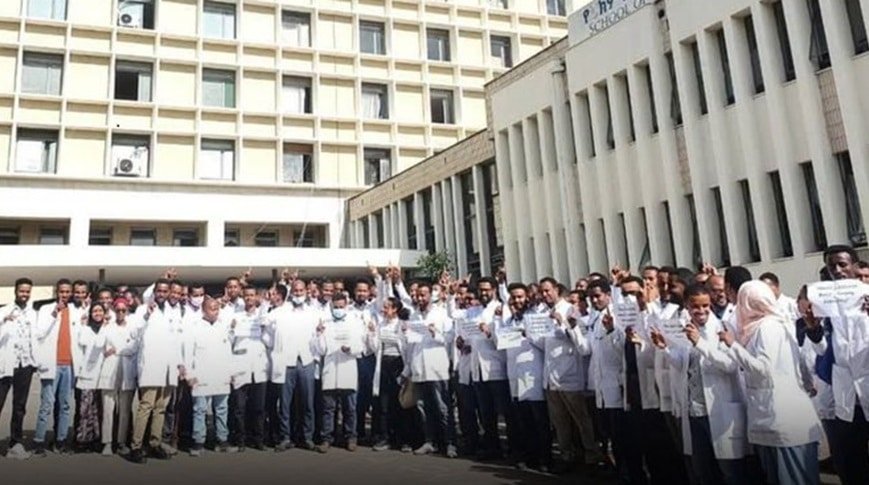
The nationwide strike of healthcare workers represents an extraordinary development in Ethiopia’s recent political reality. In a country where ethnic divisions affects nearly every aspect of public life—politics, policy, and protest—the unity displayed by doctors and healthcare workers across ethnic lines is unprecedented. This strike is not merely a demand for better wages or working conditions; it is a demonstration of national solidarity in a highly fractured society.
One of the clearest messages emerging from the strike is that unity among Ethiopians is possible when the issue is shared, urgent, and grounded in reality. Medical professionals from Tigray, Amhara, Oromia, and the Southern regions have acted in concert, underscoring the fact that poverty, inflation, state neglect, and professional humiliation are not confined to one ethnic group. This commonality of suffering—economic and institutional—has created a rare moment of collective resistance that transcends ethnicity.
Even if the government makes no concession to the doctors’ demands, the strike already marks a major success. It occurred in a nation under authoritarian rule, where public dissent is frequently met with arrest, surveillance, repression, and sometimes death. That the movement endured despite the jailing of key leaders, including figures like Dr. Mahlet Guuesh, makes its success even more remarkable. Harassment did not stop the strike. Ethnic fragmentation did not stop the strike. Instead, the strike action persisted.
Above all, the strike has redefined civic protest in Ethiopia. It has shown that cross-ethnic solidarity is not only possible, but powerful. It has exposed the limits of authoritarian intimidation and proved that coercion no longer guarantees compliance. Even under repression, professionals—and ordinary citizens—can still unite around a common cause.
The lesson is crystal clear. The doctors are doing their part, taking the risk, showing determination, and demanding reform. Now the responsibility shifts to the opposition, both those who advocate peaceful means and those who have turned to armed resistance. They must learn from the doctors’ example and build the unity required for systemic transformation. Those committed to peaceful resistance must support the doctors’ struggle and mobilize the broader Ethiopian public to push for meaningful change. Real change requires unity, direction, and the courage to confront an oppressive system. A just society will not emerge through appeasement of authoritarian power, but through collective defiance of its abuse.
Worku Aberra is a professor of economics at Dawson college, Montreal, Canada.
Editor’s Note : Views in the article do not necessarily reflect the views of borkena.com
__
Subscribe : https://borkena.com/subscribe-borkena/
Join our Telegram Channel : t.me/borkena
Like borkena on Facebook
Add your business to Ethiopian Business Listing / Ethiopian Business Directory Business Listing Toronto
Join the conversation. Follow us on X (Formerly Twitter) @zborkena to get the latest Ethiopian News updates regularly. Subscribe to YouTube channel To share information or for submission, send e-mail to info@borkena.com