
Amsal Woreta
Abstract
Digital transformation strategies are increasingly promoted as levers for development and state capacity in fragile and conflict-affected states. Ethiopia’s Digital Ethiopia 2030 strategy builds on earlier digitalization efforts to expand digital public infrastructure, e-government, and a digital economy while emphasizing inclusion and youth employment. Yet Ethiopia remains characterized by overlapping conflicts, an ethnic-federal system that has fueled contestation, mass displacement, and large-scale infrastructure destruction, alongside governance fragilities and center–periphery tensions that shape how this strategy unfolds.
This paper asks: How do Ethiopia’s conflict dynamics and governance fragilities enable or constrain the implementation of Digital Ethiopia 2030 and its goals for inclusive digital transformation? Drawing on policy documents, secondary literature on digital transformation in fragile settings, and analyses of Ethiopia’s political trajectory, the paper argues that fragility both enables and constrains digital transformation. Centralized authority, security-oriented narratives, and donor engagement have accelerated components such as digital identification and e-government, while ethnic federalism-linked conflicts, displacement, infrastructure destruction, institutional fragmentation, and communications shutdowns undermine inclusion and risk reinforcing existing territorial and social inequalities. Ethiopia thus illustrates how digital strategies in fragile contexts are deeply political projects whose distributional outcomes depend on underlying power relations and governance quality.
1. Introduction
Digital transformation has become a central pillar of development policy, with governments and international organizations framing digital public infrastructure, data systems, and online services as key to inclusive growth and state effectiveness. In fragile and conflict-affected states (FCAS), these strategies are often promoted as tools to “leapfrog” traditional constraints, extend state reach, and deliver services in difficult environments. However, the implementation of digital strategies in such contexts is inseparable from ongoing conflict dynamics, the design and practice of federal arrangements, and chronic governance fragilities.
Ethiopia provides a particularly revealing case. Over the past decade, the government has advanced an ambitious digital agenda, moving from the Digital Ethiopia 2025 framework to a newly approved Digital Ethiopia 2030 strategy that seeks to deepen digital infrastructure, government services, and a digital economy. At the same time, Ethiopia’s ethnic-federal system has contributed to repeated violent conflicts in regions such as Tigray, Amhara, and Oromia, producing mass displacement, large-scale infrastructure destruction, and pervasive insecurity. These realities shape not only the feasibility of digital roll-out but also those who can benefit from digital services and who remain excluded.
This paper addresses the following research question: How do Ethiopia’s conflict dynamics and governance fragilities enable or constrain the implementation of Digital Ethiopia 2030 and its goals for inclusive digital transformation? The core argument is that Ethiopia’s fragile context simultaneously enables and distorts digital transformation. Centralized decision-making and security-oriented narratives help to push forward key pillars such as digital ID and e-government, yet ethnic-federal contestation, displacement, infrastructure destruction, internet shutdowns, and low trust constrain inclusive implementation and risk reproducing or deepening existing inequalities.
The paper proceeds as follows. Section 2 reviews literature on digital transformation, digital public infrastructure, and governance in fragile and conflict-affected states. Section 3 outlines Ethiopia’s ethnic-federal conflicts, displacement, infrastructure destruction, governance fragilities, and the main components of Digital Ethiopia 2030. Section 4 analyses ways in which conflict and fragility have enabled selected digital reforms, while Section 5 explores how they constrain inclusive digital transformation. Section 6 examines tensions between inclusion and control within Ethiopia’s digital project. Section 7 concludes with implications for digital strategies in fragile and conflict-affected contexts.
- Literature Review and Conceptual Framework
2.1 Digital transformation and digital public infrastructure
Digital transformation in development is increasingly conceptualized around “digital public infrastructure” (DPI): foundational systems such as digital identification, interoperable payment platforms, and data-sharing frameworks that enable both public and private services. Advocates argue that DPI can drive financial inclusion, improve service delivery, and support more efficient and transparent governance. By creating common rails for identity, payments, and data exchange, digital infrastructure is seen as a general-purpose platform for innovation and economic growth.
At the same time, scholars and practitioners highlight risks around privacy, surveillance, and exclusion, especially when DPI is deployed in contexts of weak regulation and limited accountability. Research on digital ID systems shows that design choices and governance arrangements shape who can access services, how personal data are protected, and whether technologies reinforce or disrupt existing power asymmetries. Digital transformation is therefore understood as a political project embedded in specific institutional and social contexts rather than a neutral technical exercise.
2.2 Digitalization in fragile and conflict-affected states
International organizations emphasize the potential of digital technologies to support resilience and recovery in fragile and conflict-affected settings, including through remote service delivery, improved data for humanitarian response, and support to local markets. Digital tools can, in principle, mitigate some constraints posed by insecurity and weak physical infrastructure. However, comparative work suggests that digital investments in FCAS often reproduce or worsen underlying inequalities if not carefully designed and governed.
Three strands of literature are particularly relevant. First, research on state capacity and digitalization argues that digital tools can augment administrative capacity but are constrained by weak institutions and political interference. Second, studies on digital authoritarianism warn that in contexts with limited checks and balances, digital systems are vulnerable to deployment for surveillance, censorship, and repression. Third, analyses of digital divides show that conflict-affected populations often face compounded barriers— displacement, poverty, lack of connectivity, and exclusion from official ID systems—limiting their ability to benefit from digital initiatives.
2.3 Governance fragility, ethnic federalism, and digital transformation
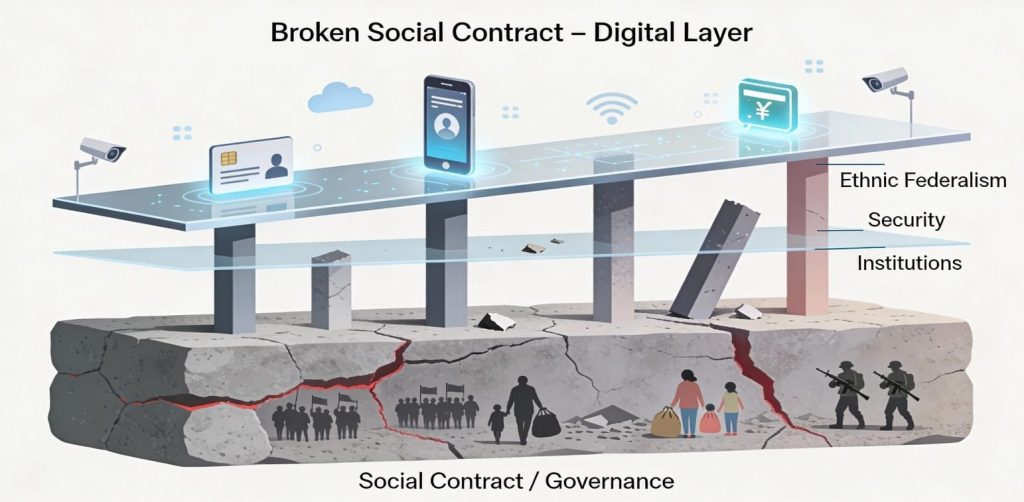
Governance fragility combines weak institutional capacity, contested legitimacy, and limited monopoly on violence. In Ethiopia, this fragility is shaped by the design and practice of ethnic federalism, which has granted regional autonomy but also hardened ethnic boundaries and contributed to violent competition over territory, identity, and resources. In such contexts, the state’s ability to implement national strategies, enforce regulations, and deliver services varies significantly across territory and social groups.
For digital transformation, this means that infrastructure rollout is likely to be uneven, regulatory frameworks may be selectively enforced, reconstruction priorities may follow political lines, and citizens’ willingness to engage with digital systems depends on trust in the state and perceptions of risk. Recent work stresses the need for conflict-sensitive digitalization that explicitly considers how ethnic and regional power relations shape who gets infrastructure, who is registered in digital systems, and who is exposed to surveillance.
2.4 Conceptual framework
This paper uses a simple conceptual framework focusing on three dimensions:
- Enabling effects: ways in which conflict and governance fragility may paradoxically facilitate certain digital reforms, for example, by strengthening central authority, incentivizing donors to invest in resilience, or framing digital tools as solutions to security and capacity problems.
- Constraining effects: ways in which conflict and fragility undermine inclusive digital transformation, through territorial fragmentation, infrastructure destruction, displacement, institutional weakness, and low trust.
- Inclusion–control tension: the extent to which digital projects framed as inclusive are also shaped by logics of control and securitization, particularly in fragile settings marked by ethnic contestation and human rights concerns.
The Ethiopian case is analyzed through this lens, with attention to how Digital Ethiopia 2030 interacts with ethnic-federal conflicts, displacement, infrastructure damage, and governance fragilities to shape the prospects for inclusive digital transformation.
- Ethiopia’s Conflict Dynamics, Governance Fragilities, and Digital Ethiopia 2030
3.1 Ethnic federalism, conflict, and displacement
Ethiopia’s contemporary conflicts are deeply intertwined with its ethnic federal system, which organizes regions largely along ethno-linguistic lines and allocates political power and territory accordingly. While federalism was intended to manage diversity and address past marginalization, it has also hardened ethnic boundaries, encouraged competition over territory, and created overlapping claims that have periodically erupted into violence, especially in Tigray, Amhara, Oromia, and other areas.
These conflicts have produced mass displacement and deepened poverty.
Millions of Ethiopians have been uprooted from their homes in recent years by fighting in Tigray, Amhara, Oromia, and elsewhere, often losing land, homes, and livelihoods and finding themselves in camps or host communities with minimal services. Displaced families frequently lack secure shelter, food, healthcare, and education, and many have also lost documentation and assets—conditions that severely limit both their immediate security and their ability to participate in digital systems for identification, banking, or accessing public services.
3.2 War damage, infrastructure destruction, and regional crises the material destruction of war has been immense. Damage and needs assessments estimate that recent conflicts have caused multi-billion-dollar losses to social and economic infrastructure, including roads, bridges, electricity networks, telecommunications, schools, and health facilities. In Tigray alone, recent reports point to more than 10 billion dollars in destroyed social infrastructure, reflecting widespread, systematic damage to public services and facilities. Other conflict-affected regions, including Amhara and Afar, have also experienced heavy destruction of public and private assets, though precise figures vary by source.
The Amhara region, one of Ethiopia’s most populous, has faced what observers describe as a new war involving federal forces and local militias, leading to states of emergency, urban fighting, and further infrastructure damage. In Oromia, a protracted insurgency and recurrent massacres linked to armed groups such as the Oromo Liberation Army have frozen economic life in some areas, disrupted markets and transport, and left many communities in chronic insecurity. For residents of these regions, the practical barriers to “going digital” are not just bandwidth or devices but destroyed roads and clinics, closed schools, unsafe travel, and pervasive fear.
These realities have direct implications for Digital Ethiopia 2030. A strategy premised on delivering digital services to citizens presupposes functioning physical infrastructure and institutions. Where water systems, health posts, and schools have been destroyed and local administrations are barely operational, digital platforms alone cannot provide meaningful access to services and may deepen frustration if promoted as substitutes for reconstruction and security.
3.3 Governance fragilities, ethnic federalism, and poverty
Governance fragility in Ethiopia is not only about limited capacity but also about contested legitimacy and unequal protection across regions and groups. Ethnic federalism has fostered local identities and self-rule in some respects, yet it has also contributed to patterns of patronage, exclusion, and competition that leave some communities feeling unprotected or targeted by security forces. Reports highlight arbitrary arrests, communal killings, and failures to prevent or punish attacks, reinforcing perceptions that the state is partial and unreliable. The fallout from war and drought has left many Ethiopians “mired in poverty,” with families losing assets and income and facing rising prices and limited access to services. In such circumstances, digital transformation risks becoming a project for those regions and groups that already enjoy relatively better security, infrastructure, and state attention, while displaced and conflict-affected populations are effectively excluded from its benefits.
3.4 From Digital Ethiopia 2025 to Digital Ethiopia 2030
Against this backdrop, the government launched the Digital Ethiopia 2025 strategy around 2019–2020 as an initial roadmap for leveraging digital technologies to support growth, jobs, and service delivery. The strategy identified priority sectors (agriculture, manufacturing, tourism, SMEs), cross-cutting enablers (connectivity, skills, entrepreneurship), and the need for a supportive legal and regulatory environment. Building on this foundation, Digital Ethiopia 2030 has been endorsed at cabinet level as a more comprehensive, long-term digital development strategy.
The 2030 vision emphasizes:
- Digital public infrastructure: expansion of the Fayda digital ID system, interoperable data platforms, and digital payments to support public services and private innovation.
- Connectivity and infrastructure: further liberalization of the telecom sector, rollout of 4G and 5G, and efforts to reduce the urban–rural connectivity gap.
- Digital government: digitization of many public services through platforms such as MESOB, with hundreds of services already online and targets exceeding 1,000 services.
- Legal and regulatory frameworks: development of laws on data protection, cybersecurity, e-transactions, and start-ups to underpin trust and innovation.
- Skills and innovation: large-scale initiatives to build digital skills among youth, support tech startups, and foster an innovative ecosystem.
Government and partner reports highlight achievements such as the digitization of over 900 public services, progress on digital ID enrollment, and a stronger policy and legal framework for digitalization. Independent commentary, however, points to an “Ethiopian paradox”: substantial investment in digital infrastructure and services without commensurate gains in inclusive development or broad-based digital usage, particularly in war-affected and marginalized regions. This paradox sets up the discussion of how conflict and governance fragilities both enable and constrain the implementation of Digital Ethiopia 2030.
4. Enabling Effects: How Fragility Accelerates Selected Digital Reforms
4.1 Centralized decision-making and policy coherence
One way in which Ethiopia’s governance configuration enables digital transformation is through centralized decision-making at the federal level. Despite political instability and regional conflicts, the executive has maintained the capacity to articulate and adopt a coherent national digital strategy, coordinate across ministries, and fast-track key policies. The approval of Digital Ethiopia 2030 amid ongoing security challenges illustrates how a strong center can keep flagship agendas moving.
Literature on state-led development suggests that centralized authority can facilitate “big push” reforms in infrastructure and regulation, particularly when political leadership sees digitalization as central to modernization and economic competitiveness. In Ethiopia, digital transformation has been framed as part of a broader economic reform package, attracting attention from top political leaders and donors even as regional crises persist.
4.2 Security and state-capacity narratives around digital ID and DPI
In fragile contexts, digital systems are often justified not only for inclusion and efficiency but also for strengthening security and state capacity. Ethiopia’s Fayda digital ID system is presented as a foundation for service delivery and financial inclusion, but also as a tool to reduce fraud, improve tax collection, and better target social programs. These narratives can mobilize political support and external financing, making DPI a priority even when broader institutional reforms proceed slowly.
Comparative studies of digital ID in low- and middle-income countries show that security and control logic often sit alongside, and sometimes overshadow, inclusion goals. In Ethiopia, the dual framing of digital ID as both inclusive and security-enhancing may explain the relatively rapid progress on this component of Digital Ethiopia 2030 compared with more politically sensitive reforms, such as deep decentralization of digital governance or robust, independent oversight of data use.
4.3 Donor engagement and “resilience” framing
International partners promote digitalization as part of resilience-building and state-capacity programs in fragile states. Ethiopia has benefited from initiatives that finance digital infrastructure, e-government platforms, and policy reforms as part of regional digitalization and recovery agendas. Fragility, in this sense, becomes a rationale for investing in systems that promise to make institutions more transparent, efficient, and resilient to shocks.
This alignment between the government’s digital agenda and donor priorities has created an enabling environment for large-scale digital projects, even when domestic politics remain contentious. However, these enabling dynamics coexist with severe constraints that limit the inclusiveness and sustainability of digital transformation, especially in regions most affected by ethnic-federal conflicts, displacement, and destruction.
5. Constraining Effects: Fragmentation, Exclusion, and Low Trust
5.1 Territorial fragmentation, destruction, and uneven access
Conflict has not only fragmented Ethiopia politically but also physically. Fighting in Tigray, Amhara, Oromia, and other regions has destroyed or severely damaged transport networks, power lines, telecom installations, schools, and health facilities, with national assessments estimating damage in the tens of billions of dollars across sectors. In Tigray, for example, hospitals, health centers, and health posts were looted or ruined on a massive scale, undermining the entire public health system. In Amhara, recent warfare has brought new destruction to urban and rural infrastructure, compounding earlier losses.
This physical devastation means that even where national indicators show progress in digital infrastructure, many communities live in places where basic services barely function or no longer exist. Rural and conflict-affected areas face long-term disruption to schools, clinics, markets, and local government offices, making it extremely difficult to use or benefit from digital platforms for education, health, or administrative services. In these contexts, Digital Ethiopia 2030’s promise of inclusive access is structurally constrained by the geography of destruction and the slow pace of reconstruction.
5.2 Displacement, poverty, and socio-economic digital divides
Mass displacement translates directly into digital exclusion
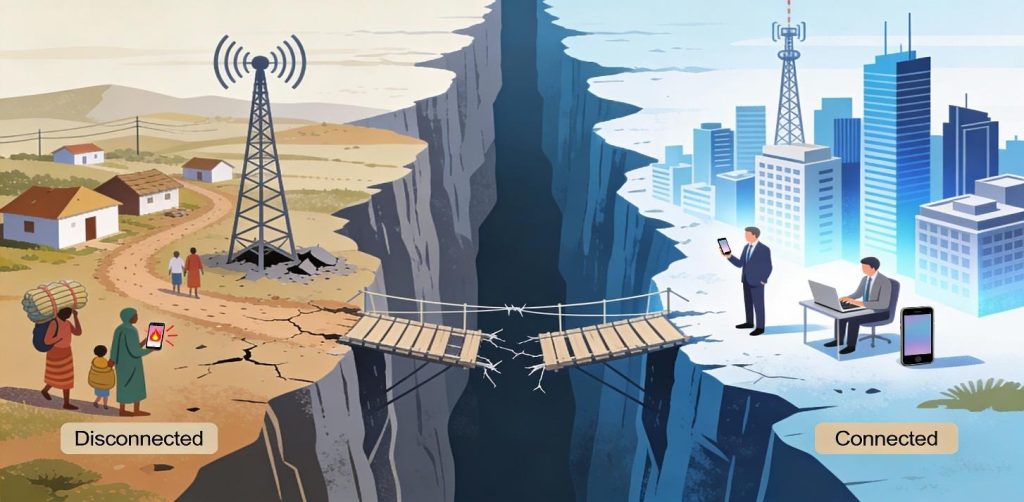
People who have lost their homes and livelihoods, and who may be living in temporary shelters or informal camps, often lack secure access to electricity, devices, or connectivity. Many displaced individuals have lost identity documents or have never been registered in systems that digital ID or social-protection platforms rely on, making it harder to prove who they are, claim entitlements, or open accounts. For these populations, survival needs—food, shelter, safety—understandably take precedence over learning to use apps or enrolling in new digital schemes. Pre-existing socio-economic and gender divides compound this. Women, the rural poor, and marginalized ethnic groups have lower rates of smartphone ownership, literacy, and regular internet use, and conflict further reduces their access to education and income. Unless digital strategies explicitly prioritize displaced and war-affected populations—through offline-capable services, targeted outreach, and integrated reconstruction efforts—the benefits of Digital Ethiopia 2030 will accrue primarily to better-off, more secure, and better-connected groups, widening the gap the strategy claims to close.
5.3 Institutional weakness, unequal protection, and implementation gaps
Institutional fragility in Ethiopia is closely linked to the ethnic-federal arrangement and the uneven protection of citizens. Some regional governments lack basic administrative and technical capacity, while others are politically contested or heavily militarized. In areas where federal and regional authorities are in open conflict or where local militias dominate, the state’s ability to implement, regulate, or maintain digital systems is minimal.
This unevenness translates into patchy implementation of national digital strategies: some regions move ahead with e-government services and digital ID enrollment, while others are stalled by insecurity, mistrust, or lack of cooperation between levels of government. In places where communities feel abandoned or targeted by the state, there may be active resistance to enrolling in state-run digital systems, which are perceived as extensions of coercive power rather than tools for inclusion.
5.4 Communications blackouts, securitization, and trust deficits
Ethiopia’s repeated use of internet shutdowns and social-media blocks is a stark contradiction between the vision of inclusive digital transformation and lived reality. Authorities have imposed broad shutdowns in response to protests and armed crises in Oromia and Amhara, as well as extended blackouts during the Tigray war, leaving millions without access to information, communication, or online services. Human rights organizations and digital-rights groups document how these shutdowns cut off people in danger from calling for help, contacting family, or sharing evidence of abuses, and how they facilitate impunity by obscuring what happens on the ground.
From the perspective of Digital Ethiopia 2030, shutting down the very networks needed for digital government and economic activity undermines both immediate functionality and long-term trust. Citizens and businesses cannot rely on digital channels if they may disappear without warning whenever security forces respond to unrest, and communities that experience shutdowns as part of broader repression are likely to see digital tools as instruments of control rather than as rights-enabling infrastructure. In regions already suffering from displacement and poverty, such blackouts deepen vulnerability: they hinder remittances, limit access to humanitarian information, and isolate people in moments of greatest need.
Together, these constraining factors show that the same fragile and conflict-affected environment that motivated donor-backed digital investments severely limit the possibility that Digital Ethiopia 2030 will deliver genuinely inclusive digital transformation.
6. Inclusion Versus Control: Tensions in Ethiopia’s Digital Project
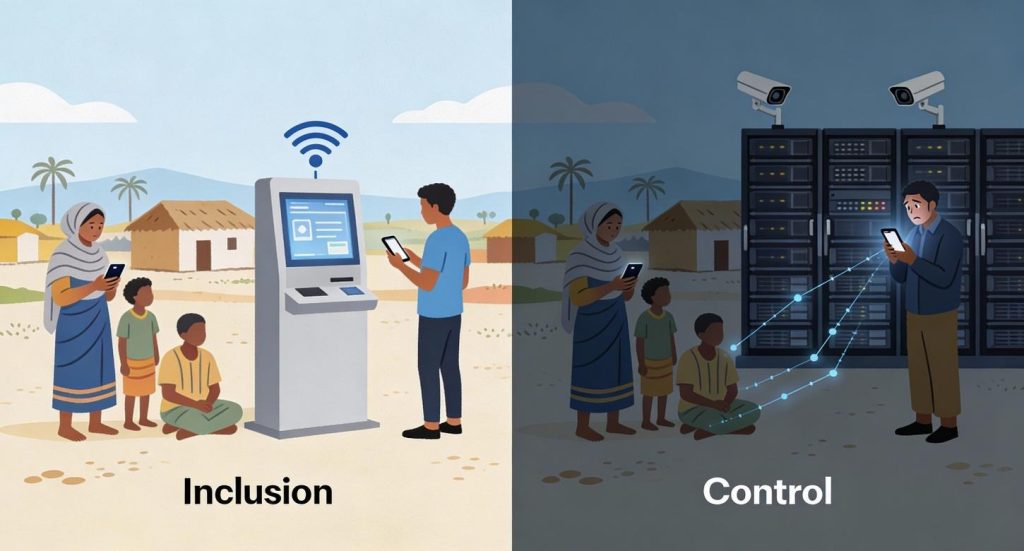
Digital Ethiopia 2030 explicitly frames inclusion as a core objective, promising to extend digital opportunities to rural populations, women, and youth while “leaving no one behind.” However, the strategy operates within a political context where the central government seeks to consolidate authority, manage dissent, and govern a heterogeneous, conflict-affected society shaped by ethnic federalism and repeated crises. This produces a tension between inclusion and control that is characteristic of digital projects in fragile settings.
On one hand, the expansion of digital ID, e-government, and online services can in principle facilitate access to social protection, financial services, and administrative processes for marginalized groups, especially if combined with proactive outreach and safeguards for displaced and conflict-affected communities. On the other hand, the same systems can be used for surveillance, monitoring political opponents, or discriminatory enforcement if robust data-protection regimes, independent oversight, and accountability mechanisms are lacking.
Ethiopia has taken steps to adopt data-protection and cybersecurity legislation, signaling awareness of the need for trust-enhancing frameworks. Nonetheless, institutional capacity to implement and enforce these laws remains limited, and civil society involvement in digital governance is constrained by broader restrictions on civic space and patterns of repression documented in human-rights reports. The literature on digital authoritarianism warns that without meaningful checks and balances, digital infrastructures can entrench asymmetric power and reduce civic space, even when formally justified as tools for efficiency and inclusion.
This inclusion–control tension affects the distribution of benefits from Digital Ethiopia 2030. Groups with greater proximity to state power, better connectivity, and higher digital literacy are more likely to use digital services, while communities with fraught relations with the state—particularly in war-affected regions—may opt out, or experience digitalization primarily as a new layer of surveillance over a context of insecurity and poverty. As a result, digital transformation risks widening existing inequalities unless deliberate measures are taken to ensure participatory governance, local ownership, and context-sensitive implementation in regions shaped by ethnic conflict and long-term marginalization.
7. Conclusion and Implications
This paper has examined how Ethiopia’s conflict dynamics and governance fragilities shape the implementation of Digital Ethiopia 2030 and its prospects for inclusive digital transformation. The analysis shows that fragility has both enabling and constraining effects. Centralized authority, security-oriented narratives, and donor support have facilitated the design and roll-out of key pillars such as digital ID, e-government platforms, and supportive legal frameworks. At the same time, ethnic-federal conflicts, territorial fragmentation, mass displacement, multi-billion-dollar infrastructure destruction, institutional weakness, digital divides, and communications shutdowns limit the inclusiveness and resilience of digital transformation, particularly in regions like Tigray, Amhara, and Oromia.
For Ethiopian policymakers, these findings underscore the need to integrate conflict sensitivity and governance reform into digital strategies. Priorities include strengthening regional capacity, ensuring equitable infrastructure investment and reconstruction in conflict-affected and marginalized areas, prioritizing displaced populations in digital inclusion efforts, and establishing robust data-protection and oversight mechanisms to guard against misuse of digital systems. Building trust requires not only technical fixes but also greater transparency, participation of civil society and local communities in digital policymaking, and clear redress mechanisms for harm related to digital ID, data use, and shutdown decisions.
For international partners, Ethiopia’s experience highlights the importance of linking digital investments to broader peacebuilding, governance, and inclusion agendas rather than treating digital transformation as a purely technical project. Donors should support not just infrastructure and platforms but also institutional capacity, rights-based regulatory frameworks, and inclusive multi-stakeholder processes that amplify the voices of conflict-affected communities in setting digital priorities. Finally, for scholars and practitioners, Ethiopia offers a rich case for comparative research on how digital strategies in fragile and conflict-affected states are shaped by, and in turn shape, ethnic federalism, political settlements, and social contracts.
Editor’s Note : Views in the article do not necessarily reflect the views of borkena.com
__
Support Borkena : https://borkena.com/subscribe-borkena/
Join our Telegram Channel : t.me/borkena
Like borkena on Facebook
Borkena Ethiopian News Youtube Channel
To submit Press Release, send submission to info@borkena.com
Add your business to Ethiopian Business Listing / Ethiopian Business Directory
Join the conversation. Follow us on X (Formerly Twitter) @zborkena to get the latest Ethiopian News updates regularly.