
By Caleb Ta. (Dr.)
Independent Researcher in African Political Affairs; Human Rights Advocate
Preface: A Test of Moral Consistency in Africa’s New Diplomacy
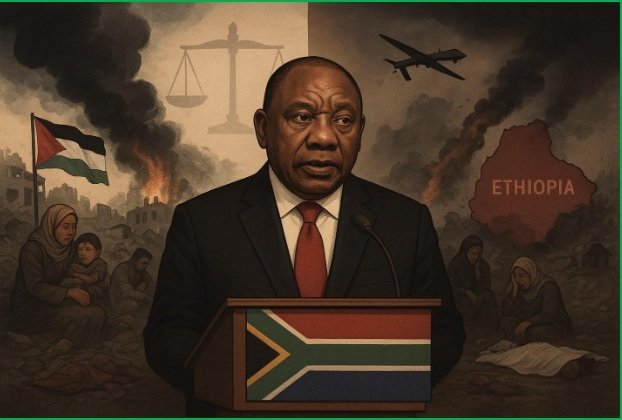
In an age when moral leadership is increasingly invoked but rarely practiced, Africa stands at a crossroads. Nations like South Africa—whose own liberation from apartheid gave it unmatched moral weight—are looked upon to guide the continent’s conscience. Yet that authority rings hollow when the same government that condemns genocide abroad remains silent about atrocities within Africa itself. As Ethiopia’s Amhara people endure what human rights groups describe as state-led massacres, displacement, and systematic persecution, the question is unavoidable: why does South Africa’s moral clarity vanish when the victims are African?
Introduction
In global diplomacy, moral authority is a currency—and few nations possess it as South Africa does. Emerging from the shadow of apartheid, South Africa’s leadership carries symbolic power when it speaks on justice and human rights. So when President Cyril Ramaphosa condemns the war in Gaza as “genocide” and “war crimes,” the world listens.
But moral authority loses its value when applied selectively. The same administration that forcefully denounces suffering abroad remains silent about the horrific atrocities unfolding in Ethiopia’s Amhara region, where thousands of civilians have been killed, displaced, and terrorized—many by their own government.
If Ramaphosa’s government claims to champion universal human rights, why does it not speak when fellow Africans are the victims?
Documented Atrocities Against the Amhara People
Reports from credible sources—Amnesty International (2024), Human Rights Watch (2025), the Ethiopian Human Rights Commission (EHRC, 2022), and the Amhara Association of America (AAA, 2024)—collectively paint a grim picture: the Ethiopian government’s military operations in Amhara have included indiscriminate airstrikes, mass detentions, extrajudicial killings, destruction of homes and places of worship, and systematic displacement.
Drone Strikes and Aerial Bombardments
The Amhara Association of America (2024) documented 53 deadly drone strikes in Amhara and Oromia regions over twelve months, resulting in 3,283 civilian casualties—2,592 killed and 691 injured. The majority of these attacks, attributed to the Ethiopian National Defense Force (ENDF), targeted populated areas such as marketplaces and residential zones.
The Armed Conflict Location & Event Data Project (ACLED), cited by DW (2024), confirmed that 52 out of 54 airstrikes in Amhara were carried out by drones, causing roughly 449 fatalities. In one incident alone, Reuters (2024) reported at least 15 civilian deaths following an airstrike on February 23, 2024.
Extrajudicial Killings and Mass Executions
Human Rights Watch (2025) reported multiple instances of Ethiopian forces executing civilians in Merawi and surrounding towns. Eyewitnesses described soldiers conducting mass roundups and shooting detainees without trial. Similarly, Amnesty International (2024) documented summary executions in Bahir Dar, the regional capital, including religious leaders and community figures.
Attacks on Churches, Mosques, and Homes
Civilian and religious structures—churches, mosques, schools, hospitals, and homes—have been hit by drone strikes and artillery fire. According to EHRC (2022), entire communities were shelled without distinction between combatants and civilians, and satellite imagery confirmed widespread damage to urban and rural settlements.
Mass Displacement and Arbitrary Detentions
Thousands of Amhara civilians have been forcibly displaced, with their homes looted or destroyed. Amnesty International (2024) reports that Ethiopia’s State of Emergency enabled mass arrests of journalists, judges, and ordinary citizens, many held without charge in degrading conditions.
South Africa’s Silence: A Crisis of Moral Integrity
South Africa’s government has positioned itself as a global defender of human rights, notably by pursuing legal action against Israel at the International Court of Justice (ICJ). Yet, this same government has shown complete silence on the atrocities in Ethiopia—atrocities that bear the hallmarks of war crimes and potentially crimes against humanity.
This contradiction exposes a deep moral inconsistency. A government cannot credibly claim to champion justice on one continent while ignoring mass killings on its own. Silence, in this case, is not neutrality—it is moral complicity.
If Ramaphosa truly believes in the universality of human rights, his administration must condemn all forms of genocide, regardless of geography or politics.
Possible Motives Behind the Silence
- Geopolitical Interests: Ethiopia’s strategic role in the African Union (AU) and its economic ties with South Africa may deter criticism.
- Diplomatic Calculations: South Africa’s government may wish to avoid conflict with a powerful African partner, prioritizing continental unity over justice.
- Selective Solidarity: The ANC’s historical anti-Western posture often directs moral outrage toward foreign powers while overlooking African perpetrators.
- Media Disparity: Global coverage of Gaza overshadows Ethiopian crises, making silence politically less costly.
These explanations, however, do not absolve South Africa of its ethical responsibility.
Why Silence Is Not Neutrality
South Africa’s failure to condemn atrocities in Amhara contradicts its stated foreign policy of “human rights–based diplomacy.” In the moral realm, silence in the face of genocide is equivalent to endorsement.
Under the Genocide Convention (1948), every state has a duty to prevent and punish genocide wherever it occurs. By ignoring atrocities in Ethiopia, South Africa risks betraying not only its founding values but also its continental moral leadership.
As Archbishop Desmond Tutu once warned, “If you are neutral in situations of injustice, you have chosen the side of the oppressor.”
Conclusion
President Cyril Ramaphosa’s stance on Gaza has earned him global recognition. But moral leadership is indivisible. To condemn genocide in Gaza while ignoring atrocities in Amhara is not justice—it is politics dressed in virtue.
If South Africa wishes to remain the moral conscience of Africa, it must apply its principles universally. The people of Amhara deserve the same empathy, advocacy, and outrage that South Africa extends to others.
Silence, in this case, is not diplomacy—it is betrayal. And history will remember not only the crimes of the powerful, but the silence of those who could have spoken.
Editor’s Note : Views in the article do not necessarily reflect the views of borkena.com
__
Support Borkena : https://borkena.com/subscribe-borkena/
Join our Telegram Channel : t.me/borkena
Like borkena on Facebook
To submit Press Release, send submission to info@borkena.com
Add your business to Ethiopian Business Listing / Ethiopian Business Directory
Join the conversation. Follow us on X (Formerly Twitter) @zborkena to get the latest Ethiopian News updates regularly.
A laughable commentary ! Can South Africa able to be a model as symbols of Human rights advocacy. There are many Human rights violation iinside South Africa against it own citizens and among African refugees. You rather appeal to Fano’s activists to discourage Fano’s combatants to stop the war and seek peaceful path. FANO’ by all it accounts can not win but misery
You sound juvenile in your understanding of global issues. I am embarrassed by your suggestion that South Africa is for hire. To begin with, the majority of news we’ve been getting was about Fano capturing or mutilating Federal army by the hundreds. Was the figure made up? Please get your info right before blabbering.