
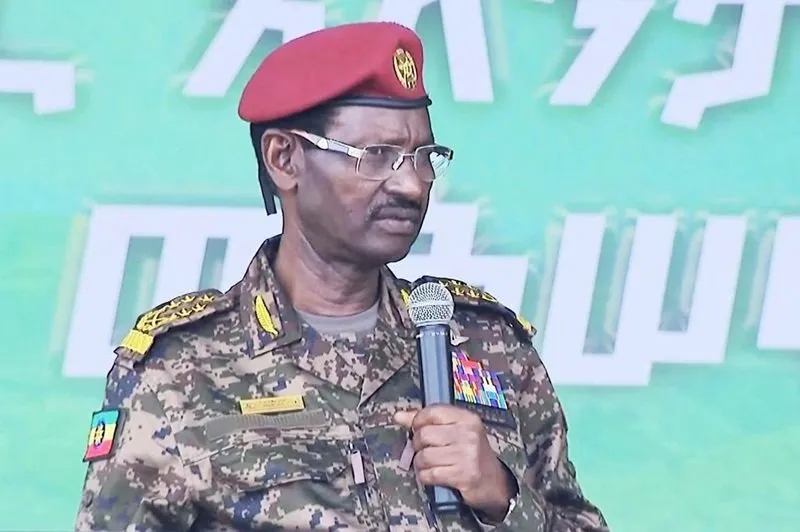
Berhanu Jula has accused three neighboring countries of “waging war against Ethiopia!” Such a declaration raises a fundamental question: who is threatening Ethiopia’s sovereignty, and what interests are driving the growing involvement of regional and international powers in the country’s internal conflicts? As the Ethiopian saying goes, “When a thief is caught, do you wait for a stick to strike him? or a beating is inevitable!” The proverb captures the irony of a political leadership that appears to recognize external threats only when those threats begin to undermine its own authority, despite the broader regional dynamics that have contributed to Ethiopia’s growing insecurity.
The reality is that Ethiopia’s internal conflicts cannot be understood in isolation from the competing interests of neighboring countries and other regional powers. Eritrea, Sudan, Egypt, Saudi Arabia, and Turkey, among others, have their own strategic, security, economic, and political calculations concerning Ethiopia. These countries may present their actions as serving their “legitimate national interests,” but the pursuit of national interests by one state can come at a considerable cost to another. When diplomatic competition gives way to support for armed groups, the consequences extend beyond political rivalries and threaten the stability of entire regions.
There are serious allegations that some of these countries have supported Ethiopian opposition forces seeking to remove Abiy Ahmed from power, including by providing training, weapons, and even arming them with drone capabilities. If substantiated, such assistance would represent a significant escalation in the internationalization of Ethiopia’s internal political struggles. Instead of encouraging dialogue, reconciliation, and a peaceful resolution to domestic grievances, external military support risks prolonging armed confrontations, increasing civilian suffering, and weakening the prospects for a durable political settlement.
Yet the central contradiction is difficult to ignore: governments that justify their involvement in Ethiopia’s affairs as necessary to protect their own security and national interests may be contributing to the very instability they claim to oppose. External actors rarely intervene without calculating the potential benefits. Some may seek strategic leverage over Addis Ababa, others may wish to influence regional security arrangements, and still others may be pursuing interests related to borders, waterways, trade, military partnerships, or broader geopolitical rivalries. Ethiopia’s internal divisions can therefore become instruments through which competing powers advance their own agendas.
However, it would be misleading to attribute Ethiopia’s political and security crisis entirely to foreign interference. External involvement can aggravate existing tensions, but the country’s internal grievances, political exclusion, unresolved conflicts, and failures of governance must also be examined. A government that fails to build public trust, address legitimate grievances, and establish an inclusive political order creates vulnerabilities that external actors may exploit. Sustainable national security requires more than accusing neighboring countries of hostile intentions; it demands competent leadership, accountable institutions, and a political process capable of addressing the causes of conflict.
The question of Abiy Ahmed’s alleged involvement in the civil war in Sudan must be examined within this broader context. His government’s relationship with the conflict, including allegations of military or logistical involvement, raises serious questions about Ethiopia’s regional priorities. Rather than assuming that such involvement is motivated by a genuine commitment to the peace and security of the Ethiopian people, critics argue that the government’s calculations may be shaped by its own political survival and its relationships with powerful external partners.
In particular, the United Arab Emirates has become an important actor in the wider regional political and security landscape. Critics contend that Abiy Ahmed’s relationship with the UAE is driven, at least in part, by the need to secure financial resources, military equipment, and political backing to sustain his government amid mounting domestic challenges. If such support is being used to strengthen the government’s coercive capacity while the country’s internal conflicts remain unresolved, the distinction between protecting the state and preserving a particular regime becomes critically important. It is important that these allegations have been supported by evidence to establish the precise nature of financial, military, or operational arrangements.
A government’s survival is not synonymous with the survival of a nation. Ethiopia’s long-term security depends on the protection of its people, the integrity of its institutions, the peaceful management of political differences, and the preservation of its sovereignty. When national resources and foreign partnerships are directed primarily toward maintaining political power rather than resolving the conflicts devastating the country, the state risks becoming increasingly dependent on external patrons while losing the confidence of its own citizens.
Ultimately, Berhanu Jula’s accusation that neighboring countries are “waging war against Ethiopia ” should prompt a broader examination of responsibility and accountability. Which foreign governments are supporting armed actors, what evidence establishes the nature of that support, and how have Ethiopia’s own political decisions contributed to the current situation? These questions must be addressed honestly, without double standards or selective outrage.
Ethiopia cannot secure lasting peace by treating every external challenge as an isolated act of aggression while ignoring the internal conditions that make the country vulnerable to foreign interference. Nor can its leaders credibly invoke national sovereignty if their policies deepen domestic divisions or leave the country increasingly dependent on outside financial and military support. The ultimate test of leadership is not whether a government can remain in power amid successive crises, but whether it can protect its people, resolve conflicts through legitimate political means, and preserve the country’s independence and dignity.
The central issue, therefore, is not simply who is waging war against Ethiopia, but who is benefiting from its continued instability—and whether the interests of the Ethiopian people are being placed above the interests of political elites and their foreign partners.
Editor’s Note: Views in the article do not necessarily reflect the views of borkena.com
__
Join our Telegram Channel: t.me/borkena
Like borkena on Facebook
To submit a press release, send the submission to info@borkena.com
Add your business to Ethiopian Business Listing / Ethiopian Business Directory
Join the conversation. Follow us on X (formerly Twitter) @zborkena to get the latest Ethiopian news updates regularly.