 reports that ongoing insecurity and movement restrictions in the Amhara region of Ethiopia hindering operation)
By: Getahun Tsegaye
Staff Reporter
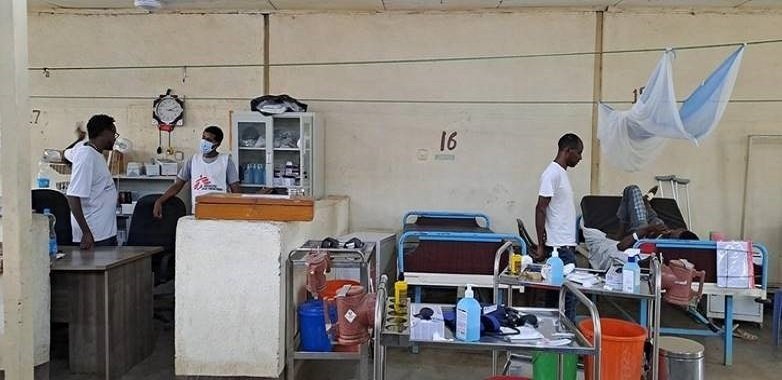
Addis Ababa, Ethiopia – Médecins Sans Frontières (MSF) reports that ongoing insecurity and movement restrictions in the Amhara region are severely hindering healthcare operations. As a result, patients are struggling to reach vital medical treatment, leading to prolonged suffering and worsening health conditions. MSF’s health center in Abdurafi, established to aid communities in Western Amhara, is among the facilities most impacted by the conflict.
One example of these challenges is the case of Dawit Hailu, a 30-year-old farmer from a remote area near Abdurafi town in northwest Amhara. Dawit recounts his harrowing experience after a snakebite on the evening of May 24, 2025, while collecting firewood approximately 17 kilometers from Abdurafi.
“I knew the risks of snakebites and was aware of MSF’s clinic in Abdurafi, but transportation was incredibly difficult due to the insecurity in my area,” Dawit shared. “With no other option, my friends carried me on a bed for 11 kilometers.”
His journey continued with immense difficulty. MSF’s report narrates, “Eventually, my brother managed to find a motorbike, and we finally arrived at the MSF clinic around midnight.”
Patients at MSF’s facility consistently describe widespread insecurity, movement restrictions, and significant financial barriers that prevent them from reaching health facilities when it matters most.
“Transport and security challenges mean many people struggle to come to the MSF clinic,” says Moses CM Malual, MSF project coordinator. “Some pay up to 5,000 birr (around USD 40) for a ride that should cost 200 birr (USD 1.45). This makes it nearly impossible for those who can’t afford such high prices to access care.”
Gebrehiwot and Engda Melak, both treated for snakebite, still vividly remember the fear they felt. “I was really scared because someone in our village had died from a snakebite recently; I thought the same would happen to me,” says Gebrehiwot. Engda adds, “I felt pain; I tried to rest because there was no transportation available at night. I had no choice but to wait until morning.”
Semere Sisay, a kala-azar patient from Abdurafi, shares his ongoing struggle: “I was first diagnosed in 2023 with a high fever, sweating, weight loss, and swollen spleen. I’ve been sick six times since then. MSF is the only provider of the medicine I need.” The conflict has further isolated him: “My wife and children fled to Sudan because of the conflict, and I’ve been going through all this alone.”
These delays have severe consequences. “More patients are arriving late with snakebites and kala-azar who should have come days earlier,” warns Ana Banda, MSF’s deputy medical coordinator. “Delays in care lead to more severe complications, and in some cases, it becomes too late to help.”
MSF has been active in the Abdurafi area since 2003, providing crucial treatment for kala-azar, snakebites, and co-infections with HIV, TB, and other related illnesses. The organization notes that “Every year from June to October, the region sees an increase in cases due to the rainy season and harvest period.”
However, health facilities are under growing strain, facing shortages of essential medicines and disrupted supply chains. “Mobile outreach services, which once played a key role in reaching remote patients with kala-azar, have been scaled back or suspended due to security concerns,” MSF stated.
“Without urgent action, preventable deaths from treatable conditions will continue to rise as the seasonal peak for both snakebite and kala-azar approaches,” Banda warned.
Between January and May 2025, MSF’s teams in the Abdurafi center treated 61 kala-azar patients and 363 snakebite cases. MSF is currently the sole provider of treatment for kala-azar and snakebite patients in the northwest part of the region. There is a “critical need for better access to and availability of healthcare services in the region—particularly the consistent supply of anti-venoms and treatment for kala-azar in health facilities,” the organization added.
Due to the prevailing insecurity, MSF has had to suspend outreach health promotion and information activities. Additionally, the organization was forced to halt life-saving ambulance referrals for highly critical patients to Gondar University Hospital, further exacerbating the challenges faced by those in need of urgent care.
Patients who brave these numerous challenges to reach health facilities face additional burdens. Many are subjected to “multiple expenses, in addition to being exposed to robbery, beatings, and other physical assaults during transport,” according to independent reports, including those from the Ethiopian Human Rights Commission (EHRC) regarding the ongoing conflict in the Amhara region.
The statement also highlighted that patients referred from health centers to hospitals are unable to travel or receive treatment due to the conflict. Gondar Hospital, known for receiving a large number of referred patients, is unable to provide adequate treatment due to road closures and patient harassment at checkpoints, further hindering access to essential care.
Subscribe : https://borkena.com/subscribe-borkena/
Join our Telegram Channel : t.me/borkena
Like borkena on Facebook
Add your business to Ethiopian Business Listing / Ethiopian Business Directory Business Listing Toronto
Join the conversation. Follow us on X (Formerly Twitter) @zborkena to get the latest Ethiopian News updates regularly. Subscribe to YouTube channel To share information or for submission, send e-mail to info@borkena.com
Hey folks! This is the perfect definition of ‘liberation’. This happens all the time when you liberate your people. Ain’t no big deal if your people die for lack of basic healthcare. You guys are so silly fussing about this. What many of you who want to be leaders are lacking is you don’t know how to teach your people how to gain weight and stay tubby lard forever. Remember our centuries old tradition: The fatter you are the more respect you get from your people. If you can’t get fat, you should get the Rastaman dreadlocks loaded with lice and scabies with a 12-inch ganja in both hands which goes with Sly serenading you with ‘I wanna take you higher!!!’ Boom laka-laka-laka, Boom laka-lak-goon-ka boom!!!