
Historical Evidence, Demographic Plausibility, and the Legacy of Emperor Menelik II
Aklog Birara (Dr)
Abstract
This article responds to Genocide Watch’s claim that Emperor Menelik II’s Ethiopian wars reduced the Oromo population from ten million in 1870 to 5 million in 1900. It argues that this claim is historically under-sourced, demographically implausible, and conceptually imprecise.
The article does not deny that Menelik’s state-building involved war, coercion, resistance, and suffering in regions. Rather, it asks whether the specific claim of a five-million-person Oromo demographic collapse caused by Menelik’s wars is supported by credible evidence.
The article evaluates the claim through historical demography, Ethiopian population estimates, the history of Oromo political formations, the legacy of the Gragn Ahmed wars, and recurrent famines that reduced Ethiopia’s population from time to time.
Ethiopia’s unfinished nation-building entails costs in human lives and in development. In this case, Ethiopia is going through similar processes as other nations including those in Europe and North America. Nation-building is never a smooth ride.
This article makes the distinction between conquest, incorporation, restoration, colonization, and genocide. It concludes that Genocide Watch should either provide the demographic evidence for its claim or revise the statement in the interest of historical accuracy and responsible human rights advocacy.
I. Introduction: Appreciation, Scope, and Purpose
I would like to begin by thanking Dr. Gregory Stanton, founder and president of Genocide Watch his thoughtful presentation on Capitol Hill on May 15, 2026.
Among the themes he addressed were:
• The Challenge of Ethiopian Constitutionalism and Federalism
• Ethiopia’s Human Rights Crisis: ethnic cleansing and genocide of Amhara, Tigrean, Annuak, and others. This is a huge contribution at a time when Ethiopians victims of state and non-state led atrocities do not have voice on the global stage.
I intentionally shared Dr. Stanton’s presentation with the international community, including Ethiopians, to encourage constructive dialogue, careful reflection, and evidence-based response. Sharing the presentation, however, should not be understood as agreement with all its conclusions.
This article does not seek to minimize Dr. Stanton’s concerns about Ethiopia’s current human rights crisis. Those concerns are serious and deserve sustained international attention.
Nor does this article attempt to provide a complete history of Oromo–other Ethiopian relations. Its narrow purpose is to examine one historically consequential claim that is harmful to the Ethiopian people attributed to Genocide Watch: that Emperor Menelik II’s wars reduced the Oromo population from ten million in 1870 to 5 million in 1900.[1]
In my assessment, this claim is historically problematic and demographically implausible. It is not supported by the type of evidence required for a claim of such magnitude. The repetition of a political narrative, however widespread and deep, does not by itself establish historical fact.
My core argument
The central argument of this article is straightforward: if Ethiopia’s total population around 1900 was nine million, the claim that the Oromo alone numbered ten million in 1870 and was reduced to five million by 1900 requires exceptionally strong demographic evidence.
To my knowledge, such evidence has not been presented.[2]
II. Method and Burden of Proof
This article evaluates the claim through five related lenses: historical demography, Ethiopian population estimates, nineteenth-century state formation, the history of Oromo political formations, and conceptual distinctions among conquest, incorporation, colonization, restoration, and genocide.
The burden of proof rests with those who advance a claim of demographic collapse and genocide. It is not sufficient to repeat a politically charged assertion or political folklore. Such a claim must be supported by credible demographic data, transparent sources, and careful historical reasoning.
This principle is especially important in the Ethiopian case. Ethiopia’s nineteenth-century population is not known with precision. The size of the Oromo population then is engineered rather than normal. This is why researchers must be extra careful.
For the record, Ethiopia held its first modern census only in 1984. For earlier periods, scholars rely on estimates, reconstructions, traveler accounts, administrative records, and later demographic modeling. These sources are imperfect. For that very reason, precise ethnic population claims for 1870 or 1900 should be treated with extra caution.
A claim that one ethnic population declined by five million people over thirty years requires more than assertion. It requires evidence that is internally consistent, demographically plausible, and historically verifiable.
For this reason, I urge Genocide Watch to either revise or retract its statement.
III. Ethiopia’s Present Crisis and the Need for Responsible Historical Debate
Ethiopia is passing through one of the most painful periods in its modern history. Ethnic hatred, political polarization, religious extremism, terrorism, irredentism, separatism, and state capture have placed the country under severe strain. Innocent people from many communities —including Amhara, Tigray, Afar, Annuak, Gurage, Wolyayta, Oromo, and others — have suffered from recurring state and non-state led violence, displacement, insecurity, and loss.
For this reason, the work of human rights organizations like Amnesty International, Human Rights Watch, the Lemkin Institute to Prevent Genocide should be taken seriously. Genocide Watch has an important mission. Dr. Stanton’s concern for victims should not be dismissed. This is the reason we asked him to serve as the keynote speaker on May 15, 2026. I commend him for this.
At the same time, human rights advocacy becomes stronger, not weaker, when it is grounded in careful historical methods, balanced evidence, and demographic plausibility.
Ethiopians who read Dr. Stanton’s analysis should therefore respond seriously and responsibly.
Outrage alone is not sufficient. Historical claims should be answered with evidence, logic, and documented counterargument. Political narratives should be examined intellectually, not merely emotionally. Accusations and counter accusations do not help the cause. Nor does questioning motives regardless of the person.
The present Ethiopian crisis makes historical accuracy even more important. Unsupported or exaggerated historical claims may intensify existing divisions rather than contribute to justice, accountability, and reconciliation, values to which Genocide Watch is committed.
IV. The Oromo Studies Association and the Formation of Historical Narrative
There is a substantial body of organized intellectual and political work behind the narratives now circulating internationally regarding Oromo history and Ethiopian state formation. One important institution in this regard is the Oromo Studies Association, OSA, founded in 1986 as a nonprofit and multidisciplinary organization. Records show that the first Journal of Oromo Studies (JOS) was published in 1992, one year after the Tigray People’s Liberation Front (TPLF) led-ethnic coalition that included the Oromo Liberation Front (OLF) took political power.
For decades, OSA and associated scholars have produced articles, books, policy recommendations, and political interpretations that have circulated widely in academic, activist, media, and policy spaces. During this same period, Amhara academics, intellectuals, and activists produced comparatively little systematic rebuttal or alternative interpretation. This created an intellectual imbalance in the international presentation of Ethiopian history.
In this regard, it is necessary to acknowledge OSA’s effectiveness. Its narratives have influenced academics, researchers, media outlets, think tanks, human rights organizations, and policy communities. These narratives often portray Amhara political actors as colonizers, oppressors, land grabbers, and beneficiaries of imperial domination. Foreign readers and institutions have encountered these claims with limited exposure to alternative evidence-based perspectives.
One influential interpretation depicts Emperor Menelik II’s campaign of restoration and incorporation as an imperialist invasion and annexation of Oromo lands by Amhara. Repeated over years, this interpretation has gained traction and has become influential in Western and Arab academic, activist, and policy circles.
The objection here is not that Oromo scholars should not write their history. They should. Every community has the right and responsibility to examine its own historical experience. The objection is that contested political narratives should not be converted into institutional judgments and government policy without rigorous scrutiny.
Historical claims involving genocide, mass death, demographic collapse, colonization, and state formation require careful evidence, comparative analysis, and conceptual precision.
V. Source Transparency and the Preparation of the Genocide Watch Statement
The Genocide Watch page identifies Dr. Gregory Stanton as the author and speaker. It also credits “Atticus Mawbe, LLB, London, England” for “research and drafting of much of this speech.” [3]
However, the page provides no institutional affiliation, biographical profile, area of specialization, or information on where the LLB was obtained.
Because the document contains grave historical and demographic claims, this limited disclosure raises legitimate questions about source verification and subject-matter review.
Readers are not provided with enough information to determine whether the acknowledged research contributor had specialized training or experience in Ethiopian history, Oromo studies, historical demography, or genocide studies.
This concern is not personal. It is institutional and methodological. When a human rights organization publishes claims with serious historical, moral, and political implications, it should disclose the evidentiary basis for those claims and ensure that they have been reviewed and vetted by qualified specialists. Where such claims are unsupported or inaccurate, the organization should correct them in the interest of historical accuracy, fairness, and responsible human rights advocacy.
VI. The Specific Claim Under Review
Genocide Watch states that “Menelik II’s Ethiopian wars cut the Oromo population from 10 million in 1870 to 5 million in 1900.” It further states that “The Oromo religion was banned, and Oromo institutions of self-governance were abolished. The Oromo remained independent until the 1890s, after which Ethiopia colonized them.” [4]
These statements raise several important questions.
First, what is the demographic source for the claim that the Oromo population was ten million in1870?
Second, what evidence supports the assertion that this population was reduced to five million by1900?
Third, how can these numbers be reconciled with estimates of Ethiopia’s total population during the same period?
Fourth, does the phrase “the Oromo remained independent” refer to all Oromo-speaking communities, to specific Oromo kingdoms, to pastoral confederacies, to regional polities, or to a unified Oromo national state?
These questions matter because the claim is not merely descriptive. It carries moral, legal, political, and historical implications. It shows bias and partisanship. It suggests that Menelik’s state-building project involved a huge and material demographic catastrophe of extraordinary scale. A claim of this kind requires correspondingly compelling evidence. This conclusion worsens the Ethiopian political discourse.
This is why I urge retraction.
VII. Conceptual Precision: Genocide, Colonization, Conquest, Incorporation, and Restoration
The terms genocide, colonization, conquest, incorporation, and restoration are not at all interchangeable. Each carries a distinct historical and legal meaning. Careless substitution of one term for another can distort intellectual honesty and historical understanding.
Genocide Watch and UN protocols teach us that Genocide refers to the intent to destroy, in whole or in part, a national, ethnic, racial, or religious group as such. Colonization refers to domination, settlement, or rule imposed by an external power over a subject territory or population. Conquest refers to military defeat and political subordination. Incorporation refers to the absorption of a polity or territory into a larger state, which may occur through war, negotiation, alliance, consent, tribute, or administrative integration. Restoration refers to the attempt to recover territories, institutions, or historical centers understood by a state or society as part of an earlier political order.
These distinctions matter for Ethiopian history. Menelik’s state-building included wars when justified, negotiation in others, alliance in others, and tribute arrangements in still others. A serious historical account must distinguish between these processes. To describe all Menelik’s state-building as “colonization” risks flattening a complex historical process into a single ideological category.
VIII. Menelik II: Liberator, State-Builder, or Domestic Colonizer?
Ethiopia is widely recognized as a symbol of Black freedom and independence largely because of Emperor Menelik II’s leadership at the Battle of Adwa in 1896. Menelik mobilized diverse segments of Ethiopian society, including Oromo leaders and fighters, and defeated Italian colonial aggression.[5]
Ethiopia’s freedom from colonial conquest is a shared achievement in the annals of history. This historical fact complicates any interpretation that presents Menelik solely as a domestic colonizer. Oromo communities were not merely passive subjects of Menelik’s rule. Notable Oromo leaders and communities were active participants in the making of the modern Ethiopian state. Figures such as Ras Gobena and Abba Jifar of Jimma demonstrate that the relationship between Menelik and Oromo political actors cannot be reduced to a single narrative of Amhara conquest over Oromo victims.[6]
This does not mean that Menelik’s expansion was peaceful everywhere. It was not. Some areas were incorporated through negotiation, through alliance, through tribute arrangements, and through war. This blend is important.
Acknowledging the demographic implausibility of Stanton’s claim does not require denying that Menelik’s expansion involved violence, coercion, resistance, and suffering in some regions. The question is not whether violence occurred, but whether the evidence supports the specific claim of a five-million-person Oromo demographic collapse caused by Menelik’s wars.[7]
The central analytical point is that restoration, alliance, negotiated incorporation, tribute, conquest, and colonization are not identical concepts. Considering them as identical leads to the wrong conclusion as is the case in Stanton’s article.
IX. Menelik’s Restorative Objective and the Historical Memory of Gragn Ahmed
A more complete historical analysis should examine the background that shaped Menelik’s campaign. Emperor Menelik II’s state-building project did not emerge in a historical vacuum. It was influenced by the long memory of Ethiopia’s earlier territorial rupture, especially the devastation associated with Ahmad ibn Ibrahim al-Ghazi, commonly known as Gragn Ahmed.[8]
Menelik’s campaign may be understood as having two broad strategic objectives.
First, he sought to restore territories that Ethiopian historical memory associated with the pre-Gragn and post-Gragn Ethiopian state.
Second, he sought to reestablish Ethiopia’s political center around Barara, በራራ—ቀዳሚት አዲስ አበባ, which historians identify with the broader historical geography of present-day Addis Ababa.[9]
In this regard, I refer to the work of historian Habtamu Mengiste Tegegne. His research identifies Barara, present-day Addis Ababa, as an ancient Ethiopian capital. I had the privilege of participating as a reviewer of this important book.
Habtamu Mengiste Tegegne’s book includes the following passage:
“Before the Emir Abd Bakr returned from Debre Libanos after burning it, the Muslim people of Barara went to the Imam and said, ‘We know the whereabouts of the King’s treasures that used to be in Badeeque; and we will lead you to them….’ He took possession of the valuables, just as they had indicated that he could, and stayed six days there plundering booty from the regions of Fatagar and Masin before returning to the Imam, who was still in Barara,” the ancient Ethiopian capital.[10]
Strengthening his argument concerning the geographical location and authenticity of the city, Habtamu Mengiste writes that “in the 15th and 16th centuries, Barara served as a major hub from which Ethiopian Christians traveled to Jerusalem, Israel.” Original village and town names changed because of Gragn Ahmed’s invasion, annexation, and renaming of places.[11]
Ahmad ibn Ibrahim al-Ghazi served as the military leader of the Adal Sultanate and led a major invasion of the Christian Ethiopian Empire between 1529 and 1543. His campaign, known as the Futuh al-Habasha, or Conquest of Abyssinia, was one of the most destructive wars in Ethiopian history.[12]
Large numbers of Ethiopian soldiers and civilians were killed during battles and subsequent occupations. Churches and monasteries were burned, looted, or destroyed, including important religious centers in Tigray and Aksum. Contemporary accounts describe forced conversions in some conquered territories and the enslavement of captives.[13]
By the mid-1530s, much of the Ethiopian Empire was under Adal occupation, and Emperor Lebna Dengel was forced into continual flight. Some sources state that three-quarters of the empire came under Gragn’s control, although the exact extent varied over time.[14]
The purpose of this background is not to justify every action taken in later centuries. Rather, it is to show that Menelik’s campaign was understood by many Ethiopian actors as a project of restoration, reconstitution, and reconstruction not as a foreign colonial invasion.
X. Ethiopia’s Recovery from Gragn’s War and the Restoration Tradition
Facing near-total defeat, the Ethiopian Empire appealed to European forces for military assistance. In 1541, a Portuguese force of around four hundred musketeers led by Cristóvão da Gama, the son of Vasco da Gama, arrived to assist Ethiopia.[15]
Although Cristóvão da Gama was captured and executed by Gragn’s forces after an earlier battle, the surviving Portuguese soldiers regrouped and joined Emperor Gelawdewos. Together, the combined Ethiopian and Portuguese forces decisively defeated the Adal army at the Battle of Wayna Daga on February 21, 1543. Ahmad Gragn was killed during the battle, and his army collapsed.[16]
This victory restored the Ethiopian Empire, but it did not erase the psychological pain and the scars of devastation. The memory of lost territories, lost economy, destroyed churches, displaced communities, and fractured political authority remained part of Ethiopian historical consciousness.
Menelik II can therefore be associated hugely within this restoration tradition. He restored and reconfirmed territories, rebuilt the state, and reclaimed the ancient capital region, naming it Addis Ababa — New Flower.[17]
This does not mean that every act of incorporation was peaceful or uncontested. It means that the historical logic of Menelik’s campaign cannot be reduced to the language of European-style colonialism without careful qualification.
XI. Contemporary Relevance and the Need for Historical Accuracy
The scars left by Gragn Ahmed’s invasion remain deeply imprinted on Ethiopian historical memory. These memories continue to shape how Ethiopians understand statehood, sovereignty, religious coexistence, and territorial integrity.
At the same time, Ethiopia today faces a grave moral and political crisis. Violence directed against civilians, including Amhara and Ethiopian Orthodox Christians in Arsi and elsewhere remain unaddressed.
This evokes painful historical memories of earlier episodes of religious and ethnic terror.
I caution though; such comparisons should be made carefully. History does not repeat itself mechanically. Rather, certain patterns may recur when state power, ethnic ideology, religious hostility, and impunity converge. The human consequences can be devastating.
To their credit, followers of Ethiopia’s major faiths — Christianity, Islam, and Judaism — have long coexisted side by side in most parts of the country. They have often embraced common humanity and a shared Ethiopian identity. Ethnic elites in power degrade these values at great cost to the Ethiopian people.
This contemporary reality makes historical accuracy even more urgent. Unsupported or exaggerated historical claims do not heal present wounds. They risk deepening them. They do not promote commonalities like shared humanity and shared national identity. They do not advance justice and equality under the law.
XII. Demographic Evidence: Why the Claim Requires Reconsideration
The most fundamental problem with Dr. Stanton’s claim is demographic.
Ethiopia’s population size in the nineteenth century is uncertain and politically contested.
Ethiopia held its first modern census only in 1984.[18]
For earlier periods, scholars rely on estimates, reconstructions, traveler accounts, administrative records, and later demographic modeling. These sources are imperfect. For that reason, any precise claim about ethnic population size in 1870 or 1900 must be treated with caution.
To establish a baseline, I reviewed historical data on Ethiopia’s estimated population from 1800 to 2020.
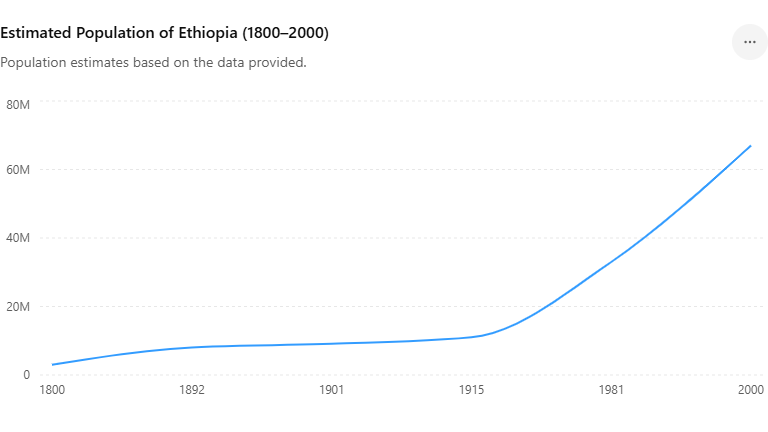
In a November 28, 2025, publication entitled “Population of Ethiopia: 1800–2020,” D. Clark estimates that “in 1800, the population of Ethiopia was 2.95 million.” [19]
It rose to 8.05 million by 1892 and 9.12 million by 1901. The graph below shows Ethiopia’s estimated population between 1800 and 2000.
Historians agree that Ethiopia suffered more than twenty major famines between 1540 and 1800. These famines killed hundreds of thousands of people cumulatively, although exact figures remain uncertain. The best-documented “Great Famine” in Ethiopian history is the 1888–1892 famine, Kifu Qen, or “Evil Days.” Many historians estimate that up to one-third of Ethiopia’s population died, possibly several million people.[20]
These demographic shocks must be taken seriously. Famine, disease, war, migration, enslavement, and displacement all affected population change. However, these factors do not by themselves support the specific claim that the Oromo population fell from ten million to five million between 1870 and 1900 because of Menelik’s wars.
Dr. Stanton’s argument is especially problematic because Ethiopia’s entire population in 1892 is estimated at 8.05 million people. In 1901, Ethiopia’s population is estimated at about 9.12 million people.[21]
If these estimates are even approximately correct, the claim that the Oromo alone numbered ten million in 1870 is mathematically implausible.
The Oromo population could only have constituted a portion of Ethiopia’s total population.
Therefore, the assertion that Menelik reduced the Oromo population from ten million to five million cannot be sustained unless one first demonstrates that the total population estimates are wrong and that the Oromo population alone exceeded Ethiopia’s entire estimated population. This does mean non-Oromo Ethiopians did not exist.
No such evidence has been provided.
I would then ask, “On what basis, then, does Dr. Stanton argue that Emperor Menelik II “cut the Oromo population from 10 million to 5 million”? Without a credible demographic source, this claim should be reconsidered and withdrawn.
I respectfully urge Dr. Stanton and Genocide Watch to review this statement and remove or revise it at the earliest opportunity.
XIII. Menelik and the Question of Genocide
The demographic implausibility of the claim also raises an ethical, moral, and legal question. As Genocide Watch and other human rights advocacy organizations know, Genocide is among the gravest accusations in international discourse. It should not be made casually, imprecisely, or based on politicized demographic claims and non-independently vetted data supported by eyewitnesses, forensic evidence, and the like.
This does not mean that Menelik’s campaigns involved no violence. They did. State formation in the nineteenth century was often violent, and Ethiopia was no exception. Regions that resisted incorporation suffered greatly. These histories deserve serious study.
However, violence, conquest, tribute, incorporation, consented affiliation of association and genocide are not synonymous. A responsible historical argument must distinguish between them.
Emperor Menelik II should not be described as genocide-prone without compelling evidence. His political method included war where resistance was fierce, but it also included alliances, negotiation, incorporation, consent, recognition of local authority, and cooperation with Oromo leaders.
Evidence shows he governed a diverse empire and depended upon multiethnic coalitions.[22]
A ruler who relied on Oromo allies, incorporated Oromo elites, collaborated with regional rulers, and mobilized diverse peoples at Adwa cannot be adequately understood through a simple narrative of anti-Oromo extermination. This depiction of Emperor Menelik II diminishes the role of Oromo in defending Ethiopians from colonial and imperial powers.
XIV. Oromo Political Formations and the Question of Independence
Dr. Stanton also states that “The Oromo remained independent until the 1890s, when they were colonized by Ethiopia.” [23]
This statement requires clarification. It asserts homogeneity. Which Oromo communities are being referenced? Which regions? Which political formation? Which institutions? Which period?
It is true historical records do indicate the existence of major independent or semi-independent Oromo kingdoms, especially the Gibe Oromo kingdoms in southwestern Ethiopia between 1700 and 1900.[24]
The Kingdom of Limmu-Ennarea was founded around 1800 and was incorporated into Ethiopia in the 1890s.
The Kingdom of Jimma, consolidated in the early nineteenth century under Abba Jifar I, operated as a semi-autonomous state until the early twentieth century.
The Kingdom of Gomma emerged in the late eighteenth century and was incorporated into Ethiopia in 1886 during the reign of Emperor Menelik II.
The Kingdom of Gumma was founded around 1770–1810 and was incorporated into Ethiopia in the late 1880s.
The Kingdom of Gera was founded around 1835 and was incorporated into Ethiopia in 1887 under Menelik II.[25]
These kingdoms operated as independent or semi-independent entities until their incorporation into Ethiopia. However, the existence of Oromo kingdoms does not necessarily establish the existence of a single, homogeneous, unified, independent Oromo national state recognized by foreign powers.
The distinction is crucial. The existence of Oromo kingdoms does not automatically establish the existence of one unified Oromo state. Nor does the incorporation of different Oromo polities into Ethiopia prove a single story of colonization. Each case must be examined in its own historical terms.
History tells us of the existence of diverse and different Amhara Kingdoms and fiefdoms in territories populated by the Amhara population.
I urge Dr. Stanton to reflect on this distinction and revise his documentation accordingly.
XV. Menelik’s Contribution to the Modern Ethiopian State
For the record, I would also ask Dr. Stanton to consider Emperor Menelik II’s historic contributions to nation-building.
Emperor Menelik II made Ethiopia a beacon of Black African freedom and independence because of his leadership at Adwa and his ability to mobilize a diverse society against foreign aggression.
He governed by listening and seeking input, including from Oromo leaders such as Ras Gobena and Abba Jifar of Jimma.[26]
He contributed significantly to the later formation of Pan-African consciousness. His victory at Adwa inspired colonized and oppressed people across Africa and beyond.[27]
He built coalitions, restored Ethiopia’s national territories, strengthened the country’s sovereign status on the world stage, and established diplomatic ties with foreign powers, including the United States of America.
I do not wish to romanticize his leadership. Like all state-builders of his era, Menelik operated in a world of war, power, alliance, tribute, and territorial consolidation. But he deserves to be understood and appreciated in his full historical complexity.
Restoration and incorporation in the making of Ethiopia are different from colonization. Where conquest occurred, it should be studied and presented honestly. Where alliance and negotiated incorporation occurred, they too should be acknowledged and appreciated hugely.
XVI. Ethiopia’s Civilizational Continuity
I give credit where credit is due. Dr. Stanton is right to recognize the historical importance of the Aksumite Kingdom, one of the most distinctive ancient civilizations in world history. Aksum’s long duration and wide influence places Ethiopia among the important centers of world civilization. The kingdom declined, but Ethiopia survived.[28]
This survival entails leadership, cost, and continuity. The Solomonic dynasty, from which Ethiopian kings and emperors — mostly Amhara of mixed ethnicity — claimed legitimacy, succeeded the Aksumite tradition, and ruled Ethiopia until 1974.
It is this continuity that I wish Dr. Stanton had emphasized more clearly. Regimes rise and fall, but Ethiopia endured because successive leaders preserved, restored, and reconstituted the state under changing historical conditions.[29]
Ethiopia is one of the world’s ancient countries. It is also among the least homogeneous countries in terms of ethnicity and faith. Any country with such a long history cannot remain homogeneous. Ethiopia’s history reflects a rich and complex mixture of faiths, languages, peoples, regions, and political traditions.
This makes Ethiopia a multiethnic and multifaith society, with each group contributing its own cultures, languages, histories, and social, economic, spiritual, and political practices. This richness is central to Ethiopia’s historical identity.
XVII. Recommended Corrections for Genocide Watch
In the interest of historical accuracy and responsible human rights advocacy, Genocide Watch should consider three corrections.
First, it should provide the source for the claim that the Oromo population was ten million in 1870 and was reduced to five million in 1900 by Menelik’s wars.
Second, it should clarify what it means by the statement that “the Oromo remained independent until the 1890s.”
Does this refer to all Oromo-speaking populations, specific Oromo kingdoms, regional polities, pastoral confederacies, or a unified national state?
Third, it should revise or withdraw demographic language that cannot be reconciled with available estimates of Ethiopia’s total population around 1900.
Because the article was published by Genocide Watch under Dr. Stanton’s name, responsibility for correction rests both with the author and with the publishing institution.
XVIII. Invitation to Correction and Dialogue
This critique is offered in the spirit of correction, not denunciation. Genocide Watch has a vital role in alerting the world to mass violence and the risks of genocide. That role is strengthened when its historical claims are carefully sourced, conceptually precise, and open to revision.
I therefore invite Dr. Stanton and Genocide Watch to review the demographic and historical claims discussed in this article, provide the evidence on which they rely, and revise statements that cannot be supported by the available record.
Such a step will contribute hugely to all the Ethiopian people who wish to build an all-inclusive, just, equitable, democratic, and prosperous Ethiopia.
XIX. Conclusion: Historical Fairness and the Adwa Spirit
It was Ethiopia’s richness of diversity that Emperor Menelik cultivated. It was this diversity, too, that enabled him to mobilize representatives of the country’s varied communities to battle against foreign aggression. He defeated a modern Italian invading army because of this broad coalition of forces.
I wish Dr. Stanton had given greater attention to Emperor Menelik’s historical stature and to the complexity of Ethiopia’s state formation.
The Adwa spirit remains a powerful symbol of African freedom, Ethiopian sovereignty, and multiethnic mobilization against colonial aggression.
For this reason, Genocide Watch should reconsider and revise its claim that Menelik II’s wars reduced the Oromo population from ten million to five million. That claim is not supported by the demographic record presented here. It risks transforming a contested political narrative into institutional judgment.
Responsible scholarship and responsible human rights advocacy must distinguish between documented atrocities, contested memories, political narratives, demographic uncertainty, and demographic impossibility.
Ethiopia’s present crisis is grave enough. It should not be compounded by historically unsupported claims that deepen ethnic division rather than clarify truth and advance the common good.
If Genocide Watch seeks to contribute to justice, accountability, and reconciliation, it should welcome correction where its historical claims are weak. Intellectual honesty that buffers truth is not weakened by revision. It strengthens it. I am confident Dr. Stanton agrees.
The purpose of this critique is therefore not to diminish the importance of advocacy of human rights, but to strengthen it by insisting that grave historical claims be supported by grave evidence.
Endnotes and References
[1] Stanton, “The Challenge of Ethiopian Constitutionalism,” Genocide Watch, 2026.
[2] Clark, “Population of Ethiopia: 1800–2020,” Statista, 2025.
[3] Stanton, “The Challenge of Ethiopian Constitutionalism.”
[4] Stanton, “The Challenge of Ethiopian Constitutionalism.”
[5] Bahru Zewde, A History of Modern Ethiopia, 2001; Marcus, Menelik II, 1975.
[6] Mohammed Hassen, The Oromo of Ethiopia, 1990; Bahru Zewde, A History of ModernEthiopia, 2001.
[7] Bahru Zewde, A History of Modern Ethiopia; Mohammed Hassen, The Oromo of Ethiopia.
[8] Pankhurst, The Ethiopians, 1998; Taddesse Tamrat, Church, and State in Ethiopia, 1972.
[9] Habtamu Mengiste Tegegne, Barara: Kedamawit Addis Ababa (1400–1887), 2020, p. ___.
[10] Habtamu Mengiste Tegegne, Barara, 2020, p. ___. [Page number to be filled later.]
[11] Habtamu Mengiste Tegegne, Barara, 2020, p. ___.
[12] Arab Faqih, Futuh al-Habasha; Pankhurst, The Ethiopians, 1998.
[13] Arab Faqih, Futuh al-Habasha; Pankhurst, The Ethiopians.
[14] Pankhurst, The Ethiopians; Taddesse Tamrat, Church, and State in Ethiopia.
[15] Pankhurst, The Ethiopians; Taddesse Tamrat, Church, and State in Ethiopia.
[16] Pankhurst, The Ethiopians.
[17] Habtamu Mengiste Tegegne, Barara, 2020; Bahru Zewde, A History of Modern Ethiopia.
[18] Ethiopia — Population and Housing Census 1984, IHSN / Central Statistical Agency.
[19] Clark, “Population of Ethiopia: 1800–2020,” Statista, 2025.
[20] Kaplan, “Kifu-Qen: The Great Famine of 1888–1892”; Pankhurst, “The Great Ethiopian Famine of 1888–1892.”
[21] Clark, “Population of Ethiopia: 1800–2020.”
[22] Bahru Zewde, A History of Modern Ethiopia; Marcus, Menelik II.
[23] Stanton, “The Challenge of Ethiopian Constitutionalism.”
[24] Mohammed Hassen, The Oromo of Ethiopia; Bahru Zewde, A History of Modern Ethiopia.
[25] Mohammed Hassen, The Oromo of Ethiopia; Bahru Zewde, A History of Modern Ethiopia.
[26] Bahru Zewde, A History of Modern Ethiopia; Mohammed Hassen, The Oromo of Ethiopia.
[27] Bahru Zewde, A History of Modern Ethiopia; Pankhurst, The Ethiopians.
[28] Taddesse Tamrat, Church, and State in Ethiopia; Pankhurst, The Ethiopians.
[29] Taddesse Tamrat, Church, and State in Ethiopia; Bahru Zewde, A History of Modern Ethiopia.
Selected Bibliography
Abba Bahrey’s Zenahu le Galla and its Impact on Emperor Za-Dengel’s War against the Oromo, 1603−1604, Published online by Cambridge University Press: 29 May 2021
Arab Faqih. Futuh al-Habasha.
Bahru Zewde. A History of Modern Ethiopia, 1855–1991. 2nd ed. Athens: Ohio University Press,2001.
Birara, Aklog, God Bless My Son—an epic Journey, Spines, May 2026.
Birara, Aklog. Waves-Endemic Poverty Globalization Cannot Tackle but Ethiopians Can, Signature Books,2010.
Clark, D. “Population of Ethiopia: 1800–2020.” Statista, 2025.
Ethiopia — Population and Housing Census 1984. IHSN / Central Statistical Agency.
Habtamu Mengiste Tegegne. Barara: Kedamawit Addis Ababa (1400–1887):
Ediget, Wodimet, ena Dageme Lidet,
Yaltenegerew Ye-Ethiopia Tarik. Arranged by Beza Asfaw. Trenton, NJ: The Red Sea Press, 2020.
Kaplan. “Kifu-Qen: The Great Famine of 1888–1892.”
Marcus, Harold G. The Life and Times of Menelik II: Ethiopia, 1844–1913. Oxford: Clarendon Press, 1975.
Mohammed Hassen. The Oromo of Ethiopia: A History, 1570–1860. Cambridge: Cambridge
University Press, 1990.
Pankhurst, Richard. The Ethiopians. Oxford: Blackwell, 1998.
Pankhurst, Richard. “The Great Ethiopian Famine of 1888–1892.” e 11, 2026
June 14, 2025
Editor’s Note: Views in the article do not necessarily reflect the views of borkena.com
__
Join our Telegram Channel : t.me/borkena
Like borkena on Facebook
To submit Press Release, send submission to info@borkena.com
Add your business to Ethiopian Business Listing / Ethiopian Business Directory
Join the conversation. Follow us on X (Formerly Twitter) @zborkenato get the latest Ethiopian News updates regularly.
To Support Borkena : https://borkena.com/subscribe-borkena/ – one time support or small monthly options available. Inquire information about it : info@borkena.com