
Amsal Woreta
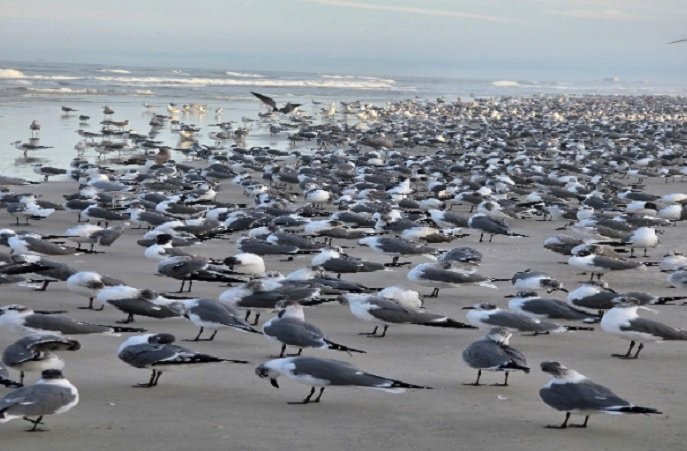
Each winter, as cold air tightens its grip on the northern sky, the shoreline of Florida slowly fills with life. From faraway coasts and distant nesting grounds, thousands of migrant birds arrive and settle on a narrow strip of sand. They stand wing to wing, their bodies forming a continuous, pulsating band of gray and white that stretches as far as the eye can see. They do not know one another by name or origin. Yet in their dense, shifting congregation there is order, mutual adjustment, and quiet peace.
What is most striking in this immense gathering is the absence of visible force. There are no fences, no police lines, no armed patrols drawing borders within the flock. When waves roll in, the birds rise together in a brief, swirling cloud and return to the sand without chaos. At the waterline they feed in turns, stepping aside so others may probe the wet surface. They tolerate closeness without aggression, and they respond to danger by moving as one, not by sacrificing a few so that others may remain comfortable. Their rules are simple: do not collide, do not trample, do not drive another into the surf.
On this shore, there are no labels of “us” and “them.” Different species mix in the same space— slight differences in size, color, and voice, but no visible hierarchy of worth. No one counts which group is more numerous, which has a historical claim to this sand, or who arrived first. The beach becomes a temporary homeland, open to any bird that survives the long journey and can find its place among the others. The only shared identity is vulnerability: each bird must eat, rest, and withstand the cold wind.
For an observer from Ethiopia, this peaceful scene is not just beautiful; it is painful. While birds from many directions share a strip of sand in Florida, human beings in Ethiopia are being driven from the land of their birth because of the identity written on their ID card, spoken in their mother tongue, or heard in their name. Entire communities have been displaced, villages emptied, and homes burned under the logic of “protecting our group” or “cleansing our area” of others. In regions like Amhara, Oromia, and elsewhere, ethicized conflict has produced killings, sexual violence, and mass flight on a scale that international reports describe as potential crimes against humanity.
These are not accidents of nature; they are the predictable outcomes of a political project that has made ethnic identity the primary organizing principle of the state. Ethiopia’s experiment with ethnic federalism has tied access to land, employment, and representation to membership in a particular group, encouraging citizens to think of themselves first as members of a “nation, nationality, or people,” and only second—if at all—as Ethiopians. Over time, this has normalized a dangerous question: not “Is this person my fellow citizen?” but “Is this person one of us or one of them?” When every dispute over land, resources, or power is framed in ethnic terms, local conflicts easily escalate into collective punishment and organized violence.
In such a context, empathy narrows. Empathy, at its simplest, is the capacity to recognize another’s suffering as morally relevant to oneself. Yet human psychology shows that when groups are defined in rigid “us versus them” terms, empathy is often reserved for in-group members and withdrawn from outsiders. People may feel deep compassion for victims who share their identity, while remaining indifferent—or even hostile—toward those who do not. In a climate of chronic hostility and propaganda, mechanisms of moral disengagement flourish: perpetrators and bystanders minimize responsibility, distort consequences, and dehumanize the targeted group, making it easier to accept or ignore their suffering.
In Ethiopia’s recent years, these dynamics have been amplified by leadership failures. Instead of a national leadership that speaks for the entire flock, the country has been governed by competing elites who mobilize constituencies along ethnic lines. When central authority weakens or becomes partisan, militias and local armed groups step into the vacuum, often acting with little accountability. International observers warn that, despite peace agreements in one part of the country, the risk of further mass atrocities remains high in others because the underlying structures of exclusion and impunity have not been addressed. In such conditions, empathy becomes not only narrow but dangerous: citizens fear that if they show solidarity with victims from another group, they may themselves be branded as traitors.
Against this landscape of division, the winter flock on the Florida shore poses a quiet but sharp question: how can creatures with such small brains and no written laws manage to live so closely without tearing one another apart, while human beings—with all their intelligence, moral teachings, and historical memory—engineer systems that make killing and displacement possible? The birds do not hold conferences or draft constitutions. They do not debate federal arrangements or negotiate cease-fires. Yet they achieve, through simple patterns of movement and mutual tolerance, what many human societies have failed to secure: the ability to rest side by side in safety.
Of course, birds are not moral agents in the human sense. Their behavior is guided by instinct, not by conscious choice or ethical reflection. But that is precisely what makes the contrast so disturbing. If nature, without parliaments or universities, can sustain a kind of practical coexistence, then the collapse of human empathy and solidarity cannot be blamed on fate alone. It reflects choices: political decisions that reward division; institutional failures that leave crimes unpunished; and intellectual habits that rationalize suffering when it is inflicted on those labeled as “others.”
The lesson of birds is not that human differences should be erased. On the beach, there is diversity—varied sizes, colors, and calls—yet this diversity does not become a pretext for expulsion. The shared rule is modest: leave enough room for others to live. A human translation of that rule would not require denying history, identity, or culture. It would require, instead, a commitment to protect the equal dignity of every person within the country’s borders, regardless of which “nation” or “people” they belong to. It would demand institutions that defend individuals as citizens, not merely as representatives of groups.
For Ethiopia, this means rethinking a political order that prioritizes ethnic belonging over common citizenship. Scholars and advocates have long pointed to the need for reforms that reduce ethnic polarization, strengthen impartial institutions, and create incentives for cross-group cooperation rather than competition. Transitional justice mechanisms must be transparent and victim-centered, not instruments for settling new scores under the language of accountability. Education, media, and religious institutions need to cultivate a broader moral imagination—one that insists that the pain of a child in a distant region, speaking another language, is as real and as unacceptable as the pain of one’s own neighbor.
Leadership, too, must change. A country wounded by decades of intergroup violence requires leaders who are willing to speak uncomfortable truths to their own supporters, not only to their rivals. They must resist the temptation to use ethnic grievance as a permanent political resource and instead risk the harder work of building trust across boundaries. International actors, for their part, should avoid the easy language of “ancient tribal conflict” and recognize the modern political decisions that continually reopen Ethiopia’s wounds.
For the writer walking along the winter shore, the birds remain both a comfort and a burden. Their dense, peaceful presence confirms that coexistence in a crowded space is possible. At the same time, they make visible what has been lost—a vision of a homeland where people of different histories and languages could once live together and could do so again. Each season, as the flocks return from the north, they bring with them an unspoken demand: that human societies, and Ethiopia in particular, learn at least as much from the wisdom of the flock as from the narratives of division.
The article ends where it begins with a solitary figure on the sand, watching thousands of birds’ rest in the fading light. The air is cold, but the shore is full of life. In that moment, the contrast between the beach and the broken homeland is almost unbearable. Yet within that pain lies a fragile hope: that by looking carefully at this simple scene, by refusing to accept cruelty as normal, and by insisting on a politics that treats every person as part of a single, diverse flock, Ethiopians and their leaders might still find a way to stand together on the same shore without fear.
Editor’s Note : Views in the article do not necessarily reflect the views of borkena.com
__
Support Borkena : https://borkena.com/subscribe-borkena/
Join our Telegram Channel : t.me/borkena
Like borkena on Facebook
Add your business to Ethiopian Business Listing / Ethiopian Business Directory Business Listing Toronto
Join the conversation. Follow us on X (Formerly Twitter) @zborkena to get the latest Ethiopian News updates regularly. Subscribe to YouTube channel To share information or for submission, send e-mail to info@borkena.com
Dear Amsal,
On that Florida shore, the birds do not ask who arrived first, who owns the sand, or whose wings are larger. They make room. They rise together when danger comes. They return together when the waves recede.
Your essay gently reminds us that coexistence is not naïve—it is disciplined. It is the quiet courage to refuse the logic of “us” and “them.”
May we, who possess laws, memory, moral language, and conscious choice, learn at least the modest wisdom of the flock: to leave enough space for one another to live. May our political elites carry the primary responsibility to build institutions and narratives that make such shared space possible.
Thank you for this deeply reflective and morally courageous piece, an essay that transforms a simple winter shoreline into a profound meditation on empathy, citizenship, and the future of Ethiopia.
Sirak
Dear Sirak, thank you so much for your deeply thoughtful response to my article. It is heartening to find a reader who so clearly hears the ‘quiet’ message I hoped to convey. Your observation that coexistence is a ‘disciplined’ act of courage perfectly captures the challenge we face. I truly appreciate you taking the time to share your reflections; they give me hope that the ‘wisdom of the flock’ is something we can still achieve together.